Sarga 84
निकुम्भिला-यज्ञविघ्नोपदेशः (Counsel to Disrupt the Nikumbhilā Rite)
युद्धकाण्ड
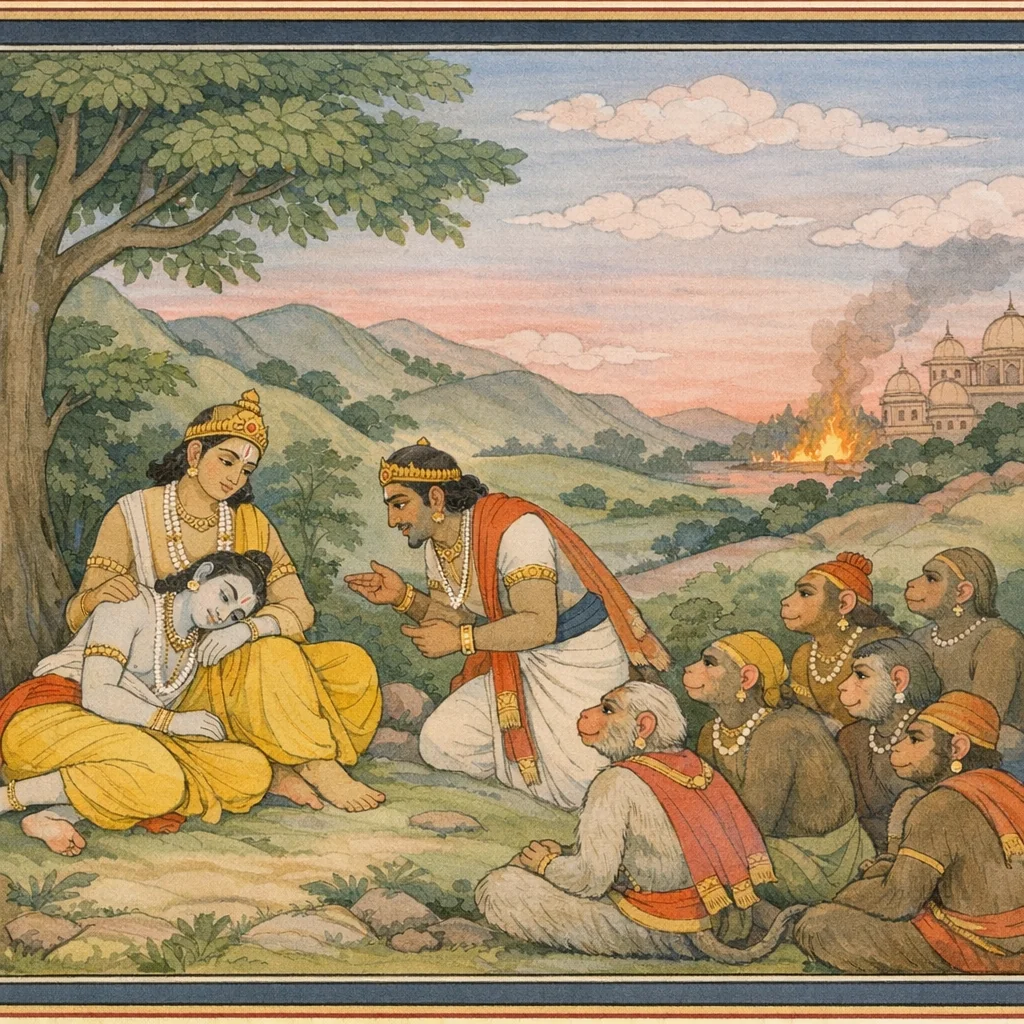
Sarga 84 stages a crisis of battlefield psychology and its correction through informed counsel. Vibhīṣaṇa arrives after assigning troop formations and finds Rāma overwhelmed—lying on Lakṣmaṇa’s lap—because Hanumān’s report has been interpreted as Sītā’s death by Indrajit. Lakṣmaṇa explains the cause of Rāma’s delusion, and Vibhīṣaṇa restrains further agitation, reframing the report as implausible and warning that Rāvaṇa will not kill Sītā. He identifies the event as māyā (a deceptive stratagem) used to divert the Vānara forces. The tactical core is then disclosed: Indrajit is proceeding to the Nikumbhilā sanctuary to perform a homa; if completed, he becomes extraordinarily difficult to confront—indeed, functionally “invisible” even to devas in battle. Vibhīṣaṇa urges immediate preemptive action: move the army before the rite concludes, abandon “false agony,” and dispatch Lakṣmaṇa as the decisive agent to break the ritual and make Indrajit vulnerable to death. The chapter thus links discernment (viveka) with time-sensitive strategy, presenting counsel as the bridge between grief and dharmic action.
Shlokas
Verse 1
राममाश्वासयानेतुलक्ष्मणेभ्रातृवत्सले ।निक्षिप्यगुल्मान् स्वस्थानेतत्रागच्छद्विभीषणः ।। ।।
While brother-loving Lakṣmaṇa was consoling Rāma, Vibhīṣaṇa came there after assigning the detachments to their proper positions.
Verse 2
नानाप्रहरणैर्वीरैश्चतुर्भिस्सचिवैर्वृत: ।नीलाञ्जनचयाकारैर्मातङ्गैरिवयूथप ।।।।
Surrounded by four heroic ministers bearing various weapons—like a leader of elephants encircled by dark, collyrium-hued tuskers—Vibhīṣaṇa approached the great-souled Rāma and saw the Vānara hosts, their eyes clouded with tears.
Verse 3
राघवं च महात्मानमिक्ष्वाकुकुलनन्दनम् ।ददर्शमोहमापन्नंलक्ष्मणस्याङ्गमाश्रितम् ।।।।
Vibhīṣaṇa saw Rāghava—the great-souled delight of the Ikṣvāku line—fallen into delusion and distress, resting upon Lakṣmaṇa’s lap.
Verse 4
राघवं च महात्मानमिक्ष्वाकुकुलनन्दनम् ।ददर्शमोहमापन्नंलक्ष्मणस्याङ्गमाश्रितम् ।।6.84.3।।
Vibhīṣaṇa saw Rāghava—the great-souled pride of the Ikṣvāku line—overcome by bewilderment and distress, leaning upon Lakṣmaṇa’s lap.
Verse 5
व्रीडितंशोकसन्तप्तंदृष्टवारामंविभीषणः ।अन्तर्धुःखएनदीनात्माकिमेतदितिसोऽब्रवीत् ।।।।
Seeing Rāma—ashamed and scorched by grief—Vibhīṣaṇa, inwardly pained and downcast, asked: “What is this (distress)?”
Verse 6
विभीषणमुखंदृष्टवासुग्रीवंतांश्चवानरान् ।लक्ष्मणोवाचमन्दार्थमिदंबाष्पपरिप्लुतः ।।।।
Lakṣmaṇa—his eyes flooded with tears—looked to Vibhīṣaṇa, to Sugrīva, and to the vānaras, and spoke these words in a subdued tone.
Verse 7
हताइन्द्रजितासीताइतिश्रुत्वैवराघवः ।हनूमद्वचनात्सौम्यततोमोहमुपागतः ।।।।
“O gentle one: hearing, from Hanūmān’s words, that ‘Sītā has been slain by Indrajit,’ Rāghava at once fell into bewilderment.”
Verse 8
कथयन्तंतुसौमित्रिंसन्निवार्यविभीषणः ।पुष्कलार्थमिदंवाक्यंविसंज्ञंराममब्रवीत् ।।।।
But Vibhīṣaṇa restrained Saumitrī as he began to speak, and addressed the unconscious Rāma with these words, rich in meaning.
Verse 9
मनुजेन्द्रार्थरूपेणयदुक्ततुहनूमता ।तदयुक्तमहंमन्येसागरस्येवशोषणम् ।।।।
What Hanumān has spoken, taking it as a fact concerning the lord of men, seems to me impossible—like the drying up of the ocean.
Verse 10
अभिप्रायंतुजानामिरावणस्यदुरात्मनः ।सीतांप्रतिमहाबाहो न च घातंकरिष्यति ।।।।
O mighty-armed one, I know the intention of the wicked-souled Rāvaṇa regarding Sītā: he will not kill her.
Verse 11
याच्यमानःसुबहुशोमयाहितचिकीर्षुणा ।वैदेहीमुत्सृजस्वेति न च तत्कृतवान्वचः ।।।।
Though I repeatedly pleaded with him, wishing his welfare—‘Release Vaidehī!’—he did not act upon those words.
Verse 12
नैवसाम्ना न दानेन न भेदेनकुतोयुधा ।साद्रष्टुमपिशक्येतनैवचान्येनकेनचित् ।।।।
Not by conciliation, nor by gifts, nor by sowing division—how much less by war—could she be ‘seen’ (recovered) by any means whatsoever.
Verse 13
वानरान्मोहयित्वातुप्रतियातः स राक्षसः ।मयामयींमहाबाहोतांविद्दिजनकात्मजाम् ।।।।
That rākṣasa, having deluded the Vānaras, withdrew. O mighty-armed one, know that ‘Janaka’s daughter’ shown here is a fabrication of māyā.
Verse 14
चैत्यंनिकुम्भिलांनामप्राप्यहोमंकरिष्यति ।हुतवानुपयातोहिदेवैरपिसवासवैः ।।।।दुराधर्षोभवत्येषसङ्ग्रामेरावणात्मजः ।
Reaching the sacred shrine called Nikumbhilā, Rāvaṇa’s son will perform a fire-offering. Having completed it and returned, he becomes exceedingly hard to assail in battle—even for the gods with Vāsava (Indra).
Verse 15
तेनमोहयतानूनमेषामायाप्रयोजिता ।।।।विघ्नमन्विच्छतातत्रवानराणांपराक्रमे ।
Surely this illusion was employed by him to delude—seeking there to create an obstacle to the Vānaras’ prowess.
Verse 16
ससैन्यास्तत्रगच्छामोयावत्तन्नसमाप्यते ।।।।त्यजेमंनरशार्दूलमिथ्यासन्तापगतम् ।सीदतेहिबलंसर्वंदृष्टवात्वांशोककर्शितम् ।।।।
Let us go there with the army before that rite is completed. O tiger among men, abandon this false anguish—seeing you worn down by grief, the entire force loses heart.
Verse 17
ससैन्यास्तत्रगच्छामोयावत्तन्नसमाप्यते ।।6.84.16।।त्यजेमंनरशार्दूलमिथ्यासन्तापगतम् ।सीदतेहिबलंसर्वंदृष्टवात्वांशोककर्शितम् ।।6.84.17।।
Let us go there with the army before that rite is completed. O tiger among men, abandon this false anguish—seeing you worn down by grief, the entire force loses heart.
Verse 18
इहत्वंस्वस्थहृदयस्तिष्ठसत्त्वसमुच्छ्रितः ।लक्ष्मणंप्रेषयास्माभिस्सहसैन्यानुकर्षिभिः ।।।।
You remain here, steady at heart and raised in courage; send Lakṣmaṇa with us, along with those who will bring the forces forward.
Verse 19
एषतंनरशार्दूलोरावणिंनिशितैश्शरैः ।त्याजयिष्यतितत्कर्मततोवध्योभविष्यति ।।।।
This tiger among men will drive Rāvaṇa’s son away from that rite with sharp arrows; once he is forced to abandon it, he will then become killable.
Verse 20
तस्यैतेनिशितास्तीक्ष्णाःपत्रिपत्राङ्गवाजिनः ।पतत्रिणइवासौम्याश्शराःपास्यन्तिशोणितम् ।।।।
These whetted, razor-pointed arrows—feathered as if with the limbs of birds—will drink his blood like cruel birds.
Verse 21
सत्सन्दिशमहाबाहोलक्ष्मणंशुभलक्षणम् ।राक्षसस्यविनाशायवज्रंवज्रधरोयथा ।।।।
“O mighty-armed one, send forth Lakṣmaṇa of auspicious marks for the destruction of that rākṣasa—just as the wielder of the thunderbolt sends the vajra.”
Verse 22
मनुजवरन कालविप्रकर्षोरिपुनिधनंप्रतियत्क्षामोऽद्यकर्तुम् ।त्वमतिसृजरिपोर्वधायवाणीममररिपोर्मथनेयथामहेन्द्रः ।।।।
“O best of men, delay is not fitting now when the enemy’s destruction is at hand. Command (Lakṣmaṇa) to slay the foe, as Mahendra commanded in the crushing of the enemy of the gods.”
Verse 23
समाप्तकर्माहि स राक्षसाधिपोभवत्यदृश्यस्समरेसुरासुरैः ।युयुत्सतातेनसमाप्तकर्मणाभवेत्सुराणामपिसंशयोमहान् ।।।।
For once that lord of rākṣasas completes his rite, he becomes invisible in battle even to gods and asuras; and with him thus empowered, even the gods would face great uncertainty about engaging him in combat.
Frequently Asked Questions
The dilemma is leadership paralysis caused by grief and misinformation: Rāma’s despair after hearing that Sītā was killed. The pivotal action is Vibhīṣaṇa’s insistence on abandoning unverified sorrow and executing a preemptive mission to prevent Indrajit’s ritual from completing.
The upadeśa is that dharmic action requires clarity (viveka) and timely resolve: deception can weaponize emotion, so counsel grounded in knowledge must restore composure, prioritize protectable goods (Sītā’s safety), and convert grief into disciplined duty.
The key landmark is the Nikumbhilā caitya (sanctuary) in Laṅkā, presented as a ritual power-site where a homa can transform military capability (e.g., invisibility/near-invincibility), making it a strategic node in the campaign’s “digital map.”