Sarga 83
त्र्यशीतितमः सर्गः (Sarga 83) — Hanumān Reports Sītā’s ‘Slaying’; Rāma Collapses; Lakṣmaṇa’s Counter-Discourse on Dharma and Artha
युद्धकाण्ड
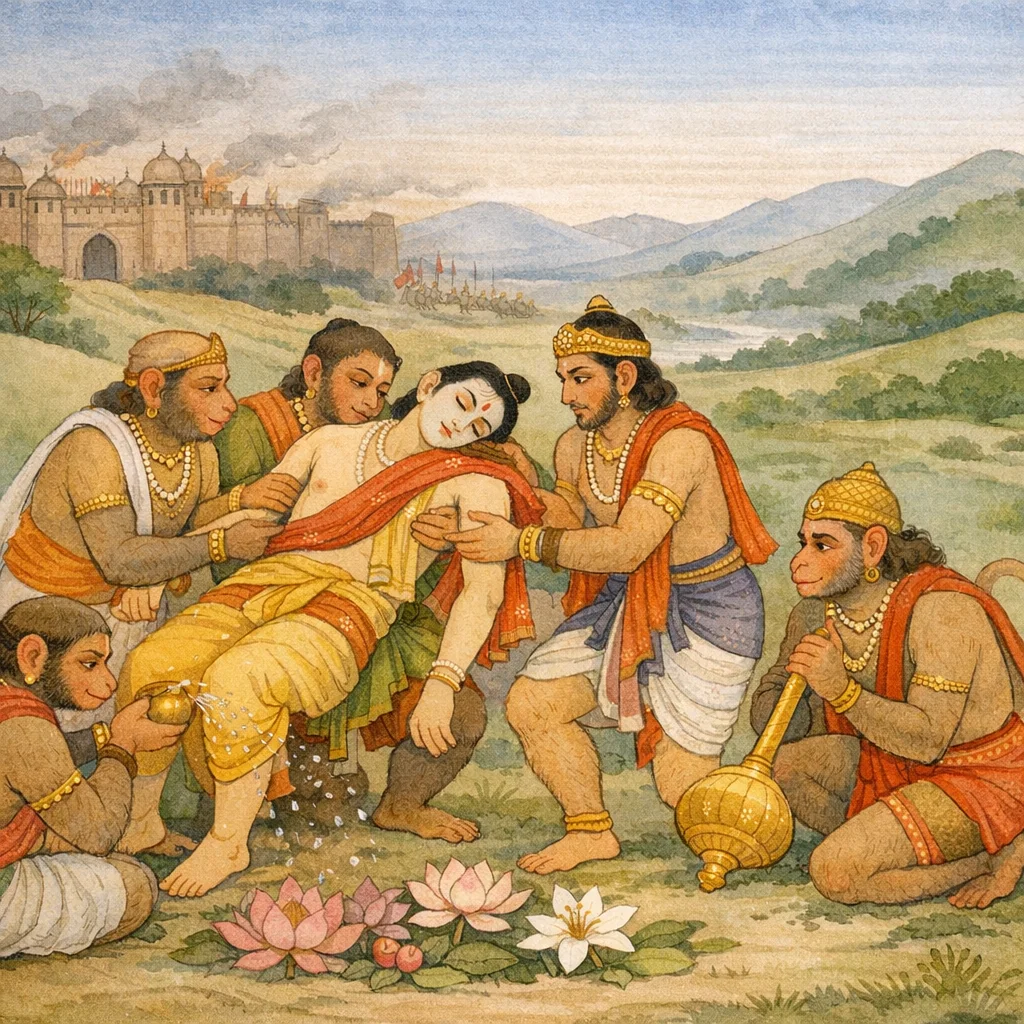
This sarga opens with Rāma hearing the intense saṅgrāma-nirghoṣa (war-roar) between Rākṣasas and Vānaras and directing Jāmbavān, the ṛkṣapati (bear-king), to reinforce Hanumān at the western gate. Hanumān arrives with battle-worn Vānaras and reports a devastating claim: Indrajit, son of Rāvaṇa, struck down the weeping Sītā before their eyes. The news precipitates a psychological collapse—Rāma, overcome by śoka, falls like a root-cut tree. Vānara leaders rush in, lift him, and sprinkle fragrant water (lotus-and-lily scented) as if calming a sudden flare of inextinguishable fire. Lakṣmaṇa then embraces the distressed Rāma and delivers a sharply reasoned speech that frames a dharma-sankat: if a virtuous, self-controlled person suffers while the unrighteous prosper, then dharma appears ineffective. He advances skeptical arguments—questioning whether dharma yields visible recompense, whether destiny rather than agency bears moral residue, and whether ‘truth-speaking’ as dharma is consistent with royal conduct. The speech pivots to artha-śāstra-like realism: prosperity enables social bonds, action, and even virtues; renouncing wealth can interrupt undertakings and invite error. Lakṣmaṇa concludes with resolve to neutralize the sorrow caused by Indrajit through decisive action and urges Rāma to recognize his own mahātman stature. The chapter thus juxtaposes battlefield intelligence, grief management, and a philosophically charged debate on dharma, artha, and effective kingship.
Shlokas
Verse 1
राघवश्चापिविपुलंतंराक्षसवनौकसाम् ।श्रुत्वासङ्ग्रामनिर्घोषंजाम्बवन्तमुवाच ह ।।6.83.1।।
Rāghava too, hearing the tremendous din of battle between the Rākṣasas and the forest-dwellers (Vānaras), addressed Jāmbavān.
Verse 2
सौम्यनूनंहनुमताकृतंकर्मसुदुष्करम् ।श्रूयते च यथाभीमस्सुमहावायुधस्वनः ।।6.83.2।।
O gentle one, surely Hanumān has accomplished a most difficult deed; for a truly terrifying, mighty clamor of weapons is being heard.
Verse 3
तद्गच्छकुरुसाहाय्यंस्वबलेनाभिसम्वृतः ।क्षिप्रमक्षपतेतस्यकपिश्रेष्ठस्ययुध्यतः ।।6.83.3।।
Therefore go—surrounded by your own forces—and render aid at once, O lord of bears, to that best of monkeys as he fights.
Verse 4
ऋक्षराक्षस्तथोक्तस्तुस्वेनानीकेनसम्वृतः ।आगच्छत्पश्चिमद्वारंहनूमान्यत्रवानरः ।।6.83.4।।
Thus instructed, the lord of bears, surrounded by his own troop, went toward the western gate—where Hanūmān the Vānara was stationed.
Verse 5
अथायान्तंहनूमन्तंददर्शर्क्षपतिपथि ।वानरैःकृतसङ्ग्रामैश्श्वसद्भिरभिसम्वृतम् ।।6.83.5।।
Then, on the way, the lord of bears saw Hanūmān approaching, surrounded by vānaras who had fought in battle and were breathing hard.
Verse 6
दृष्टापथिहनूमांश्चतदृक्षबलमुद्यतम् ।नीलमेघनिभंभीमंसन्निवार्यन्यवर्तत ।।6.83.6।।
Seeing on the road that fearsome bear-force, poised to fight and dark as a blue cloud, Hanūmān restrained them and turned them back.
Verse 7
स तेनसहसैन्येनसन्निकर्षंमहायशाः ।शीघ्रमागम्यरामायदुःखितोवाक्यमब्रवीत् ।।6.83.7।।
Then that illustrious one, accompanied by the troops, came swiftly into Rāma’s presence and, distressed, spoke these words.
Verse 8
समरेयुध्यमानानामस्माकंप्रेक्षतांपुरः ।जघानरुदतींसीतामिन्द्रजिद्रावणात्मजः ।।6.83.8।।
While we were fighting in battle, before our very eyes as we looked on, Indrajit—Rāvaṇa’s son—struck Sītā as she wept.
Verse 9
उद्भ्रान्तचित्तस्तांदृष्टवाविषण्णोऽहमरिन्दमः ।तदहंभवतोवृतंविज्ञापयितुमागतः ।।6.83.9।।
O subduer of foes, seeing her, my mind was thrown into turmoil and I became despondent; therefore I have come to inform you of what has occurred.
Verse 10
तस्यतद्वचनंश्रुत्वाराघवश्शोकमूर्चितः ।निपपाततदाभूमौछिन्नमूलंइवद्रुमः ।।6.83.10।।
Hearing his words, Rāghava—overwhelmed and faint with grief—collapsed to the ground like a tree whose roots have been cut.
Verse 11
तंभूमौदेवसङ्काशंपतितंदृश्यराघवम् ।अभिपेतुस्समुत्पत्यसर्वतःकपिसत्तमाः ।।6.83.11।।
Seeing Rāghava—godlike—fallen upon the ground, the best of the monkeys sprang up and rushed in from all sides.
Verse 12
आसिञ्चन् सलिलैश्चैनंपद्मोत्पलसुगन्धिभिः ।प्रदहन्तमानासाद्यंसहसाग्निमिवोद्यतम् ।।6.83.12।।
Reaching him, they sprinkled him with waters fragrant with lotus and lily—like dousing a suddenly flaring, blazing fire that cannot be approached.
Verse 13
तंलक्ष्मणोऽथबाहुभ्यांपरिष्वज्यसुदुःखितः ।उवाचराममस्वस्थंवाक्यंहेत्वर्थसम्युतम् ।।6.83.13।।
Then Lakṣmaṇa, deeply distressed, embraced the unwell Rāma with his arms and spoke words filled with reason and purpose.
Verse 14
शुभेवर्त्मनितिष्ठन्तंत्वामार्यविजितेन्द्रियम् ।अनर्थेभ्यो न शक्नोतित्रातुंधर्मोनिरर्थकः ।।6.83.14।।
O noble one—self-controlled and steadfast on the auspicious path—if Dharma cannot protect you from calamity, then Dharma itself becomes meaningless.
Verse 15
भूतानांस्थावाराणां च जङ्गमानां च दर्शनम् ।यथास्ति न तथाधर्मस्तेननास्तीतिमेमतिः ।।6.83.15।।
We see both immobile and moving beings experiencing happiness just as they are; therefore, dharma is not (the determining) cause of such happiness—this is my view.
Verse 16
यथैवस्थावरंव्यक्तंजङ्गमं न तथाविधम् ।नायमर्थस्तथायुक्तस्त्वद्विधो न विपद्यते ।।6.83.16।।
Just as the immobile world is plainly seen (to fare as it does), the moving world is not seen to follow any such fixed rule; this reasoning is not sound—for one like you should not come to ruin.
Verse 17
यद्यधर्मोभवेद्भूतोरावणोनरकंव्रजेत् ।भवांश्चधर्मसम्युक्तोनैवंव्यसनमाप्नुयात् ।।6.83.17।।
If adharma truly existed as a real force, Rāvaṇa would go to hell; and you, endowed with dharma, would not meet with such distress.
Verse 18
तस्य च व्यसनाभावाद्व्यसनंचागतेत्वयि ।धर्मोभवत्यधर्मश्चपरस्परविरोधिनौ ।।6.83.18।।
Since he has no distress, while distress has come upon you, dharma and adharma—mutually opposed—seem to have exchanged their places.
Verse 19
धर्मेणोपलभेद्धर्ममधर्मंचाप्यधर्मतः ।यद्यधर्मेणयुज्येयुर्येष्वधर्मःप्रतिष्ठितः ।।6.83.19।।यदिधर्मेणवियुज्येरन्नधर्मरुचयोजनाः ।धर्मेणचरतांधर्मंचैषांधर्मफलंभवेत् ।।6.83.20।।
One gains dharma through dharma, and adharma through adharma; if those in whom adharma is firmly rooted unite themselves with adharma, (their course follows that very principle).
Verse 20
धर्मेणोपलभेद्धर्ममधर्मंचाप्यधर्मतः ।यद्यधर्मेणयुज्येयुर्येष्वधर्मःप्रतिष्ठितः ।।6.83.19।।यदिधर्मेणवियुज्येरन्नधर्मरुचयोजनाः ।धर्मेणचरतांधर्मंचैषांधर्मफलंभवेत् ।।6.83.20।।
If people who delight in adharma were separated from dharma, then those who live by dharma would obtain dharma—and for them the fruit of dharma would indeed come to be.
Verse 21
यस्मादर्थाविवर्धन्तेयेष्वधर्मःप्रतिष्ठितः ।क्लिश्यन्तेधर्मशीलाश्चतस्मादेतौनिरर्थकौ ।।6.83.21।।
For we see wealth and advantage increase among those in whom adharma is established, while those devoted to dharma suffer; therefore these two (claims about moral order) appear purposeless.
Verse 22
वध्यन्तेपापकर्माणोयद्यधर्मेणराघव ।वधकर्महतोऽधर्मः स हतःकिंवधिष्यति ।।6.83.22।।
O Rāghava, if sinners are slain because of adharma, then that adharma is itself ‘killed’ by the very act of killing; once killed, whom could that adharma kill thereafter?
Verse 23
अथवाविहितेनायंहन्यतेहन्तिवापरम् ।विधिरालिप्यतेतेन न स पापेनकर्मणा ।।6.83.23।।
Or else, a man is slain (or slays another) by what is ordained; it is destiny that becomes tainted by that, not the person by the sinful act.
Verse 24
अदृष्टप्रतिकारेणत्वव्यक्तेनासतासता ।कथंशक्यंपरंप्राप्तुंधर्मेणारिविकर्षण ।।6.83.24।।
O crusher of enemies! When the recompense of dharma is not visibly seen and its reality is uncertain—whether it is real or unreal—how can one possibly attain the highest good through righteousness?
Verse 25
यदिसत्स्यात्सतांमुख्यनासत्स्यत्तवकिञ्चन ।त्वयायदीदृशंप्राप्तंतस्मात्सन्नोपपद्यते ।।6.83.25।।
If goodness truly governed outcomes, O foremost among the good, then not even the slightest evil should have befallen you. Since you have met with such suffering, it seems that ‘the good’ does not consistently hold true (as a rule of results).
Verse 26
अथवादुर्बलःक्लीबोबलंधर्मोऽनुवर्तते ।दुर्बलोहृतमर्यादो न सेव्यइतिमेमतिः ।।6.83.26।।
Or else dharma is feeble and ineffectual, merely following after brute force. A dharma that is weak and stripped of its boundaries is not worth serving—so I think.
Verse 27
बलस्ययदिचेद्धर्मोगुणभूतःपराक्रमे ।धर्ममुत्सृज्यवर्तस्वयथाधर्मेतथाबले ।।6.83.27।।
If, in acts of valor, dharma is only a subordinate quality of power, then abandon dharma and conduct yourself by power—just as you once conducted yourself by dharma.
Verse 28
अथचेत्सत्यवचनंधर्म: किलपरन्तप ।अनृतस्त्वय्यकरुणःकिं न बद्धस्त्वयापिता ।।6.83.28।।
If, indeed, truth-speaking is dharma, O scorcher of foes, then why did you not bind your father—who acted without compassion toward you and (as it seems) stood in untruth?
Verse 29
यदिधर्मोभवेद्भूतअधर्मोवापरन्तप ।न स्महत्वामुनिंवज्रीकुर्यादिज्यांशतक्रतुः ।।6.83.29।।
If dharma (alone) truly prevailed—or if adharma did—O scorcher of foes, then Indra, the wielder of the thunderbolt, would not have killed a sage and yet performed sacrifice as ‘Śatakratu’.
Verse 30
अधर्मसंश्रितोधर्मोविनाशयतिराघव ।सर्वमेतद्यथाकामंकाकुत्स्थकुरुतेनरः ।।6.83.30।।
When dharma clings to adharma, it brings ruin, O Rāghava. In all this, O scion of Kakutstha, people act simply as they please.
Verse 31
ममचेदंमतंतातधरोऽयमितिराघव ।धर्ममूलंत्वयाछिन्नंराज्यमुत्सृजतातदा ।।6.83.31।।
This is my view too, dear Rāghava: ‘this is dharma’. Yet when you renounced the kingdom then, you cut off dharma at its very root.
Verse 32
अर्थेभ्योहिप्रवृद्धेभ्यःसम्वृत्तेभ्यस्ततस्ततः ।क्रियाःसर्वाःप्रवर्तन्तेपर्वतेभ्यःइवापगाः ।।6.83.32।।
For when resources and advantages grow—accumulating from many directions—all undertakings begin to move forward, like rivers flowing from mountains.
Verse 33
अर्थेनहिविमुक्तस्यपुरुषस्याल्पचेतसः ।विच्छिद्यन्तेक्रियास्सर्वाग्रीष्मेकुसरितोयथा ।।6.83.33।।
For a man of scant understanding who abandons wealth, all his undertakings get cut off—just as small streams dry up in summer.
Verse 34
सोऽयमर्थंपरित्यज्यसुखकामःसुखैधितः ।पापमारभतेकर्तुंतदादोषःप्रवर्तते ।।6.83.34।।
Having cast away wealth, yet still craving pleasure—after being accustomed to comfort—one begins to commit sin; then fault and downfall set in.
Verse 35
यस्यार्थास्तस्यमित्राणियस्यार्थास्यस्यबान्धवाः ।यस्यार्थास्सपुमान्लोकेयस्यार्थाः स च पण्डितः ।।6.83.35।।
He who has wealth has friends; he who has wealth has kin. In the world, the one with wealth is deemed ‘manly,’ and the one with wealth is even called ‘learned.’
Verse 36
यस्यार्थास्स च विक्रान्तोयस्यार्थास्स च बुद्धिमान् ।यस्यार्थास्समहाभागोयस्यार्थास्समहागुणः ।।6.83.36।।
He who has wealth is called valiant; he who has wealth is called intelligent. He who has wealth is termed fortunate, and he who has wealth is praised as virtuous.
Verse 37
अर्थस्यैतेपरित्यागेदोषाःप्रव्याहृतामया ।राज्यमुत्सृजतावीरयेनबुद्धिस्त्वयाकृता ।।6.83.37।।
These are the faults I have declared that follow from abandoning wealth. O hero, when you gave up the kingdom—by what reasoning you formed that resolve, I cannot accept as sound.
Verse 38
यस्यार्थाःधर्मकामार्थास्तस्यसर्वंप्रदक्षिणम् ।अधनेनार्थकामेननार्थश्शक्योविचिन्वता ।।6.83.38।।
For the one who possesses wealth, dharma and kāma run smoothly and turn out auspicious. But for the penniless man who craves wealth and frets after it, wealth is not easily obtained.
Verse 39
हर्षःकामश्चदर्पश्चधर्मःक्रोधश्शमोदमः ।अर्थादेतानिसर्वाणिप्रवर्तन्तेनराधिप ।।6.83.39।।
Joy, desire, pride, even dharma, anger, forbearance, and self-control—O lord of men—these all become operative through wealth.
Verse 40
येषांनश्यत्ययंलोकश्चरतांधर्मचारिणाम् ।तेऽर्थास्त्वयि न दृश्यन्तेदुर्दिनेषुयथाग्रहाः ।।6.83.40।।
Those who live as strict followers of dharma may even lose their standing in this world; such ‘wealth’ is not seen in you—like planets hidden on clouded days.
Verse 41
त्वयिप्रव्रजितेवीरगुरोश्चवचनेस्थिते ।रक्षसापहृताभार्याप्राणैःप्रियतरातव ।।6.83.41।।
When you went forth into exile, O hero, standing by your elder’s command, your wife—dearer to you than life—was abducted by a Rākṣasa.
Verse 42
तदद्यविपुलंवीरदुःखमिन्द्रजिताकृतम् ।कर्मणाव्यपनेष्यामितस्मादुत्तिष्ठराघव ।।6.83.42।।
Rise up, heroic Rāghava. Today I shall remove this great grief inflicted by Indrajit—by decisive action; therefore, stand up.
Verse 43
उत्थिष्ठनरशार्दूलदीर्घबाहोधृतव्रत ।किमात्मानंमहात्मानंमात्मानं न बुध्यसे ।।6.83.43।।
Rise, tiger among men—long-armed and firm in vow. Why do you not recognize yourself: a great-souled one, master of your own self?
Verse 44
O sinless one, I spoke thus out of love for you; seeing (the prospect of) Janaka’s daughter’s destruction, I am enraged. With my arrows I shall strike down Laṅkā—together with its chariots, elephants, horses, and its lord of Rākṣasas.
Frequently Asked Questions
The dilemma is whether dharma is meaningful when a righteous leader (Rāma) suffers and the unrighteous (Rāvaṇa/Indrajit) appear to succeed; the pivotal action is Lakṣmaṇa’s attempt to restore Rāma’s agency by reframing the crisis and calling for forceful counter-action.
The text stages a deliberate tension: Lakṣmaṇa articulates skepticism about moral causality (dharma’s fruits) and elevates artha as the practical basis of effective action, yet the narrative channels this critique into renewed resolve—ethical leadership must endure grief, but cannot abdicate decisive responsibility.
The western gate of Laṅkā functions as a tactical landmark in the siege narrative, while Laṅkā itself is invoked as the political-military center to be destroyed; culturally, the fragrant water sprinkling evokes a ritualized care-response to royal collapse, blending battlefield urgency with courtly/ritual sensibilities.