Sarga 82
इन्द्रजित्-हनूमद्-युद्धं तथा निकुम्भिलायां होमः (Indrajit vs Hanuman; Indrajit’s Nikumbhila rite)
युद्धकाण्ड
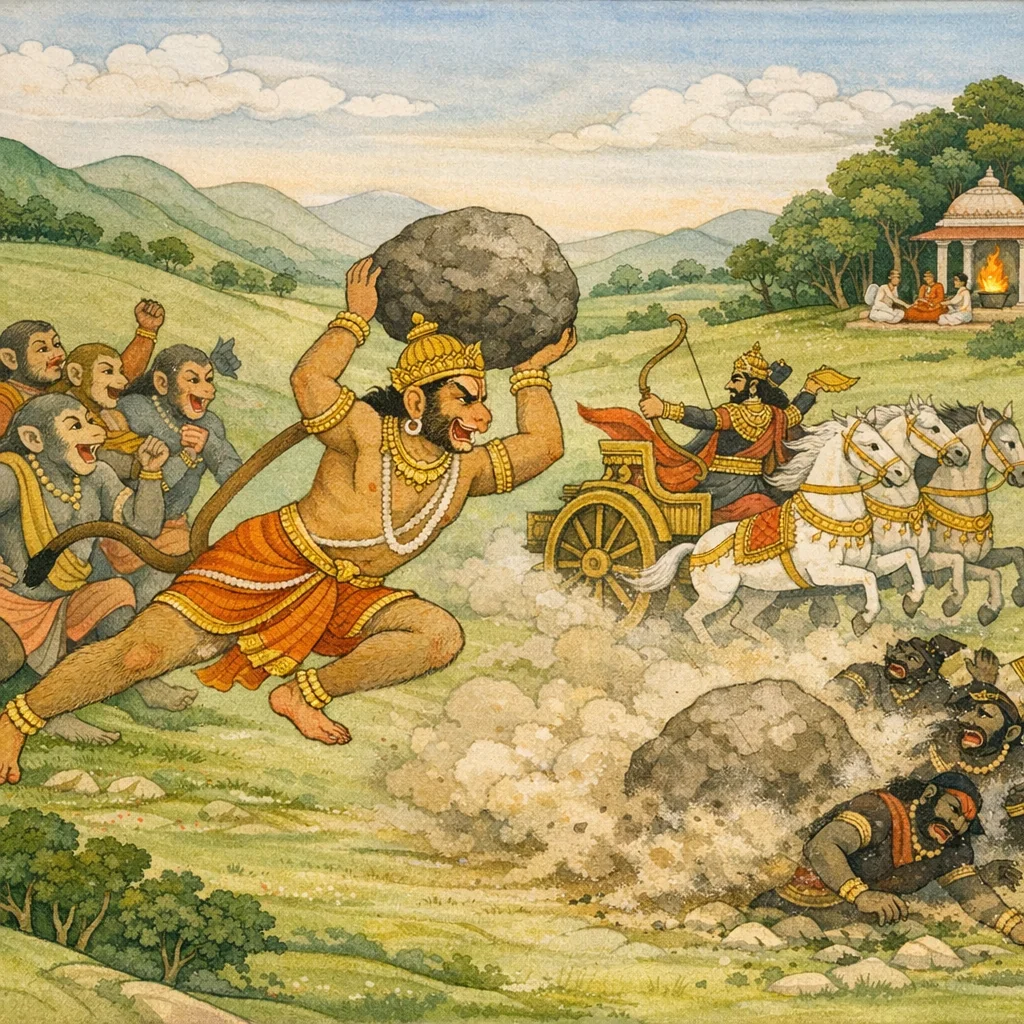
Sarga 82 opens with battlefield shock: the Vānara chiefs, hearing a thunder-like roar associated with Indrajit, scatter in fear. Hanumān (Mārutātmaja) arrests the rout, rebukes their loss of yuddhotsāha (martial resolve), and re-forms the line by demanding they return to the front. Re-energized, the Vānaras seize trees and mountain-peaks, surge forward roaring, and Hanumān burns through the enemy host metaphorically “like fire,” causing heavy Rakṣasa casualties. In a focused exchange, Hanumān hurls a massive rock at Rāvaṇi’s chariot; the charioteer evades, and the rock fails to strike Indrajit, instead cleaving the earth and crushing troops where it lands. The battle escalates as Vānaras rain trees and stones, while Indrajit and his followers answer with volleys of arrows and close-combat weapons (tridents, swords, spears, maces). After checking the enemy line, Hanumān instructs the Vānara army to withdraw with a strategic rationale: their overriding duty is Rāma’s purpose, and they must report the critical claim that Sītā has been killed and await Rāma–Sugrīva’s decision. Observing Hanumān moving toward Rāma, Indrajit departs to Nikumbhilā to perform a blood-oblation fire rite; the sacrificial fire blazes sun-like as Rakṣasas versed in ritual witness the offering—closing the sarga on the junction of warfare and ritual power.
Shlokas
Verse 1
श्रुत्वातुभीमनिर्ह्रादंशक्राशनिसमस्वनम् ।वीक्षमाणादिशस्सर्वादुद्रुवुर्वानरर्षभा: ।।।।
Hearing that dreadful roar, like Indra’s thunderbolt, the foremost of the Vānaras, looking around in every direction, fled.
Verse 2
तानुवाचततःसर्वान्हनुमान् मारुतात्मजः ।विषण्णवदनान्दीनांस्त्रस्तान्विद्रवतःपृथक् ।।।।
Then Hanumān, son of the Wind-god, addressed them all—their faces downcast, wretched and frightened, scattering and fleeing in different directions.
Verse 3
कस्माद्विषण्णवदनाविद्रवध्वंप्लवङ्गमाः ।त्यक्तयुद्धसमुत्साहाश्शूरत्वंक्वनुवोगतम् ।।।।
“O monkeys, why do you flee with downcast faces, having abandoned your zeal for battle? Where has your valor gone?”
Verse 4
पृष्ठतोऽनुव्रजध्वंमामग्रतोयन्तमाहवे ।शूरैरनिजनोपेतैरयुक्तंहिनिवर्तितुम् ।।।।
“Follow behind me as I advance to the front in battle. For heroes who are not alone, it is not fitting to turn back.”
Verse 5
एवमुक्तास्सुसङ्क्रुद्धावायुपुत्रेणधीमता ।शैलशृङ्गान् द्रुमांश्चवजगृहुर्हृष्टमानसाः ।।।।
Thus addressed by the wise son of the Wind-god, the Vanaras—now fiercely enraged and heartened—seized mountain-peaks and trees (as weapons).
Verse 6
अभिपेतुश्चगर्जन्तोराक्षसान्वानरर्षभाः ।परिवार्यहनूमन्तमन्वयुश्चमहाहवे ।।।।
Roaring aloud, the foremost of the Vānara warriors rushed upon the Rākṣasas; gathering around Hanumān, they followed him into the great battle.
Verse 7
स तैर्वानरमुख्यैश्चहनुमान्सर्वतोवृतः ।हुताशनइवार्चिष्मानदहच्छत्रुवाहिनीम् ।।।।
Encircled on every side by the foremost Vānara leaders, Hanumān—blazing like fire—burned through the enemy host.
Verse 8
स राक्षसानांकदनंचकारसुमहाकपिः ।वृतोवानरसैन्येनकालान्तकयोमोपमः ।।।।
That mighty great ape wrought havoc among the Rākṣasas; surrounded by the Vānara army, he was like Yama, death at the end of time.
Verse 9
स तुकोपेनचाविष्टःशोकेन च महाकपिः ।हनूमान्रावणिरथेमहतींपातयच्छिलाम् ।।।।
But Hanumān, the great ape—seized by anger and grief—hurled a massive rock down upon the chariot of Rāvaṇa’s son.
Verse 10
तामापतन्तींदृष्टवैवरथस्सारथिनातदा ।विधेयाश्वसमायुक्तोविदूरमपवाहितः ।।।।
Then, seeing that (missile/rock) rushing toward them, the chariot—yoked to obedient horses—was quickly driven far away by the charioteer.
Verse 11
तमिन्द्रजितमप्राप्यरथस्थंसहसारथिम् ।विवेशधरणींभित्त्वासाशिलाव्यर्थमुद्यता ।।।।
That rock, hurled with force, failed to reach Indrajit seated in the chariot along with his charioteer; splitting the earth, it sank into the ground in vain.
Verse 12
पतितायांशिलायांतुव्यथितारक्षसांचमूः ।निपतन्त्या च शिलयाराक्षसामथिताभृशम् ।।।।
When the rock fell, the rākṣasa ranks were thrown into alarm; and by that crashing rock, many rākṣasas were violently smashed.
Verse 13
तमभ्यधावन् शतशोनदन्तःकाननौकसः ।तेद्रुमांश्चमहाकायागिरिशृङ्गाणिचोद्यताः ।।।।
Then those gigantic forest-dwelling Vānara warriors, roaring in hundreds, rushed at them—lifting up trees and even mountain-peaks as weapons.
Verse 14
क्षिपनीन्द्रजितंसङ्ख्येवानराभीमविक्रमाः ।वृक्षशैलमहावर्षंविसृजन्तःप्लवङ्गमाः ।।।।शत्रूणांकदनंचक्रुर्नेदुश्चविविधैस्स्वनैः ।
In the thick of battle, the mighty Vānaras hurled themselves against Indrajit; those leaping warriors rained down a great shower of trees and rocks, crushing the enemy ranks and shouting with many kinds of war-cries.
Verse 15
वानरैसैर्महाभीमैर्घोररूपानिशाचराः ।।।।वीर्यादभिहतावृक्षैर्व्यचेष्टन्तरणक्षितौ ।
Struck down with force by those most fearsome Vānara warriors using trees as weapons, the dreadful night-ranging Rākṣasas writhed and collapsed upon the battlefield.
Verse 16
स्वसैन्यमभिवीक्ष्याथवानरार्दितमिन्द्रजित् ।।।।प्रगृहीतायुधःक्रुद्धःपरानभिमुखोययौ ।
Seeing his own forces harried by the Vānaras, Indrajit—angry and weapon in hand—moved straight toward the enemy.
Verse 17
सःशरौघानवसृजन्स्वसैन्येनाभिसम्वृतः ।।।।जघानकपिशार्दूलान्सुबहून्दृष्टविक्रमः ।
Surrounded by his own troops, that proven warrior loosed volleys of arrows and struck down many of the tiger-like heroes among the Vānara host.
Verse 18
शूलैःरशनिभिःखङ्गै: पट्टसै: कूटमुद्गरैः ।।।।तेचाप्यनुचरास्तस्यवानरान्जघ्नुराहवे ।
And his followers too struck the Vānaras in the battle—using tridents, thunderbolt-like weapons, swords, axes, and heavy bludgeons.
Verse 19
स्कन्धविटपैश्शालैश्शिलाभिश्चमहाबलः ।।।।हनूमान्कदनंचक्रेरक्षसांभीमकर्मणाम् ।
Hanumān, possessed of great strength, wrought devastation among the Rākṣasas of dreadful deeds—smashing them with huge tree-trunks and boughs, and with rocks and stones.
Verse 20
सनिवार्यपरानीकमब्रवीत्तान्वनौकसः ।।।।हनूमान् सन्निवर्तध्वं न नस्साध्यमिदंबलम् ।
Having checked the enemy force, Hanumān spoke to those forest-dwellers: “Turn back—this army is not to be overcome by us (in this moment).”
Verse 21
त्यक्त्वाप्राणान्विवेष्टन्तोरामप्रियचिकीर्षवः ।।।।यन्निमित्तंहियुध्यामोहतासाजनकात्मजा ।
“Wishing to do what is dear to Rāma, we are ready to abandon our very lives. Yet the very reason for which we fight—Janaka’s daughter—has been slain.”
Verse 22
इममर्थंहिविज्ञाप्यरामंसुग्रीवमेव च ।।।।तौयत्प्रतिविधास्येतेतत्करिष्यामहेवयम् ।
“After informing Rama—and Sugriva as well—of this matter, we shall do exactly what those two decide in response.”
Verse 23
त्युक्त्वावानरश्रेष्ठोवारयन्सर्ववानरान् ।।।।शनैश्शनैरसन्त्रस्तस्सबलस्सन्यवर्तत ।
Having spoken thus, the foremost of the Vanaras restrained all the Vanaras; fearless and with his forces, he withdrew little by little.
Verse 24
ततःप्रेक्ष्यहनूमन्तंव्रजन्तंयत्रराघवः ।।।।स होतुकामोदुष्टात्मागतश्चैत्यंनिकुम्भिलाम् ।
Then, seeing Hanuman going toward Raghava, that wicked-minded one—desiring to perform an oblation—went to the shrine at Nikumbhilā.
Verse 25
निकुम्भिलामधिष्ठायपावकंजुहवेन्द्रजित् ।।।।यज्ञभूम्यांततोगत्वापावकस्तेनरक्षसा ।हूयमानःप्रजज्वालमांसशोणितभुक्तदा ।।।।
Reaching Nikumbhilā, Indrajit made offerings into the fire. Having gone to the sacrificial ground, the fire—fed by that rākṣasa with flesh and blood—blazed up as the oblations were poured.
Verse 26
निकुम्भिलामधिष्ठायपावकंजुहवेन्द्रजित् ।।6.82.25।।यज्ञभूम्यांततोगत्वापावकस्तेनरक्षसा ।हूयमानःप्रजज्वालमांसशोणितभुक्तदा ।।6.82.26।।
Reaching Nikumbhilā, Indrajit made offerings into the fire. Having gone to the sacrificial ground, the fire—fed by that rākṣasa with flesh and blood—blazed up as the oblations were poured.
Verse 27
सोऽर्चिःपिनद्धोददृशेहोमशोणिततर्पितः ।सन्ध्यागतइवादित्यःसुतीव्रोऽग्नि: समुत्थितः ।।।।
Sated with the blood offered in oblation, the fire’s flame appeared thick and swelling; rising intensely bright, it looked like the sun at twilight.
Verse 28
अथेन्द्रजिद्राक्षभूतयेतुजुहावहव्यंविधिनाविधानवित् ।दृष्टवाव्यतिष्ठन्त च राक्षसास्तेमहासमूहेषुसमानयज्ञाः ।।।।
Then Indrajit—skilled in ritual procedure—poured the prescribed offerings into the fire according to rule, while the rākṣasas, gathered in great crowds and aligned in the rite, stood watching.
Frequently Asked Questions
Hanumān confronts panic-induced flight and reframes duty: rather than pursue total annihilation, he prioritizes the coalition’s mission—communicating a decisive intelligence-claim (Sītā’s alleged death) to Rāma and Sugrīva—thereby legitimizing a controlled retreat as strategic dharma rather than cowardice.
Courage is portrayed as disciplined clarity: restoring collective morale, acting forcefully when required, and restraining force when higher obligations (service to Rāma’s purpose and truthful reporting) demand a change of tactic.
Nikumbhilā is highlighted as a ritual power-site (yajñabhūmi) where Indrajit performs a blood-oblation into the sacrificial fire; the episode links battlefield outcomes to sanctioned (though grim) ritual technology within Laṅkā’s cultural-religious landscape.