Sarga 81
इन्द्रजितो मायासीतावधः — Indrajit’s Illusory Sita Episode and Hanuman’s Rebuke
युद्धकाण्ड
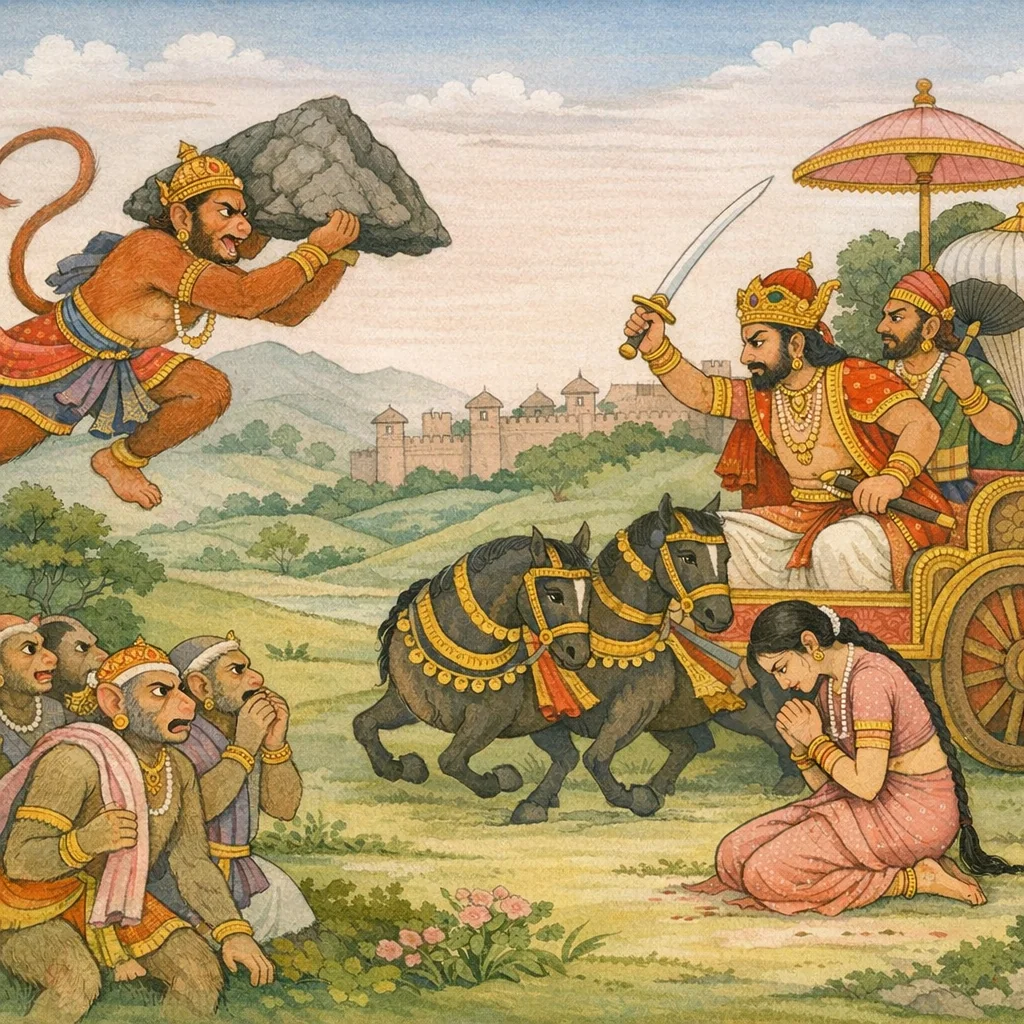
Sarga 81 frames a psychological and ethical crisis engineered by Indrajit. After discerning Rāghava’s intent, Indrajit withdraws into Laṅkā and, recalling the deaths of Rākṣasas, emerges enraged through the western gate. Seeing Rāma and Lakṣmaṇa ready for battle, he manifests māyā: an illusory Sītā is placed on a chariot amid Rākṣasa protection, and he advances toward the Vānara host to bewilder them. The Vānaras surge forward; Hanumān leads, bearing a mountain-peak as a weapon. He sees the chariot-borne woman—described with ascetic austerity, single braid, dust-covered limbs—and recognizes her as Maithilī. Alarmed, Hanumān confronts Indrajit as Indrajit theatrically seizes her hair, strikes her, and argues that harming women is permissible as enemy-affliction. Hanumān condemns the act as ignoble and predicts Indrajit’s imminent death and posthumous disgrace. Indrajit then publicly ‘kills’ the illusory Sītā with a sword, proclaiming the Vānara effort futile; the Vānara ranks momentarily collapse into grief and flight, while Indrajit rejoices and roars—marking māyā as a weapon aimed at morale rather than battlefield necessity.
Shlokas
Verse 1
विज्ञायतुमनस्तस्यराघवस्यमहात्मनः ।स निवृत्याहवात्तस्मात् प्रविवेशपुरींततः ।।।।
Having understood the mind and intent of the high-souled Rāghava, he withdrew from that battlefield and then entered the city.
Verse 2
सोऽनुस्मृत्यवधंतेषांराक्षसानांतरस्विनाम् ।क्रोधताम्रेक्षणश्शूरोनिर्जगामाहाद्युति: ।।।।
Remembering the slaughter of those valiant Rākṣasas, the heroic, radiant Indrajit came forth—his eyes reddened with anger.
Verse 3
स पश्चिमेवद्वारेणनिर्ययौराक्षसैर्वृतः ।इन्द्रजित्सुमहावीर्यःपौलस्त्योदेवकण्टकः ।।।।
Indrajit—mighty in prowess, a scion of the Paulastya line and a tormentor of the gods—came out through the western gate, surrounded by rākṣasas.
Verse 4
इन्द्रजित्तुततोदृष्टवाभ्रातरौरामलक्ष्मणौ ।रणायाभ्युद्यतौवीरौमायांप्रादुष्करोत्तदा ।।।।
Then Indrajit, seeing the heroic brothers Rāma and Lakṣmaṇa fully prepared for battle, revealed his power of illusion at that time.
Verse 5
इन्द्रजित्तुरथेस्थाप्यसीतांमायामयींतदा ।बलेनमहतावृत्यतस्यावधमरोचयत् ।।।।
Then Indrajit, placing an illusory Sītā upon his chariot and surrounding her with a great force, resolved upon (the plan of) killing her.
Verse 6
मोहनार्थंतुसर्वेषांबुद्धिंकृत्वासुदुर्मतिः ।हन्तुंसीतांव्यवसितोवानराभिमुखोययौ ।।।।
With the intent to delude everyone, that wicked-minded one, determined to kill Sītā, went forth facing the Vānara host.
Verse 7
तम्दृष्टवात्वभिनिर्यान्तंसर्वेतेकाननौकसः ।उत्पेतुरभिसङ्क्रुद्धाश्शिलाहस्तायुयुत्सवः ।।।।
Seeing him advancing, all those dwellers of the forest sprang up in fury, eager to fight, with rocks held in their hands.
Verse 8
हनूमान् पुरतस्तेषांजगामकपिकुञ्जरः ।प्रगृह्यसुमहच्छृङ्गंपर्वतस्यदुरासदम् ।।।।
Hanumān—the great bull-elephant among monkeys—went before them, seizing a vast mountain-peak, hard to approach.
Verse 9
स ददर्शहतानन्दांसीतामिन्द्रजितोरथे ।एकवेणीधरांदीनामुपवासकृशाननाम् ।।।।परिक्लिष्टैकवसनाममृजांराघवप्रियाम् ।रजोमलाभ्यामालिप्तैस्सर्वगात्रैर्वरस्त्रियम् ।।।।
He saw Sītā upon Indrajit’s chariot—joyless, wearing a single braid, pitiable, her face thinned by fasting; clad in one worn garment, seemingly without the will to live; Rāghava’s beloved, a noble woman, her whole body smeared with dust and grime and left unadorned.
Verse 10
स ददर्शहतानन्दांसीतामिन्द्रजितोरथे ।एकवेणीधरांदीनामुपवासकृशाननाम् ।।6.81.9।।परिक्लिष्टैकवसनाममृजांराघवप्रियाम् ।रजोमलाभ्यामालिप्तैस्सर्वगात्रैर्वरस्त्रियम् ।।6.81.10।।
He saw Sītā in Indrajit’s chariot—joyless, wearing her hair in a single braid, pitiable, her face thinned by fasting; clad in a single, worn garment, unadorned, dear to Rāghava, and with dust and grime smeared over all her limbs, that noble woman.
Verse 11
तांनिरीक्ष्यमुहूर्तंतुमैथिलीत्यध्यवस्यतु ।बभूवाचिरदृष्टाहितेनसाजनकात्मजा ।।।।
After watching her for a moment, he concluded, “She is Maithilī,” for that daughter of Janaka had been seen by him not long before.
Verse 12
अब्रवीत्तांतुशोकार्तांनिरानन्दांतपस्विनीम् ।दृष्टवारथोस्थितांदृष्ट्वाराक्षसेन्द्रसुतश्रिताम् ।।।।कंसमर्थितमस्येतिचिन्तयन्समहाकपिः ।सहतैर्वानरश्रेष्ठैरभ्यधावतरावणिम् ।।।।
Seeing her—grief-stricken, joyless, living like an ascetic—seated in the chariot and under the power of the rākṣasa-king’s son, the great ape pondered, “What has been done to her?” Then, with the foremost of the vānaras, he rushed at Rāvaṇi (Indrajit).
Verse 13
अब्रवीत्तांतुशोकार्तांनिरानन्दांतपस्विनीम् ।दृष्टवारथोस्थितांदृष्ट्वाराक्षसेन्द्रसुतश्रिताम् ।।6.81.12।।कंसमर्थितमस्येतिचिन्तयन्समहाकपिः ।सहतैर्वानरश्रेष्ठैरभ्यधावतरावणिम् ।।6.81.13।।
Seeing her—grief-stricken and joyless, living like an ascetic—seated in the chariot and under the rākṣasa prince’s power, the great ape wondered what had been done to her; and with the foremost vānaras he charged at Rāvaṇi (Indrajit).
Verse 14
तद्वानरबलंदृष्टवारावणिःक्रोधमूर्छितः ।कृत्वाविकोशंनिस्त्रिंशंमूर्ध्निसीतामकर्षयत् ।।।।
Seeing that vānara force, Rāvaṇi—overcome by a swoon of anger—drew his sword and seized Sītā by the hair at her head.
Verse 15
तांस्त्रियंपश्यतांतेषांताडयामासरावणि: ।क्रोशन्तींरामरामेतिमाययायोजितांरथे ।।।।
While they looked on, Rāvaṇi struck that woman—set upon the chariot by deception—as she cried out, “Rāma! Rāma!”
Verse 16
गृहीतमूर्धजांदृष्टवाहनुमान् दैन्यमागतः ।शोकजंवारिनेत्राभ्यामुत्सृजन्मारुतात्मजः ।।।।
Seeing her hair seized, Hanumān—the son of Māruta—fell into anguish, letting tears born of sorrow stream from his eyes.
Verse 17
तांदृष्टवाचारुसर्वाङ्गींरामस्यमहिषींप्रियाम् ।अब्रवीत्पुरुषंवाक्यंक्रोधाद्रक्षोधिपात्मजम् ।।।।
Seeing that beloved queen of Rāma, lovely in every limb, he—angered—addressed the rākṣasa prince with harsh words of rebuke.
Verse 18
दुरात्मन्नात्मनाशायकेशपक्षेपरामृशः ।ब्रह्मर्षीणांकुलेजातोराक्षसींयोनिमाश्रितः ।।।।
O evil-minded one—seizing her by the hair is only for your own ruin. Though born in a lineage associated with Brahmarṣis, you have taken refuge in a Rākṣasī womb and conduct.
Verse 19
धिक्त्वांपापसमाचारंयस्यतेमतिरिदृशी ।नृशंसानार्य दुर्वृत्त क्षुद्र पापपराक्रम ।।।।अनार्यस्येदृशंकर्मघृणातेनास्तिनिर्घृण ।
Shame on you—whose mind has resolved upon such sinful conduct! O cruel and ignoble one, of base nature and wicked prowess—this deed is fit only for the unworthy; you have no compassion, merciless as you are.
Verse 20
च्युतागृहाच्चराज्याच्चरामहस्ताच्चमैथिली ।।।।किंतवैषापराद्धाहियदेनांहन्तुमिच्छसि ।
Maithilī has been torn away from her home, her kingdom, and even from Rāma’s protecting hand. What wrong has she done to you that you wish to kill her?
Verse 21
सीतांहत्वातु न चिरंजीविष्यसिकथञ्चन ।।।।वधार्हकर्मणानेनममहस्तगतोह्यसि ।
If you kill Sītā, you will not live long—by no means. By this deed that merits death, you have truly come into my hands.
Verse 22
येच स्त्रीघातिनांलोकालोकवध्यैषुकुसतिताः ।।।।इहजीवितमुत्सृज्यप्रेत्यतान्प्रतिपत्स्यसे ।
Those realms destined for the slayers of women—cast among the world’s condemned—will be yours. Giving up life here, after death you will fall into those very states.
Verse 23
तिब्रुवाणोहनुमान् सायुधैर्हरिभिर्वृतः ।।।।अभ्यदावत् ससुङ्कृद्धोराक्षसेन्द्रसुतंप्रति ।
Thus speaking, Hanumān—surrounded by armed Vānara warriors—charged forward in great fury toward the son of the Rākṣasa king.
Verse 24
पतन्तंमहावीर्यंतदनीकंवनौकसाम् ।।।।रक्षसांभीमकोपानामनीकंतुन्यवारयत् ।
That mighty troop of forest-dwelling Vānaras, rushing in, checked the advancing Rākṣasa ranks—terrible in their fury.
Verse 25
सःतांबाणसहस्रेणविक्षोभ्यहरिवाहिनीम् ।।।।हनूमन्तंहरिश्रेष्ठमिन्द्रजित् प्रत्युवाच ह ।
Having thrown the Vānara host into turmoil with a thousand arrows, Indrajit then spoke in reply to Hanumān, the foremost of monkeys.
Verse 26
सुग्रीवस्त्वं च रामश्चयन्निमित्तमिहागताः ।।।।तांवधिष्यामिवैदेहीमद्यैवतवपश्यतः ।
“For whose sake Sugrīva, you, and Rāma have come here—I will kill that Vaidehī today, before your very eyes.” Thus Indrajit threatened.
Verse 27
इमांहत्वाततोरामंलक्ष्मणंत्वां च वानर ।।।।सुग्रीवं च वधिष्यामितंचानार्यंविभीषणम् ।
“After killing her today, I shall then kill Rāma, Lakṣmaṇa, and you, O vānarā—Sugrīva as well, and that ignoble Vibhīṣaṇa.”
Verse 28
न हन्तव्याःस्त्रियश्चेतियद् ब्रवीषिप्लवङ्गम ।।।।पीडाकरममित्राणांयत्स्यात्कर्तव्यमेवतत् ।
“You say, ‘Women must not be slain,’ O plavaṅgama. Yet whatever becomes a source of affliction to one’s enemies—that alone must be done.”
Verse 29
तमेवमुक्त्वारुदतींसीतांमयामयीं च ताम् ।।।।शितधारेणखङ्गेननिजघानेन्द्रजित्स्वयम् ।
Having spoken thus, Indrajit himself struck down with a sharp-edged sword that weeping ‘Sītā’—a form fashioned by illusion.
Verse 30
यज्ञोपवीतमार्गेणभिन्नातेनतपस्विनी ।।।।सापृथिव्यांपृथुश्रोणीपपातप्रियदर्शना ।
Split by him along the line of the sacred thread, that ascetic woman—broad-hipped and fair to behold—fell upon the earth.
Verse 31
त्तामिन्द्रजित् स्त्रियंहत्वाहनूमन्तमुवाच ह ।।।।मयारामस्यपश्येमांकोपेन च ।एषाविशस्तावैदेहीनिष्फलोवःपरिश्रमः ।।।।
After killing that woman, Indrajit said to Hanumān, “Look—Rāma’s Vaidehī has been hewn down by me in wrath. Your efforts have become fruitless.”
Verse 32
त्तामिन्द्रजित् स्त्रियंहत्वाहनूमन्तमुवाच ह ।।6.81.31।।मयारामस्यपश्येमांकोपेन च ।एषाविशस्तावैदेहीनिष्फलोवःपरिश्रमः ।।6.81.32।।
After killing that woman, Indrajit said to Hanumān, “Look—Rāma’s Vaidehī has been hewn down by me in wrath. Your efforts have become fruitless.”
Verse 33
ततःखडगेनमहताहत्वातामिन्द्रजित् स्वयम् ।हृष्टस्सरथमास्थायननाद च महास्वनम् ।।।।
Then Indrajit himself, having slain her with his great sword, rejoiced; mounting his chariot, he roared with a mighty sound.
Verse 34
वानराश्शुश्रुवुश्शब्दमदूरेप्रत्यवस्थिताः ।व्यादितास्यस्यनदतस्तद्दुर्गंसंश्रितस्यतु ।।।।
The vānaras, stationed not far away, heard the roar of him who cried out with gaping mouth—having taken refuge in that hard-to-reach stronghold.
Verse 35
तथातुसीतांविनिहत्यदुर्मतिःप्रहृष्टचेतास्सबभूवरावणिः ।तंहृष्टरूपंसमुदीक्ष्यवानराविषण्णरूपास्सहसाप्रददुद्रुवुः ।।।।
Thus, after ‘killing Sītā,’ that evil-minded son of Rāvaṇa became elated. Seeing him exultant, the vānaras—overcome with sorrow—suddenly fled in a rout.
Frequently Asked Questions
Indrajit stages violence against a woman (an illusory Sītā) to break enemy morale, forcing the narrative to examine wartime limits: whether psychological victory can justify acts framed as cruelty toward the protected and non-combatant.
The dialogue asserts that adharma—especially cruelty and the targeting of the vulnerable—corrodes the perpetrator and invites retribution; Hanumān’s rebuke frames such conduct as self-destructive and socially condemnable, regardless of tactical gain.
The action is anchored at Laṅkā’s city-space and its western gate, with culturally marked details such as the yajñopavīta-mārga (sacred-thread line) used to describe the sword’s diagonal cut, and emblematic war-objects like the chariot, sword, and mountain peak.