Sarga 80
इन्द्रजितो यज्ञानुष्ठानं अन्तर्धानं च (Indrajit’s Rite and the Invisible Assault)
युद्धकाण्ड
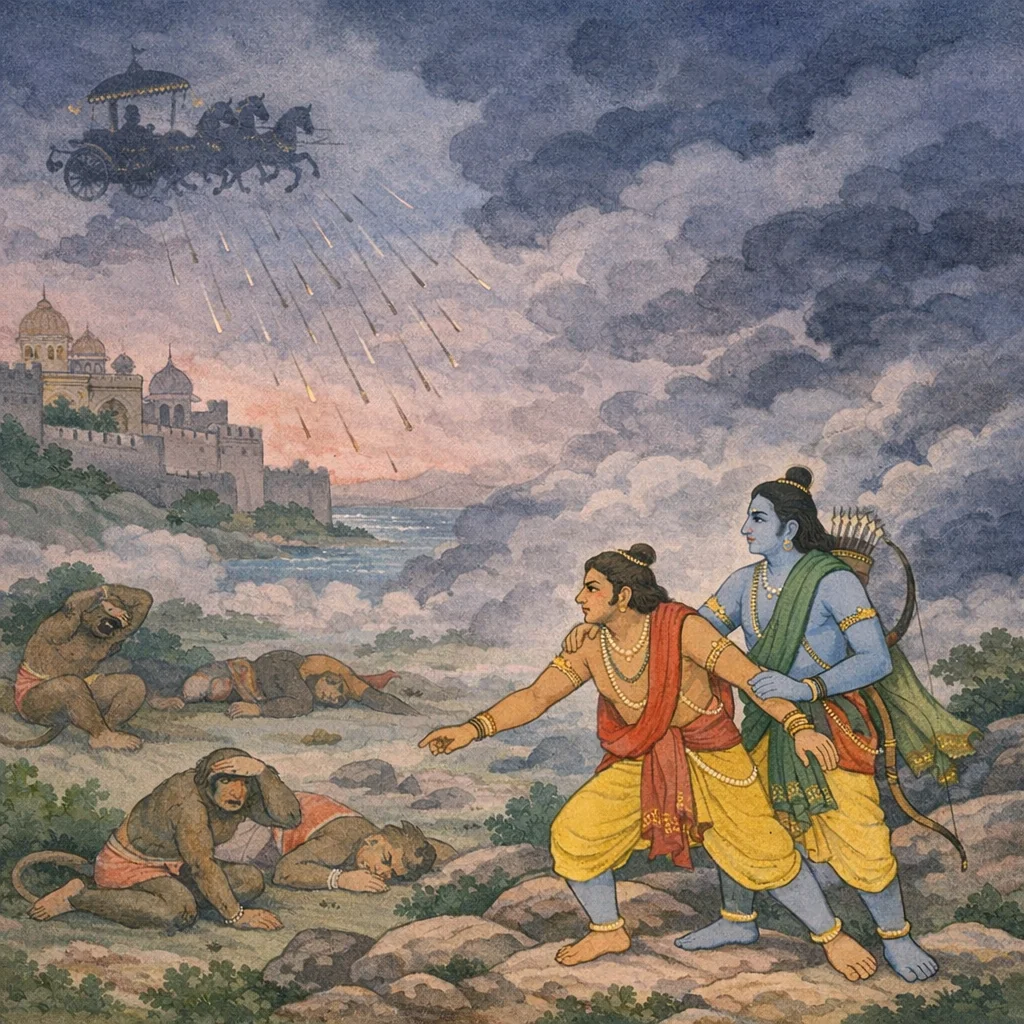
Sarga 80 opens with Rāvaṇa’s reaction to the death of Makarākṣa: he is described as a seasoned war-victor who, enraged and grinding his teeth, deliberates on immediate counteraction and commands his son Indrajit (Rāvaṇi) to enter battle. Indrajit first performs a rākṣasa-specific fire rite (yajña/homa): ritual implements and substitutions are described (weapons treated as sacrificial adjuncts, red garments, iron ladles), and a dark goat is seized for offering. Omens of victory are noted as the smokeless, golden-flaring fire receives oblations. Having gratified devas, dānavas, and rākṣasas, Indrajit mounts an exquisitely ornamented chariot, becomes invisible (antardhāna), and boasts of delivering victory to his father by killing Rāma, Lakṣmaṇa, and the vānaras. In battle he strikes from the sky while remaining out of sight, generating smoke-and-fog darkness that erases directions and conceals sound and form. Rāma and Lakṣmaṇa counter with divine missiles but cannot touch the unseen foe; vānaras fall in hundreds. Lakṣmaṇa proposes deploying the Brahmāstra broadly, but Rāma restrains him with a rule-based ethic: one must not annihilate many for the sake of one, nor kill those who are non-combatant, hidden, surrendering, fleeing, or inattentive. Rāma then resolves to focus weapons precisely against the māyin Indrajit and considers swift means of his defeat as the vānaras stand ready.
Shlokas
Verse 1
मकराक्षंहतंश्रुत्वारावणस्समितिञ्जयः ।रोषेणमहताविष्टोदन्ताङ्कटकटाय्य च ।।।।कोपितश्चतदातत्रकिंकार्यमितिचिन्तयन् ।आदिदेशाथसङ्क्रुद्धोरणायेजितंसुतम् ।।।।
Hearing that Makarākṣa had been slain, Rāvaṇa—ever victorious in battle—was seized by great fury, grinding his teeth. Then, enraged and thinking, “What is to be done now?”, he commanded his son Indrajit to go to war.
Verse 2
मकराक्षंहतंश्रुत्वारावणस्समितिञ्जयः ।रोषेणमहताविष्टोदन्ताङ्कटकटाय्य च ।।6.80.1।।कोपितश्चतदातत्रकिंकार्यमितिचिन्तयन् ।आदिदेशाथसङ्क्रुद्धोरणायेजितंसुतम् ।।6.80.2।।
Hearing that Makarākṣa had been slain, Rāvaṇa—ever victorious in battle—was seized by great fury, grinding his teeth. Then, enraged and thinking, “What is to be done now?”, he commanded his son Indrajit to go to war.
Verse 3
जहिवीर महावीर्यौभ्रातरौरामलक्ष्मणौ ।अदृश्योदृश्यमानोवासर्वथात्वंबलाधिकः ।।।।
O valiant one! Slay the two mighty brothers—Rāma and Lakṣmaṇa. Whether unseen or seen, you are in every way superior in force.
Verse 4
त्वमप्रतिमकर्माणमिन्द्रंजयसिसंयुगे ।किंपुनर्मानुषौदृष्टवा न वधिष्यसिसंयुगे ।।।।
You have conquered Indra—whose deeds are unmatched—in battle; why then, upon seeing mere human warriors, would you not strike them down in combat?
Verse 5
तथोक्तोराक्षसेन्द्रेणप्रतिगृह्यपितुर्वचः ।यज्ञभूमौ स विधिवत् पावकंजुहवेन्द्रजित् ।।।।
Thus addressed by the lord of the Rākṣasas, Indrajit accepted his father’s command and, at the sacrificial ground, duly offered oblations into the sacred fire according to rite.
Verse 6
जुह्वतश्चापितत्राग्निंरक्तोष्णीषधरास्त्रिरियः ।आजग्मुस्तत्रसम्भ्रान्ताराक्षस्योयत्ररावणिः ।।।।
While he was making offerings into the fire there, Rākṣasa women—wearing red head-dresses—hurried to that place where Rāvaṇa’s son was.
Verse 7
शस्त्राणिशरपत्राणिसमिधोऽथविभीतकाः ।लोहितानि च वासांहिस्रुवंकार्ष्णायसंतथा ।।।।
There were weapons and blades of reed-grass, vibhītaka-wood as fuel-sticks, red garments, and likewise an iron ladle for the offerings.
Verse 8
सर्वतोऽग्निंसमास्तीर्यशरपत्रैस्सतोमरैः ।छागस्यसर्वकृष्णस्यगळंजग्राहजीवतः ।।।।
Having strewn the area around the fire on all sides with reed-grass and weapons, he seized the throat of a living, wholly black goat (for the intended offering).
Verse 9
सकृदेवसमिद्धस्यविधूमस्यमहार्चिषः ।बभूवुस्तानिलिङ्गानिविजयंदर्शयन्ति च ।।।।
When the sacrificial fire was kindled just once—smokeless yet blazing with great flames—those very signs appeared, indicating victory.
Verse 10
प्रदक्षिणावर्तशिखस्तप्तहाटकसन्निभः ।हविस्तत्प्रतिजग्राहपावकस्स्वयमुत्थितः ।।।।
The fire, rising of itself, with flames curling to the right and gleaming like refined gold, received that oblation.
Verse 11
हुत्वाग्निंतर्पयित्वाथदेवदानवराक्षसान् ।आरुरोहरथश्रेष्ठमन्तर्थानगतंशुभम् ।।।।
After making offerings into the fire and ritually gratifying the Devas, Dānavas, and Rākṣasas, Indrajit mounted an excellent, auspicious chariot and then vanished from sight.
Verse 12
स वाजिभिश्चतुर्भिस्तुबाणैश्चनिशितैर्युतः ।आरोपितमहाचापश्शुशुभेस्यन्दनोत्तमः ।।।।
That superb chariot shone brightly—yoked to four horses, stocked with sharp arrows, and bearing a mighty bow set in place.
Verse 13
जाज्वल्यमानोवपुषातपनीयपरिच्छदः ।मृगैश्चन्द्रार्धचन्द्रैश्च स रथस्समलङ्कृतः ।।।।
Blazing in appearance and clad in golden fittings, that chariot was richly adorned with figures of deer and with moon and crescent-moon emblems.
Verse 14
जाम्बूनदमहाकम्बुर्दीप्तपावकसन्निभः ।बभूवेन्द्रजितःकेतुर्वैदूर्यसमलङ्कृतः ।।।।
Its standard—Indrajit’s banner—gleamed like a blazing fire, set with great golden ornaments and adorned with vaidūrya gems.
Verse 15
तेनचादित्यकल्पेनब्रह्मास्त्रण च पालितः ।स बभूवदुराधर्षोरावणिस्सुमहाबलः ।।।।
Guarded by that Brahmā-weapon and radiant like the sun, Rāvaṇa’s son became exceedingly powerful and hard to overcome.
Verse 16
सोऽभिनिर्यायनगरादिन्द्रजित्समितिञ्जयः ।हत्वाग्निंराक्षसैर्मन्त्रैरन्तर्धानगतोऽब्रवीत् ।।।।
Then Indrajit, victorious in battle, went out from the city; after offering into the fire with rākṣasa-mantras, he passed into invisibility and spoke.
Verse 17
अद्यहत्वारणेयौतौमिथ्याप्रव्रजितौवने ।जयंपित्रेप्रदास्यामिरावणायरणार्जितम् ।।।।
“Today, after killing in battle those two who have gone to the forest in a false exile, I shall present to my father Rāvaṇa the victory won in war.”
Verse 18
अद्यनिर्वानरमुर्वींहत्वारामंसलक्ष्मणम् ।करिष्येपरमांप्रीतिमित्युक्त्वान्तरधीयत ।।।।
“Today, after slaying Rāma together with Lakṣmaṇa and making the earth bereft of monkeys, I shall bring my father supreme delight”—having said this, he vanished from view.
Verse 19
आपपातथसङ्कृद्धोदशग्रीवेणचोदितः ।तीक्षणकार्मुकनाराचैस्तीक्षणस्त्विन्द्ररिपूरणे ।।।।
Then, urged on by Daśagrīva (Rāvaṇa), Indrajit—fierce in battle and armed with keen bows and barbed missiles—rushed forward in wrath.
Verse 20
स ददर्शमहावीर्यौनागौत्रिशिरसानिव ।सृजन्ताविषुजालानिवीरौवानरमध्यगौ ।।।।
He beheld the two great heroes—Rāma and Lakṣmaṇa—standing amid the Vānara host, like mighty serpents, casting forth a net of arrows.
Verse 21
इमौतावितिसञ्चिन्त्यसज्जंकृत्वा च कार्मुकम् ।सन्ततानेषुधाराभिःपर्जन्यइववृष्टिमान् ।।।।
Recognizing, “These are the two,” he made his bow ready and poured forth an unbroken stream of arrows—like a rain-laden cloud.
Verse 22
तुवैहायसंप्राप्यसरथोरामलक्ष्मणौ ।आचक्षुर्विषयेतिष्ठवनिव्याधनिशितैश्शरैः ।।।।
Then, mounting his aerial chariot, he remained beyond the range of sight and struck Rāma and Lakṣmaṇa with keen-pointed arrows from the sky.
Verse 23
तौतस्यशरवेगेनपरीतौरामलक्ष्मणौ ।धनुषीसशरेकृत्वादिव्यमस्त्रंप्रचक्रतुः ।।।।
Enveloped by the rush of his arrows, Rāma and Lakṣmaṇa took up their bows with arrows and brought forth a splendid divine weapon in reply.
Verse 24
प्रच्छादयन्तौगगनंशरजालैर्महाबलौ ।तमस्त्रःसूर्यसङ्काशैर्नैवपस्पृशतुश्शरैः ।।।।
Though the mighty pair veiled the sky with nets of arrows, radiant like the sun, their shafts still could not reach him.
Verse 25
स हिधूमान्धकारं च चक्रेप्रच्चादयन्नभः ।दिशश्चान्तर्दधेश्रीमान्नीहारतमसावृताः ।।।।
For he, the splendid one, shrouded the sky in smoky darkness, and the directions disappeared, wrapped in mist and gloom.
Verse 26
नैवज्यातलनिर्घोषा न च नेमिखुरस्वनः ।शुश्रुवेचरतस्तस्य न च रूपंप्रकाशते ।।।।
As he moved, neither the twang and striking sounds were heard, nor the noise of wheels and hooves; and even his form did not become visible.
Verse 27
घनान्धकारेतिमिरेशरावर्षमिवाद्भुतम् ।स ववर्षमहाबाहुर्नाराचशरवृष्टिभिः ।।।।
In that thick, cloud-like darkness, the mighty-armed one poured down a wondrous rain of missiles—showers of nārāca arrows.
Verse 28
स रामंसूर्यसङ्काशैश्शरैर्धत्तवरोर्भृशम् ।विव्याधसमरेक्रुद्धःसर्वगात्रेषुरावणिः ।।।।
Then the enraged Rāvaṇi—endowed with boons—pierced Rāma grievously in battle, striking him with sun-bright arrows across all his limbs.
Verse 29
तौहन्यमानौनाराचैर्धाराभिरिवपर्वतौ ।हेमपुङ्खान्नरव्याघ्रौतिग्मान्मुमुचतुःशरान् ।।।।
Though battered by streams of nārāca arrows like two mountains under a pounding downpour, the tiger-like heroes among men released sharp arrows with golden fletching.
Verse 30
अन्तरिक्षेसमासाद्यरावणिंकङ्कपत्रिणः ।निकृत्यपतगाभूमौसेतुस्तेशोणितोक्षिताः ।।।।
Reaching Rāvaṇa’s son in the sky, those arrows—winged as it were—cut into him; and, drenched in blood, they fell down upon the ground.
Verse 31
अतिमात्रंशरौघेणपीड्यमानौनरोत्तमौ ।तानिषून्पततोभल्लैरनेकैर्विचकर्ततुः ।।।।
Pressed hard by a torrent of arrows, the two best of men cut down those incoming shafts with many bhalla-arrows.
Verse 32
यतोहिददृशातेतौशरान् निपतितान्शितान् ।ततस्तुतौदाशरथीससृजातेऽस्त्रमुत्तमम् ।।।।
When they perceived from which direction the sharp arrows were falling, the two sons of Daśaratha then set forth their finest weapon toward it.
Verse 33
रावणिस्तुदिशस्सर्वारथेनातिरथोऽपतत् ।विव्याधतौदाशरथीलघ्वस्त्रनिशितैःशरैः ।।।।
But Rāvaṇa’s son—an eminent chariot-warrior—ranged in all directions with his chariot and pierced the two sons of Daśaratha with swift, sharp arrows.
Verse 34
तेनातिविद्धौतौवीरौरुक्मपुङ्खैःसुसम्हतैः ।बभूवतुर्धाशरथीपुष्पितामिवकिंशुकौ ।।।।
Struck severely by his well-made, gold-feathered arrows, the two heroic sons of Daśaratha appeared like kiṃśuka trees in full bloom.
Verse 35
नास्यवेगगतिंकचशिन्न च रूपंधनुश्शरान् ।न चान्यद्विदितंकिञ्चित्सूर्यस्येवाभ्रसम्प्लवे ।।।।
No one could discern his speed and movement, nor his form, nor even his bow and arrows—just as, when clouds thicken, nothing is known except the sun itself.
Verse 36
तेनविद्धाश्चहरयोनिहताश्चगतासवः ।बभूवुःशतशस्तत्रपतिताधरणीतले ।।।।
Struck by him, the monkeys—slain and bereft of life—fell there upon the earth in their hundreds.
Verse 37
लक्ष्मणस्तुततस्सुङ्क्रृद्धोभ्रातरंवाक्यमब्रवीत् ।ब्राह्ममस्त्रंप्रयोक्ष्यामिवधार्थंसर्वरक्षसाम् ।।।।
Then Lakṣmaṇa, enraged, spoke to his brother: “I will deploy the Brahmā-weapon to destroy all the Rākṣasas.”
Verse 38
तमुवाचततोरामोलक्ष्मणंशुभलक्षणम् ।नैकस्यहेतोरक्षांसिपृथिव्यांहन्तुमर्हसि ।।।।
Then Rāma said to Lakṣmaṇa of auspicious marks: “For the sake of a single one, you ought not to slay the Rākṣasas across the earth.”
Verse 39
अयुध्यमानंप्रच्छन्नंप्राञ्जलिंशरणागतम् ।पलायमानंमत्तंवा न हन्तुंत्वमिहार्हसि ।।।।
Here you ought not to kill one who is not fighting—one who has withdrawn or hidden—nor one who comes with folded hands seeking refuge; nor one who is fleeing, or one who is heedless and not in a condition to fight.
Verse 40
अस्यैवतुवधेयत्नंकरिष्यावोमहाभुज ।आदेक्ष्यावोमहावेगावस्त्रानाशीविषोपमान् ।।।।
But for his slaying, O mighty-armed one, we shall exert ourselves; we shall deploy swift, forceful weapons—like venomous serpents in their deadly strike.
Verse 41
तमेनंमायिनंक्षुद्रमन्तर्हितरथंबलात् ।राक्षसंनिहनिष्यन्तिदृष्टवावानरयूथपाः ।।।।
If they catch sight of that petty, deceitful Rākṣasa—the conjurer who moves with a hidden chariot—the Vanara troop-leaders will strike him down by sheer force.
Verse 42
यद्येषभूमिंविशतेदिवंवारसातलंवापिनभस्स्थलंवा ।एवंनिगूढोऽममास्त्रदग्धःपतिष्यतेभूमितलेगतासुः ।।।।
Even if he were to enter the earth, or the heavens, or even Rasātala, or the expanse of the sky—though he remain concealed—burnt by my weapon he will fall upon the ground, his life spent.
Verse 43
इत्येवमुक्त्वावचनंमहात्मारघुप्रवीरःप्लवगर्षभैर्वृतः ।वधायरौद्रस्यनृशंसकर्मणस्तदामहात्मात्वरितंनिरीक्षते ।।।।
Having spoken thus, the great-souled hero of the Raghu line—surrounded by the foremost of the Vanaras—then swiftly considered the means to bring about the death of that fierce one whose deeds were cruel.
Frequently Asked Questions
Lakṣmaṇa proposes using the Brahmāstra to destroy all rākṣasas to neutralize Indrajit’s threat; Rāma rejects collective annihilation for a single target and reasserts rules of engagement—prohibiting killing those not actively fighting, those hidden or surrendering, those fleeing, or those incapacitated/inattentive.
Power must be governed by maryādā: even under deception and mass casualty, righteous action requires discrimination (viveka), proportional response, and adherence to ethical constraints; victory is pursued through precise intent and disciplined means, not indiscriminate force.
The narrative foregrounds Laṅkā’s yajñabhūmi (ritual ground) as a cultural-ritual locus for rākṣasa practices, and the aerial battle-space (vaihāyasa/sky) where Indrajit’s antardhāna tactics transform the battlefield through manufactured darkness (smoke and fog).