Sarga 8
युद्धकाण्डे अष्टमः सर्गः — राक्षससभा-युद्धपरामर्शः (War-Council Boasts and Stratagems)
युद्धकाण्ड
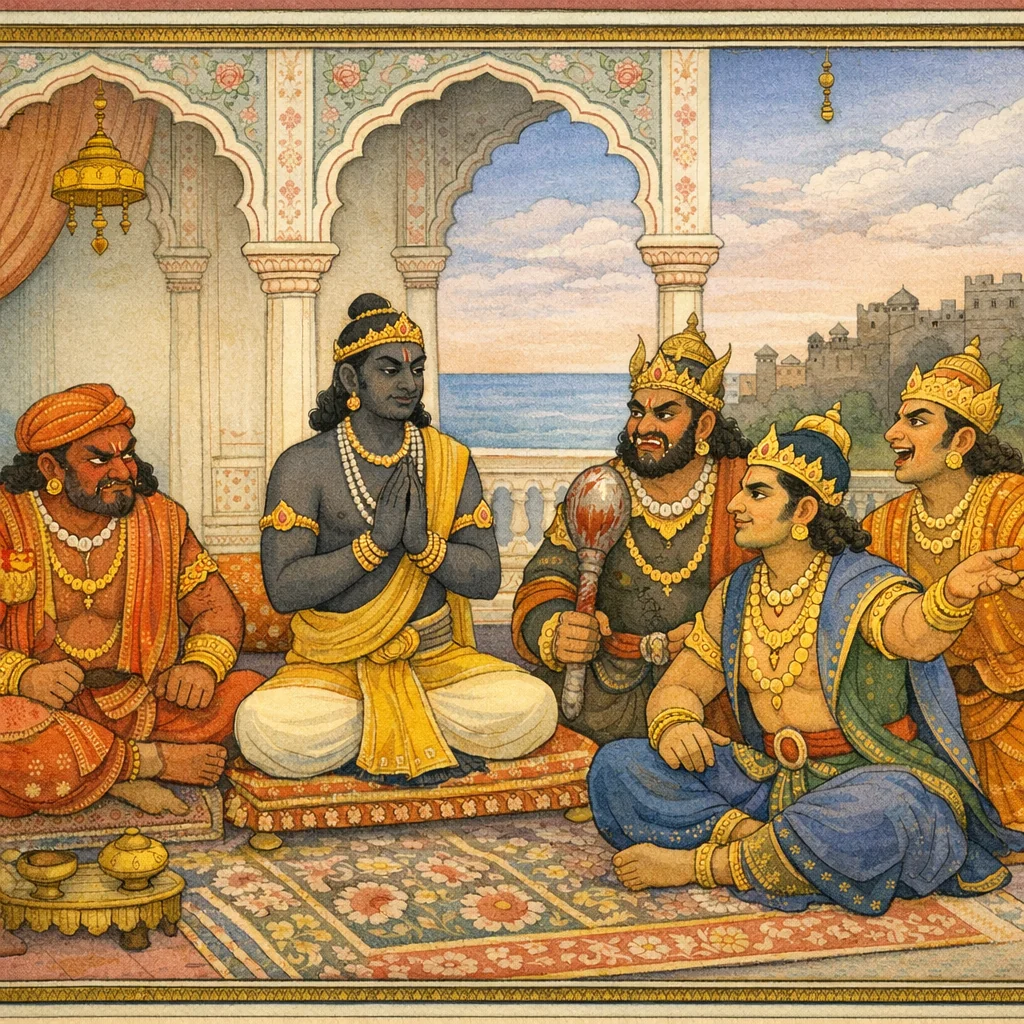
Sarga 8 stages a Laṅkā court war-council in which multiple Rākṣasa leaders compete to frame the threat and propose responses after Hanumān’s earlier disruptions. Prahasta, described as cloud-dark and speaking with folded palms, advances a rhetoric of contempt for Hanumān and proposes victory through upāya (cunning stratagem) and vigilance rather than raw bravado: thousands of kāmarūpa Rākṣasas should approach Rāma in human guise and deliver deceptive speech to destabilize Rāma and Lakṣmaṇa. The discourse then shifts to escalating vows of single-handed slaughter: Durmukha condemns the humiliation as unforgivable; Vajradaṃṣṭra grasps a gore-stained iron bludgeon; Vajrahanu and others boast of consuming or killing the Vānara leaders (Sugrīva, Aṅgada, Hanumān) and even Rāma with Lakṣmaṇa. A further ruse is voiced—claiming Bharata is coming with an army—to sow confusion. The sarga thus documents the court’s psychology: strategic deception is articulated, but it is repeatedly overshadowed by performative martial arrogance, offering a literary study in counsel, propaganda, and the ethical contrast between dharmic resolve and adharmic manipulation.
Shlokas
Verse 1
ततोनीलाम्बुदनिभ: प्रहस्तोनामराक्षसः ।अब्रवीत्प्राञ्जलिर्वाक्यंशूरस्सेनापतिस्तदा ।।6.8.1।।
Then the heroic rākṣasa commander Prahastha, dark as a rain-cloud, spoke with folded hands.
Verse 2
देवदानवगन्धर्वाःपिशाचपतगोरगाः ।नत्वांधर्षयितुंशक्याःकिंपुनर्वानरारणे ।।6.8.2।।
“Even devas, dānavas, gandharvas—yes, even piśācas, birds, and serpents—are not able to confront you in battle; how much less, then, the vānaras in war.”
Verse 3
सर्वेप्रमत्ताविश्वस्तावञ्चितास्स्महनूमता ।नहिमेजीवतोगच्छेज्जीवन् सवनगोचरः ।।6.8.3।।
All of us, careless and overconfident, were outwitted by Hanumān. While I still live, that forest-ranging one will not escape alive.
Verse 4
सर्वांसागरपर्यन्तांसशैलवनकाननाम् ।करोम्यवानरांभूमिमाज्ञापयतुमांभवान् ।।6.8.4।।
Let my lord command me: I will make the whole earth—bounded by the ocean, with its mountains and forests—free of vānaras.
Verse 5
रक्षांचैवविधास्यामिवानराद्रजनीचर ।नागमिष्यतितेदुःखंकिञ्चिदात्मापराधजम् ।।6.8.5।।
O night-roamer, I will indeed arrange protection against the vānaras. You need not suffer even the least sorrow arising from your own fault.
Verse 6
अब्रवीच्चसुसङ्कृद्धोदुर्मुखोनामराक्षसः ।इदंनक्षमणीयंहिसर्वेषांनःप्रधर्षणम् ।।6.8.6।।
Then the rākṣasa named Durmukha, enraged, spoke: “This humiliation of all of us is not something to be forgiven.”
Verse 7
अयंपरिभवोभूयःपुरस्यान्तःपुरस्यच ।श्रीमतोराक्षसेन्द्रस्यवानरेणप्रधर्षणम् ।।6.8.7।।
This is a further outrage—an assault by a mere vānara upon the city and even the inner palace of the prosperous lord of rākṣasas.
Verse 8
अस्मिन् मुहूर्तेगत्वैकोनिवर्तिष्यामिवानरान् ।प्रविष्टान् सागरंभीममम्बरंवारसातलम् ।।6.8.8।।
This very moment I will go alone and finish the vānaras—even if they have entered the dreadful ocean, the sky, or the netherworld.
Verse 9
ततोऽब्रवीत्सुसङ्कृद्धोवज्रदंष्ट्रोमहाबलः ।प्रगृह्यपरिघंघोरंमांसशोणितरूषितम् ।।6.8.9।।
Then the mighty Vajradaṃṣṭra, burning with rage, spoke—gripping a dreadful iron club smeared with flesh and blood.
Verse 10
किंवोहनुमताकार्यंकृपणेनतपस्विना ।रामेतिष्ठतिदुर्धर्षेससुग्रीवेऽपिसलक्ष्मणे ।।6.8.10।।
“What need have we of dealing with Hanumān—wretched and helpless—when the unassailable Rama stands there, along with Sugrīva and Lakṣmaṇa?”
Verse 11
अद्यरामंससुग्रीवंपरिघेणसलक्ष्मणम् ।आगमिष्यामिहत्वैकोविक्षोभ्यहरिवाहिनीम् ।।6.8.11।।
“Today, I shall go alone and, with an iron bar, kill Rama, Sugrīva, and Lakṣmaṇa, then return after throwing the vānaras’ army into chaos.”
Verse 12
इदंममापरंवाक्यंशृणुराजन् यदीच्छसि ।उपायकुशलोह्येवजयेच्छत्रूनतन्द्रितः ।।6.8.12।।
“O King, if you wish, hear another word from me: only one skilled in means and ever vigilant truly conquers enemies.”
Verse 13
कामरूपधराश्शूरास्सुभीमाभीमदर्शनाः ।राक्षसावैसहस्राणिराक्षसाधिपनिश्चिताः ।।6.8.13।।काकुत्स्थमुपसङ्गम्यबिभ्रतोमानुषंवपुः ।सर्वेह्यसम्भ्रमाभूत्वाब्रुवन्तुरघुसत्तमम् ।।6.8.14।।
“O lord of the rākṣasas, let thousands of rākṣasas—heroes of terrifying form, able to assume any shape at will—approach Kakutstha (Rama) wearing human bodies, and, without agitation, address the best of the Raghus.”
Verse 14
कामरूपधराश्शूरास्सुभीमाभीमदर्शनाः ।राक्षसावैसहस्राणिराक्षसाधिपनिश्चिताः ।।6.8.13।।काकुत्स्थमुपसङ्गम्यबिभ्रतोमानुषंवपुः ।सर्वेह्यसम्भ्रमाभूत्वाब्रुवन्तुरघुसत्तमम् ।।6.8.14।।
“O lord of the rākṣasas, let thousands of rākṣasas—heroes of terrifying form, able to assume any shape at will—approach Kakutstha (Rama) wearing human bodies, and, without agitation, address the best of the Raghus.”
Verse 15
प्रेषिताभरतेनैवभ्रात्रातवयवीयसा ।सहिसेनांसमुत्थाप्यक्षिप्रमेवोपयास्यति ।।6.8.15।।
“We have been sent by your younger brother Bharata. He has roused the army and will come here very soon.”
Verse 16
ततोवयमितस्तूर्णंशूलशक्तिगदाधराः ।चापबाणासिहस्ताश्चत्वरितास्तत्रयामहे ।।6.8.16।।
“Then we shall swiftly go from here to that place, bearing tridents, javelins, and maces—bows, arrows, and swords in hand—hastening to the fight.”
Verse 17
आकाशेगणशस्थ्सित्वाहत्वातांहरिवाहिनीम् ।अश्मशस्त्रमहावृष्ट्याप्रापयामयमक्षयम् ।।6.8.17।।
“Stationed in the sky in groups, we shall strike down that vanara host; with a great rain of stones and weapons we will send them to Yama’s abode.”
Verse 18
एवंचेदुपसर्पेतामनयंरामलक्ष्मणौ ।अवश्यमपनीतेनजहतामेवजीवितम् ।।6.8.18।।
“If thus Rāma and Lakṣmaṇa were to be brought into distress, then surely—by deception—they would be made to give up their very lives.”
Verse 19
कौम्भकर्णिस्ततोवीरोनिकुम्भोनामवीर्यवान् ।अब्रवीत्परमक्रुद्धोरावणंलोकरावणम् ।।6.8.19।।
Thereupon Nikumbha—the heroic, valiant son of Kumbhakarṇa—highly enraged, spoke to Rāvaṇa, the one who makes the world cry out.
Verse 20
सर्वेभवन्तस्तिष्ठन्तुमहाराजेनसङ्गताः ।अहमेकोहनिष्यामिराघवंसहलक्ष्मणम् ।।6.8.20।।सुग्रीवञ्चहनूमन्तंसर्वांनेवचवानरान् ।
“Let all of you remain here with the great king. I alone will kill Rāghava together with Lakṣmaṇa—and Sugrīva and Hanūmān as well, indeed all the vānaras.”
Verse 21
ततोवज्रहनुर्नामराक्षसःपर्वतोपमः ।।6.8.21।।क्रुद्ध: परिलिहन्सृक्कांजिह्वयावाक्यमब्रवीत् ।
Then the rākṣasa named Vajrahanu, mountain-like in form, enraged and licking his lips with his tongue, spoke these words.
Verse 22
स्वैरंकुर्वन्तुकर्माणिभवन्तोविगतज्वराः ।।6.8.22।।एकोऽहंभक्षयिष्यामितांसर्वांहरियूथपान् ।स्वस्थाःक्रीडन्तुनिश्चिन्ताःपिबन्तुमधुवारुणीम् ।।6.8.23।।
“Let all of you, free of anxiety, go about your tasks as you please. I alone will devour the entire vanara host. Rest easy—sport without worry, and drink sweet wine.”
Verse 23
स्वैरंकुर्वन्तुकर्माणिभवन्तोविगतज्वराः ।।6.8.22।।एकोऽहंभक्षयिष्यामितांसर्वांहरियूथपान् ।स्वस्थाःक्रीडन्तुनिश्चिन्ताःपिबन्तुमधुवारुणीम् ।।6.8.23।।
“Let all of you, free of anxiety, go about your tasks as you please. I alone will devour the entire vanara host. Rest easy—sport without worry, and drink sweet wine.”
Verse 24
अहमेकोवधिष्यामिसुग्रीवंसहलक्ष्मणम् ।साङ्गदंचहनूमन्तंरामंचरणकुञ्जरम् ।।6.8.24।।
I alone will slay Sugrīva along with Lakṣmaṇa—Angada and Hanumān as well—and even Rāma, that great war-elephant.
Frequently Asked Questions
The pivotal action is the proposal of deceptive approach—kāmarūpa Rākṣasas taking human form to speak misleadingly to Rāma—raising an ethical contrast between victory by manipulation (upāya framed as cunning) and the dharmic ideal of straightforward conduct.
The sarga implies that counsel without restraint becomes self-defeating: while vigilance and intelligent planning are praised, repeated vows of effortless annihilation reveal hubris, illustrating how court rhetoric can drift from realistic strategy into performative overconfidence.
No single pilgrimage-site is foregrounded; instead the chapter maps a wartime cosmology and theater—Laṅkā as the political center, the sky as an attack-domain, and ‘Yama’s abode’ as a cultural idiom for death—alongside a catalogue of weapons (parigha, śūla, śakti, gadā) that functions as a martial inventory.