Sarga 79
मकराक्षवधः (The Slaying of Makarākṣa)
युद्धकाण्ड
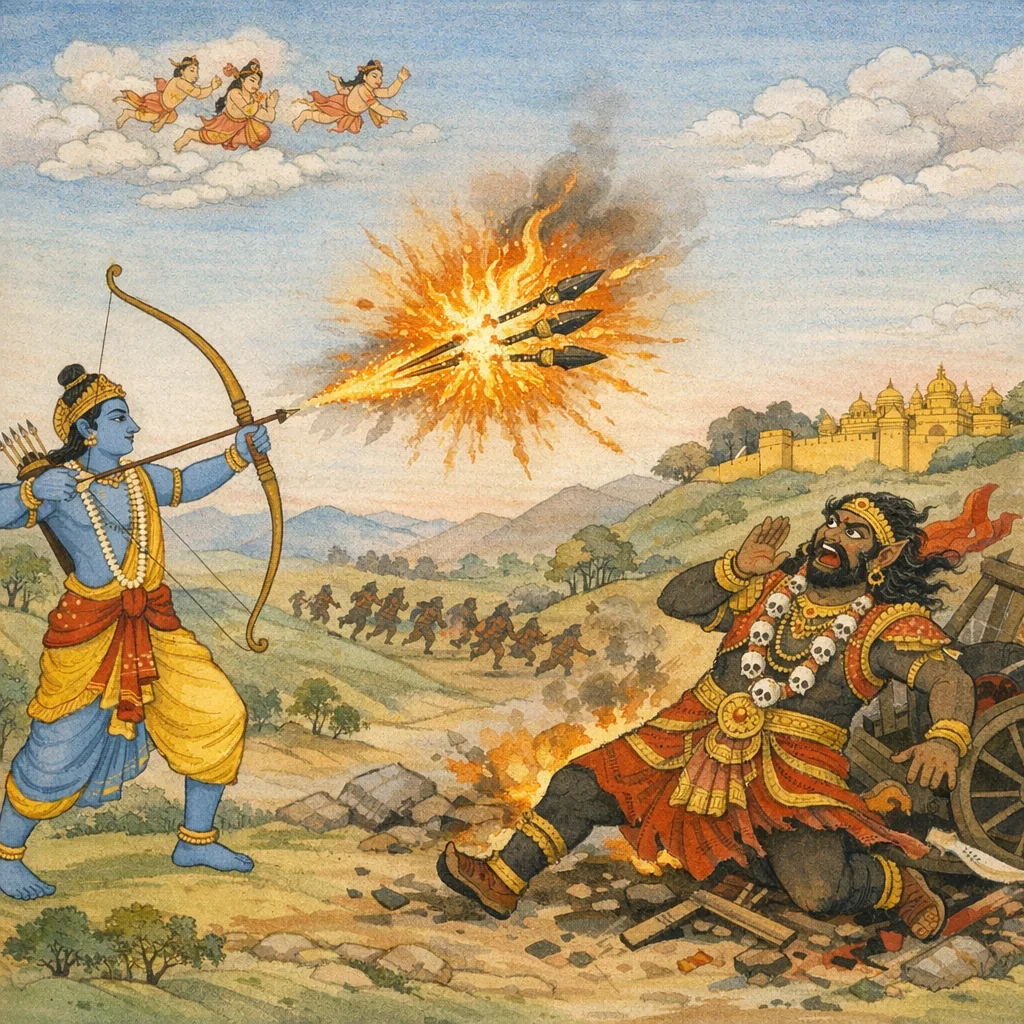
Sarga 79 stages a concentrated duel episode within the wider Laṅkā war. After Makarākṣa (identified as Khara’s son) appears, Vānara leaders rally and prepare for combat as a broader Vanara–Rākṣasa battle erupts with trees, rocks, and weapon volleys. Makarākṣa challenges Rāma to a direct duel, invoking inherited grievance from Daṇḍakāraṇya and escalating with threats of dispatching Rāma to Yama’s realm. Rāma counters the rhetoric by rejecting victory-by-speech and recalls the earlier destruction of Khara’s forces, reframing the encounter as proof through action. A high-intensity exchange of arrow volleys follows, described through atmospheric sound imagery and the attention of celestial beings. Rāma breaks Makarākṣa’s chariot and forces him to fight on foot; the Rākṣasa then seizes a terrifying Rudra-given flaming śūla (pike), likened to a cosmic destruction-weapon, causing even gods to panic. Rāma splits the airborne śūla with three arrows; praised by beings in the sky, he then fixes the Pāvaka-astra and strikes Makarākṣa, who falls with his heart split. Witnessing their commander’s fall, the Rākṣasas retreat toward Laṅkā in fear of Rāma’s arrows.
Shlokas
Verse 1
निर्गतंमकराक्षंतेदृष्टवावानरपुङ्गवाः ।आप्लुत्यसहसासर्वेयोद्धुकामाव्यवस्थिताः ।।।।
Seeing Makarākṣa emerge, those foremost of vānaras leapt up at once and took their positions, eager to fight.
Verse 2
ततःप्रवृत्तंसुमहत्तद्युद्धंरोमहर्षणम् ।निशाचरैःप्लवङ्गानांदेवानांदानवैरिव ।।।।
Then a vast and hair-raising battle broke out between the night-rangers (Rākṣasas) and the Vanaras—like the ancient clash of Devas and Dānavas.
Verse 3
वृक्षशूलनिपातैश्चशिलापरिघपातनैः ।अन्योन्यंमर्दयन्तिस्मतदाकपिनिशाचराः ।।।।
Then the monkeys and the rākṣasas battered one another—hurling down trees and pikes, and crashing rocks and clubs upon each other.
Verse 4
शक्तिखडगगदाकुन्तैस्तोमरैश्चनिशाचराः ।पट्टसैर्भिण्ढिपालैश्चबाणपातैःसमन्ततः ।।।।पाशमुद्गरदण्डैश्चनिखातैश्चापरेस्तथा ।कदनंकपिसिंहानांचक्रुस्तेरजनीचराः ।।।।
Hurling javelins, swords, maces, spears and lances—along with short blades, bhiṇḍipālas, showers of arrows, nooses, mallets, staffs, and other weapons—the night-rangers wrought slaughter among the lion-like monkeys on every side.
Verse 5
शक्तिखडगगदाकुन्तैस्तोमरैश्चनिशाचराः ।पट्टसैर्भिण्ढिपालैश्चबाणपातैःसमन्ततः ।।6.79.4।।पाशमुद्गरदण्डैश्चनिखातैश्चापरेस्तथा ।कदनंकपिसिंहानांचक्रुस्तेरजनीचराः ।।6.79.5।।
With javelins, swords, maces, spears, lances, short blades, bhiṇḍipālas, and showers of arrows—together with nooses, mallets, staffs, and other weapons—the night-rangers caused devastation among the lion-like monkeys all around.
Verse 6
बाणौघैरर्दिताश्चापिखरपुत्रेणवानराः ।सम्भ्रान्तमनसस्सर्वेदुद्रुवुर्भयपीडिताः ।।।।
Struck by volleys of arrows shot by Khara’s son, all the vānaras—terrified and shaken in mind—fled in fear.
Verse 7
तान्दृष्टवाराक्षसास्सर्वेद्रवमाणान्वलीमुखान् ।नेदुस्तेसिम्हवद्दृष्टाराक्षसाजितकाशिनः ।।।।
Seeing the vānaras fleeing, all the rākṣasas roared like lions, appearing as though they had already won.
Verse 8
विद्रवत्सुतदातेषुवानरेषुसमन्ततः ।रामस्तान्वारमायासशरवर्षेणराक्षसान् ।।।।
Then, as the vānaras scattered in flight on every side, Rama checked the rākṣasas by a rain of arrows.
Verse 9
रितान्राक्षसान्दृष्टवामकराक्षोनिशाचरः ।क्रोधानलसमाविष्टोवचनंचेदमब्रवीत् ।।।।
Seeing the rākṣasas checked, the night-roaming Makarākṣa—consumed by the fire of anger—spoke these words.
Verse 10
तिष्ठराम मयासार्धंद्वन्द्वयुद्धंददामिते ।त्याजयिष्यामितेप्राणान् धनुर्मुक्सैशशितैश्शरैः ।।।।
“Stand, Rāma! I offer you single combat with me. With sharp arrows loosed from my bow, I shall take away your life.”
Verse 11
यत्तदादण्डकारण्येपितरंहतवान्मम ।तदग्रतःस्वकर्मस्थंदृष्टवारोषोऽभिवर्धते ।।।।
“Because long ago in Daṇḍakāraṇya you slew my father—now, seeing you before me, present as the doer of that very deed, my wrath only increases.”
Verse 12
दह्यन्तेधृशमङ्गानिदुरात्मन्ममराघव ।यन्मयासि न दृष्टस्त्वंतस्मिन् कालेमहावने ।।।।
“My limbs burn fiercely, O Rāghava of evil intent, because at that time in the great forest I did not set eyes upon you.”
Verse 13
दिष्ट्यासिदर्शनंराम ममत्वंप्राप्तवानिह ।काङ्क्षितोऽसिक्षुधार्तस्यसिंहस्येवेतरोमृगः ।।।।
“Fortune has brought you into my sight here, O Rāma. You are the one I have longed for—like a different beast awaited by a hungry lion.”
Verse 14
अद्यमद्बाणवेगेनप्रेतराडिवषयंगतः ।येत्वयानिहताःशूराःसहतैश्चसमेष्यसि ।।।।
“Today, driven by the speed of my arrows, you will go to the realm of Yama, and you will join those warriors whom you have slain.”
Verse 15
बहुनात्रकिमुक्तेनशृणुराम वचोमम ।पश्यन्तुसकलालोकास्त्वा, मांचैवरणाजिरे ।।।।
“Why say more? Hear my words, Rāma: let all the worlds look on—upon you and upon me—here on the field of battle.”
Verse 16
अस्त्रैर्वागदयावापिबाहुभ्यांवामहाहवे ।अभ्यस्तंयेनवाराम तेनैवयुधिवर्तताम् ।।।।
“Whether with missiles, or with a mace, or even with bare arms—O Rāma—fight in this great combat with whatever you are most practiced in.”
Verse 17
मकराक्ष्वचश्श्रुत्वारामोदशरथात्मजः ।अब्रवीत्प्रहसन्वाक्यमुत्तरोत्तरवादिनम् ।।।।
Hearing Makarākṣa’s words, Rāma—the son of Daśaratha—smiled and replied to him, who kept speaking in ever more heated retorts.
Verse 18
कत्थसेकिंवृथारक्षो बहून्यसदृशानिते ।न रणेशक्यतेजेतुंविनायुद्धेनवाग्भलात् ।।।।
“Why do you boast so vainly, O Rākṣasa, speaking so many impossibilities? On the battlefield, victory cannot be won by the mere force of words—without true fighting.”
Verse 19
चतुर्दशसहस्राणिरक्षसांत्वत्पिता च यः ।त्रिशिरादूषणश्चापिदण्डकेनिहतामया ।।।।
“In Daṇḍaka, fourteen thousand Rākṣasas—and your father as well—together with Triśiras and Dūṣaṇa, were slain by me.”
Verse 20
स्वाशितास्तवमांसेनगृध्रगोमायुवायसाः ।भविष्यन्त्यद्यवैपाप तीक्ष्णतुण्डनखाङ्कुराः ।।।।
“Indeed, today, O sinner, vultures, jackals, and crows—sharp-beaked and clawed—will be filled with your flesh.”
Verse 21
राघवेणैवमुक्तस्तुमकराक्षोमहाबलः ।बाणौघानमुचत्तस्मैराघवायरणाजिरे ।।।।
Thus addressed by Rāghava on the battlefield, the mighty Makarākṣa loosed a dense volley of arrows at Rāma.
Verse 22
तान्शरान् शरवर्षेणरामश्चिच्छेदनैकधा ।निपेतुर्भुवितेछिन्नारुक्मपुङ्खास्सहस्रशः ।।।।
Rāma, with a counter-rain of arrows, cut those shafts into many pieces; the golden-feathered arrows fell to the earth in thousands of fragments.
Verse 23
तद्युद्धमभवत्तत्रसमेत्यान्योन्यमोजसा ।खरराक्षसपुत्रस्यसूनोर्धशरथस्य च ।।।।
There, when they came face to face, a fierce combat arose between the son of Khara and the son of Daśaratha.
Verse 24
जीमूतयोरिवाकाशेशब्दोज्यातलयोस्तदा ।धनुर्मुक्तःस्वनोत्कृष्टश्श्रूयते च रणाजिरे ।।।।
Then, on that battlefield, the taut twang—released from the bows by the hands and bowstrings—was heard in the sky like the thunder of clouds.
Verse 25
देवदानवगन्धर्वाःकिन्नराश्चमहोरगाः ।अन्तरिक्षगतास्सर्वेद्रष्टुकामास्तदद्भुतम् ।।।।
Devas, Dānavas, Gandharvas, Kinnaras, and mighty serpents—all stationed in the sky—gathered there, eager to witness that astonishing event.
Verse 26
विद्धमन्योन्यगात्रेषुद्विगुणंवर्धतेपरम् ।कृतप्रतिकृतान्योन्यंकुरुतांतौरणाजिरे ।।।।
Though their bodies were pierced again and again, their ardor only rose—redoubling—on the battlefield, as each answered the other’s blows with blows in return.
Verse 27
राममुक्तांस्तुबाणौघान् राक्षसस्त्वच्छिनद्रणे ।रक्षोमुक्तांस्तुरामोवैनैकथाप्राच्छिनच्छरैः ।।।।
In the clash of battle, the rākṣasa cut down the volleys of arrows released by Rāma; and Rāma, in turn, shattered the missiles released by the rākṣasa in manifold ways with his own shafts.
Verse 28
बाणौघैर्विततास्सर्वादिशश्चप्रदिशस्तथा ।सञ्छन्नावसुधाचैवसमन्तान्नप्रकाशते ।।।।
All the directions and intermediate quarters were spread over with torrents of arrows; the very earth, covered on every side, could scarcely be seen.
Verse 29
तःक्रुद्धोमहाबाहुर्धनुच्शिच्छेदरक्षसः ।अष्टाभिरथनाराचैस्सूतंविव्याधराघवः ।।।।
Then the mighty-armed Rāghava, enraged, cut the rākṣasa’s bow; and with eight steel-shafted arrows he struck the charioteer as well.
Verse 30
भित्त्वारथंशरैरामोहत्वाआश्वानपातयत् ।विरथोवसुधास्थश्चमकराक्षोनिशाचरः ।।।।
Rāma shattered the chariot with his arrows, slew the horses, and brought them down; and Makarākṣa, the night-roaming rākṣasa, left without a chariot, stood upon the ground.
Verse 31
तत्तिष्ठद्वसुधांरक्षश्शूलंजग्राहपाणिना ।त्रासनंसर्वभूतानांयुगान्ताग्निसमप्रभम् ।।।।
Standing there upon the earth, the rākṣasa seized a pike in his hand—an object of terror to all beings—blazing like the fire at the world’s end.
Verse 32
दुरवापम् महच्छूलंरुद्रदत्तंभयङ्करम् ।जाज्वल्यमानमाकाशेसंहारास्त्रमिवापरम् ।।।।यंदृष्टवादेवताःसर्वाभयार्ताविद्रुतादिशः ।
A great pike—hard to withstand, bestowed by Rudra, terrifying—blazed in the sky like yet another weapon of annihilation. Seeing it, all the gods, stricken with fear, fled toward the quarters.
Verse 33
विभ्राम्यतुमहच्छूलंप्रज्वलन्तन्निशाचरः ।।।।स क्रोधाप्राहिणोत्तस्मैराघवायमहात्मने ।
Whirling that great, blazing pike, the night-roaming rākṣasa, in fury, hurled it at the great-souled Rāghava.
Verse 34
तमापतन्तंज्वलितंखरपुत्रकराच्च्युतम् ।।।।बाणैत्रिभिराकाशेशूलंचिच्छेदराघवः ।
Rāghava cleft in mid-air, with three arrows, the blazing pike that had been hurled from the hand of Khara’s son as it came flying toward him.
Verse 35
सच्छन्नोनैकथाशूलोदिव्यहाटकमण्डितः ।।।।व्यशीर्यतमहोल्केवरामबाणार्दितोभुवि ।
Struck by Rāma’s arrows, that gold-adorned pike shattered into many pieces and dropped to the ground like a great burning brand breaking apart.
Verse 36
च्छूलंनिहतंदृष्टवारामेणाक्लिष्टकर्मणा ।।।।साधुसावधितिभूतानिव्याहरन्तिनभोगताः ।
Seeing the pike destroyed by Rāma of tireless action, the beings in the sky cried out in praise, “Well done! Well done!”
Verse 37
तंदृष्टवानिहतंशूलंमकराक्षोनिशाचरः ।।।।मुष्टिमुद्यम्यकाकुत्स्थंतिष्ठतिष्ठेतिचाब्रवीत् ।
When the night-ranger Makarākṣa saw his pike destroyed, he raised his fist and shouted to Kakutstha, “Stand! Stand!”
Verse 38
सःतंदृष्टवाऽपतन्तंवैप्रहस्यरघुनन्दनः ।।।।पावकास्त्रंततोरामस्सन्दधेतुशरासने ।
Seeing him rushing in, Rāma—delight of the Raghu line—smiled, and then set the Fire-missile upon his bow.
Verse 39
तेनास्त्रणहतंरक्षःकाकुत्थ्सेनतदारणे ।।।।सञ्चिन्नहृदयंतत्रपपात च ममार च ।
Struck down in battle by that weapon of Kakutstha, the rākṣasa fell there with his heart cleft and died.
Verse 40
दृष्टवातेराक्षसास्सर्वेमकराक्षस्यपातनम् ।।।।लङ्कामेवप्रधावन्तरामबाणभयार्दिताः ।
When they saw Makarākṣa fall, all those rākṣasas—terrified of Rāma’s arrows—fled straight back to Laṅkā.
Verse 41
दशरथनृपसूनुबाणवेगैःरजनिचरंनिहतंखरात्मजंतम् ।ददृशुरथदेवताःप्रहृष्टागिरिमववज्रहतंक्षितौकीर्णम् ।।।।
Then the gods, rejoicing, beheld that night-ranger—Khara’s son—slain by the force of the arrows of Daśaratha’s son, shattered upon the earth like a mountain struck by a thunderbolt.
Frequently Asked Questions
The chapter contrasts boastful threat-speech with accountable battlefield conduct: Makarākṣa seeks to establish dominance through intimidation and vendetta, while Rāma insists that victory is determined by disciplined action in combat, not by rhetorical force.
The dialogue teaches that anger and inherited grievance, when absolutized, distort judgment; principled restraint and clarity of purpose govern legitimate force. Rāma’s response models measured confidence: words are secondary to ethical agency and demonstrable capability.
Daṇḍakāraṇya is cited as the earlier theater of conflict motivating Makarākṣa’s grievance, and Laṅkā functions as the immediate strategic center to which the Rākṣasas retreat. The reference to Yama’s realm frames the duel within a culturally legible horizon of death, judgment, and consequence.