Sarga 77
निकुम्भवधः — The Slaying of Nikumbha (Hanuman’s Duel)
युद्धकाण्ड
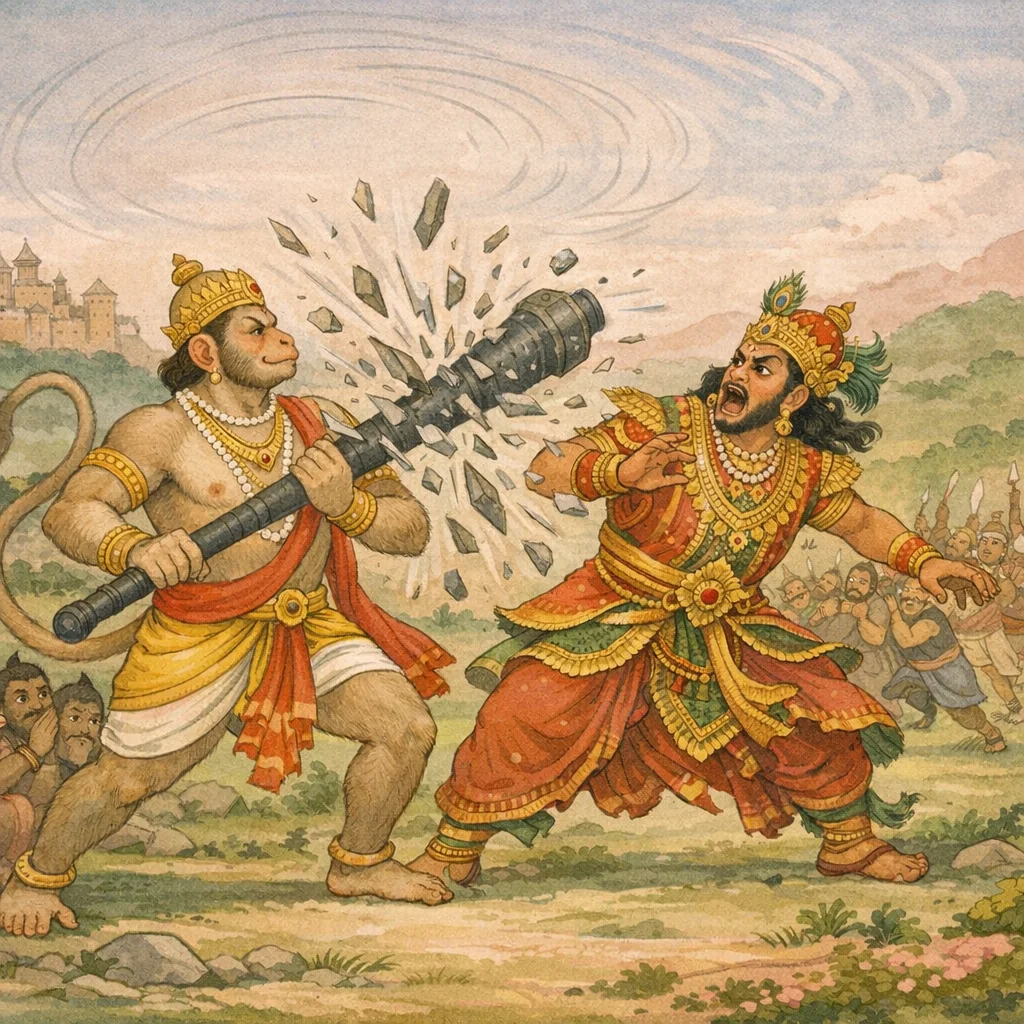
Sarga 77 stages a focused battlefield episode in which Nikumbha, enraged after seeing his brother felled by Sugrīva, confronts the vanara leadership with a terrifying display of weaponry and ornamented martial splendor. He arms himself with an auspicious parigha (iron club) likened to the peak of Mahendra, roaring and whirling it so violently that the sky is described as revolving—an epic simile intensifying psychological warfare. The armies on both sides momentarily freeze in fear, establishing a tactical pause that highlights morale as a factor in combat. Hanumān alone stands firm, presenting his chest; Nikumbha’s club shatters into splinters upon impact, underscoring Hanumān’s superhuman steadiness and the futility of brute force against disciplined strength. Hanumān retaliates with a decisive fist-blow, then endures being seized and carried, striking again while restrained. Regaining freedom, he hurls Nikumbha down, leaps upon his chest, and breaks his neck with a forceful twist, ending the duel. The vanaras exult; fear spreads through the rākṣasa ranks, and the narrative transitions toward intensified conflict involving Rāma and a rākṣasa champion (Makara), signaling escalation after the commander’s fall.
Shlokas
Verse 1
निकुम्भोभ्रातरंदृष्टवासुग्रीवेणनिपातितम् ।प्रदहन्निवकोपेनवानरेन्द्रमवैक्षत ।।।।
Nikumbha, seeing his brother struck down by Sugrīva, fixed his gaze upon the Vānara-king in wrath, as though he would burn him with it.
Verse 2
ततस्स्रग्दामसन्नद्धंदत्तपञ्चाङ्गुलंशुभम् ।आददेपरिघंवीरोमहेन्द्रशिखरोपमम् ।।।।
Then the hero Nikumbha, adorned with a garland and taking up an auspicious iron club—five fingers in breadth—seized a weapon like the peak of Mount Mahendra.
Verse 3
हेमपट्टपरिक्षिप्तंवज्रविद्रुमभूषितम् ।यमदण्डोपमंभीमंरक्षसांभयनाशनम् ।।।।
It was bound with a golden band, adorned with diamond and coral, dreadful like Yama’s rod, and a fear-dispelling weapon for the rākṣasas.
Verse 4
तमाविध्यमहातेजाश्शक्रध्वजसमंतदा ।निननादविवृत्तास्योनिकुम्भोभीमविक्रमः ।।।।
Then Nikumbha, of dreadful prowess, roaring with mouth wide open, brandished that splendid weapon—like Indra’s banner—and struck forth with force.
Verse 5
उरोगतेननिष्केणभुजस्थैरङ्गदैरपि ।कुण्डलाभ्यां च चित्राभ्यांमालया च विचित्रया ।।।।निकुम्भोभूषणैर्भातितेनस्मपरिघेण च ।यथेन्द्रधनुषामेघस्सविद्युत्स्तनयित्नुमान् ।।।।
Nikumbha shone with ornaments— a golden breast-plate, armlets upon his arms, splendid earrings, and a variegated garland—while holding his iron club; he looked like a cloud lit by lightning and thunder, arched with Indra’s rainbow.
Verse 6
उरोगतेननिष्केणभुजस्थैरङ्गदैरपि ।कुण्डलाभ्यां च चित्राभ्यांमालया च विचित्रया ।।6.77.5।।निकुम्भोभूषणैर्भातितेनस्मपरिघेण च ।यथेन्द्रधनुषामेघस्सविद्युत्स्तनयित्नुमान् ।।6.77.6।।
Nikumbha shone with ornaments— a golden breast-plate, armlets upon his arms, splendid earrings, and a variegated garland—while holding his iron club; he looked like a cloud lit by lightning and thunder, arched with Indra’s rainbow.
Verse 7
परिघाग्रेणपुष्पोटवातग्रथनिर्महात्मनः ।प्रजज्वालसघोषश्चविधूमइवपावकः ।।।।
As that great warrior whirled the iron club, a bursting clash of winds arose; it flared with a crashing sound like smokeless fire.
Verse 8
नगर्याविटपावत्यागन्धर्वभवनोत्तमैः ।सतारग्रहनक्षत्रंसचन्द्रंसमहाग्रहम् ।।।।निकुम्भपरिघाघूर्णंभ्रमतीवनभस्थ्सलम् ।
The sky—adorned as though it held the city of Viṭapavatī with splendid Gandharva-mansions, and filled with stars, constellations, the moon, and the great planets—seemed to whirl around, as if set spinning by Nikumbha’s revolving iron club.
Verse 9
दुरासदश्चसञ्जज्ञेपरिघाभरणप्रभः ।।।।कपीनांसनिकुम्भाग्निर्युगान्ताग्निरिवोत्थितः ।
His radiance—flaring from the iron club and his ornaments—became unapproachable; for the Vānara hosts, Nikumbha blazed up like the fire that rises at the end of an age.
Verse 10
राक्षसावानराश्चापि न शेकुस्स्पन्दितुंभयात् ।।।।हनूमांस्तुविवृत्योरस्तस्थौतस्याग्रतोबली ।
Rākṣasas—and even the Vānaras—could not so much as stir from fear; but mighty Hanumān, baring his chest, stood firm before him.
Verse 11
परिघोपमबाहुस्तुपरिघंभास्करप्रभम् ।।।।बलीबलवतस्तस्यपातयामासवक्षसि ।
That mighty rākṣasa—whose arms were like iron bars—brought down his sun-bright iron club upon the chest of the powerful Hanumān.
Verse 12
स्थिरेतस्योरसिव्यूढेपरिघश्शतधाकृतः ।।।।विकीर्यमाणस्सहसाउल्काशतमिवाम्बरे ।
The moment it struck his broad and firm chest, the iron club shattered into a hundred pieces, scattering at once like a hundred meteors across the sky.
Verse 13
स तुतेनप्रहारेणविचचालमहाकपिः ।।।।परिघेणसमाधूतोयथाभूमिचलेऽचलः ।
Though struck and shaken by that blow of the iron club, the great monkey remained unmoved—steady like a mountain even when the earth quakes.
Verse 14
तथाभिहतस्तेनहनुमान् प्लवगोत्तमः ।।।।मुष्टिंसम्वर्तयामासबलेनातिमहाबलः ।
Thus struck, Hanumān—the foremost of the monkeys, of immense strength—tightened his fist with all his might.
Verse 15
तमुद्यम्यमहातेजानिकुम्भोरसिवीर्यवान् ।।।।अभिचिक्षेपवेगेनवेगवान् वायुविक्रमः ।
Then the radiant and valiant Hanumān—swift as the Wind—raised his fist and hurled it with speed onto Nikumbha’s chest.
Verse 16
ततःपुस्फोटचर्मास्यप्रसुस्राव च शोणितम् ।।।।मुष्टिनातेनसञ्जज्ञेमेघेविद्युदिवोत्थिता ।
Then his skin split and blood began to flow; from that blow of the fist it appeared like lightning flashing forth from a cloud.
Verse 17
सःतुतेनप्रहारेणनिकुम्भोविचचाल ह ।।।।स्वस्थश्चापिनिजग्राहहनूमन्तंमहाबलम् ।
Yet by that blow Nikumbha did not give way; regaining himself, he seized the mighty Hanumān.
Verse 18
चुक्रुशुस्तदासङ्ख्येभीमंलङ्कानिवासिनः ।।।।निकुम्भेनोद्यतंदृष्टवाहनूमन्तंमहाबलम् ।
Then, in the midst of battle, the residents of Laṅkā cried out fearfully on seeing the mighty Hanumān lifted up by Nikumbha.
Verse 19
तदाह्रियमाणोऽपिकुम्भकर्णात्मजेन ह ।।।।आजघानानिलसुतोवज्रकल्पेनमुष्टिना ।
Even as he was being carried off by Kumbhakarṇa’s son, the son of the Wind struck him with a fist hard as a thunderbolt.
Verse 20
आत्मानंमोक्षयित्वाथक्षितावभ्यवपद्यत ।।।।हनूमानुन्ममाथाशुनिकुम्भंमारुतात्मजः ।
Then Hanumān, the Wind-god’s son, freeing himself, sprang onto the ground and at once began to assail Nikumbha fiercely.
Verse 21
निक्षिप्यपरमायत्तोनिकुम्भंनिष्पिपेष ह ।।।।उत्पत्यचास्यवेगेनपपातोरसिवीर्यवान् ।
With immense exertion he hurled Nikumbha down and crushed him; then, springing up with speed, the mighty one fell upon his chest.
Verse 22
परिगृह्य च बाहुभ्यांपरिवृत्यशिरोधराम् ।।।।उत्पाटयामानशिरोभैरवंनदतोमहत् ।
Seizing him with both arms and wrenching his neck around, Hanumān tore off his head, as Nikumbha cried out terribly and loudly.
Verse 23
अथनिनदतिसादितेनिकुम्भेपवनसुतेनरणेबभूवयुद्धम् ।दशरथसुतराक्षसेन्द्रसून्वोर्भृशतरमागतरोषयोस्सुभीमम् ।।।।
Then, as Nikumbha—still crying out—was slain by the Wind-god’s son on the battlefield, a most dreadful and violent battle arose between Daśaratha’s son and the son of the rākṣasa-king, both inflamed with intense anger.
Verse 24
व्यपेतेतुजीवेनिकुम्भस्यहृष्टाविनेदुःप्लवङ्गादिशस्सस्वनुश्च ।चचालेवचोर्वीपफालेवचद्यौर्भयंराक्षसानांबलंचाविवेश ।।।।
When Nikumbha’s life had departed, the monkeys rejoiced and shouted, and the quarters resounded; the earth seemed to shake, the sky seemed to split, and fear seized the rākṣasa host.
Frequently Asked Questions
The pivotal action is Hanumān’s deliberate refusal to retreat when both armies are immobilized by fear; he absorbs the strike openly (showing his chest) and responds with measured, decisive force to neutralize a dangerous commander, reflecting duty-bound courage rather than reckless aggression.
Even without extended dialogue, the episode teaches that inner steadiness (dhairya) and trained strength can render intimidation ineffective; fear is shown as a collective contagion, while composure enables right action aligned with the larger dharmic objective.
The chapter uses landmark similes—Mahendra mountain, Indra’s banner and rainbow, and the celestial city Vitapavatī/Alakā—to scale the combat imagery; these references function as cultural indexing devices that place the duel within a cosmically resonant battlefield aesthetic.