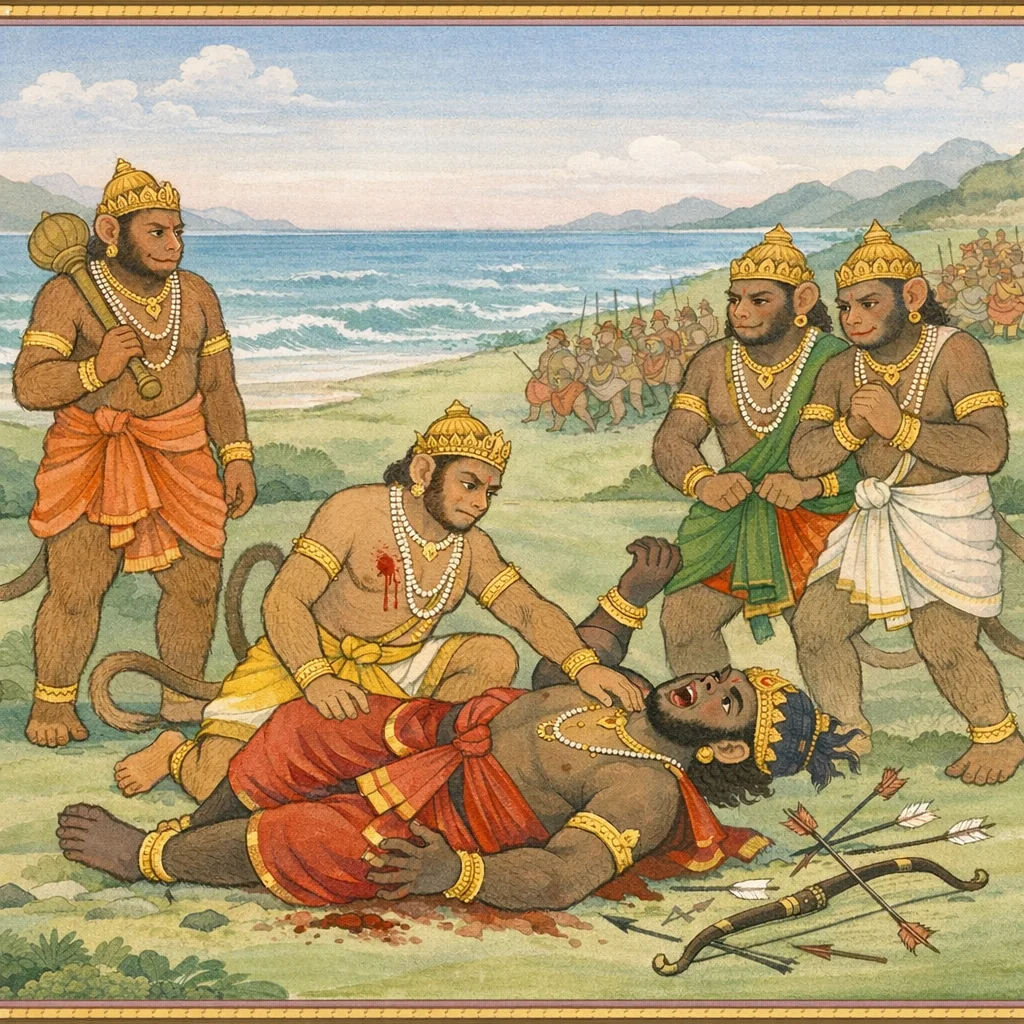
Sarga 76
युद्धे अङ्गद-मैन्द-द्विविद-राक्षसयुद्धम्; कुम्भस्य प्रादुर्भावः तथा सुग्रीवेण पराभवः (Sarga 76: Angada and the Vanara chiefs battle Kampana, Prajaṅgha, Yūpākṣa, Śoṇitākṣa; Kumbha enters and is checked by Sugrīva)
युद्धकाण्ड
Sarga 76 unfolds as an escalating sequence of duel-logic within mass combat. Angada, eager for battle amid “destruction of heroes,” engages Kampana; after being struck and reeling, he regains composure and kills Kampana with a mountain-peak blow. Śoṇitākṣa, with Prajaṅgha and Yūpākṣa, presses the attack; Angada’s maternal uncles, Mainda and Dvivida, form a protective screen, and a three-on-three engagement erupts, marked by improvised weapons (trees, rocks) and close-quarters disarmaments. Prajaṅgha is felled; Yūpākṣa is seized and ultimately killed by Mainda, while Dvivida mauls Śoṇitākṣa. The narrative then pivots to Kumbha (Kumbhakarṇa’s son), who restores Rākṣasa morale and shifts to archery, wounding Angada and forcing Rāma to order reinforcements (Jāmbavān, Suṣeṇa, Vegadarśī). Kumbha’s arrow-volley halts the Vānara advance until Sugrīva personally engages, breaks Kumbha’s bow, provokes him with strategic praise, and grapples him in an elephant-like clinch; after a dramatic ocean-throw and counterstrike, Sugrīva’s thunderous fist drops Kumbha, shaking the earth and intensifying fear in the Rākṣasa host. The chapter’s thematic lesson is leadership under crisis: protection of allies, morale repair, and the calibrated use of speech and force as battlefield instruments.
Shlokas
Verse 1
प्रवृत्तेसङ्कुलेतस्मिन् घोरेवीरजनक्ष्ये ।अङ्गदःकम्पनंवीरमाससादरणोत्सुकः ।।।।
As that fierce and tangled combat raged on—bringing about the destruction of many heroes—Aṅgada, eager for battle, closed upon the valiant Kampana.
Verse 2
आहूयसोङ्गदंकोपात्ताडयामासवेगितः ।गदयाकम्पनःपूर्वं स चचालभृशाहतः ।।।।
Challenging Aṅgada, Kampana in anger struck swiftly with his mace; and Aṅgada, grievously hit, reeled from the blow.
Verse 3
स संज्ञांप्राप्यतेजस्वीचिक्षेपशिखरंगिरेः ।अर्दितस्तत्प्रहारेणकम्पनःपतितोभुवि ।।।।
The radiant Angada, regaining consciousness, hurled a mountain-peak; struck and crushed by that blow, Kampana fell to the ground.
Verse 4
ततस्तुकम्पनंदृष्टवाशोणिताक्षोहतंरणे ।रथेनाभ्यपतत् क्षिप्रंतत्राङ्गदमभीतवत् ।।।।
Then, seeing Kampana slain in battle, Śoṇitākṣa—fearless—rushed swiftly by chariot to the place where Aṅgada stood.
Verse 5
सोङ्गदंनिशितैर्बाणैस्तदाविव्याधवेगितः ।शरीरदारणैस्तीक्ष्णैःकालाग्निसमविग्रहैः ।।।।क्षुरक्षुरप्रैर्नाराचैर्वत्सदन्तैश्शिलीमुखैः ।कर्णिशल्यविपाठैश्चबहुभिश्चशितैश्शरैः ।।।।
Then, moving swiftly, he pierced Aṅgada with sharp arrows—body-rending, fierce as the fire of dissolution—using many kinds of shafts: kṣura, kṣurapra, nārāca, vatsadanta, śilīmukha, karṇi, śalya, vipāṭa, and numerous other keen missiles.
Verse 6
सोङ्गदंनिशितैर्बाणैस्तदाविव्याधवेगितः ।शरीरदारणैस्तीक्ष्णैःकालाग्निसमविग्रहैः ।।6.76.5।।क्षुरक्षुरप्रैर्नाराचैर्वत्सदन्तैश्शिलीमुखैः ।कर्णिशल्यविपाठैश्चबहुभिश्चशितैश्शरैः ।।6.76.6।।
Then, moving swiftly, he struck Angada with sharp arrows—keen, body-rending, like the blazing fire of dissolution—using many kinds of shafts: kṣura, kṣurapra, nārāca, vatsadanta, śilīmukha, karṇi, śalya, vipāṭha, and numerous other razor-edged missiles.
Verse 7
अङ्गदःप्रतिविद्धाङ्गोवालिपुत्रःप्रतापवान् ।धनुरग्य्रंरथंबाणान्ममर्दतरसाबली ।।।।
Vali’s courageous son Aṅgada—though his body had been struck—surged forward with force and smashed the formidable bow, the chariot, and the arrows (of his foe).
Verse 8
शोणिताक्षस्ततःक्षिप्रमसिचर्मसमाददे ।उत्पपातदिवंक्रुद्धोवेगवानविचारयन् ।।।।
Thereupon Śoṇitākṣa swiftly took up sword and shield, and—enraged—leapt into the sky with great speed, without hesitation.
Verse 9
तंक्षिप्रतरमाफ्लुत्यपरामृश्याङ्गदोबली ।करेणतस्यतंखङ्गंसमाच्छिद्यननाद च ।।।।
Leaping up even more swiftly, the mighty Aṅgada seized him, and with his hand struck down that sword of his—then roared aloud.
Verse 10
तस्यांसफलकेखडगंनिजघानततोऽङ्गदः ।यज्ञोपवीतवच्चैनंचिच्छेदकपिकुञ्जरः ।।।।
Then Aṅgada drove his sword into the broad plate of the enemy’s shoulder; and that elephant among monkeys cut him through, as though along the line of a sacred thread.
Verse 11
तंप्रगृह्यमहाखडगंविनद्य च पुनःपुनः ।वालिपुत्रोऽभिदुद्रावरणशीर्षेपरानरीन् ।।।।
Seizing that great sword and roaring again and again, Vāli’s son rushed forward at the forefront of battle against the enemy foes.
Verse 12
आयसींतुगदांप्रगृह्य स वीरःकनकाङ्गदः ।शोणिताक्षस्समाविध्यतमेवानुपपात ह ।।।।
But Śoṇitākṣa—the hero adorned with golden armlets—grasped an iron mace, took aim, and rushed after him to strike.
Verse 13
प्रजङ्घसहितोवीरोयूपाक्षस्तुततोबली ।रथेनाभिययौक्रुद्दोवालिपुत्रंमहाबलम् ।।।।
Then the mighty hero Yūpākṣa—together with Prajaṅgha—angrily drove up in his chariot and attacked Vāli’s immensely powerful son.
Verse 14
तयोर्मध्येकपिश्रेष्ठश्शोणिताक्षप्रजङ्घयोः ।विशाखयोर्मध्यगतःपूर्णचन्द्रइवाभवत् ।।।।
Between those two—Śoṇitākṣa and Prajaṅgha—the foremost of monkeys stood shining, like the full moon set between the Viśākhā stars.
Verse 15
अङ्गदंपरिरक्षन्तौमैन्दोद्विविदएव च ।तस्यतस्थतुरभ्याशेपरस्परदिदृक्ष्या ।।।।
Mainda and Dvivida stood close by, guarding Aṅgada and keeping watch on each other as they faced the enemy at close quarters.
Verse 16
भिपेतुर्महाकायाःप्रतियत्तामहाबलाः ।राक्षसावानरान् रोषादसिचर्मगदाधराः ।।।।
Huge-bodied, immensely strong Rākṣasas—alert and enraged—rushed upon the Vānaras, bearing swords, shields, and maces.
Verse 17
त्रयाणांवानरेन्द्राणांत्रिभीराक्षसपुङ्गवैः ।संसक्तानांमहद्युद्धमभवद्रोमहर्षणम् ।।।।
As the three Vānara chiefs and the three foremost Rākṣasas closed in combat, a great battle arose—one that made the onlookers shudder with awe.
Verse 18
तेतुवृक्षान् समादायसम्प्रचिपुराहवे ।खडगेनप्रतिचिच्छेदतान् प्रजङ्घोमहाबलः ।।।।
Then, in the thick of battle, they seized trees and hurled them; but the mighty Prajaṅgha cut them down with his sword.
Verse 19
रथानश्वान् द्रुमैश्शैलैस्तेप्रचिक्षिपुराहवे ।शरौघैःप्रतिचिच्छेदतान्यूपाक्षोनिशाचरः ।।।।
In that battle they hurled trees and rocks at chariots and horses; the night-roamer Yūpākṣa cut them apart with volleys of arrows.
Verse 20
सृष्टाव्निविदमैन्दाभ्यांद्रुमानुत्पाट्यवीर्यवान् ।बभञ्जगदयामध्येशोणिताक्षःप्रतापवान् ।।।।
Valiant Śoṇitākṣa tore up the trees hurled by Dvivida and Mainda, and with his mace smashed them in mid-course.
Verse 21
उद्यम्यविपुलंखडगंपरमर्मनिकृन्तनम् ।प्रजङ्घोवालिपुत्रायअभिदुद्राववेगितः ।।।।
Lifting a massive sword, keen to cleave vital points, Prajaṅgha charged swiftly at Vāli’s son, Aṅgada.
Verse 22
तमभ्याशगतंदृष्टवावानरेन्द्रोमहाबलः ।आजघानाश्वकर्णेनद्रुमेणातिबलस्तदा ।।।।
Seeing him rush in close, the mighty Vānara leader struck at once with an aśvakarṇa tree, wielding tremendous power.
Verse 23
बाहुंचास्यसनिस्त्रिंशमाजघान स मुष्टिना ।वालिपुत्रस्यघातेन स पपातक्षितावसिः ।।।।
With his fist, Vāli’s son struck the opponent’s arm that held the sword; by Aṅgada’s blow the sword fell to the ground.
Verse 24
तंदृष्टवापतितंभूमौखङ्गमुलसन्निभम् ।मुष्टिंसम्वर्तयामासवज्रकल्पंमहाबलः ।।।।
Seeing the pestle-like sword lying fallen on the ground, the mighty one clenched his fist, hard as a thunderbolt, readying himself for the next blow.
Verse 25
स ललाटेमहावीर्यमङ्गदंवानरर्षभम् ।आजघानमहातेजास्समुहूर्तंचचाल ह ।।।।
That radiant warrior struck the mighty Angada, bull among the Vānara hosts, on the forehead; and for a brief while Angada reeled, stunned by the blow.
Verse 26
स संज्ञांप्राप्यतेजस्वीवालिपुत्रःप्रतापवान् ।प्रजङ्घस्यशिरःकायातखङ्गेनपातयत्क्षितौ ।।।।
Regaining his senses, the radiant and formidable son of Vāli struck with his sword and severed Prajaghna’s head from his body, casting it down upon the earth.
Verse 27
स यूपाक्षोऽश्रुपूर्णाक्षःपितृव्येनिहतेरणे ।अवरुह्यरथात्क्षिप्रंक्षीणेषुखङ्गमाददे ।।।।
Yūpākṣa, his eyes brimming with tears at his uncle’s fall in battle, quickly descended from his chariot and, when his missiles were spent, took up his sword.
Verse 28
तमापतन्तंसम्प्रेक्ष्ययूपाक्षंद्विविदस्त्वरन् ।आजघानोरसिक्रुद्धोजग्राह च बलाद्बली ।।।।
Seeing Yūpākṣa rushing in, Dvivida quickly met him; enraged, he struck him on the chest and seized him with overpowering force.
Verse 29
गृहीतंभ्रातरंदृष्टवाशोणिताक्षोमहाबलः ।आजघानगदाग्रेणवक्षसिद्विविदंततः ।।।।
Then, seeing his brother seized, the mighty Śoṇitākṣa struck Dvivida on the chest with the head of his mace.
Verse 30
स गदाभिहतस्तेनसञ्चचालमहाबलः ।उद्यता च पुनस्तस्यजहारद्विविदोगदाम् ।।।।
Though mighty, Dvivida reeled when struck by that mace; yet he recovered, and once again snatched away his opponent’s upraised mace.
Verse 31
तस्मिन्नन्तरेमैन्दोवीरोवानरयूथपः ।यूपाक्षंताडयामासतलेनोरसिवीर्यवान् ।।।।
In the meantime, Mainda—the valiant leader of the Vānara troops—struck Yūpākṣa on the chest with his palm.
Verse 32
तौशोणिताक्ष्यूपाक्षौप्लवङ्गाभ्यांतरस्विनौ ।चक्रतुस्समरेतीव्रमाकर्षोत्पाटनंभृशम् ।।।।
Then Śoṇitākṣa and Yūpākṣa—both fierce and impetuous—engaged the two Vānara warriors in a brutal grapple in battle, violently dragging and wrenching one another.
Verse 33
द्विविदश्शोणिताक्षंतुविददारनखैर्मुखै ।निष्पिपेष च वेगेनक्षितावाविध्यवीर्यवान् ।।।।
Valiant Dvivida tore Śoṇitākṣa across the face with his nails and teeth; then, gathering speed, he hurled him down upon the earth and crushed him.
Verse 34
पाक्षमभिसङ्कृद्धो मैन्दो वानरयूथपः ।पीडयामासबाहुभ्यांसपपातहतःक्षितौ ।।।।
Enraged, Mainda—the leader of the vānara host—pressed down and crushed Pākṣa with his arms, and Pākṣa fell dead upon the ground.
Verse 35
हतप्रवीराव्यथिताराक्षसेन्द्रचमूस्तदा ।जगामाभिमुखीसातुकुम्भकर्णसुतोयतः ।।।।
Then the army of the rākṣasa king—its champions slain and its ranks shaken—moved forward toward the place where Kumbhakarṇa’s son was engaged.
Verse 36
आपततनीं च वेगेनकुम्भस्तांसान्त्वयच्चमूम् ।अथोत्कष्टंमहावीर्यैर्लब्धलक्ष्यैःप्लवङ्गमैः ।।।।निपातितमहावीरांदृष्टवारक्षश्चमूंततः ।कुम्भःप्रचक्रेतेजस्वीरणेकर्मसुदुष्करम् ।।।।
Kumbha swiftly reassured the faltering rākṣasa troops. Then, seeing their great heroes struck down by the powerful vānara warriors who had found their mark, the radiant Kumbha seized the moment and undertook, on the battlefield, a deed exceedingly hard to accomplish.
Verse 37
आपततनीं च वेगेनकुम्भस्तांसान्त्वयच्चमूम् ।अथोत्कष्टंमहावीर्यैर्लब्धलक्ष्यैःप्लवङ्गमैः ।।6.76.36।।निपातितमहावीरांदृष्टवारक्षश्चमूंततः ।कुम्भःप्रचक्रेतेजस्वीरणेकर्मसुदुष्करम् ।।6.76.37।।
Kumbha swiftly reassured the wavering rākṣasa troops; and seeing their mighty heroes felled by the powerful vānara warriors who had gained the advantage, the radiant Kumbha set in motion, in battle, an undertaking of extreme difficulty.
Verse 38
स धनुर्धन्विनांश्रेष्ठःप्रगृह्यसुसमाहितः ।मुमोचाशीविषप्रख्यान्शरान्देहविदारणान् ।।।।
He—the foremost among bowmen—took up his bow with perfect composure and released arrows like venomous serpents, capable of rending bodies apart.
Verse 39
तस्यतच्छुशुभेभूयस्सशरंधनुरुत्तमम् ।विद्युदैरावतार्चिष्मद्िद्वतीयेन्द्रधनुर्यथा ।।।।
Then his excellent bow, with arrows set upon it, shone all the more—gleaming like a raincloud lit by lightning—like a second rainbow of Indra.
Verse 40
आकर्णाकृष्टमुक्तेनजघानद्विविदंतदा ।तेनहाटकपुङ्खेनपत्रतिणापत्त्रवाससा ।।।।
Then he struck Dvivida with an arrow drawn back to the ear and released—an arrow with golden fletching and leaf-like wings, dispatched to kill.
Verse 41
सहसाभिहतस्तेनविप्रमुक्तपदस्स्फुरन् ।निपपाताद्रिकूटाभोविह्वलन् प्लवगोत्तमः ।।।।
Struck suddenly by him, Dvivida—the foremost of the vānara warriors—trembled, his legs giving way, and fell down like a mountain peak, bewildered by the blow.
Verse 42
मन्दस्तुभ्रातरंभग्नंदृष्टवातत्रमहाहवे ।लभिदुद्राववेगेनप्रगृह्यमहतींशिलाम् ।।।।
Seeing his brother struck down in that great battle, Mainda swiftly rushed forward, seizing a massive rock.
Verse 43
तांशिलांतुप्रचिक्षेपराक्षसायमहाबलः ।बिभेदतांशिलांकुम्भःप्रसन्नैःपञ्चभिश्शरैः ।।।।
The mighty Mainda hurled that rock at the Rākṣasa; but Kumbha split the rock apart with five keen arrows.
Verse 44
सन्धायचान्यंसुमुखंशरमाशीविषोपमम् ।आजघानमहातेजावक्षसिद्विविदाग्रजम् ।।।।
Then the mighty Kumbha set another well-fashioned arrow, serpent-like in its deadly force, and struck Dvīvida’s elder brother on the chest.
Verse 45
स तुतेनप्रहारेणमैन्दोवानरयूथपः ।मर्मण्यभिहतस्तेनपपा त भुविमूर्छितः ।।।।
Struck by that blow at a vital spot, Mainda—the leader of the Vānara troop—fell to the ground, senseless.
Verse 46
अङ्गदोमातुलौदृष्टवापथितौतुमहाबलौ ।अभिदुद्राववेगेनकुम्भमुद्यतकार्मुकम् ।।।।
Seeing his two powerful maternal uncles fallen, Aṅgada rushed swiftly at Kumbha, who stood with bow raised.
Verse 47
तमापतन्तंविव्याधकुम्भःपञ्चभिरायसैः ।त्रिभिश्चान्यैश्शितैर्बाणैर्मातङ्गमिवतोमरैः ।।।।
As Aṅgada charged, Kumbha pierced him with five steel arrows and three other sharp shafts—like an elephant struck with lances.
Verse 48
सोऽङ्गदंविविधैभिर्बाणैःकुम्भोविव्याथवीर्यवान् ।अकुण्ठधारैर्निशितैस्तीक्ष्णैःकनकभूषणैः ।।।।
Valiant Kumbha struck Aṅgada with many kinds of arrows—sharp, keen-edged, and adorned with gold.
Verse 49
अङ्गदःप्रतिविद्धाङ्गोवालिपुत्रो न कम्पते ।शिलापादपवर्षाणितस्यमूर्ध्निववर्ष ह ।।।।
Though his body was pierced, Aṅgada—Vālin’s son—did not waver; he rained rocks and uprooted trees upon Kumbha’s head.
Verse 50
स प्रचिच्छेदतान् सर्वान् बिभेद च पुनश्शिलाः ।कुम्भकर्णात्मजश्रशीमान् वालिपुत्त्रसमीरितान् ।।।।
That illustrious son of Kumbhakarṇa cut them all down and again shattered the rocks that Vālin’s son had hurled.
Verse 51
आपतन्तं च ससम्प्रेक्ष्यकुम्भोवानरयूथपम् ।भ्रुवोर्विव्याथबाणाभ्यामुल्काभ्यामिवकुञ्जरम् ।।।।
Seeing the vanara leader rushing toward him, Kumbha struck him with two arrows, piercing his brows—like an elephant struck by two blazing firebrands.
Verse 52
तस्यसुस्रावरुधिरंपिहितेचास्यलोचने ।अङ्गदःपाणिनानेत्रेपिधायरुधिरोक्षिते ।।।।सालमासन्नमेकेनपरिजग्राहपाणिवा ।
Blood streamed forth, and his eyes were covered over. Angada, his eyes drenched in blood, covered them with one hand and with the other seized a śāla tree close by.
Verse 53
सम्पीड्यरसिचास्कन्धम् करेणाभिनिवेश्य च ।।।।किञ्चिदभ्यवनम्यैनमुन्ममाथयथागजः ।
Pressing the tree’s trunk against his chest and bracing it with his hand, he bent it slightly and then wrenched it up—like an elephant uprooting a tree.
Verse 54
तमिन्द्रकेतुप्रतिमंवृक्षंमन्दरसन्निभम् ।।।।समुत्सृजन्तंवेगेनपश्यतांसर्वरक्षसाम् ।
Before the eyes of all the rākṣasas, he was about to hurl with force that tree—like Indra’s banner, and massive as Mount Mandara.
Verse 55
सबिभेदशितैर्बाणैस्सप्तभिःकायभेदनैः ।।।।अङ्गदोविव्यधेऽभीक्षणंससादचमुमोह च ।
He pierced him with seven sharp arrows that tore the body. Angada was struck with intense pain; he faltered and then swooned.
Verse 56
अङ्गदंव्यथितंदृष्टवासीदन्तमिवसागरम् ।।।।दुरासदंहरिश्रेष्ठंरामायन्येन्यवेदयन् ।
Seeing Angada—tormented, the foremost of the vanaras, hard to assail—sinking down as though into an ocean, the leading vanaras reported the matter to Rāma.
Verse 57
रामस्तुव्यथितंश्रुत्वावालिपुत्त्रंरणाजरे ।।।।व्यादिदेशहरिश्रेष्ठान्जाम्बवत्प्रमुखांस्ततः ।
Hearing that Vāli’s son had been wounded on the battlefield, Rāma then issued orders to the foremost of the vanaras, with Jāmbavān at their head.
Verse 58
तेतुवानरशार्दूलाश्श्रुत्वारामस्यशासनम् ।।।।अभिपेतुस्सुसङ्कृद्धाःकुम्भमुद्यतकार्मुकम् ।
Hearing Rāma’s command, those tiger-like vanaras, enraged, rushed to attack Kumbha as he stood with his bow raised.
Verse 59
ततोद्रुमशिलाहस्ताःकोपसंरक्तलोचनाः ।।।।रिरक्षिषन्तोऽभ्यपतन्नङ्गदंवानरर्षभाः ।
Then the bull-like vanaras, holding trees and rocks in their hands, their eyes reddened with anger, sprang forward to protect Angada.
Verse 60
जाम्बवांश्चसुषेणश्चवेगदर्शी च वानरः ।।।।कुम्भकर्णात्मजंवीरंक्रुद्धास्समभिदुद्रुवुः ।
Jāmbavān, Suṣeṇa, Vegadarśī, and other heroic Vānara warriors—angered—rushed together to attack the valiant son of Kumbhakarṇa.
Verse 61
समीक्ष्यापततस्तांस्तुवानरेन्द्रान् महाबलान् ।।।।आववारशरौघेणनगेनेवजलाशयम् ।
Seeing those mighty Vānara chiefs charging forward, Kumbha checked them with a dense volley of arrows—like a mountain blocking the course of a rushing flood.
Verse 62
तस्यबाणपथंप्राप्य न शेकुरतिवर्तितुम् ।।।।वानरेन्द्रामहात्मानोवेलामिवमहादधिः ।
Coming within the range of his arrows, those great-souled Vānara chiefs could not pass beyond it—just as the great ocean cannot overstep its shoreline.
Verse 63
तांस्तुदृष्टवाहरिगणान् शरवृष्टिभिरर्दितान् ।।।।अङ्गदंपृष्ठतःकृत्वाभ्रातृजंप्लवगेश्वरः ।भिदुद्राववेगेनसुग्रीवःकुम्भमाहवे ।।।।शैलसानुचरंनागंवेगवानिवकेसरी ।
Seeing the Vānara host tormented by a rain of arrows, Sugrīva—the lord of the Plavagas—placed Aṅgada, his brother’s son, behind him and charged swiftly at Kumbha in battle, like a swift lion attacking a mountain-roaming elephant.
Verse 64
तांस्तुदृष्टवाहरिगणान् शरवृष्टिभिरर्दितान् ।।6.76.63।।अङ्गदंपृष्ठतःकृत्वाभ्रातृजंप्लवगेश्वरः ।भिदुद्राववेगेनसुग्रीवःकुम्भमाहवे ।।6.76.64।।शैलसानुचरंनागंवेगवानिवकेसरी ।
This Southern Recension numbering repeats the same statement: seeing the Vānara host afflicted by arrows, Sugrīva charged Kumbha with speed, guarding his rear with Aṅgada, like a swift lion attacking a mountain-ranging elephant.
Verse 65
उत्पाट्य च महाशैलनश्वकर्णान्दवान्बहून् ।।।।अन्यांश्चविविधान्ववृक्षाचिक्षेपचिमहाबलः ।
Then the mighty one uprooted many great trees—Aśvakarṇas and other forest trees of various kinds—and hurled them (at the enemy).
Verse 66
तांछादयन्तीमाकाशंवृक्षवृष्टिंदुरासदाम् ।।।।कुम्भकर्णात्मजश्शीघ्रंचिच्छेदनिशितैश्शरैः ।
Kumbhakarṇa’s son swiftly cut to pieces with sharp arrows that shower of trees which covered the sky and was hard to approach.
Verse 67
अभिलक्षेणतीव्रेणकुम्भेननिशितैश्शरैः ।।।।अचितास्तेद्रुमारेजुर्यथाघोराषतघ्नयः ।
With sharp arrows fiercely aimed by Kumbha, those trees became studded (with shafts) and gleamed—like dreadful śataghnī weapons.
Verse 68
द्रुमवर्षंतुसञ्छिन्नंदृष्टवाकुम्भोनवीर्यवान् ।।।।वानराधिपति: शीमान्महासत्त्वो न विव्यथे ।
Seeing that the rain of trees had been shattered by Kumbha, the valiant, illustrious lord of the Vānaras—great in spirit—did not waver.
Verse 69
निर्भिद्यमानस्सहसासहमानश्चतान् शरान् ।।।।कुम्भस्यधनुराक्षिप्यबभञ्जेन्द्रधनुष्प्रभम् ।
Though being pierced, and enduring those arrows, he suddenly seized Kumbha’s bow—shining like Indra’s rainbow—and snapped it.
Verse 70
अवफ्लुत्यततश्शीघ्रंकृत्वाकर्मसुदुष्करम् ।।।।अब्रवीत्कुपितःकुम्भंभग्नशृङ्गमिवद्विपम् ।
Then, leaping swiftly and accomplishing a feat most difficult, Sugrīva—angered—addressed Kumbha, who stood like an elephant with broken tusks.
Verse 71
निकुम्भाग्रजवीर्यंतेबाणवेगवदद्भुतम् ।।।।सन्नतिश्चप्रभावश्चतववारावणस्यवा ।
O elder brother of Nikumbha! Your valor—wondrous with the speed of your arrows—your discipline, and your splendor are remarkable, like those of Rāvaṇa himself.
Verse 72
प्रह्लादबलिवृत्रघ्नकुभेरवरुणोपम ।।।।एकस्त्वमनुजातोऽसिपितरंबलवृत्ततः ।
You are comparable in might to Prahlāda, Bali, the slayer of Vṛtra (Indra), Kubera, and Varuṇa; and you alone are born in your father’s likeness—true to his strength and stature.
Verse 73
त्वामेवैकंमहाबाहुंचापहस्तमरिन्दमम् ।।।।त्रिदशानातिवर्तन्तेजितेन्द्रियमिवाधयः ।विक्रमस्वमहाबुद्धे कर्माणिममपश्यतः ।।।।
You alone, mighty-armed, bow-in-hand, subduer of foes—are one whom even the gods cannot surpass, like afflictions that cannot overpower a self-mastered man. Therefore, O keen-minded one, display your prowess and deeds before my eyes!
Verse 74
त्वामेवैकंमहाबाहुंचापहस्तमरिन्दमम् ।।6.76.73।।त्रिदशानातिवर्तन्तेजितेन्द्रियमिवाधयः ।विक्रमस्वमहाबुद्धे कर्माणिममपश्यतः ।।6.76.74।।
You alone, mighty-armed, bow-in-hand, subduer of foes—are one whom even the gods cannot surpass, like afflictions that cannot overpower a self-mastered man. So, O keen-minded one, show your prowess and deeds before me!
Verse 75
वरदानापतितृव्यस्तेसहतेदेवदानवान् ।कुम्भकर्णस्तुवीर्येणसहते च सुरासुरान् ।।।।
By the power of boons, your uncle can withstand even the Devas and Dānavas; and Kumbhakarṇa, by sheer valor, could withstand both gods and demons.
Verse 76
ततःकुम्भस्तुसुग्रीवंबाहुभ्यांजगृहेतदा ।गजाविवाहितमदौनिश्श्वसन्तौमुहुर्मुहु 76.81।।अन्योन्यगात्रग्रथितौकर्षन्तावितरेतरम् ।सधूमांमुखतोज्वालांविसृजन्तौपरिश्रमात् ।।6.76.82।।
Then Kumbha seized Sugrīva with both arms. Like two rut-maddened elephants, they grappled limb to limb, dragging each other again and again, panting heavily; and from exhaustion they seemed to breathe out flames from their mouths, wreathed with smoke.
Verse 77
महाविमर्दंसमरेमयासहतवाद्भुतम् ।अद्यभूतानिपश्यन्तुशक्रशम्बरयोरिव ।।।।
Let all beings today behold the marvelous, mighty clash in battle between you and me—like that (famed combat) of Śakra and Śambara.
Verse 78
कृतमप्रतिमंकर्मदर्शितंचास्त्रकौशलम् ।पातिताहरिवीराश्चत्वयावैभीमविक्रमाः ।।।।
You have accomplished an unsurpassed feat and displayed skill in weapons; indeed, by you many monkey-warriors of terrible valor have been struck down.
Verse 79
उपालम्भभयाच्चापिनासिवीरमयाहतः ।कृतकर्मपरिश्रान्तोविश्रान्तःपश्यमेबलम् ।।।।
O hero, I have not finished you—out of fear that I might later be reproached for striking you down while you were weary. You are exhausted from your exertions and have paused to rest; now, after resting, behold my strength.
Verse 80
तेनसुग्रीववाक्येनसावमानेनमानितः ।अग्नेराज्याहुतस्येवतेजस्तस्याभ्यवर्धत ।।।।
Stung—and yet goaded—by Sugrīva’s words, which carried a note of contempt even while they flattered, his ardour swelled, like fire that blazes higher when fed with ghee.
Verse 81
तेनसुग्रीववाक्येनसावमानेनमानितः ।अग्नेराज्याहुतस्येवतेजस्तस्याभ्यवर्धत ।।6.76.80।।
Stung—and yet goaded—by Sugrīva’s words, which carried a note of contempt even while they flattered, his ardour swelled, like fire that blazes higher when fed with ghee.
Verse 82
ततःकुम्भस्तुसुग्रीवंबाहुभ्यांजगृहेतदा ।गजाविवाहितमदौनिश्श्वसन्तौमुहुर्मुहु 76.81।।अन्योन्यगात्रग्रथितौकर्षन्तावितरेतरम् ।सधूमांमुखतोज्वालांविसृजन्तौपरिश्रमात् ।।।।
Then Kumbha seized Sugrīva with his arms. Like two rut-maddened elephants, the two—locked limb to limb—strained against each other again and again, panting heavily; and from sheer exertion they breathed out flames mixed with smoke from their mouths.
Verse 83
तयोःपादाभिघाताच्चनिमग्नाचाभवन्महि ।व्याघूर्णिततरङ्गश्चचुक्षुभेवरुणालयः ।।।।
By the pounding of their feet, the earth seemed to sink; and the ocean—the abode of Varuṇa—grew turbulent, its waves rolling in violent swirls.
Verse 84
ततःकुम्भंसमुत्क्षिप्यसुग्रीवोलवणाम्भसि ।पातयामासवेगेनदर्शयन्नुदधेस्तलम् ।।।।
Then Sugrīva hoisted Kumbha up and hurled him with force into the salty sea, as though to show him the ocean’s very bottom.
Verse 85
ततःकुम्भनिपातेनजलराशिस्समुत्थितः ।व्निध्यमन्दरसङ्काशोविससर्पसमन्ततः ।।।।
Then, by Kumbha’s plunge, the mass of water heaved up—looming like Vindhya and Mandara—spreading and surging in all directions.
Verse 86
ततःकुम्भस्समुत्पत्यसुग्रीवमभिपद्य च ।आजघानोरसिक्रुद्धोवज्रवेगेनमुष्टिना ।।।।
Then Kumbha sprang back up, rushed at Sugrīva, and in anger struck him on the chest with a fist that fell like a thunderbolt.
Verse 87
तस्यचचर्मच पुस्फोटबहुसुस्रावशोणितम् ।स च मुष्टिर्महावेगःप्रतिजघ्नेऽस्थिमण्डले ।।।।
His armour split, and blood flowed out in abundance. That fist-blow, driven with great force, struck hard upon the frame of his bones.
Verse 88
त्दावेगेनतत्रासीत्तेजःप्रज्वलितंमहत् ।वज्रनिष्पेषसञ्जाताज्वालामेरोर्यथागिरेः ।।।।
Then, at that very spot, from the sheer force of the blow, a great blaze seemed to flare up—like a flame born of a thunderbolt’s crushing, as on Mount Meru.
Verse 89
स तत्राभिहतस्तेनसुग्रीवोवानरर्षभः ।मुष्टिंसम्वर्तयामासवज्रकल्पंमहाबलः ।।।।
Struck there by him, Sugrīva—the bull among the Vānaras, mighty in strength—tightened his fist, hard as a thunderbolt.
Verse 90
अर्चिस्सहस्रविकचरविमण्डलसप्रभम् ।स मुष्टिंपातयामासकुम्भस्योरसिवीर्यवान् ।।।।
Then the valiant Sugrīva drove down his fist upon Kumbha’s chest—his blow gleaming like the sun’s disc ringed with a thousand spreading rays.
Verse 91
स तुतेनप्रहारेणविह्वलोभृशताडितः ।निपपाततदाकुम्भोगतार्चिरिवपावकः ।।।।
Smitten hard by that blow, Kumbha reeled in pain and fell—like a fire whose radiance has gone out.
Verse 92
मुष्टिनाभिहतस्तेननिपपाताशुराक्षसः ।लोहिताङ्गइवाकाशाददीप्तरमशिर्यदृच्छया ।।।।
Struck by that fist, the Rākṣasa fell swiftly—like a blazing, ruddy-hued meteor that, by chance, drops from the sky.
Verse 93
कुम्भस्यपततोरूपंभग्नस्योरसिमुष्टीना ।बभौरुद्राभिपन्नस्ययथारूपंगवांपतेः ।।।।
As Kumbha fell, his form—his chest shattered by the fist—appeared like the sun’s own aspect when overcome by Rudra.
Verse 94
तस्मिन्हतेभीमपराक्रमेणप्लवङ्गमानामृषभेणयुद्धे ।महीसशैलासवनाचचालभयं च रक्षांस्यधिकंविवेश ।।।।
When he was slain in battle by the bull among the monkey-host—terrible in prowess—the earth shook with its mountains and forests, and greater fear entered the Rākṣasas.
Frequently Asked Questions
The pivotal action is protective warfare under pressure: Mainda and Dvivida take positions to safeguard Angada, and later Sugriva advances with Angada held to the rear, modeling alliance-duty where personal valor is subordinated to shielding vulnerable leaders and stabilizing the line.
Sugriva’s address to Kumbha illustrates speech as a strategic instrument: calibrated praise and challenge can shape an opponent’s emotional state, revealing that leadership in war includes psychological governance alongside physical force.
The ocean (Varuṇa’s abode) functions as a dramatic battlefield landmark when Sugriva hurls Kumbha into it; the narration also uses cultural-poetic benchmarks—Indra’s bow, Mandara/Vindhya, Meru, and Śakra–Śambara—to index scale, intensity, and cosmic resonance.