Sarga 74
औषधिपर्वताहरणम् / The Retrieval of the Herb-Bearing Mountain
युद्धकाण्ड
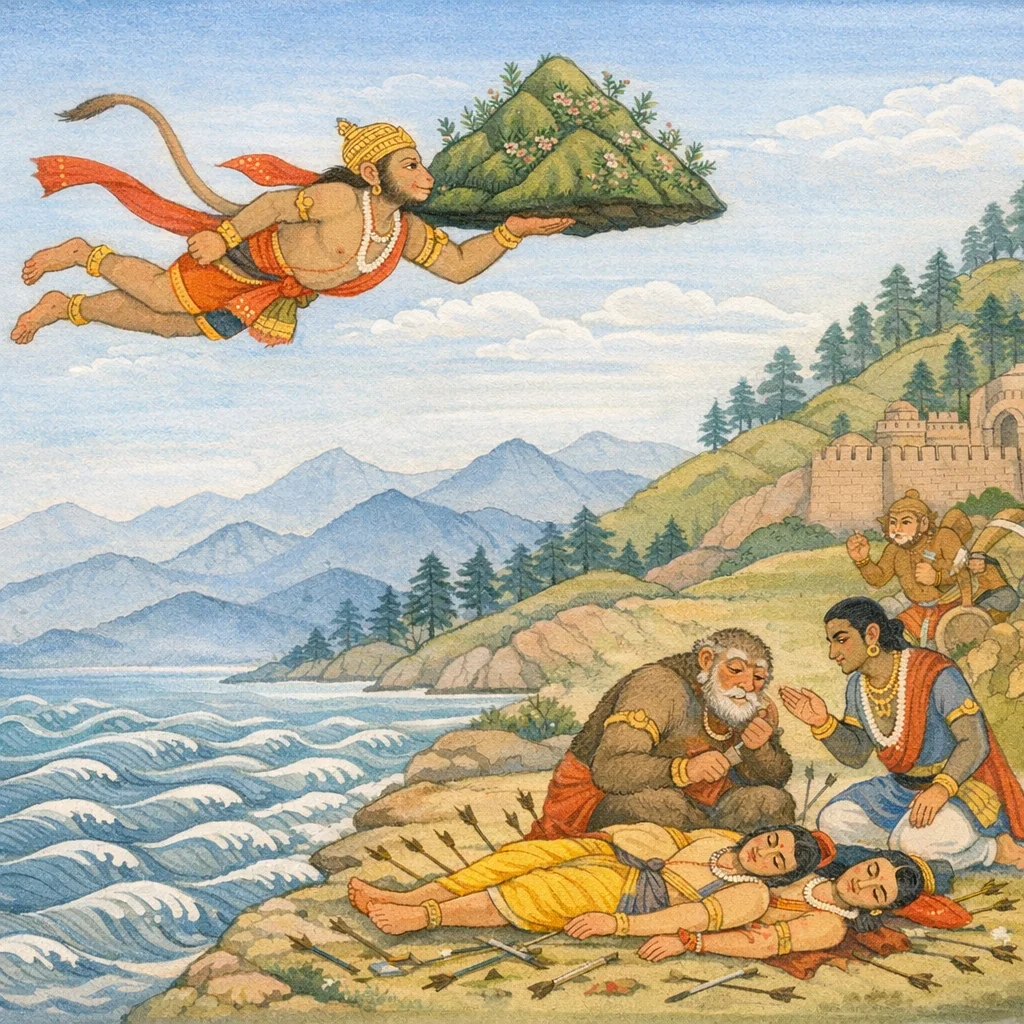
Sarga 74 records a mass-casualty crisis after Indrajit’s Brahmāstra-network renders Rāma and Lakṣmaṇa unconscious and devastates the vānara host. The leadership field collapses into confusion; Vibhīṣaṇa, as the foremost strategist among the wise, reassures the commanders by framing the event as the unavoidable consequence of honoring a creator-conferred weapon. With Hanumān, he surveys the wounded and fallen, locating the aged Jāmbavān pierced by arrows. A brief but pointed dialogue follows: Jāmbavān, unable to see, identifies Vibhīṣaṇa by voice and insists that hope of survival hinges on Hanumān’s continued life and action. Hanumān then approaches with formal reverence, restoring Jāmbavān’s morale. Jāmbavān issues a precise operational directive: fly beyond the sea to Himavat, locate the herb-mountain between Ṛṣabha and Kailāsa, and bring the four medicines—Mṛtasañjīvanī, Viśalyakaraṇī, Suvarṇakaraṇī, and Sandhānakaraṇī. Hanumān’s takeoff is depicted through cosmic-scale kinetic imagery (earth and ocean shaking, mountains pressed and shattered). Reaching the Himalayas, the herbs conceal themselves; Hanumān uproots the entire peak and returns. The fragrance of the herbs revives the princes and restores vānara warriors instantly, reconstituting the coalition’s fighting capacity.
Shlokas
Verse 1
तयोस्तदासादितयोरणाग्रेमुमोहसैन्यंहरिपुङ्गवानाम् ।सुग्रीवनीलाङ्गदजाम्बवन्तो न चापिकिञ्चित्प्रतिपेदिरेते ।।6.74.1।।
When the two were struck down at the very front of battle, the army of the foremost Vanaras sank into confusion; even Sugrīva, Nīla, Aṅgada, and Jāmbavān could not determine what should be done.
Verse 2
ततोविषण्णंसमवेक्ष्यसैन्यंविभीषणोबुद्धिमतांवरिष्ठः ।उवाचशाखमृगराजवीरानाश्वासयन्नप्रतिमैर्वचोभिः ।।6.74.2।।
Then Vibhīṣaṇa—foremost among the wise—seeing the army dejected, spoke to the heroic leaders of the monkeys, consoling them with incomparable words.
Verse 3
माभैष्टनास्त्यत्रविषादकालोयदार्यपुत्त्रौविवशौविषण्णौ ।स्वयम्भुवोवाक्यमथोद्वहन्तौयत्सादिताविन्द्रजिदस्त्रजालैः ।।6.74.3।।
Do not be afraid—this is no time for despair. For the two noble princes, though overwhelmed and downcast, have been struck by Indrajit’s net of missiles while upholding the ordinance of the Self-born (Creator).
Verse 4
तस्मैतुदत्तंपरमास्त्रमेतत्स्वयम्भुवाब्राह्मममोघवेगम् ।तन्मानयन्तौयुधिराजपुत्रौनिपातितौकोऽत्रविषादकालः ।।6.74.4।।
Indeed, to him was granted this supreme Brahmā-weapon by Svayambhū (the Self-born), swift and unfailing. Honoring that missile, the two princes have fallen in battle—so what occasion is there here for grief?
Verse 5
ब्राह्ममस्त्रंततोधीमान्मानयित्वातुमारुतिः ।विभीषणवचश्श्रुत्वाहनूमांस्तमथाब्रवीत् ।।6.74.5।।
Then the wise son of Māruta (Hanumān), having duly honoured the Brahmā-weapon and having heard Vibhīṣaṇa’s counsel, spoke to him.
Verse 6
एतस्मिन्निहतेसैन्येवानराणांतरस्विनाम् ।योयोधारयतेप्राणांस्तंतमाश्वासयाव ।।6.74.6।।
Now that the mighty vānara host has been struck down, let us go to each one who still clings to life and restore his courage.
Verse 7
तावुभौयुगपवदीरौहनूमद्राक्षसोत्तमौ ।उल्काहस्तौतदारात्रौरणशीर्षेविचेरतुः ।।6.74.7।।
Then, in the night, those two heroes—Hanumān and the foremost among the Rākṣasas (Vibhīṣaṇa)—moved about together on the battlefield, torches in hand, searching among the fallen.
Verse 8
भिन्नलाङ्गूलहस्तोरुपादाङ्गुळशिरोधरैः ।स्रवद्भिःक्षतजंगात्रैःप्रस्रवद्भिस्ततस्ततः ।।6.74.8।।पतितैःपर्वताकारैर्वानरैरभिसङ्कुलाम् ।शस्सैश्चपतितैर्दीप्तैर्ददृशातेवसुन्धराम् ।।6.74.9।।
They beheld, here and there, fallen Vānaras—some with tails severed, hands and thighs broken, feet and fingers mangled, even heads and necks struck—while blood streamed from their wounded bodies and fluids poured forth in helpless collapse.
Verse 9
भिन्नलाङ्गूलहस्तोरुपादाङ्गुळशिरोधरैः ।स्रवद्भिःक्षतजंगात्रैःप्रस्रवद्भिस्ततस्ततः ।।6.74.8।।पतितैःपर्वताकारैर्वानरैरभिसङ्कुलाम् ।शस्सैश्चपतितैर्दीप्तैर्ददृशातेवसुन्धराम् ।।6.74.9।।
They saw the earth crowded with fallen Vānaras like mountains, and with bright weapons cast down and scattered across the ground.
Verse 10
सुग्रीवमङ्गदंनीलंशरभंगन्धमादनम् ।गवाक्षं च सुषेणं च वेगदर्शिनमाहुकम् ।।6.74.10।।मैन्दंनळंज्योतिमुखंद्विविदंपनसंतथा ।विभीषणोहनूमांश्चददृशातेहतान् रणे ।।6.74.11।।
Vibhīṣaṇa and Hanūmān saw, on the battlefield, the leaders struck down—Sugrīva, Aṅgada, Nīla, Śarabha, Gandhamādana, Gavākṣa, Suṣeṇa, Vegadarśin, Āhuka; and also Mainda, Nala, Jyotimukha, Dvivida, and Panasa.
Verse 11
सुग्रीवमङ्गदंनीलंशरभंगन्धमादनम् ।गवाक्षं च सुषेणं च वेगदर्शिनमाहुकम् ।।6.74.10।।मैन्दंनळंज्योतिमुखंद्विविदंपनसंतथा ।विभीषणोहनूमांश्चददृशातेहतान् रणे ।।6.74.11।।
Vibhīṣaṇa and Hanūmān saw, on the battlefield, the leaders struck down—Sugrīva, Aṅgada, Nīla, Śarabha, Gandhamādana, Gavākṣa, Suṣeṇa, Vegadarśin, Āhuka; and also Mainda, Nala, Jyotimukha, Dvivida, and Panasa.
Verse 12
सप्तषष्टिर्हताःकोट्योवानराणांतरस्विनाम् ।अह्नःपञ्चमशेषेणवल्लभेनस्वयम्भुवः ।।6.74.12।।
By the Creator’s beloved (Indrajit) and by the Creator’s missile, sixty-seven crores of mighty Vanaras were struck down within the fifth and final division of the day.
Verse 13
सागरौघनिभंभीमंदृष्टवाबाणार्दितंबलम् ।मार्गतेजाम्बवन्तंस्मिहनूमान् सविभीषणः ।।6.74.13।।
Seeing the formidable host—like an ocean-flood—wounded by arrows, Hanumān together with Vibhīṣaṇa began to search for Jāmbavān.
Verse 14
स्वभावजरयायुक्तंवृद्धंशरशतैश्चितम् ।प्रजापतिसुतंवीरंशाम्यन्तमिवपावकम् ।।6.74.14।।दृष्टवातमुपसङ्ग्रम्यपौलस्त्योवाक्यमब्रवीत् ।
He saw Jāmbavān—aged by the natural course of time, pierced thickly by hundreds of arrows—heroic son of Prajāpati, like a fire dying down. Seeing him, Paulastya (Vibhīṣaṇa) went up to him and spoke.
Verse 15
च्चिदार्यशरैस्तीक्ष्णैर्नप्राणाध्वंसितास्तव ।।6.74.15।।विभीषणवचश्श्रुत्वाजाम्बवानृक्षपुङ्गवः ।कृच्छ्रादभ्युग्दिरन्वाक्यमिदंवचनमब्रवीत् ।।6.74.16।।
“Noble sir—have your life-breaths not been destroyed by these sharp arrows?”
Verse 16
च्चिदार्यशरैस्तीक्ष्णैर्नप्राणाध्वंसितास्तव ।।6.74.15।।विभीषणवचश्श्रुत्वाजाम्बवानृक्षपुङ्गवः ।कृच्छ्रादभ्युग्दिरन्वाक्यमिदंवचनमब्रवीत् ।।6.74.16।।
Hearing Vibhīṣaṇa’s words, Jāmbavān—the foremost of bears—spoke this reply, uttering it with great difficulty.
Verse 17
नैरृतेन्द्रमहावीर्यस्वरेणत्वाऽभिलक्ष्ये ।पीड्यमानशशितैर्बाणैर्नत्वापश्यामिचक्षुषा ।।6.74.17।।
“O lord of rākṣasas, great in valor—I recognize you by your voice. Tormented by sharp arrows, I cannot see you with my eyes.”
Verse 18
अञ्जनासुप्रजायेनमातरिश्वा च नैरृत ।हनुमान् वानरश्रेष्ठःप्राणान् धारयतेक्वचित् ।।6.74.18।।
“O rākṣasa—does Hanumān, the best of vānaras, still sustain his life?—he by whose birth Añjanā and (the Wind-god) Mātariśvan are blessed with good offspring.”
Verse 19
श्रुत्वाजाम्बवतोवाक्यमुवाचेदंविभीषणः ।आर्यपुत्रावतिक्रम्यकस्मात्पृच्छसिमारुतिम् ।।6.74.19।।
Hearing Jāmbavān’s words, Vibhīṣaṇa said: “Noble sir—passing over the other noble sons, why do you ask specifically about Māruti (Hanumān)?”
Verse 20
नैवराजनिसुग्रीवेनाङ्गदेनापिराघवे ।आर्यसन्दर्शितस्स्नेहोयथावायुसुतेपरः ।।6.74.20।।
“Noble one, you do not show such affection toward King Sugrīva, nor even toward Aṅgada or Rāghava, as you do toward the son of the Wind (Hanumān).”
Verse 21
विभीषणवचश्श्रुत्वाजाम्बवान्वाक्यमब्रवीत् ।शृणुनैरृतशार्दूलयस्मात् पृच्छामिमारुतिम् ।।6.74.21।।
Hearing Vibhīṣaṇa’s words, Jāmbavān replied: “Listen, tiger among rākṣasas—this is why I ask about Māruti (Hanumān).”
Verse 22
तस्मिन्जीवतिवीरेतुहतमप्यहतंबलम् ।हनूमत्युज्झितप्राणेजीवन्तोऽपिवयम् हृता ।।6.74.22।।
So long as that heroic Hanumān lives, even if the army is shattered, it is as though it were not truly destroyed; but if Hanumān’s life-breath is gone, then even we who are still alive are as good as dead.
Verse 23
धरतेमारुतिस्तातमारुतप्रतिमोयदि ।वैश्वानरसमोवीर्वेजीविताशाततोभवेत् ।।6.74.23।।
Dear one, if Māruti—peer of the Wind-god, and in valor like Vaiśvānara (Fire)—still draws breath, then from that alone there arises hope for life.
Verse 24
ततोवृद्धमुपागम्यनियमेनाभ्यवादयत् ।गृह्यजाम्बवतःपादौहनूमान्मारुतात्मजः ।।6.74.24।।
Then Hanumān, son of the Wind-god, approached the aged Jāmbavān; observing proper conduct, he clasped his feet and respectfully greeted him.
Verse 25
श्रुत्वाहनुमतोवाक्यंतदाऽपिव्यथितेन्द्रियः ।पुनर्जातमिवात्मानंमन्यतेप्लवगोत्तमः ।।6.74.25।।
Though his senses had been shaken, on hearing Hanumān’s words the foremost of the vānaras felt as if he had been born anew.
Verse 26
ततोऽब्रवीन्महातेजाहनूमन्तं स जाम्बवान् ।आगच्छहरिशार्दूल वानरांस्त्रातुमर्हसि ।।6.74.26।।
Then the radiant Jāmbavān spoke to Hanumān: “Come, tiger among monkeys—you must save and protect the vānaras.”
Verse 27
नान्योवक्रमपर्याप्तस्त्वमेषांपरमस्सखा ।त्वत्पराक्रमकालोऽयंनान्यंपश्यामिकथञ्चन ।।6.74.27।।
No one else has sufficient prowess; you are their highest friend. This is the time for your heroism—indeed, I see no other at all.
Verse 28
ऋक्ष्वानरवीराणामनीकानिप्रहर्षय ।शल्यौकुरुचाप्येतासादितौरामलक्ष्मणौ ।।6.74.28।।
Bring joy to the hosts of bear- and vānara-warriors; and make Rāma and Lakṣmaṇa—who have been struck down and lie helpless—free of those barbs and restored.
Verse 29
गत्वापरममध्वानमुपर्युपरिसागरम् ।हिमवन्तंनगश्रेष्ठंहनुमन्गन्तुमर्हसि ।।6.74.29।।
Hanumān, you must travel a very great distance, flying high over the sea, and go to Himavān—the best of mountains.
Verse 30
ततःकाञ्चनमत्युच्चमृषभंपर्वतोत्तमम् ।कैलासशिखरंचापिद्रक्ष्यस्यरिनिषूदन ।।6.74.30।।
There you will behold the exceedingly lofty, golden Ṛṣabha—foremost of mountains—and also the summit of Kailāsa, O destroyer of enemies.
Verse 31
तयोशशिखरयोर्मध्येप्रदीप्तमतुलप्रभम् ।सर्यौषधियुतंवीर द्रक्ष्यस्यौषधिपर्यतम् ।।6.74.31।।
O hero! Between those two mountain-peaks you will see a mountain blazing with incomparable radiance, covered with every kind of medicinal herb.
Verse 32
तस्यवानरशार्दूल चतस्रो मूधि सम्भवाः ।द्रक्ष्यस्योषधयोदीप्तादीपय्नत्योदिशोदश ।।6.74.32।।
O tiger among monkeys! On that mountain’s summit you will see four radiant herbs growing there, shining forth and lighting up the ten directions.
Verse 33
मृतसञ्जीवनींचैवविशल्यकरणीमपि ।सुवर्णकरणींचैवसन्धानकरणींतथा ।।6.74.33।।
They are: Mṛtasañjīvanī, and also Viśalyakaraṇī; Suvarṇakaraṇī as well, and likewise Sandhānakaraṇī.
Verse 34
तास्सर्वाहनुमन्गृह्वक्षिप्रमागन्तुमर्हसि ।आश्वासयहरीन् प्राणैर्योज्यगन्धवहात्मज ।।6.74.34।।
Hanumān, take all those herbs and you must return at once. O son of the Wind-god, restore the monkeys’ lives and hearten them again.
Verse 35
श्रुत्वाजाम्बवतोवाक्यंहनूमान् हरिपुङ्गवः ।आपूर्यतबलोद्धर्षैस्तोयवेगैरिवार्णवः ।।6.74.35।।
Hearing Jāmbavān’s words, Hanumān—the foremost of the monkeys—swelled with surging strength, like the ocean rising with rushing waters.
Verse 36
पर्वततटाग्रस्थःपीडयन् पर्वतोत्तमम् ।हनूमान्दृश्यतेवीरोद्वितीयइवपर्वतः ।।6.74.36।।
Standing on the mountain’s edge-crest and pressing down the best of mountains beneath his feet, the heroic Hanumān appeared like a second mountain.
Verse 37
हरिपादविनिर्भग्नोनिषसाद स पर्वतः ।न शशाकतदात्मानंसोढुंभृशनिपीडितः ।।6.74.37।।
Crushed by the monkey’s feet, that mountain sank down; pressed exceedingly hard, it could not endure itself.
Verse 38
तस्यपेतुर्नगाभूमौहरिवेगाच्चजज्वलुः ।शृङ्गाणि च व्यशीर्यन्तपीडितस्यहनूमता ।।6.74.38।।
Driven by Hanumān’s speed, portions of the mountain fell to the ground and flared, and its peaks shattered as it was crushed by him.
Verse 39
तस्मिन् सम्पीड्यमानेतुभग्नद्रुमशिलातले ।न शेकुर्वानरास्स्थातुंघूर्णमानेनगोत्तमे ।।6.74.39।।
As that best of mountains was being crushed—its surface strewn with broken trees and rocks—the vānaras could not keep their footing upon it as it reeled and shook.
Verse 40
साघूर्णितमहाद्वाराप्रभग्नगृहगोपुरा ।लङ्कात्रासाकुलारात्रौप्रवृत्तेवाभवत्तदा ।।6.74.40।।
Then, with her great gates trembling and her houses and gate-towers shattered, Laṅkā—overwhelmed by fear in the night—seemed as though she were dancing and quaking.
Verse 41
पृथिवीधरसङ्काशोनिपीड्यधरणीधरम् ।पृथिवींक्षोभयामाससार्णवांमारुतात्मजः ।।6.74.41।।
The son of the Wind-god, massive like a mountain, pressed down upon the earth-bearing mountain and made the very earth—with its oceans—tremble.
Verse 42
आरुरोहतदातस्माद्धरिर्मलयपर्वतम् ।मेरुमन्दरसङ्काशंनानाप्रस्रवणाकुलम् ।।6.74.42।।नानाद्रुमलताकीर्णंविकासिकमलोत्पलम् ।सेवितंदेवगन्धर्वैष्षष्टियोजनमुच्छ्रितम् ।।6.74.43।।विद्याधरैर्मुनिगणैरप्सरोभिर्निषेवितम् ।नानामृगगणाकीर्णंबहुकन्दरशोभितम् ।।6.74.44।।सर्वानाकुलयंस्तत्रयक्षगन्धर्वकिन्नरान् ।हनुमान् मेघसङ्काशोववृधेमारुतात्मजः ।।6.74.45।।
Then that vānar climbed from there onto the Malaya mountain, which resembled Meru and Mandara and was crowded with many streams and springs.
Verse 43
आरुरोहतदातस्माद्धरिर्मलयपर्वतम् ।मेरुमन्दरसङ्काशंनानाप्रस्रवणाकुलम् ।।6.74.42।।नानाद्रुमलताकीर्णंविकासिकमलोत्पलम् ।सेवितंदेवगन्धर्वैष्षष्टियोजनमुच्छ्रितम् ।।6.74.43।।विद्याधरैर्मुनिगणैरप्सरोभिर्निषेवितम् ।नानामृगगणाकीर्णंबहुकन्दरशोभितम् ।।6.74.44।।सर्वानाकुलयंस्तत्रयक्षगन्धर्वकिन्नरान् ।हनुमान् मेघसङ्काशोववृधेमारुतात्मजः ।।6.74.45।।
It was strewn with many kinds of trees and creepers, bright with blooming lotuses and water-lilies, frequented by devas and gandharvas, and rose to a height of sixty yojanas.
Verse 44
आरुरोहतदातस्माद्धरिर्मलयपर्वतम् ।मेरुमन्दरसङ्काशंनानाप्रस्रवणाकुलम् ।।6.74.42।।नानाद्रुमलताकीर्णंविकासिकमलोत्पलम् ।सेवितंदेवगन्धर्वैष्षष्टियोजनमुच्छ्रितम् ।।6.74.43।।विद्याधरैर्मुनिगणैरप्सरोभिर्निषेवितम् ।नानामृगगणाकीर्णंबहुकन्दरशोभितम् ।।6.74.44।।सर्वानाकुलयंस्तत्रयक्षगन्धर्वकिन्नरान् ।हनुमान् मेघसङ्काशोववृधेमारुतात्मजः ।।6.74.45।।
It was resorted to by vidyādharas, hosts of sages, and apsarases; it teemed with many herds of animals and was adorned with numerous caves.
Verse 45
आरुरोहतदातस्माद्धरिर्मलयपर्वतम् ।मेरुमन्दरसङ्काशंनानाप्रस्रवणाकुलम् ।।6.74.42।।नानाद्रुमलताकीर्णंविकासिकमलोत्पलम् ।सेवितंदेवगन्धर्वैष्षष्टियोजनमुच्छ्रितम् ।।6.74.43।।विद्याधरैर्मुनिगणैरप्सरोभिर्निषेवितम् ।नानामृगगणाकीर्णंबहुकन्दरशोभितम् ।।6.74.44।।सर्वानाकुलयंस्तत्रयक्षगन्धर्वकिन्नरान् ।हनुमान् मेघसङ्काशोववृधेमारुतात्मजः ।।6.74.45।।
There, unsettling all the yakṣas, gandharvas, and kinnaras, Hanumān—the son of the Wind-god—expanded in size, cloud-like in vastness.
Verse 46
पद्भ्यांतुशैलमापीड्यबडबामुखवन्मुखम् ।विवृत्योग्रंननादोच्चैस्त्रासयन्निवराक्षसान् ।।6.74.46।।
Pressing the mountain beneath his feet, he opened his mouth like the mare-faced fire and roared fiercely and loudly, as though to strike terror into the rākṣasas.
Verse 47
तस्यनानद्यमानस्यश्रुत्वानिनदमद्भुतम् ।लङ्कास्थाराक्षसास्सर्वे न शेकुस्स्पन्दितुंभयात् ।।6.74.47।।
Hearing that wondrous roar as he thundered, all the rākṣasas dwelling in Laṅkā were so afraid that they could not even move.
Verse 48
नमस्कृत्वाऽथरामायमारुतिर्भीमविक्रमः ।राघवार्थेपरंकर्मसमीहतपरन्तपः ।।6.74.48।।
Then Māruti—terrible in prowess, a scorcher of foes—bowed to Rāma and resolved to undertake a supreme deed for the sake of Rāghava.
Verse 49
स पुच्छमुद्यम्यभुजङ्गकल्पंविनम्यपृष्ठंश्रवणेनिकुञ्च्य ।विवृत्यवक्त्रंबडबामुखाभमापुफ्लुवेव्योमनिचण्डवेगः ।।6.74.49।।
Raising his serpent-like tail, bending his back and drawing in his ears, and opening his mouth like the mare-faced fire, he sprang into the sky with furious speed.
Verse 50
सवृक्षषण्डांस्तरसाजहारशैलान् शिलाःप्राकृतवानरांश्च ।बाहूरुवेगोद्धतसम्प्रणुन्नास्तेक्षीणवेगास्सलिलेनिपेतुः ।।6.74.50।।
With sheer speed he swept along clusters of trees, mountains, rocks, and even ordinary monkeys; but, driven and tossed up by the force of his arms and thighs, they lost momentum and fell down into the waters.
Verse 51
तौप्रसार्योरगभोगकल्पौभुजौभुजङ्गारिनिकाशवीर्यः ।जगाममेरुंनगराजमग्य्रंदिशःप्रकर्षन्निववायुसूनुः ।।6.74.51।।
Stretching out his arms like coiling serpents, the son of Vāyu—whose might was like that of Garuḍa, the enemy of serpents—sped toward the lofty lord of mountains, Meru, as though he were drawing the very quarters along with him.
Verse 52
स सागरंघूर्णितवीचिमालंतथाभृशंभ्रामितसर्वसत्त्वम् ।समीक्षमाणस्सहसाजगामचक्रंयथाविष्णुकराग्रमुक्तम् ।।6.74.52।।
Watching the ocean—its wave-garlands set swirling and its creatures violently whirled about—he rushed on like Viṣṇu’s discus released from the edge of his hand.
Verse 53
स पर्वतान्वृक्षगवान् सरांसिनदीस्तटाकानिपुरोत्तमानि ।स्फीतान् जनान्तानपिसम्प्रवीक्ष्यजगामवेगापतितृतुल्यवेगः ।।6.74.53।।
Glancing over mountains, wooded lands, lakes, rivers, tanks, and the finest cities—and even flourishing settlements—he sped on with a swiftness equal to his father’s.
Verse 54
आदित्यपथमाश्रित्यजगाम स गतक्लमः ।हनूमांस्त्वरितोवीरःपितृतुल्यपराक्रमः ।।6.74.54।।
Unwearied, the hero Hanumān hurried on, keeping to the Sun’s path—his prowess equal to his father’s.
Verse 55
जवेनमहतायुक्तोमारुतिर्मारुतोयथा ।जगामहरिशार्दूलोदिशश्शब्देनपूरयन् ।।6.74.55।।
Endowed with tremendous speed, Māruti—the tiger among monkeys—moved like the wind itself, filling the quarters with sound.
Verse 56
स्म्मरन्जाम्बवतोवाक्यंमारुतिर्वातरंहसा ।ददर्शसहसागत्वाहिमवन्तंमहाकपिः ।।6.74.56।।
Moving with the speed of the wind, Māruti—the great ape—remembered Jāmbavān’s words and, arriving swiftly, beheld Himavān (the Himālayas).
Verse 57
नानाप्रस्रवणोपेतंनानाकन्दरनिर्घरम् ।श्वेताभ्रचयसङ्काशैशशिखरैश्चारुदर्शनैः ।।6.74.57।।शोभितंविविधैर्वृक्षैरगमत्पर्वतोत्तमम् ।
He reached that foremost mountain, rich with many springs and resounding with many caves and cascades, adorned with diverse trees, its beautiful peaks resembling masses of white clouds.
Verse 58
स तंसमासाद्यमहानगेन्द्रमतिप्रवृद्धोत्तमघोरशृङ्गम् ।ददर्शपुण्यानिमहाश्रमाणिसुरर्षिसंघोत्तमसेवितानि ।।6.74.58।।
Having reached that great lord of mountains with towering, formidable peaks, he saw holy great hermitages, frequented by the choicest assemblies of gods and sages.
Verse 59
स ब्रह्मकोशंरजतालयं च शक्रालयंरुद्रशरप्रमोक्षम् ।हयाननंब्रह्मशिरश्चदीप्तंददर्शवैवस्वतकिङ्करांश्च ।।6.74.59।।
He beheld the seat of Brahmā, the silver-hued abode, the dwelling of Śakra (Indra), the place where Rudra once loosed his arrow, the horse-faced Lord (Hayagrīva), the radiant Brahmaśiras, and also the attendants of Vaivasvata (Yama).
Verse 60
वज्रालयंवैश्रवणालयं च सूर्यप्रभंसूर्यनिबन्धनंच । a.ब्रह्मासनंशङ्करकार्मुकं च ददर्शनाभिं च वसुन्धरायाः ।।6.74.60।।
He saw Vajrālaya, the abode of Vaiśravaṇa (Kubera) shining like the sun, the place where the Sun was bound, the seat of Brahmā, the place of Śaṅkara’s bow, and even the navel of the Earth.
Verse 61
कैलासमग्य्रंहिमवच्छिलां च तथर्षभंकाञ्चनशैलमग्य्रम् ।सन्दीप्तसर्वौषधिसन्प्रदीप्तंददर्शसर्वौषधिपर्वतेन्द्रम् ।।6.74.61।।
He beheld lofty Kailāsa, the crags of Himavat, and likewise Ṛṣabha—the foremost golden mountain—and then the kingly mountain where all medicinal herbs blazed with a concentrated radiance.
Verse 62
स तंसमीक्ष्यानलरश्मिदीप्तंविसिष्मियेवासवदूतसूनुः ।आवृत्यतंचौषधिपर्वतेन्द्रंतत्रौषधीनांविचयंचकार ।।6.74.62।।
Seeing that mountain blazing with fire-like rays, the son of Vāsava’s messenger (Hanumān) marveled; circling the lord of herb-bearing mountains, he examined and tried to discern the herbs there.
Verse 63
सयोजनसहस्राणिसमतीत्यमहाकपिः ।दिव्यौषधिधरंशैलंव्यचरन्मारुतात्मजः ।।6.74.63।।
After traversing a thousand yojanas, the great ape—son of the Wind—moved about on the mountain that bore divine herbs, searching through it.
Verse 64
महौषध्यस्ततस्सर्वास्तस्मिन् पर्वतसत्तमे ।विज्ञायार्थिनमायान्तंततोजग्मुरदर्शनम् ।।6.74.64।।
Then, on that excellent mountain, all the great herbs—realizing that a seeker had come for them—vanished from sight.
Verse 65
स तामहात्माहनुमानपश्यंश्चुकोपकोपाच्चभृशंननाद ।अमृष्यमाणोऽनगिनिकाशचक्षुर्महीधरेन्द्रंतमुवाचवाक्यम् ।।6.74.65।।
Not seeing those herbs, the great-souled Hanumān flared with anger and roared loudly; unable to endure it, with eyes like fire, he addressed that lord of mountains in stern words.
Verse 66
कीमेतदेवंसुविनिश्चितंतेयद्राघवेनासिकृतानुकम्प ।पश्याद्यमद्बाहुबलाभिभूतोविकीर्णमात्मानमथोनगेन्द्र ।।6.74.66।।
“What is this resolve of yours—that you show no compassion toward Rāghava? Look now, O king of mountains: overpowered by the strength of my arms, you shall be shattered.”
Verse 67
स तस्यशृङ्गंसनगंसनागंसकाञ्चनंधातुसहस्रजुष्टम् ।विकीर्णकूटंज्वलिताग्रसानुंप्रगृह्यवेगात्सहसोन्ममाथ ।।6.74.67।।
Then he seized that mountain-peak—together with its trees and elephants, rich with gold and thronged with countless ores; its crags shattered and its summit blazing— and, in a sudden rush of force, he tore it up.
Verse 68
सतसमुत्पाट्यखमुत्पपातवित्रास्यलोकान् ससुरासुरेन्द्रान् ।संस्तूयमानःखचरैरनेकैर्जगामवेगाद्गरुडोग्रवेगः ।।6.74.68।।
Uprooting that mountain, he sprang up into the sky; and as he sped on with a force like Garuḍa’s, he struck awe in the worlds—even among the lords of gods and demons—while many sky-going beings praised him.
Verse 69
स भास्कराध्वानमनुप्रपन्नस्तंभास्कराभंशिखरंप्रगृह्य ।बभौतदाभास्करसन्निकाशोरवेस्समीपेप्रतिभास्कराभः ।।6.74.69।।
Approaching the sun’s path, and bearing that peak radiant like the sun, he then shone near the Sun himself—like a second sun appearing beside it.
Verse 70
स तेनशैलेनभृशंरराजशैलोपमोगन्धवहात्मजस्तु ।सहस्रधारेणसपावकेनचक्रेणखेविष्णुरिवार्पितेन ।।6.74.70।।
With that mountain he blazed forth brilliantly—the son of the Wind-God, mountain-like himself—appearing in the sky like Viṣṇu bearing his fiery, thousand-edged discus.
Verse 71
तंवानराःप्रेक्ष्यविनेदुरुच्चैस्सतानपिप्रेक्ष्यमुदाननाद ।तेषांसमुध्घुष्टरवंनिशम्यलङ्कालयाभीमतरंविनेदुः ।।6.74.71।।
Seeing him, the Vānaras cried out loudly in joy; and he too, seeing them, roared with gladness. Hearing that tumultuous shout, the inhabitants of Laṅkā raised an even more dreadful cry in fear.
Verse 72
ततोमहात्मानिपपाततस्मिन् शैलोत्तमेवानरसैन्यमथ्ये ।हर्युत्तमेभ्यशशिरसाऽभिवाद्यविभीषणंतत्र स सस्वजे च ।।6.74.72।।
Then that great-souled one descended there with the foremost mountain into the midst of the Vānara host; bowing his head, he greeted the best of the Vānaras, and there he embraced Vibhīṣaṇa.
Verse 73
तावप्युभौमानुषराजपुत्रौतंगन्धमाघ्रायमहौषधीनाम् ।बभूवतुस्तत्रतदाविशल्यावुत्तस्थुरन्ये च हरिप्रवीराः ।।6.74.73।।
Those two princes, sons of the king among men, inhaled the fragrance of the great healing herbs and at once became free of arrows and wounds; and other heroic Vānaras also rose up again.
Verse 74
सर्वेविशल्याविरुजाःक्षणेनहरिप्रवीराश्चहताश्चयेस्युः ।गन्धेनतासांप्रवरौषधीनांसुप्तानिशान्तेष्विवसम्प्रबुद्धाः ।।6.74.74।।
In an instant, all the heroic Vānaras—those wounded and even those who had fallen—became free of darts and pain through the fragrance of those supreme herbs, awakening as if from sleep at the end of night.
Verse 75
दाप्रभृतिलङ्कायांयुध्यन्तेहरिराक्षसाः ।तदाप्रभृतिमानार्थमाज्ञयारावणस्य च ।।6.74.75।।येहन्यन्तेरणेतत्रराक्षसाःकपिकुञ्जरैः ।हताहतास्तुक्षिप्यन्तेसर्वएवतुसागरे ।।6.74.76।।
From the time the Vānaras and Rākṣasas began fighting in Laṅkā, from that very time onward—by Rāvaṇa’s command—(a practice was followed) for the sake of leaving no proof.
Verse 76
दाप्रभृतिलङ्कायांयुध्यन्तेहरिराक्षसाः ।तदाप्रभृतिमानार्थमाज्ञयारावणस्य च ।।6.74.75।।येहन्यन्तेरणेतत्रराक्षसाःकपिकुञ्जरैः ।हताहतास्तुक्षिप्यन्तेसर्वएवतुसागरे ।।6.74.76।।
Those Rākṣasas who were slain there in battle by the mighty leaders among the Vānaras were, as soon as they fell, all thrown into the ocean.
Verse 77
Then the Vānara—Hanumān, son of the Wind—swiftly carried that mountain of medicinal herbs back to Himavān, and once again returned to rejoin Rāma.
Frequently Asked Questions
The coalition faces a dharma-critical emergency: whether despair should dissolve duty after the princes fall unconscious. The text resolves it through disciplined action—Vibhīṣaṇa’s reassurance, Jāmbavān’s prioritization of collective survival, and Hanumān’s mission to heal rather than retaliate.
Hope is anchored in responsible agency: when fate manifests as overwhelming force (astra), the proper response is not denial but swift, skillful service (sevā) that restores life and moral order.
The narrative maps a medicinal geography: Himavat (Himalayas), Kailāsa, Ṛṣabha, and the herb-mountain (Oṣadhiparvata). It also preserves cultural protocols—Hanumān’s respectful foot-clasping of the elder Jāmbavān as a marker of disciplined hierarchy in crisis.