Sarga 73
इन्द्रजितः ब्रह्मास्त्र-यागः तथा वानरसेनाविध्वंसः (Indrajit’s Brahmastra Rite and the Crushing of the Vanara Host)
युद्धकाण्ड
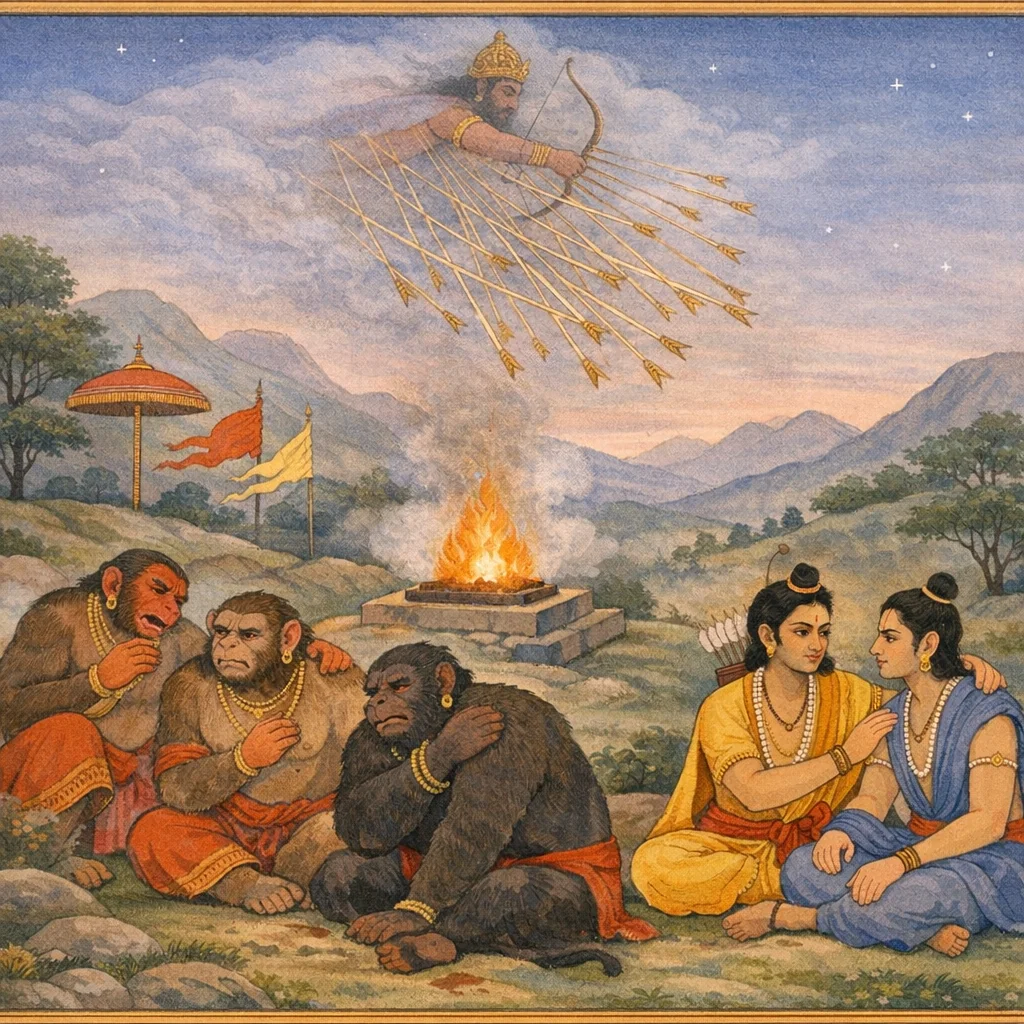
Sarga 73 opens with surviving rākṣasas reporting to Rāvaṇa the deaths of leading champions (Devanṭaka, Triśiras, Atikāya). Rāvaṇa, overwhelmed by grief and strategic anxiety, is consoled by Indrajit, who asserts a vow to bring down Rāma and Lakṣmaṇa. Indrajit departs with a tumultuous escort—conchs, drums, parasols, and ceremonial fans—projecting royal-military pageantry. Reaching the battlefield, he establishes a protective perimeter and performs a fire-rite (homa) with strikingly martial substitutions (weapons as ritual elements), receiving auspicious victory-signs as the fire blazes smokelessly. The fire deity accepts the oblation; Indrajit invokes the Brahmāstra and charges his chariot and bow, causing cosmic tremors among planets and stars. Concealed by māyā, he rains a net of arrows and weapons, devastating the vānaras and wounding major leaders (Hanūmān, Sugrīva, Aṅgada, Jāmbavān, Nala, and others). Rāma diagnoses the Brahmāstra’s provenance and counsels Lakṣmaṇa to endure its hail with composure. Indrajit, seeing Rāma and Lakṣmaṇa struck down amid the demoralized host, roars in triumph and returns to Laṅkā to report success to his father.
Shlokas
Verse 1
ततोहतान्राक्षसपुङ्गवांस्तान् देवान्तकादित्रिशिरोतिकायान् ।रक्षोगणास्तत्रहतावशिष्टास्तेरावणायत्वरिताश्शशंसुः ।।।।
Then the surviving bands of Rākṣasas—those left alive after the slaughter—hurried to Rāvaṇa and reported that Devantaka, Triśiras, and Atikāya, the foremost among them, had been killed.
Verse 2
ततोहतांस्तान् सहसानिशम्यराजामुमोहपरिप्लुताक्षः ।पुत्रक्षयंभ्रातृवधं च घोरंविचिन्त्यराजाविपुलंप्रदध्यौ ।।।।
Then the king, hearing suddenly that they had been slain, lost consciousness—his eyes flooded with tears. Reflecting on the dreadful loss of his son and the killing of his brother, he sank into deep and heavy thought.
Verse 3
ततस्तुराजानमुदीक्ष्यदीनंशोकार्णवेसम्परिपुप्लुवानम् ।रथर्षभोराक्षसराजसूनुस्तमिन्द्रजिद्वाक्यमिदंबभाषे ।।।।
Then, seeing the king despondent and as though drowning in an ocean of grief, Indrajit—Rāvaṇa’s son, foremost among chariot-warriors—addressed him with these words.
Verse 4
न तात मोहंपरिगन्तुमर्हसियत्रेन्द्रजिजजीवतिराक्षसेन्द्र ।नेन्द्रारिबाणाभिहतोहिकश्चित्प्राणान् समर्थस्समरेऽभिपातुम् ।।।।
“Dear lord of the Rākṣasas, you must not fall into delusion so long as Indrajit lives. For no one, once struck in battle by the arrows of Indra’s foe, is able to preserve his life.”
Verse 5
पश्याद्यरामंसहलक्ष्मणेनमद्बाणनिर्भिन्नविकीर्णदेहम् ।गतायुषंभूमितलेशयानंशितैश्शरैराचितसर्वगात्रम् ।।।।
“Look now—Rāma with Lakṣmaṇa: their bodies torn and scattered by my arrows, their life ended, lying on the ground, every limb bristling with sharp shafts.”
Verse 6
इमांप्रतिज्ञांशृणुशक्रशत्रोःसुनिश्चितांपौरुषदैवयुक्ताम् ।अद्यैवरामंसहलक्ष्मणेनसन्तर्पयिष्यामिशरैरमोघैः ।।।।
“Hear this vow of the foe of Indra—firmly resolved, backed by both human prowess and divine power: today itself I will overwhelm Rāma together with Lakṣmaṇa with unfailing arrows.”
Verse 7
अद्येन्द्रवैवस्वतविष्णुमित्रसाध्याश्चवैश्वानरचन्द्रसूर्याः ।द्रक्ष्यन्तुमेविक्रममप्रमेयंविष्णोरिवोग्रंबलियज्ञवाटे ।।।।
“Today let Indra, Vaivasvata, Viṣṇu, Mitra, the Sādhyas, Vaiśvānara, the Moon, and the Sun witness my immeasurable prowess—just as they once beheld Viṣṇu’s terrible might in Bali’s sacrificial arena.”
Verse 8
स एवमुक्त्वात्रिदशेन्द्रशत्रुरापृच्छयराजानमदीनसत्त्वः ।समारुरोहानितुल्यवेगंरथंखरश्रेष्ठसमाधियुक्तम् ।।।।
Having spoken thus, the foe of Indra—steadfast in spirit—took leave of the king and mounted a chariot swift as the wind, yoked with the finest asses.
Verse 9
तमास्थायमहातेजारथंहरिरथोपमम् ।जगामसहसातत्रयत्रयुद्धमरिन्दमः ।।।।
Mounting that chariot—splendid like Indra’s—Indrajit, radiant and a subduer of foes, hastened at once to where the battle raged.
Verse 10
तंप्रस्थितंमहात्मानमनुजग्मुर्महाबलाः ।सम्हर्षमाणाबहनोधनुष्प्रवरपाणयः ।।।।गजस्कन्धगताःकेचित्केचित्प्रवरवाजिभिः ।व्याघ्रवृश्चिकमार्जारखरोरोष्ट्रैश्चभुजङ्गमैः ।।।।वराहैश्श्वापदैस्सिंहैर्जम्बुकैःपर्वतोपमैः ।काकहंसमयूरैश्चराक्षसाभीमविक्रमाः ।।।।प्रासमुद्गरनिस्त्रिंशपरश्वथगदाधराः ।भुशुण्डिमुद्गरायष्टिशतघ्नीपरिघायुधा ।।।।
As that great one set out, many mighty Rākṣasas—exultant and bearing excellent bows—followed after him.
Verse 11
तंप्रस्थितंमहात्मानमनुजग्मुर्महाबलाः ।सम्हर्षमाणाबहनोधनुष्प्रवरपाणयः ।।6.73.10।।गजस्कन्धगताःकेचित्केचित्प्रवरवाजिभिः ।व्याघ्रवृश्चिकमार्जारखरोरोष्ट्रैश्चभुजङ्गमैः ।।6.73.11।।वराहैश्श्वापदैस्सिंहैर्जम्बुकैःपर्वतोपमैः ।काकहंसमयूरैश्चराक्षसाभीमविक्रमाः ।।6.73.12।।प्रासमुद्गरनिस्त्रिंशपरश्वथगदाधराः ।भुशुण्डिमुद्गरायष्टिशतघ्नीपरिघायुधा ।।6.73.13।।
Some rode on elephant-backs, some on excellent horses; others mounted tigers, scorpions, cats, donkeys, camels, and even serpents.
Verse 12
तंप्रस्थितंमहात्मानमनुजग्मुर्महाबलाः ।सम्हर्षमाणाबहनोधनुष्प्रवरपाणयः ।।6.73.10।।गजस्कन्धगताःकेचित्केचित्प्रवरवाजिभिः ।व्याघ्रवृश्चिकमार्जारखरोरोष्ट्रैश्चभुजङ्गमैः ।।6.73.11।।वराहैश्श्वापदैस्सिंहैर्जम्बुकैःपर्वतोपमैः ।काकहंसमयूरैश्चराक्षसाभीमविक्रमाः ।।6.73.12।।प्रासमुद्गरनिस्त्रिंशपरश्वथगदाधराः ।भुशुण्डिमुद्गरायष्टिशतघ्नीपरिघायुधा ।।6.73.13।।
Those Rākṣasas of dreadful prowess also rode boars, wild beasts, lions, jackals huge as mountains, and even crows, geese, and peacocks.
Verse 13
तंप्रस्थितंमहात्मानमनुजग्मुर्महाबलाः ।सम्हर्षमाणाबहनोधनुष्प्रवरपाणयः ।।6.73.10।।गजस्कन्धगताःकेचित्केचित्प्रवरवाजिभिः ।व्याघ्रवृश्चिकमार्जारखरोरोष्ट्रैश्चभुजङ्गमैः ।।6.73.11।।वराहैश्श्वापदैस्सिंहैर्जम्बुकैःपर्वतोपमैः ।काकहंसमयूरैश्चराक्षसाभीमविक्रमाः ।।6.73.12।।प्रासमुद्गरनिस्त्रिंशपरश्वथगदाधराः ।भुशुण्डिमुद्गरायष्टिशतघ्नीपरिघायुधा ।।6.73.13।।
They bore spears, hammers, swords, axes, and maces—armed also with bhuśuṇḍīs, mallets, iron staves, śataghnīs, and parighas.
Verse 14
स शङ्खनिनदैःपूर्णैर्भेरीणांचापिनिस्स्वनैः ।जगामत्रिदशेन्द्रास्तूयमानोनिशाचरैः ।।।।
He—Indra’s foe—advanced amid the full blare of conches and the resounding beat of drums, while the night-rangers praised him.
Verse 15
स शङ्खशशिवर्णेनछत्रेणरिपुसूदनः ।रराजप्रतिपूर्णेननभश्चन्द्रमसायथा ।।।।
With a parasol white as conch and moon, that slayer of foes shone—like the full moon in the sky.
Verse 16
अवीज्यतततोवीरोहैमैर्हेमविभूषितैः ।चारुचामरमुख्यैश्चमुख्यस्सर्वधनुष्मताम् ।।।।
Thereafter that hero—foremost among all archers—was fanned with splendid fly-whisks, their golden handles adorned with gold.
Verse 17
स तुदृष्टवाविनिर्यान्तंबलेनमहातावृतम् ।राक्षसाधिपतिश्रशीमान् रावणःपुत्रमब्रवीत् ।।।।
Seeing his son setting out, surrounded by a vast army, the prosperous lord of the Rākṣasas—Rāvaṇa—addressed him.
Verse 18
त्वमप्रतिरथःपुत्रत्वयावैवासवोजितः ।किम्पुनर्मानुषंधृष्यंनिहनिष्यसिराघवम् ।।।।तथोक्तोराक्षसेन्द्रेणप्रत्यगृह्णान्महाशिषः ।
“Son, you are without an equal as a chariot-warrior; indeed, you have conquered Vāsava (Indra). Why then should you not slay Rāghava—only a human, and one who can be assailed?” Thus addressed by the lord of the Rākṣasas, he accepted the great blessings.
Verse 19
तस्त्विन्द्रजितालङ्कासूर्यप्रतिमतेजसा ।।।।रराजाप्रतिवीर्येणद्यौरिवार्केणभास्वता ।
Then Laṅkā shone with Indrajit—radiant like the sun and unmatched in valor—just as the sky shines with the blazing sun.
Verse 20
सम्प्राप्यमहातेजायुद्धभूमिमरिन्दमः ।।।।स्थापयामासरक्षांसिरथंप्रतिसमन्ततः ।
Reaching the battlefield, the mighty and foe-subduing one stationed the Rākṣasas all around his chariot as a protective ring.
Verse 21
ततस्तुहुतभोक्तारंहुतभुक्सदृशप्रभः ।।।।जुहावराक्षसश्रेष्ठोमन्त्रवद्विधिवत्तदा ।
Then the foremost of the Rākṣasas, blazing like the Fire itself, performed offerings to the Fire-god—reciting mantras and observing the proper rites.
Verse 22
सहविर्लाजसंस्कारैर्माल्यगन्धपुरस्कृतैः ।।।।जुहुवेपावकंतत्रराक्षनेन्द्रःप्रतापवान् ।
There the valiant lord among the Rākṣasas offered worship to Pāvaka (Fire), using offerings prepared with parched grain and preceded by garlands and fragrances.
Verse 23
शस्त्राणिशरपत्राणिसमिधोऽथविभीतकाः ।।।।लोहितानि च वासांसिस्रुवंकार्ष्णायसंतथा ।
In that rite, weapons served as the ‘leaves’ (of the offering), vibhītaka-wood as the fuel-sticks; red cloths were used, and the ladle too was made of black iron.
Verse 24
सतत्राग्निंसमास्तीर्यशरपत्रैस्सतोमरैः ।।।।छागस्यकृष्णवर्णस्यगळंजग्राहजीवतः ।
There he spread the fire with arrow-like ‘leaves’ and lances, and seized by the neck a living, dark-colored goat (for the offering).
Verse 25
सकृदेवसमिद्धस्यविधूमस्यमहार्चिषः ।।।।बभूवुस्तानिलिङ्गानिविजयंयान्यदर्शयन् ।
As soon as the fire was kindled—smokeless and leaping with great flames—there appeared those signs that proclaimed victory.
Verse 26
प्रदक्षिणावर्तशिखस्तप्तकाञ्चनभूषणः ।।6.72.26।।हविस्तत्प्रतिजग्राहपावकस्स्वयमास्थितः ।
Fire himself appeared—his flames curling to the right and adorned as though with polished-gold ornaments—and personally accepted that oblation.
Verse 26
प्रदक्षिणावर्तशिखस्तप्तकाञ्चनभूषणः ।।6.72.26।।हविस्तत्प्रतिजग्राहपावकस्स्वयमास्थितः ।
Fire himself appeared—his flames curling to the right and adorned as though with polished-gold ornaments—and personally accepted that oblation.
Verse 27
सोऽस्त्रमाहारयामासब्राह्ममिन्द्ररिपुस्तदा ।।।।धनुश्चात्मरथंचैवसर्वंतत्राभ्यमन्त्रयत् ।
Then Indrajit invoked the Brahmā-weapon, and there he consecrated by mantra his bow and even his own chariot—everything for that purpose.
Verse 28
तस्मिन्नाहूयमानेस्त्रेहूयमाने च पावके ।।।।सार्धंग्रहेन्दुनक्षत्रैर्वितत्रासनभस्थ्सलम् ।
As that missile was being invoked and the fire-offering was being poured, the very expanse of the sky trembled in alarm—along with the planets, the moon, and the stars.
Verse 29
स पावकंपावकदीप्ततेजाहुत्वामहेन्द्रप्रतिमप्रभावः ।स चापबाणासिरथाश्वसूतःखेऽन्तर्दधेऽत्मानमचिन्त्यरूपः ।।।।
Having offered into the fire, blazing like fire itself and possessing prowess comparable to great Indra, that inconceivable Indrajit—equipped with bow and arrows, sword, chariot, horses, and charioteer—vanished into the sky.
Verse 30
ततोहयरथाकीर्णंपताकाध्वजशोभितम् ।निर्ययौराक्षसबलंनर्दमानंययुत्सया ।।।।
Then the rākṣasa host—thick with horses and chariots, adorned with pennants and banners—marched out roaring, eager for battle.
Verse 31
तेशरैर्बहुभिश्चित्रैस्तीक्ष्णवेगैरलङ्कृतैः ।तोमरैरङ्कुशैश्चापिवानरान् जघ्नुराहवे ।।।।
In the battle they struck the vānaras with many ornate arrows of sharp, swift force—also with lances and goads.
Verse 32
रावणिस्तुततस्सङ्कृद्धस्तान्निरीक्ष्यनिशाचरान् ।हृष्टाभवन्तोयुध्यन्तुवानराणांजिघांसया ।।।।
Then Rāvaṇa’s son, enraged, looked upon those night-rangers and said: “Be exultant—fight, intent on slaying the vānaras.”
Verse 33
ततस्तेराक्षसास्सर्वेनर्धन्तोजयकाङ्क्षिणः ।अभ्यवर्षंस्ततोघोरान्वानरान् शरवृष्टिभिः ।।।।
Then all those rākṣasas, roaring and craving victory, poured a dreadful rain of arrows upon the vānaras.
Verse 34
स तुनालीकनाराचैर्गदाभिर्मुसलैरपि ।रक्षोभिस्सम्वृतस्सङ्ख्येवानरान् विचकर्त ह ।।।।
But he—screened by rākṣasas in the thick of battle—tore through the vānaras with nālīka-arrows, maces, and even clubs.
Verse 35
तेवध्यमानास्समरेवानराःपादपायुधाः ।अभ्यवर्षन्तसहसारावणिंशैलपादपैः ।।।।
Though being struck down in battle, the Vanaras—armed with uprooted trees—suddenly showered Rāvaṇa’s son (Indrajit) with rocks and tree-trunks.
Verse 36
इन्द्रजित्तुतदाक्रुद्धोमहातेजामहाबलः ।वानराणांशरीराणिव्यधमद्रावणात्मजः ।।।।
Then Indrajit—Rāvaṇa’s son, mighty and radiant—grew enraged and violently struck at the bodies of the Vanaras.
Verse 37
शरेणैकेन च हरीन्नवपञ्च च सप्त च ।बिभेदसमरेक्रुद्धोराक्षसान् संप्रहर्षयन् ।।।।
Enraged on the battlefield, he pierced the Vanaras—some with a single arrow, others with nine, five, or seven—delighting the Rākṣasas.
Verse 38
स शरैस्सूर्यसङ्काशैश्शातकुम्भविभूषितैः ।वानरान् समरेवीरःप्रममाथसुदुर्जयः ।।।।
That hard-to-conquer hero crushed the Vanaras in battle with arrows blazing like the sun and adorned with gold.
Verse 39
तेभिन्नगात्रास्समरेवानराश्शरपीडिताः ।पेतुर्मथितसङ्कल्पास्सुरैरिवमहासुराः ।।।।
Pierced by arrows in battle, those Vanaras—limbs shattered and resolve shaken—fell like great Asuras struck down by the Devas.
Verse 40
तंतपन्तमिवादित्यंघोरैर्बाणगभस्तिभिः ।अभ्यधावन्तसङ्कृद्धास्सम्युगेवानरर्षभाः ।।।।
Enraged in the clash of arms, the best of the Vanaras charged toward him—like the blazing sun—whose dreadful arrows shone like rays.
Verse 41
ततस्तुवानरास्सर्वेभिन्नदेहाविचेतसः ।व्यथिताविद्रवन्तिस्मरुधिरेणसमुक्षिताः ।।।।
Then all the Vanaras—bodies shattered, senses reeling—ran about in distress, drenched in blood.
Verse 42
रामस्यार्थेपराक्रम्यवानरास्त्यक्तजीविताः ।नर्दन्तस्तेऽभिवृत्तास्तुसमरेसशिलायुधाः ।।।।
For Rāma’s cause, the Vanaras—staking their very lives—roared and pressed on in battle, armed with rocks, refusing to turn back.
Verse 43
तेद्रुमैःपर्वताग्रैश्चशिलाभिश्चप्लवङ्गमाः ।अभ्यवर्षन्तसमरेरावणिंपर्यवस्थिताः ।।।।
Those Plavaṅgamas, having closed in again, showered Rāvaṇa’s son in battle with trees, mountain-peaks, and rocks.
Verse 44
तद्रुमाणांशिलानां च वर्षंप्राणहरंमहत् ।व्यपोहतमहातेजारावणिस्समितिंजयः ।।।।
Then the mighty Rāvaṇi (Indrajit), ever victorious in battle, beat back that massive, life-taking barrage of trees and rocks.
Verse 45
ततःपावकसङ्काशैश्शरैराशीविषोपमैः ।वानराणामनीकानिबिभेदसमरेप्रभुः ।।।।
Thereafter, in the battle, the lordly warrior split the Vānara formations with arrows blazing like fire and deadly as venomous serpents.
Verse 46
अष्टादशशरैस्तीक्ष्णैस्सविदद्वागन्धमादनम् ।विव्याथनवभिश्चैवनलंदूरादवस्थितम् ।।।।
With eighteen keen arrows he struck Gandhamādana; and with nine more he grievously wounded Nala, who stood at a distance.
Verse 47
सप्तभिस्तुमहावीर्योमैन्दंमर्मविदारणैः ।पञ्चभिर्विशिखैश्चैवगजंविव्याथसंयुगे ।।।।
That great hero wounded Mainda with seven arrows that tore the vital spots, and in the same battle he struck Gaja with five shafts as well.
Verse 48
जाम्बवन्तंतुदशभिर्नीलंत्रिंशद्भिरेव च ।सुग्रीवमृषभंचैवसोऽङ्गदंद्विविधंतथा ।।।।घोरैर्दत्तवरैस्तीक्ष्णैर्निष्प्राणानकरोत्तदा ।
Then he struck Jāmbavān with ten arrows, Nīla with thirty, and likewise Sugrīva, Ṛṣabha, Aṅgada, and Dvivida—using sharp, terrible shafts empowered by boons—so that they lay senseless, as if without life.
Verse 49
अन्यानपितदामुख्यान्वानरान् बहुभिश्शरैः ।।।।अर्दयामाससङ्कृद्धःकालानगिरिवमूर्छितः ।
And then, enraged, he harried many other chief Vānaras too with countless arrows—like a raging fire at the world’s ending, blazing out of control.
Verse 50
सशरैस्सूर्यसङ्काशैस्सुमुक्सैशशीघ्रगामिभिः ।।।।वानराणामनीकानिनिर्ममन्थमहारणे ।
With well-released arrows, swift and bright as the sun, he crushed the Vānara ranks in that great battle.
Verse 51
आकुलांवानरींसेनांशरजालेनमोहिताम् ।।।।हृष्टस्सपरयाप्रीत्याददर्शक्षतजोक्षिताम् ।
He looked upon the Vānara army—thrown into confusion, deluded by a net of arrows, drenched in blood—and he rejoiced with great delight.
Verse 52
वानरेवमहातेजाराक्षसेन्द्रात्मजोबली ।।।।संसृज्यबाणवर्षं च शस्त्रवर्षं च दारुणम् ।ममर्दवानरानीकमिन्द्रजित्त्वरितोबली ।।।।
Thus the mighty, radiant Indrajit—son of the lord of Rākṣasas—swiftly unleashed a dreadful rain of arrows and weapons and crushed the Vānara host.
Verse 53
वानरेवमहातेजाराक्षसेन्द्रात्मजोबली ।।6.73.52।।संसृज्यबाणवर्षं च शस्त्रवर्षं च दारुणम् ।ममर्दवानरानीकमिन्द्रजित्त्वरितोबली ।।6.73.53।।
Indrajit—mighty and swift—let loose a dreadful rain of arrows and weapons, and crushed the Vanara host.
Verse 54
स्वसैन्यमुत्सृज्यसमेत्यतूर्णंमहारणेवानरवाहिनीषु ।अदृश्यमानश्शरजालमुग्रंववर्षनीलाम्बुधरोयथाम्बु ।।।।
Leaving his own troops behind and rushing into the great battle against the Vanara columns, he remained unseen and poured down a fierce net of arrows—like a dark rain-cloud shedding water.
Verse 55
तेशक्रजिद्बाणविशीर्णदेहामायाहताविस्वरमुन्नदन्तः ।रणेनिपेतुर्हरयोऽद्रिकल्पायथेन्द्रवज्राभिहतानगेन्द्राः ।।।।
In the battle, the Vanaras—mountain-like—had their bodies shattered by Indrajit’s arrows; struck down by his deceit, they cried out harshly and fell like great peaks blasted by Indra’s thunderbolt.
Verse 56
तेकेवलंसन्ददृशुशशिताग्रान्बाणान्रणेवानरवाहिनीषु ।मायानिगूढंतुसुरेन्द्रशत्रुं न चावृतंराक्षसमभ्यपश्यन् ।।।।
In the battle the Vanara ranks saw only the sharp-pointed arrows raining upon them; the enemy of Indra, hidden by illusion, could not be seen—even though the missiles struck.
Verse 57
ततस्सरक्षोधिपतिर्महात्मासर्वादिशोबाणगणैशशिताग्रैः ।प्रच्छादयामासरविप्रकाशैर्विपादयामास च वानरेन्द्रान् ।।।।
Then that great Rakshasa lord blanketed every direction with volleys of sharp-tipped arrows, radiant like the sun, and struck down the Vanara leaders.
Verse 58
स शूलनिस्त्रिंशपरश्वधानिव्याविध्यदीप्तानलसन्निभानि ।सविस्फुलिङ्गोज्ज्वलपावकानिववर्षतीव्रंप्लवगेन्द्रसैन्ये ।।।।
He whirled and hurled tridents, swords, and axes—blazing like kindled fire, bright with sparks—and rained them down violently upon the Vanara army.
Verse 59
ततोज्वलनसङ्काशैश्शरैर्वानरयूथपाः ।ताडिताश्शक्रजिद्बाणैःप्रफुल्लाइवकिंशुकाः ।।।।
Then the Vanara troop-leaders, struck by Indrajit’s arrows that gleamed like fire, appeared like kiṃśuka trees in full bloom.
Verse 60
तेन्योन्यमभिसर्पन्तोनिनदन्तश्चविस्वरम् ।राक्षसेन्द्रास्त्रनिर्भिन्नानिपेतुर्वानरर्षभाः ।।।।
Those bull-like Vanaras, pierced by the Rakshasa lord’s weapons, surged toward one another; crying out in broken tones, they collapsed.
Verse 61
उदीक्षमाणागगनंकेचिन्नेत्रेषुताडिताः ।शरैर्विविशुरन्योन्यंपेतुश्चजगतीतले ।।।।
Some, staring up into the sky, were struck in the eyes by arrows; clinging to one another, they fell upon the ground.
Verse 62
हनूमन्तं च सुग्रीवमङ्गदंगन्धमादनम् ।जाम्बवन्तंसुषेणं च वेगदर्शिनमेव च ।।।।मैन्दं च द्विविदंनीलंगवाक्षंगजगोमुभौ ।केसरिंहरिलोमानंविद्युद्धंष्ट्रं च वानरम् ।।।।सूर्याननंज्योतिमुखंतथादधिमुखंहरिम् ।पावकाक्षनळंचैवकुमुदंचैववानरम् ।।।।प्रसैश्शूलैश्शितैर्बाणैरिन्द्रजिन्मन्त्रसम्हितैः ।विव्याधहरिशार्दूलान् सर्वांस्तान्राक्षसोत्तमः ।।।।
Indrajit struck down the foremost vānara champions—Hanumān, Sugrīva, Aṅgada, Gandhamādana, Jāmbavān, Suṣeṇa, and Vegadarśin.
Verse 63
हनूमन्तं च सुग्रीवमङ्गदंगन्धमादनम् ।जाम्बवन्तंसुषेणं च वेगदर्शिनमेव च ।।6.73.62।।मैन्दं च द्विविदंनीलंगवाक्षंगजगोमुभौ ।केसरिंहरिलोमानंविद्युद्धंष्ट्रं च वानरम् ।।6.73.63।।सूर्याननंज्योतिमुखंतथादधिमुखंहरिम् ।पावकाक्षनळंचैवकुमुदंचैववानरम् ।।6.73.64।।प्रसैश्शूलैश्शितैर्बाणैरिन्द्रजिन्मन्त्रसम्हितैः ।विव्याधहरिशार्दूलान् सर्वांस्तान्राक्षसोत्तमः ।।6.73.65।।
He also struck Mainda, Dvivida, Nīla, Gavākṣa, Gaja and Gomukha—along with Kesarin, Harilomān, and Vidyuddaṃṣṭra, those mighty vānara warriors.
Verse 64
हनूमन्तं च सुग्रीवमङ्गदंगन्धमादनम् ।जाम्बवन्तंसुषेणं च वेगदर्शिनमेव च ।।6.73.62।।मैन्दं च द्विविदंनीलंगवाक्षंगजगोमुभौ ।केसरिंहरिलोमानंविद्युद्धंष्ट्रं च वानरम् ।।6.73.63।।सूर्याननंज्योतिमुखंतथादधिमुखंहरिम् ।पावकाक्षनळंचैवकुमुदंचैववानरम् ।।6.73.64।।प्रसैश्शूलैश्शितैर्बाणैरिन्द्रजिन्मन्त्रसम्हितैः ।विव्याधहरिशार्दूलान् सर्वांस्तान्राक्षसोत्तमः ।।6.73.65।।
He struck Sūryānana, Jyotimukha, and Dadhimukha, and also Pāvakākṣa; as well as Naḷa and Kumuda—vānara heroes of great renown.
Verse 65
हनूमन्तं च सुग्रीवमङ्गदंगन्धमादनम् ।जाम्बवन्तंसुषेणं च वेगदर्शिनमेव च ।।6.73.62।।मैन्दं च द्विविदंनीलंगवाक्षंगजगोमुभौ ।केसरिंहरिलोमानंविद्युद्धंष्ट्रं च वानरम् ।।6.73.63।।सूर्याननंज्योतिमुखंतथादधिमुखंहरिम् ।पावकाक्षनळंचैवकुमुदंचैववानरम् ।।6.73.64।।प्रसैश्शूलैश्शितैर्बाणैरिन्द्रजिन्मन्त्रसम्हितैः ।विव्याधहरिशार्दूलान् सर्वांस्तान्राक्षसोत्तमः ।।6.73.65।।
That foremost of rākṣasas—Indrajit—pierced all those ‘tigers among the vānara hosts’ with lances, tridents, and razor-sharp arrows empowered by mantras.
Verse 66
स वैगदाभिर्हरियूथमुख्यान्निर्भिद्यबाणैस्तपनीयवङ्खैः ।ववर्षरामंशरवृष्टिजालैस्सलक्ष्मणंभास्कररमशिकल्पैः ।।।।
After battering the leaders of the vānara troops with maces and golden-hued arrows, he showered Rāma—together with Lakṣmaṇa—with a net-like storm of shafts blazing like the sun’s rays.
Verse 67
स बाणवर्षैरभिवृष्यमाणोधारानिपातानिवतानच्नित्य ।समीक्षमाणःपरमाद्भुतश्रीरामतदालक्ष्मणमित्युवाच ।।।।
As the arrow-storm poured down upon him, Rāma—of wondrous majesty—regarded it without agitation, as one would mere rainfall, and then spoke to Lakṣmaṇa.
Verse 68
असौपुनर्लक्ष्मणराक्षसेन्द्रोब्रह्मास्त्रमाश्रित्यसुरेन्द्रशत्रुः ।निपातयित्वाहरिसैन्यमुग्रमस्मान्शरैरर्दयतिप्रसक्तः ।।।।
“Lakṣmaṇa, that rākṣasa prince—Indra’s foe—has taken refuge in the Brahmāstra. Having struck down the fierce vānara host, he now relentlessly torments us with his arrows.”
Verse 69
स्वयम्भुवादत्तवरोमहात्मा ।समाहितोन्तर्हितभीमकायः ।कथंनुशक्योयुधिनष्टदेहोनिहन्तुमद्येन्द्रजिदुद्यतास्त्रः ।।।।
“How can Indrajit be slain today in battle—he who has received boons from the Self-born (Brahmā), who is resolute, who hides his dreadful form, whose body is not visible, and who fights with weapons ever raised?”
Verse 70
मन्येस्वयम्भुर्भगवानच्नित्योयस्यैतदस्त्रंप्रभवश्चयोऽस्य ।बाणावपातास्त्वमिहाद्यधीमन्मयासहाव्यग्रमनास्सहस्व ।।।।
“I deem the Self-born Lord (Brahmā) inconceivable—this weapon is his, and its might proceeds from him. Therefore, O wise one, endure here today this hail of arrows together with me, keeping your mind untroubled.”
Verse 71
प्रच्छादयत्येषहिराक्षसेन्द्रस्सर्वाधिशस्सायकवृष्टिजालैः ।एतच्चसर्वंपतिताग्य्रशूरं न भ्राजतेवानरराजसैन्यम्।। ।।
For this rākṣasa-king (Indrajit) is veiling the field on every side with a dense net of arrow-showers; and thus the entire army of the Vanara king, its foremost heroes fallen, no longer shines in battle.
Verse 72
आवांतुदृष्टवापतितौविसंज्ञौनिवृत्तयुद्दौगतरोषहर्षे ।ध्रुवंप्रवेक्ष्यत्यमरारिवासमसौसमादायरणाग्रलक्ष्मीम् ।।।।
But seeing us two fallen and senseless—our combat stilled, our wrath and exultation spent—he will surely enter the abode of the foes of the gods (Laṅkā), thinking he has secured the splendor of victory at the forefront of war.
Verse 73
ततस्तुताविन्द्रजिदस्त्रजालैर्भभूवतुस्तत्रतथाविशस्तौ ।स चापितौतत्रविदर्शयित्वाननादहर्षाद्युधिराक्षसेन्द्रः ।।।।
Then, struck there by Indrajit’s net of weapons, the two lay thus felled; and the rākṣasa-lord, beholding them in that state on the field, roared aloud in battle out of exhilaration.
Verse 74
सतत्तदावानरसैन्यमेवंरामं च सङ्ख्येसहलक्ष्मणेन ।विषादयित्वासहसाविवेशपुरींदशग्रीवभुजाभिगुप्ताम् ।।।।सन्स्तूयमानस्सतुयातुधानैः ।पत्रे च सर्वंहृषितोऽभ्युवाच ।।।।
Having thus cast the Vanara host into despair—along with Rāma and Lakṣmaṇa in the thick of battle—he swiftly entered the city guarded by Daśagrīva’s arms (Laṅkā). And, praised by the rākṣasas, he joyfully reported everything to his father.
Frequently Asked Questions
The pivotal action is Indrajit’s concealed assault (māyā-nigūḍha) empowered by a Brahmāstra invocation; the episode foregrounds the tension between martial effectiveness and the ethical ambiguity of invisible, ritual-amplified violence in a dharma-framed war.
Rāma’s instruction to Lakṣmaṇa emphasizes disciplined composure (avyagra-manāḥ) and clear discernment: when confronted with overwhelming, divinely-sourced force, the righteous response includes steadiness, accurate attribution of causality, and refusal to collapse into panic.
The narrative pivots between Laṅkā (as the fortified rākṣasa capital) and the yuddha-bhūmi (battlefield), while highlighting Vedic ritual culture through the homa setting—mantra-recitation, offerings, and omens—recast in a militarized register.