Sarga 7
राक्षसपरिषद्वाक्यम् — Counsel of the Rakshasa Court to Ravana
युद्धकाण्ड
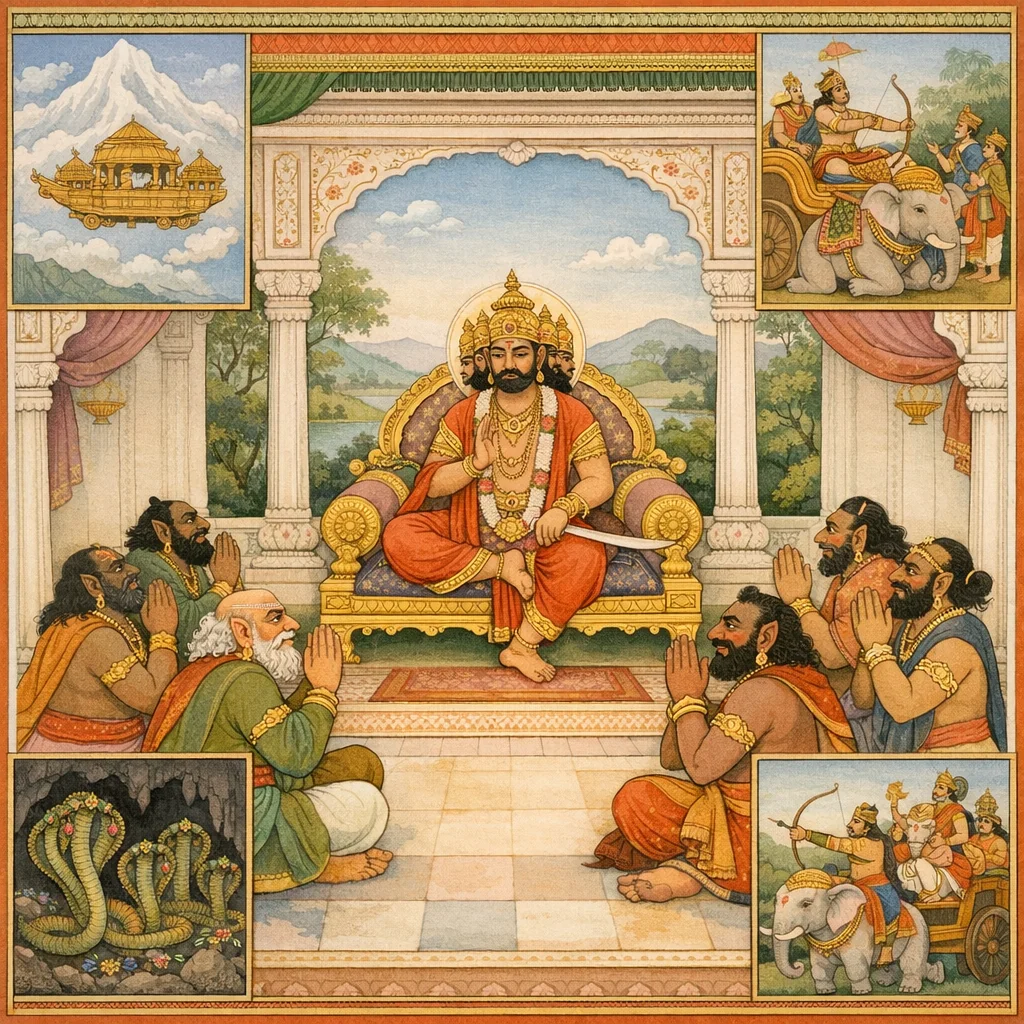
In this chapter, the rākṣasa elders and warriors address Rāvaṇa with folded hands, attempting to stabilize his resolve through courtly reassurance and martial boasting. They argue that the threat arises from ‘ordinary’ opponents and should not trouble the king’s mind, while also revealing a lack of nuanced political intelligence in their assessment of the enemy. The speech functions as a catalog of Rāvaṇa’s prior conquests: subjugation of nāgas in Rasātala (including Vāsuki and Takṣaka), humiliation of Kubera and seizure of the Puṣpaka vimāna from Kailāsa, and the alliance-by-fear that brought Mandodarī (daughter of the dānava Maya) as wife. The court further praises victories over dānavas (including Madhu) and mythic warfare imagery describing a plunge into a ‘Yama-loka ocean’ of death-like perils, emphasizing Rāvaṇa’s reputation for overcoming existential threats. The counsel culminates in strategic recommendation: dispatch Indrajit, credited with obtaining rare boons from Maheśvara through sacrifice and with having once captured Indra and entered Laṅkā with him, to annihilate the vānar forces and even Rāma.
Shlokas
Verse 1
इत्युक्ताराक्षसेन्द्रेणराक्षसास्तेमहाबलाः ।ऊचुःप्रान्जलयःसर्वेरावणंराक्षसेश्वरम् ।।।।
Thus addressed by the lord of the Rākṣasas, those mighty Rākṣasas—all with hands joined in salute—spoke to Rāvaṇa, the ruler of the Rākṣasas.
Verse 2
द्विषत्पक्षमविज्ञायनीतिबाह्यास्त्वबुद्धयः ।राजन्परिघशक्त्यृष्टिशूलपट्टिशकुन्तलम् ।।।।
Not understanding the enemy’s side, and lacking statecraft, they are foolish—though, O king, they bear iron bars, javelins, spears, tridents, swords, and sharp lances.
Verse 3
इत्युक्ताराक्षसेन्द्रेणराक्षसास्तेमहाबलाः ।ऊचुःप्रान्जलयःसर्वेरावणंराक्षसेश्वरम् ।।।।द्विषत्पक्षमविज्ञायनीतिबाह्यास्त्वबुद्धयः ।
Thus addressed by the lord of the rākṣasas, those powerful rākṣasas—ignorant of the enemy’s side and devoid of sound statecraft—spoke to Rāvaṇa, the ruler of rākṣasas, with hands joined in supplication.
Verse 4
राजन्परिघशक्त्यृष्टिशूलपट्टिशकुन्तलम् ।।।।
O King, (we possess weapons such as) iron clubs, javelins, swords, spears, barbed/trident-like weapons, and ploughshares.
Verse 5
सुमहन्नोबलंकस्माद्विषादंभजतेभवान् ।त्वयाभोगवतींगत्वानिर्जिताःपन्नगायुधि ।।।।
Why do you give way to despondency, when our power is so great? When you went to Bhogavatī, the serpent-beings were defeated by you in battle.
Verse 6
कैलासशिखरावासीयक्षैर्बहुभिरावृतः ।सुमहत्कदनंकृत्वावश्यस्तेधनदःकृतः ।।6.7.6।।
Kubera (Dhanada), dwelling on the peak of Kailāsa and surrounded by many yakṣas, was brought under your control after you wrought a great slaughter.
Verse 7
समहेश्वरसख्येनश्लाघमानस्त्वयाविभो ।निर्जितःसमरेरोषाल्लोकपालोमहाबलः ।।।।
O mighty lord! Though he boasted of his friendship with Maheśvara (Śiva), that powerful Lokapāla was, in wrathful battle, subdued by you.
Verse 8
विनिहत्यचयक्षौघान्विक्षोभ्यचविनिगृह्यच ।त्वयाकैलासशिखराद्विमानमिदमाहृतम् ।।।।
After striking down the hordes of Yakṣas—shaking them into turmoil and overpowering them—you brought this very aerial car from the peak of Kailāsa.
Verse 9
मयेनदानवेन्द्रेणत्वद्भयात्सख्यमिच्छता ।दुहितातवभार्यार्थेदत्ताराक्षसपुङ्गव ।।।।
O foremost of Rākṣasas! Maya, lord of the Dānavas, seeking alliance out of fear of you, gave his daughter to you as a wife.
Verse 10
दानवेन्द्रोमधुर्नामवीर्योत्सिक्तोदुरासदः ।विगृह्यवशमानीतःकुम्भीनस्याःसुखावहः ।।।।
“Madhu by name—the lord of the Dānavas, proud of his prowess and hard to assail—who brought joy to Kumbhīnasī as her husband, was challenged and brought under your sway.”
Verse 11
निर्जितास्तेमहाबाहोनागागत्वारसातलम् ।वासुकिस्तक्षकःशङखोजटीचवशमाहृताः ।।।।
“O mighty-armed one, going down to Rasātala you conquered the Nāgas—Vāsuki, Takṣaka, Śaṅkha, and Jaṭī—and brought them under your control.”
Verse 12
अक्षयाबलवन्तश्चशूरालब्धवराःपुनः ।त्वयासंवत्सरंयुद्ध्वासमरेदानवाविभो ।।।।
“O mighty lord, even the Dānavas—imperishable, powerful, heroic, and boon-endowed—fought you in war for a full year.”
Verse 13
स्वबलंसमुपाश्रित्यनीतावशमरिन्दम ।मायाश्चाधिगतास्तत्रबह्व्योवैराक्षसाधिप ।।।।
O king of the Rākṣasas—subduer of foes—by relying on your own strength they were brought under control; and from them, indeed, many arts of illusion were learned there.
Verse 14
शूराश्चबलवन्तश्चवरुणस्यसुतारणे ।निर्जितास्तेमहाभागचतुर्विधबलानुगाः ।।।।
O fortunate king, in battle you overcame the heroic and mighty sons of Varuṇa—those who were attended by the fourfold army.
Verse 15
मृत्युदण्डमहाग्राहंशाल्मलिद्रुममण्डितम् ।कालपाशमहावीचिंयमकिंकरपन्नगम् ।।।।महाज्वरेणदुर्धर्षंयमलोकमहार्णवम् ।अवगाह्यत्वयाराजन्यमस्यबलसागरम् ।।।।जयश्चविपुलःप्राप्तोमृत्युश्चप्रतिषेधितः ।सुयुद्धेनचतेसर्वेलोकास्तत्रसुतोषिताः ।।।।
You plunged into that ocean-like realm of Yama—where the Rod of Death was a monstrous alligator, where śālmalī trees stood as its grim adornment, where the Noose of Time rose as a towering wave, and where Yama’s attendants swarmed like serpents.
Verse 16
मृत्युदण्डमहाग्राहंशाल्मलिद्रुममण्डितम् ।कालपाशमहावीचिंयमकिंकरपन्नगम् ।।6.7.15।।महाज्वरेणदुर्धर्षंयमलोकमहार्णवम् ।अवगाह्यत्वयाराजन्यमस्यबलसागरम् ।।6.7.16।।जयश्चविपुलःप्राप्तोमृत्युश्चप्रतिषेधितः ।सुयुद्धेनचतेसर्वेलोकास्तत्रसुतोषिताः ।।6.7.17।।
O king, having plunged into that vast ocean which was Yama’s world—unassailable because of the great fever-spirit—you confronted and crossed the ocean-like host of Yama’s forces.
Verse 17
मृत्युदण्डमहाग्राहंशाल्मलिद्रुममण्डितम् ।कालपाशमहावीचिंयमकिंकरपन्नगम् ।।6.7.15।।महाज्वरेणदुर्धर्षंयमलोकमहार्णवम् ।अवगाह्यत्वयाराजन्यमस्यबलसागरम् ।।6.7.16।।जयश्चविपुलःप्राप्तोमृत्युश्चप्रतिषेधितः ।सुयुद्धेनचतेसर्वेलोकास्तत्रसुतोषिताः ।।6.7.17।।
Thus you won vast victory and even checked back death; and by your noble fighting, all the worlds there were greatly pleased.
Verse 18
क्षत्रियैर्बहुभिर्वीरैःशक्रतुल्यपराक्रमैः ।आसीद्वसुमतीपूर्णामहद्भिरिवपादपैः ।।।।
The earth was filled with many kṣatriya heroes, whose prowess was like Indra’s—standing upon her like great trees.
Verse 19
तेषांवीर्यगुणोत्साहैर्नसमोराघवोरणे ।प्रसह्यतेत्वयाराजन्हताःसमरदुर्जयाः ।।।।
In valor, excellence, and ardor, Rāghava was not their equal in battle; yet you, O king, overpowered and slew those who were hard to defeat in war.
Verse 20
तिष्ठवाकिंमहाराजश्रमे णतववानरान् ।अयमेकोमहाबाहुरिन्द्रजित्क्षपयिष्यति ।।।।
Stay, O great king—why weary yourself against your monkey-foes? This mighty-armed Indrajit alone will destroy them.
Verse 21
अनेनहिमहाराजमहेश्वरमनुत्तमम् ।इष्ट्वायज्ञंवरोलब्धोलोकेपरमदुर्लभः ।।।।
For by him, O great king, having worshipped the supreme Maheśvara through sacrifice, a boon was obtained—one exceedingly rare in the world.
Verse 22
शक्तितोमरमीनंचविनिकीर्णान्त्रशैवलम् ।गजकछपसम्बाधमश्वमण्डूकसंकुलम् ।।6.7.22।।रुद्रादित्यमहाग्राहंमरुद्वसुमहोरगम् ।रथश्वगजतोयौघंपदातिपुलिनंमहत् ।।6.7.23।।अनेनहिसमासाद्यदेवानांबलसागरम् ।गृहीतोदैवतपतिर्लङ्कांचापिप्रवेशितः ।।6.7.24।।
He (Rāvaṇa) had once come upon that ‘ocean of the gods’—an ocean teeming with fish that were spears and javelins, with water-weeds made of scattered entrails; crowded with elephants like tortoises, and filled with horses like frogs.
Verse 23
शक्तितोमरमीनंचविनिकीर्णान्त्रशैवलम् ।गजकछपसम्बाधमश्वमण्डूकसंकुलम् ।।6.7.22।।रुद्रादित्यमहाग्राहंमरुद्वसुमहोरगम् ।रथश्वगजतोयौघंपदातिपुलिनंमहत् ।।6.7.23।।अनेनहिसमासाद्यदेवानांबलसागरम् ।गृहीतोदैवतपतिर्लङ्कांचापिप्रवेशितः ।।6.7.24।।
That vast ocean had Rudras and Ādityas as its great crocodiles, Maruts and Vasus as its mighty serpents; its surging waters were chariots, horses, and elephants, and its broad sandbanks were the masses of foot-soldiers.
Verse 24
शक्तितोमरमीनंचविनिकीर्णान्त्रशैवलम् ।गजकछपसम्बाधमश्वमण्डूकसंकुलम् ।।6.7.22।।रुद्रादित्यमहाग्राहंमरुद्वसुमहोरगम् ।रथश्वगजतोयौघंपदातिपुलिनंमहत् ।।6.7.23।।अनेनहिसमासाद्यदेवानांबलसागरम् ।गृहीतोदैवतपतिर्लङ्कांचापिप्रवेशितः ।।6.7.24।।
Indeed, after meeting that ocean-like host of the gods, the lord of the gods (Indra) was seized by him and even carried into Laṅkā.
Verse 25
पितामहनियोगाच्चमुक्तःशम्बरवृत्रहा ।गतस्त्रिविष्टपम्राजन्सर्वदेवनमस्कृतः ।।।।
Released by the ordinance of Pitāmaha (Brahmā), Indra—slayer of Śambara and Vṛtra—returned to Triviṣṭapa (heaven), honored by all the gods, O King.
Verse 26
तमेवत्वंमहाराजविसृजेन्द्रजितंसुतम् ।यावद्वानरसेनांतांसरामांनयतिक्षयम् ।।।।
Therefore, O great king, dispatch your son Indrajit at once, so that he may bring that army of vānaras—together with Rāma—to destruction.
Verse 27
राजन्नापदयुक्तेयमागताप्राकृताज्जनात् ।हृदिनैवत्वयाकार्यात्वंवधिष्यसिराघवम् ।।।।
O King, this peril has come from mere ordinary folk; do not take it to heart—surely you will slay Rāghava (Rāma).
Frequently Asked Questions
The pivotal action is the court’s attempt to shape royal decision-making through flattery and selective precedent, minimizing the enemy and urging escalation by dispatching Indrajit—highlighting the ethical risk of counsel that prioritizes pride over accurate threat assessment.
The dialogue illustrates how power can become epistemically fragile: lacking nīti (political discernment), a court may confuse past victories and divine boons with guaranteed success, turning rhetoric into a substitute for strategic truth.
Key landmarks include Rasātala and Bhogavatī (subterranean nāga realms), Kailāsa (Kubera’s domain and the source of the vimāna), Laṅkā (the political-military center), and mythic Yama-loka imagery used to magnify Ravana’s martial reputation.