Sarga 65
कुम्भकर्णप्रस्थानम् — Kumbhakarna’s Departure for Battle
युद्धकाण्ड
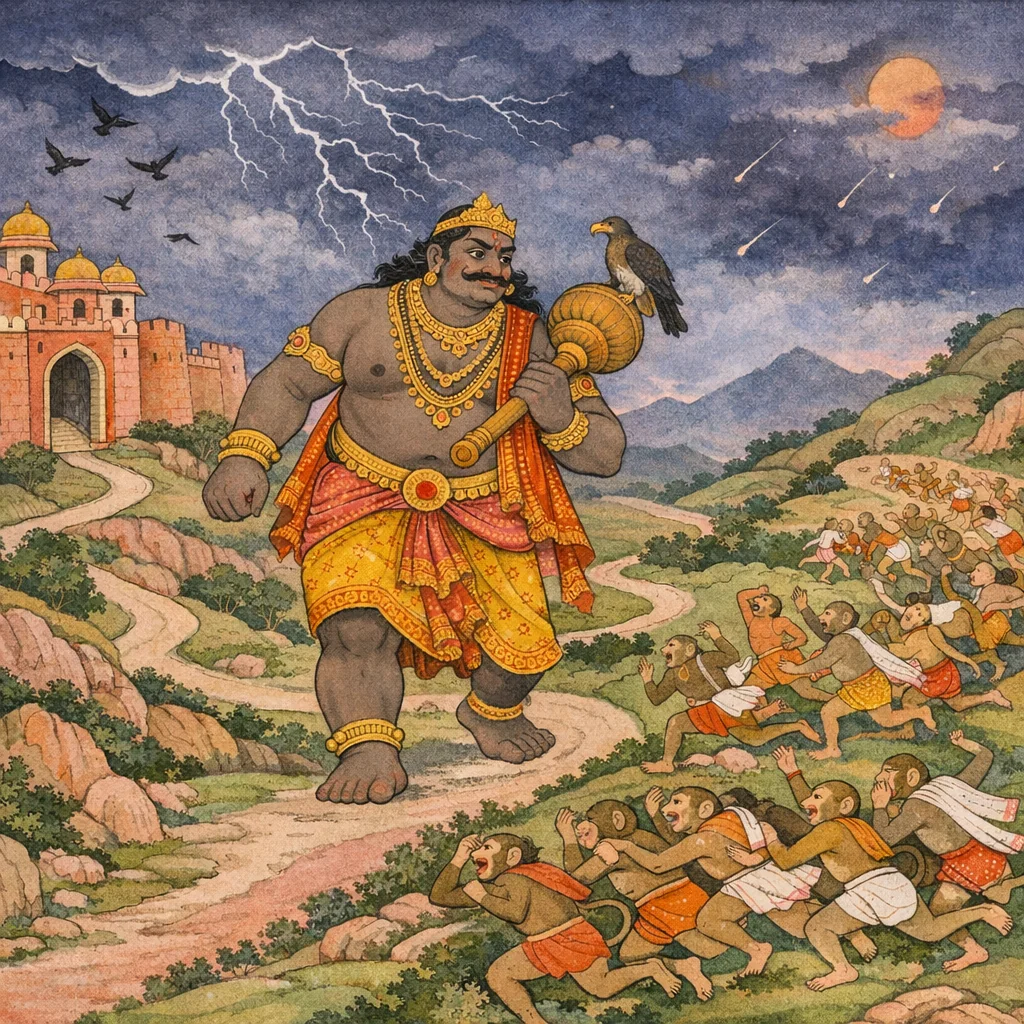
Sarga 65 frames Kumbhakarṇa’s mobilization as a courtly-counsel episode turning into a ritualized arming and sortie. Kumbhakarṇa rebukes Mahodara’s discouraging tone and asserts a warrior’s ethic: deeds, not self-praise, validate valor; he declares he will go to the battlefield to rectify the collective strategic failures. Rāvaṇa replies with persuasion and reassurance—diagnosing Mahodara’s fear of Rāma, praising Kumbhakarṇa’s unmatched strength and goodwill, and urging him to destroy the Vānara host and the two princes. Kumbhakarṇa vows to remove Rāvaṇa’s dread by killing Rāma, proposes advancing alone while the army stays, but Rāvaṇa cautions against solitary overconfidence and orders a guarded advance. A ceremonial investiture follows: garlands, armlets, rings, ornaments, crown, earrings, girdle, and armor are placed upon Kumbhakarṇa, who is described through cosmic similes (fire, moon, Narāyaṇa/Trivikrama). As he sets out amid drums, conches, chariots, elephants, and diverse mounts, ominous portents arise—dark clouds with lightning, jackals, circling birds, a vulture alighting on his weapon, meteors, dimmed sun, and still wind—yet he proceeds under the compulsion of destiny. Crossing the rampart, he terrifies the Vānara ranks; their dispersal and collapse under his roar establishes the sarga’s thematic hinge: rhetorical confidence and royal pageantry against the counterweight of ominous signs and impending mortality.
Shlokas
Verse 1
स तथोक्तस्तुनिर्भर्त्स्यकुम्भकर्णोमहोदरम् ।अब्रवीद्राक्षसश्रेष्ठंभ्रातरंरावणंततः ।।।।
Thus spoken to, Kumbhakarna rebuked Mahodara; then he addressed his brother Ravana, the foremost among the Rakshasas.
Verse 2
सोऽहंतवभयंघोरंवधात्तस्यदुरात्मनः ।रामस्याद्यप्रमार्जामिनिर्वैरोहिसुखीभव ।।।।
I shall wipe away your dreadful fear today by killing that wicked-souled Rāma; be free from enmity, and be at ease.
Verse 3
गर्जन्ति न वृथाशूरानिर्जलाइवतोयदाः ।पश्यसम्पद्यमानंतुगर्जितंयुधिकर्मणा ।।।।
Heroes do not roar in vain, like clouds that hold no water; behold my roar proved true through deeds on the battlefield.
Verse 4
न मर्षयन्तिचात्मानंसम्भावयतिनात्मना ।अदर्शयित्वाशूरास्तुकर्मकुर्वन्तिदुष्करम् ।।।।
True warriors do not indulge themselves even when honored; they do not praise themselves. Without making a display, they accomplish deeds that are hard to perform.
Verse 5
विक्लबानामबुद्धीनांराज्ञापण्डितमानिनाम् ।श्रृण्वतासदितमिदंत्वाद्विधानांमहोदर ।।।।
Fearsome jackals howled, with flaming morsels in their mouths; and birds circled in inauspicious (leftward) rounds and then settled.
Verse 6
युद्धेकापुरुषैर्नित्यंभवद्भिःप्रियवादिभि: ।राजानमनुगच्छद्भिःसर्वंकृत्यमोद्धिसादितम् ।।।।
“You—ever cowardly in battle, though sweet-tongued—by trailing after the king and flattering him, have brought every affair to this ruin.”
Verse 7
राजशेषाकृतालङ्काक्षीणःकोशोबलंहतम् ।राजानमिममासाद्यसुहृचचिह्नममित्रकम् ।।।।
“Laṅkā has been reduced to what is left of a kingdom; the treasury is depleted and the army destroyed—because hostile men, wearing the marks of friendship, have surrounded and swayed this king.”
Verse 8
एषनिर्याम्यहंयुद्धमुद्यतश्शत्रुनिर्जये ।दुर्नयंभवतामद्यसमीकर्तुंमिहाहवे ।।।।
Thus I now set out for battle, ready to overpower the enemies, so that here in the fight I may atone for—and set right—the misjudgments committed by you all.
Verse 9
एवमुक्तवतोवाक्यंकुम्भकर्णस्यधीमतः ।प्रत्युवाचततोवाक्यंप्रहसन्राक्षसाधिपः ।।।।
When the wise Kumbhakarṇa had spoken thus, the lord of the rākṣasas then—smiling with a laugh—replied with his own words.
Verse 10
महोदरोऽयंरामात्तुपरित्रस्तो न संशयः ।न हिरोचयतेतात युद्धंयुद्धविशारद ।।।।
This Mahodara is frightened of Rama—there is no doubt. He does not truly approve of war, my dear, even though he is skilled in battle.
Verse 11
कश्चिन्मेत्वत्समोनास्तिसौहृदेनबलेन च ।गच्छशत्रुवधायत्वंकुम्भकर्णजयाय च ।।।।
None is your equal for me—neither in loyal affection nor in strength. Go, Kumbhakarna, to slay the enemies and to win victory.
Verse 12
तस्मात्तुशत्रुनाशार्थंभवान्सम्बोधितोमया ।अयंहिकालस्सुहृदांराक्षसानामरिन्दम ।।।।
Therefore you have been roused by me for the destruction of the enemy. For this is indeed the critical hour for the Rakshasas and their allies, O subduer of foes.
Verse 13
तद्गच्छशूलमादायपाशहस्तइवान्तकः ।वानरान्राजपुत्रौ च भक्ष्यादित्यतेजसा ।।।।
So go—taking up the trident—like Death himself holding the noose in his hand; with sun-like radiance, devour the Vanaras and the two royal princes.
Verse 14
समालोक्यतुतेरूपंविद्रविष्यन्तिवानराः ।रामलक्ष्मणयोश्चापिहृदयेप्रस्फुटिष्यतः ।।।।
Seeing your terrifying form, the Vānara hosts will flee; and even the hearts of Rāma and Lakṣmaṇa will be shattered.
Verse 15
एवमुक्त्वामहातेजाःकुम्भकर्णंमहाबलम् ।पुनर्जातमिवात्मानंमेनेराक्षसपुङ्गवः ।।।।
Having spoken thus to mighty Kumbhakarṇa, the radiant leader among the Rākṣasas felt as though he himself had been born anew.
Verse 16
कुम्भकर्णबलाभिज्ञोजानंस्तस्यपराक्रमम् ।बभूवमुदितोराजाशशाङ्कइवनिर्मलः ।।।।
Knowing Kumbhakarṇa’s strength and valor, the king became joyful—clear and serene like the spotless moon.
Verse 17
इत्येवमुक्तःसम्हृष्टोनिर्जगाममहाबलः ।राज्ञस्तुवचनंश्रुत्वाकुम्भकर्णस्समुद्यत:।। ।।
Thus addressed, the mighty Kumbhakarṇa—delighted on hearing the king’s words—rose up and set forth.
Verse 18
आददेनिशितंशूलंवेगाच्छत्रुनिबर्हणम् ।सर्वकालायसंदीप्तंतप्तकाञ्चनभूषणम् ।।।।
In haste he seized a sharp śūla, a slayer of foes—glowing like dark iron, adorned with ornaments of heated gold.
Verse 19
इन्द्राशनिसमंभीमंवज्रप्रतिमगौरवम् ।देवदानवगन्धर्वयक्षपन्नगसूदनम् ।। ।।रक्तमाल्यंमहाधामंस्वतश्चोद्गतपावकम् ।आदायनिशितंशूलंशत्रुशोणितरञ्जितम् ।।।।कुम्भकर्णोमहातेजारावणंवाक्यमब्रवीत् ।
Taking up that sharp śūla—terrible like Indra’s thunderbolt, heavy as a vajra, a slayer of Devas, Dānavas, Gandharvas, Yakṣas, and serpentine beings—wreathed in red garlands, blazing with great radiance, as if fire rose from it of itself, stained with the blood of foes—mighty Kumbhakarṇa spoke to Rāvaṇa.
Verse 20
इन्द्राशनिसमंभीमंवज्रप्रतिमगौरवम् ।देवदानवगन्धर्वयक्षपन्नगसूदनम् ।।6.65.19 ।।रक्तमाल्यंमहाधामंस्वतश्चोद्गतपावकम् ।आदायनिशितंशूलंशत्रुशोणितरञ्जितम् ।।6.65.20।।कुम्भकर्णोमहातेजारावणंवाक्यमब्रवीत् ।
Wielding that sharp śūla—dreadful like Indra’s thunderbolt, heavy as a vajra, a destroyer of celestial and netherworld beings, blazing and garlanded in red, reddened with enemy blood—mighty Kumbhakarṇa spoke to Rāvaṇa.
Verse 21
गमिष्याम्यहमेकाकीतिष्ठत्विहबलंमम ।।।।अद्यतान् क्षुभितान् क्रुद्धोभक्षयिष्यामिवानरान् ।
I will go forth alone; let my forces remain here. Today, in wrath, I shall devour those agitated Vānara warriors.
Verse 22
कुम्भकर्णवचश्श्रुत्वारावणोवाक्यमब्रवीत् ।।।।सैन्यैःपरिवृतोगच्छशूलमुद्गतपाणिभिः ।
Hearing Kumbhakarṇa’s words, Rāvaṇa replied: “Go forth surrounded by the troops, with the śūla held aloft in your hands.”
Verse 23
वानराहिमहात्मानश्शीघ्रास्सव्यवसायिनः ।।।।एकाकिनंप्रमत्तंवानयेयुद्धशनैःक्ष्यम् ।
For the Vānara warriors are great-souled, swift, and steadfast in resolve; if one is alone or off guard, they will wear him down in battle and destroy him—even with their teeth.
Verse 24
तस्मात्परमदुर्धर्षै: सैन्यैःपरिवृतोव्रज ।।।।रक्षसामहितंसर्वंशत्रुपक्षंनिषूदय ।
Therefore, go forth surrounded by armies that are exceedingly hard to assail, and strike down the entire enemy faction—those who are hostile to the Rākṣasas.
Verse 25
अथासनात्समुत्पत्यस्रजं मणिकृतान्तराम् ।।।।आबबन्धमहातेजाःकुम्भकर्णस्यरावणः ।
Then the radiant Rāvaṇa rose from his seat and fastened upon Kumbhakarṇa a flower-garland set with intervals of gems.
Verse 26
अङ्गदान्यङ्गुलीवेष्टान्वराण्याभरणानि च ।।।।हारं च श्शिसङ्काशमाबबन्दमहात्मनः ।
He placed upon that great-souled one armlets, rings, exquisite ornaments, and a necklace gleaming like the moon.
Verse 27
दिव्यानि च सुगन्धीनिमाल्यदामानिरावणः ।।।।श्रोत्रिचासञ्जयामासश्रीमतीचास्यकुण्डले ।
Rāvaṇa also set on him heavenly, fragrant garland-strings, and he hung upon his ears splendid earrings.
Verse 28
काञ्चनाङ्गदकेयूरोनिष्काभरणभूषितः ।।।।कुम्भकर्णोबृहत्कर्णस्सुहुतोऽग्निरिवाबभौ ।
Adorned with golden armlets and bracelets and decorated with niṣka-ornaments, Kumbhakarṇa—broad-eared—shone like a well-kindled sacrificial fire.
Verse 29
श्रोणीसूत्रेणमहतामेचकेनव्यराजत ।।।।अमृतोत्पादनेनद्धोभुजङ्गेनेवमन्दरः ।
With a massive dark girdle about his hips he gleamed, like Mount Mandara bound by the serpent for the churning that brought forth nectar.
Verse 30
स काञ्चनंभारसहंनिवातंविद्युत्प्रभंदीप्तमिवात्मभासा ।आबध्यमानःकवचंरराजसन्ध्याभ्रसम्वीतराजः ।।।।
As he was being strapped into a heavy golden cuirass—wind-firm, lightning-bright, blazing with its own radiance—he shone like a kingly mountain wrapped in the clouds of twilight.
Verse 31
सर्वाभरणसर्वाङ्गश्शूलपाणिस्सराक्षसः ।त्रिविक्रमकृतोत्साहोनारायणइवाबभौ ।।।।भ्रातरंसम्परिष्वज्यकृत्वाचापिप्रदक्षिणम् ।प्रणम्यशिरसातस्मैसम्प्रतस्थेमहाबलः ।।।।
Adorned on every limb, that Rākṣasa, holding a trident, appeared like Nārāyaṇa poised for the three strides. Then, embracing his brother, circling him in reverence, and bowing his head, the mighty one set out.
Verse 32
सर्वाभरणसर्वाङ्गश्शूलपाणिस्सराक्षसः ।त्रिविक्रमकृतोत्साहोनारायणइवाबभौ ।।6.65.31।।भ्रातरंसम्परिष्वज्यकृत्वाचापिप्रदक्षिणम् ।प्रणम्यशिरसातस्मैसम्प्रतस्थेमहाबलः ।।6.65.32।।
Endowed with great strength, he embraced his brother, circumambulated him in reverence, bowed with his head, and then set forth.
Verse 33
निष्पतन्तंमहाकायंमहानादंमहाबलम् ।तमाशीर्भिःप्रशस्ताभिःप्रेषयामासरावणः ।।।।
As the huge-bodied, thunder-voiced, mighty one was setting out, Rāvaṇa sent him forth with auspicious benedictions.
Verse 34
शङ्खदुन्दुभिनिर्घोषैस्सैन्यैश्चापिवरायुथैः ।तंगजैश्चतुरङ्गैश्चस्यन्दनैश्चाम्बुदस्वनैः ।।।।अनुजग्मुर्महात्मानं रथिनो रथिनां वरम् ।
Amid the blare of conches and drums, with troops bearing excellent weapons—along with elephants, horses, and thunder-sounding chariots—the chariot-warriors followed that great-souled hero, the foremost among charioteers.
Verse 35
सर्पैरुष्ट्रैःखरैरश्वैस्सिम्हद्विपमृगद्विजैः ।अनुजग्मुश्चतंघोरंकुम्भकर्णंमहाबलम् ।।।।
They followed the dreadful, mighty Kumbhakarṇa—mounted on serpents, camels, donkeys, horses, and even lions, elephants, deer, and birds.
Verse 36
स पुष्पवर्षैरवकीर्यमाणोधृतातपत्रःशितशूलपाणिः ।मदोत्कटःशोणितगन्धमत्तोविनिर्ययौदावनदेवशत्रुः ।।।।
Showered with cascades of flowers, shaded by a parasol, holding a sharp trident, intoxicated with drink and maddened by the scent of blood, that foe of devas and dānavas sallied forth.
Verse 37
पदातयश्चबहवोमहानादामहाबलाः ।अन्वयूराक्षसाभीमाभीमाक्षाश्शस्त्रपाणयः ।।।।
Many rākṣasas followed on foot—roaring loudly, powerful, terrifying, with dreadful eyes, bearing weapons in their hands.
Verse 38
रक्ताक्षास्सुमहाकायानीलाञ्चनचयोपमाः ।शूलानुद्यम्यखडगांश्चनिशितांश्चपरश्वधान् ।।।।बहुव्यामांश्चपरिघान्गदाश्चमुसलानि च ।तालस्कन्धांश्चविपुलान्क्षेपणीयान्दुरासदान् ।।।।
Red-eyed and huge-bodied, dark as heaps of blue collyrium, they marched forth brandishing tridents, swords, and sharpened axes—along with iron bars of many spans, maces, clubs, massive palm-trunks, and hard-to-resist missiles.
Verse 39
रक्ताक्षास्सुमहाकायानीलाञ्चनचयोपमाः ।शूलानुद्यम्यखडगांश्चनिशितांश्चपरश्वधान् ।।6.65.38।।बहुव्यामांश्चपरिघान्गदाश्चमुसलानि च ।तालस्कन्धांश्चविपुलान्क्षेपणीयान्दुरासदान् ।।6.65.39।।
They bore iron bars of many spans, maces and clubs, and massive palm-trunks—throwable weapons that were hard to withstand.
Verse 40
अथान्यद्वपुरादायदारुणंरोमहर्षणम् ।निष्पपातमहातेजाःकुम्भकर्णोमहाबलः ।।।।धनुःशतपरीणाहः स षट्छत्रसमुच्छ्रितः ।रौद्रःशकटचक्राक्षोमहापर्वतसन्निभः ।।।।
Then the mighty, radiant Kumbhakarṇa assumed another form—terrible and hair-raising—and sprang forth: a body a hundred bows in girth, rising to the height of six hundred bows, fierce, with eyes like chariot-wheels, like a great mountain.
Verse 41
अथान्यद्वपुरादायदारुणंरोमहर्षणम् ।निष्पपातमहातेजाःकुम्भकर्णोमहाबलः ।।6.65.40।।धनुःशतपरीणाहः स षट्छत्रसमुच्छ्रितः ।रौद्रःशकटचक्राक्षोमहापर्वतसन्निभः ।।6.65.41।।
He was a hundred bow-lengths in girth and rose to the height of six hundred bows; wrathful, with eyes like chariot-wheels, he looked like a vast mountain.
Verse 42
सन्निपत्य च रक्षांसिदग्धशैलोपमामहान् ।कुम्भकर्णोमहावक्त्रःप्रहसन्निदमब्रवीत् ।।।।
Drawing near the rākṣasas, the great Kumbhakarṇa—like a charred mountain, with a vast mouth—laughed and spoke these words.
Verse 43
अद्यवानरमुख्यानांतानियूथानिभागश ।निर्दहिष्यामिसङ्ख्रुद्धश्शलाभानिवपावकः ।।।।
“Today, in fury, I will burn up those troops of the vanara leaders—division by division—like fire consumes moths.”
Verse 44
नापराध्यन्तिमेकामंवानरा: वनचारिणः ।जातिरस्मद्विधानांसापुरोद्यानविभूषणम् ।।।।
“Those vanaras who roam the forests have never, of their own will, offended me. That very kind is, for people like us, an ornament of the royal gardens.”
Verse 45
पुररोधस्यमूलंतुराघवस्सहलक्ष्मणः ।हतेतस्मिन् हतंसर्वंतंवधिष्यामिसंयुगे ।।।।
“But the true root of this siege of the city is Rāghava together with Lakṣmaṇa. If he is slain, everything is as good as slain; therefore I will kill him in battle.”
Verse 46
एवंतस्यब्रुवाणस्यकुम्भकर्णस्यराक्षसाः ।नादंचक्रुर्महाघोरंकम्पयन्तइवार्णवम् ।।।।
As Kumbhakarṇa spoke thus, the rākṣasas raised a dreadful roar, as though they were shaking the ocean itself.
Verse 47
तस्यनिष्पततस्तूर्णंकुम्भकर्णस्यधीमतः ।बभूवुर्घोररूपाणिनिमित्तानिसमन्ततः ।।।।
As the wise Kumbhakarṇa rushed forth swiftly, dreadful omens appeared on every side.
Verse 48
उल्काशनियुतामेघाबभूवुर्गर्धभारुणाः ।ससागरवनाचैववसुधासमकम्पत ।।।।
Clouds, donkey-colored and charged with meteors, thunder, and lightning, gathered; and the earth—with its oceans and forests—seemed to tremble.
Verse 49
घोररूपाश्शिवानेदुस्सज्वालकबलैर्मुखैः ।मण्डलान्यपसव्यानिबबन्धुश्चविहङ्गमाः ।।।।
Fearsome jackals howled, with flaming morsels in their mouths; and birds circled in inauspicious (leftward) rounds and then settled.
Verse 50
निष्पपात च गृध्रोमालेवाऽस्यपथिगच्छतः ।प्रास्फुरन्नयनंचास्यसव्योबाहुश्चकम्पत ।।।।
As he advanced along the road, an eagle suddenly alighted—like a garland—upon his spear; and his eye began to twitch, while his left arm/shoulder throbbed: ominous signs on his march.
Verse 51
निष्पपाततदाचोल्काज्वलन्तीभीमनिश्श्वना ।आदित्योनिष्प्रभश्चासीन्नप्रवाति च ऽनिलः ।।।।
Then a blazing meteor fell with a terrifying roar; the sun grew dim, and even the wind failed to blow—cosmic omens gathering around the coming conflict.
Verse 52
अचिन्तयन्महोत्पातानुदितान्रोमहर्षणान् ।निर्ययौकुम्भकर्णस्तुकृतान्तबलचोदितः ।।।।
But Kumbhakarṇa went forth without heeding those great, hair-raising portents, driven onward as though compelled by the power of Death and destiny.
Verse 53
न लङ्घयित्वाप्राकारंपद्भ्यांपर्वतसन्निभः ।ददर्शाभ्रघनप्रख्यंवानरानीकमद्भुतम् ।।।।
Mountain-like in form, he advanced on foot, crossing the rampart, and beheld the wondrous host of Vānaras, massed like a thick bank of clouds.
Verse 54
तेदृष्टवाराक्षसश्रेष्ठंवानराःपर्वतोपमम् ।वायुनुन्नाइवघनाययुस्सर्वादिशस्तदा ।।।।
Seeing the foremost of the Rākṣasas, mountain-like in stature, the Vānaras scattered then in every direction, like clouds driven apart by the wind.
Verse 55
तद्वानरानीकमतिप्रचण्डंदिशोद्रवद्भिन्नमवाभ्रजालम् ।स कुम्भकर्णस्समवेक्ष्यहर्षान्ननादभूयोघनवद्घनाभः ।।।।
Seeing that fiercely formidable Vānara host now broken and fleeing in all directions like a web of clouds, Kumbhakarṇa—dark as a raincloud—roared again and again in exultation.
Verse 56
तेतस्यघोरंनिनदंनिशम्ययथानिनादंदिविवारिदस्य ।पेतुर्धरण्यांबहवःप्लवङ्गानिकृत्तमूलाइवशालवृक्षाः ।।।।
Hearing his dreadful roar—like the thunder of rainclouds in the sky—many Vānaras collapsed to the earth, like śāla trees falling when their roots have been cut.
Verse 57
विपुलपरिघवान् स कुम्भकर्णोरिपुनिधनायविनिस्पृतोत्मा ।कपिषणभयमाददत्सुभीमंप्रभुरिवदण्डवान्युगान्ते ।।।।
Bearing a massive iron club, Kumbhakarṇa—set loose for the destruction of enemies—advanced as a terrifying source of fear to the Vānara ranks, like a sovereign wielder of punishment at the end of an age.
Frequently Asked Questions
The sarga contrasts fear-based counsel with duty-based action: Kumbhakarṇa condemns demoralizing speech, commits to repairing collective failures through battlefield responsibility, while Rāvaṇa balances praise with strategic caution against reckless solitary combat.
Valor is authenticated by conduct rather than self-advertisement, yet true leadership integrates courage with prudence; additionally, the narrative juxtaposes human agency (arming, counsel, resolve) with nimitta and daiva (portents and destiny) to frame war as morally charged and time-bound.
Laṅkā’s prākāra (rampart) marks the threshold from courtly order to battlefield chaos, while the ceremonial gifting of garlands, ornaments, parasol, and armor reflects royal investiture culture; the omen imagery (sky, ocean, birds, jackals, meteors) situates the march within traditional Sanskrit portent-lore.