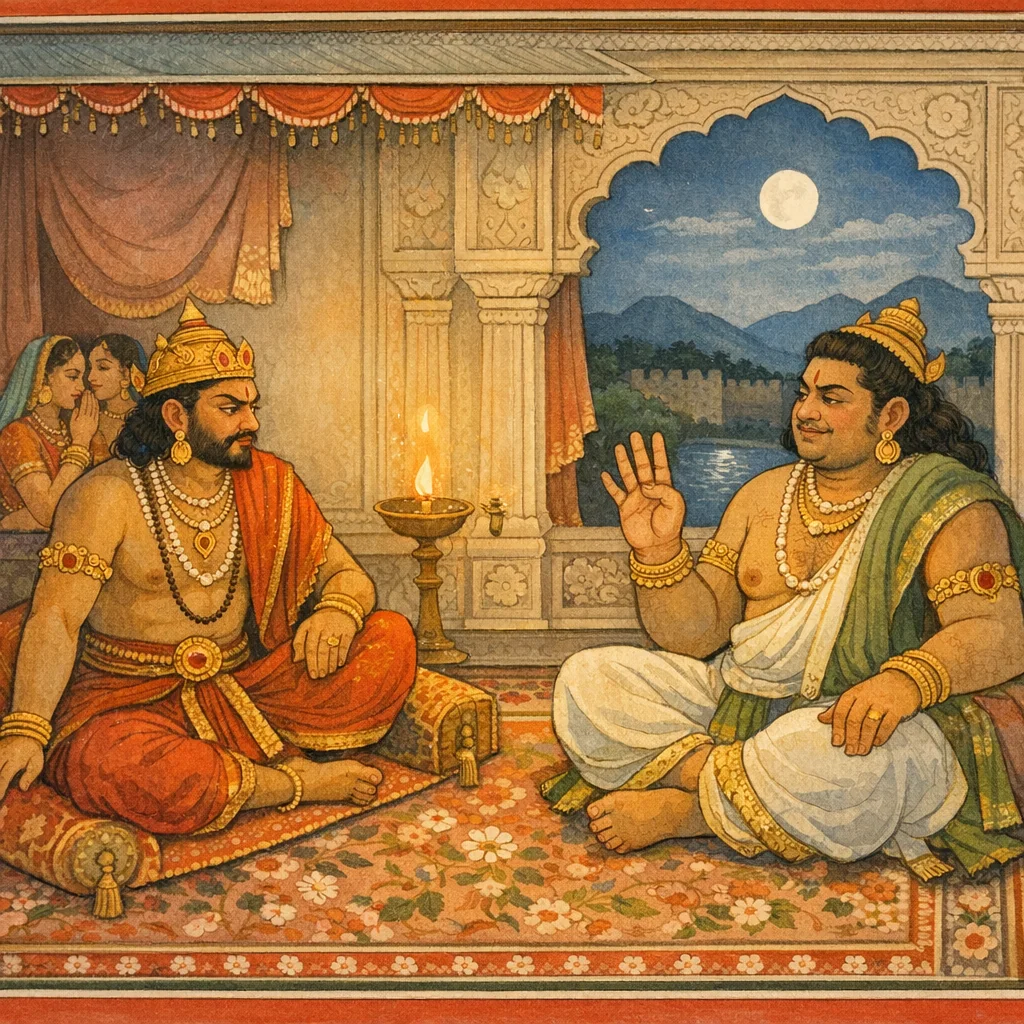
Sarga 63
कुम्भकर्णोपदेशः — Kumbhakarna’s Counsel and War-Boast to Ravana
युद्धकाण्ड
Sarga 63 stages a pivotal counsel-scene inside Laṅkā. Hearing Rāvaṇa’s lament, Kumbhakarṇa initially responds with derisive laughter, then pivots into a formalized nīti discourse: a king must discern what is best among policy options and act with ministers, timing, and consequence-awareness. He outlines classical methods—conciliation (sāntva), gifting (dāna), dissension (bheda), and valorous force (vikrama)—to be applied singly or in combination according to kāla (right time), while pursuing dharma, artha, and kāma in ordered balance. He warns against unlearned, impudent advisers, and against ministers who collude with enemies, emphasizing behavioral scrutiny during deliberation. Rāvaṇa, stung by the admonition, rejects retrospection and demands immediate actionable counsel. Kumbhakarṇa then softens his tone, reassures Rāvaṇa of protection, and offers himself as the decisive instrument of war, escalating into hyperbolic martial vows: he will destroy Rāma, Lakṣmaṇa, Sugrīva, and Hanumān, and even challenge cosmic deities. The chapter thus juxtaposes sober statecraft with performative bravado, mapping how counsel is transformed into mobilization rhetoric on the eve of battle.
Shlokas
Verse 1
तस्यराक्षसराजस्यनिशम्यपरिदेवितम् ।कुम्भकर्णोबभाषेदंवचनंप्रजहास च ।।6.63.1।।
Hearing the lamentation of the rākṣasa-king, Kumbhakarṇa replied with these words—and laughed as well.
Verse 2
दृष्टोदोषोहियोऽस्माभिःपुरामन्त्रन्वििर्णये ।हितेष्वनभियुक्तेनसोऽयमासादितस्त्वया ।।6.63.2।।
The calamity that I had foreseen earlier during counsel and decision-making—because you did not properly rely on your well-wishers—has now come upon you.
Verse 3
शीघ्रंखल्वभ्युपेतंत्वांफलंपापस्यकर्मणः ।निरयेष्वेवपतनंयथादुष्कृतकर्मणः ।।6.63.3।।
Swiftly, indeed, the consequence of your sinful action has come upon you—just as those who commit evil deeds fall headlong into the hell-realms.
Verse 4
प्रथमंवैमहाराजकृत्यमेतदचिन्तितम् ।केवलंवीर्यदर्पेणनानुबन्धोविचिन्तितः ।।6.63.4।।
At the outset, O great king, this course of action was undertaken without reflection; in sheer pride of strength, its consequences were not considered.
Verse 5
यःपश्चातूर्वकार्याणिकुर्यादैश्वर्यमास्थितः ।पूर्वंचोत्तरकार्याणि न स वेदनयानया ।।6.63.5।।
One who, relying on prosperity and power, postpones the duties that should be done first and then attends to what comes later—such a person does not understand proper policy and its opposite (right and wrong course).
Verse 6
देशकालविहीनानिकर्माणिविपरीतवत् ।क्रियमाणानिदुष्यन्तिहवींष्यप्रयतेष्विव ।।6.63.6।।
Actions undertaken without due regard for place and time turn ruinous; when performed in such a manner, they become fruitless—like oblations offered without the proper consecration.
Verse 7
त्रयाणांपञ्चधायोगंकर्मणांयःप्रपश्यति ।सचिवैस्समयंकृत्वा स सभ्येवर्ततेपथि ।।6.63.7।।
He who foresees how policy must be applied in its threefold modes and in its fivefold considerations—and who acts at the proper moment in consultation with ministers—proceeds on the right path in the royal assembly.
Verse 8
यथागमं च योराजासमयंविचिकीर्षति ।बुध्यतेसचिवान्बध्यासुहृदश्चानुपश्यति ।।6.63.8।।
That king who, in accordance with rightful tradition, seeks to act at the proper juncture—who understands his ministers with discernment and keeps his well-wishers in view—truly understands what ought to be done.
Verse 9
धर्ममर्थं च कामं च सर्वान्वारक्षसांपते ।भजतेपुरुषःकालेत्रीणिद्वन्द्वानिवापुनः ।।6.63.9।।
O lord of rākṣasas, a man should pursue dharma, artha, and kāma—either all together, or at least in balanced pairs—each in its proper time.
Verse 10
त्रिषुचैतेषुयच्छ्रेष्ठंश्रुत्वातन्नावबुध्यते ।राजावाराजमात्रोवाव्यर्थंतस्यबहुश्रुतम् ।।6.63.10।।
Among these three, if a king—or even one fit to be called king—hears what is best yet fails to grasp it, then all his learning is wasted.
Verse 11
उपप्रदानंसान्त्वं च भेदंकाले च विक्रमम् ।योगं च रक्षसांश्रेष्ठतावुभौ च नयानयौ ।।6.63.11।।कालेधर्मार्थकामान्यस्सम्मन्त्ऱ्यसचिवैःसह ।निषेवेतात्मवान्लोके न स व्यसनमाप्नुयात् ।।6.63.12।।
O best of rākṣasas, giving (concessions), conciliation, sowing division, and—when time demands—bold force, as well as their proper combination: these constitute policy and its opposite, used rightly or wrongly.
Verse 12
उपप्रदानंसान्त्वं च भेदंकाले च विक्रमम् ।योगं च रक्षसांश्रेष्ठतावुभौ च नयानयौ ।।6.63.11।।कालेधर्मार्थकामान्यस्सम्मन्त्ऱ्यसचिवैःसह ।निषेवेतात्मवान्लोके न स व्यसनमाप्नुयात् ।।6.63.12।।
He who, self-possessed, consults with ministers and pursues dharma, artha, and kāma in their proper season—such a man does not fall into calamity in this world.
Verse 13
हितानुबन्धमालोच्यकार्यात्कार्यमिहात्मनः ।राजासहार्थतत्त्वज्ञैस्सचिवैर्बुस्सहिजीवति ।।6.63.13।।
A king who reflects on the long-term consequences of what is beneficial, and decides each action as it should be done—together with ministers who know realities—lives supported by their counsel and intelligence.
Verse 14
अनभिज्ञायशास्त्रार्थान् पुरुषाःपशुबुद्धयः ।प्रागल्भ्याद्वक्तुमिच्छन्तिमन्त्रेष्वभ्यन्तरीकृताः ।।6.63.14।।
Men of animal-like understanding, ignorant of the meaning of the treatises, when admitted into councils, wish to speak out of sheer presumption.
Verse 15
अशास्त्रविदुषांतेषां न कार्यमभिहितंवचः ।अर्थशास्त्रानभिज्ञानांविपुलांश्रियमिच्छताम् ।।6.63.15।।
The advice of those who do not know the śāstras should not be acted upon—especially of those ignorant of arthaśāstra who yet crave vast prosperity.
Verse 16
अहितं च हिताकारंधार्ष्ट्याज्जल्पन्तियेनराः ।अवेक्ष्यमन्त्रबाह्यास्तेकर्तव्याःकृत्यदूषणा:।। 6.63.16।।
Those men who brazenly prattle what is harmful while dressing it as beneficial—after due scrutiny—must be kept outside the council, for they spoil the enterprise.
Verse 17
विनाशयन्तोभर्तारंसहिताश्शत्रुभिर्बुधैः ।विपरीतानिकृत्यानिकारयन्तीहमन्त्रिणः ।।6.63.17।।
Here, certain ministers—seeking to ruin their lord—collude with wise enemies and induce him to undertake actions that are utterly perverse.
Verse 18
तान्भर्तामित्रसङ्काशानमित्रान्मन्त्रनिर्णये ।व्यवहारेणजानीयात्सचिवानुपसम्हितान् ।।6.63.18।।
A ruler should recognize, during counsel and decision-making, those ministers who look like friends but are truly enemies—men drawn into the enemy’s orbit—by observing their conduct.
Verse 19
चपलस्येहकृत्यानिसहसानुप्रधावतः ।छिद्रमन्येप्रपद्यन्तेक्रौञ्चस्य ख मिवद्विजाः ।।6.63.19।।
When a ruler is fickle and rushes headlong into actions, others seize upon his vulnerabilities—just as birds find openings in the sky around Mount Krauñca.
Verse 20
योहिशत्रुमवज्ञायनात्मानमभिरक्षति ।अवाप्नोतिहिसोऽनर्थान् स्थानाच्चव्यवरोप्यते ।।6.63.20।।
He who, despising the enemy, fails to safeguard himself surely meets calamities—and is even dragged down from his position.
Verse 21
यदुक्तमिहतेपूर्वंक्रियतामनुजेन च ।तदेवनोहितंवाक्यंयदिच्छसि च तत्कुरु ।।6.63.21।।
What your younger brother advised you earlier should be carried out; that counsel alone is for our good. Yet do as you wish.
Verse 22
तत्तुश्रुत्वादशग्रीवःकुम्भकर्णस्यभाषितम् ।भ्रुकुटिंचैवसञ्चक्रेक्रुद्धश्चैनमभाषत ।।6.63.22।।
Hearing Kumbhakarṇa’s words, Daśagrīva knit his brows; angered, he spoke to him.
Verse 23
मान्योगुरुवारिचार्यःकिमांत्वमनुशाससि ।किमेवंवाक्छ्रमंकृत्वाकालेयुक्तंविधीयताम् ।।6.63.23।।
“Though you are worthy of respect—like a father or a teacher—why do you instruct me so? Why display verbal cleverness? Let what is fitting for the moment be done.”
Verse 24
विभ्रमाच्चित्तमोहाद्वाबलवीर्याश्रयेणवा ।नाभिपन्नमिदानींयद्व्यर्थातस्यपुनःकथाः ।।6.63.24।।
“Whether through delusion, confusion of mind, or reliance on my own strength and valor, what has already been done cannot be undone now; to speak of it again is futile.”
Verse 25
अस्मिन्कालेतुयद्युक्तंतदिदानींविधीयताम् ।गतंतुनानुशोचन्तिगतंतुगतमेवहि ।।6.63.25।।
“Let what is proper for this moment be done now. One should not lament what is past—for what is past is truly gone.”
Verse 26
ममापनयजंदोषंविक्रमेणसमीकुरु ।यदिखल्वस्तिमेस्नेहोविक्रमंवाऽवगच्छसि ।।6.63.26।।यदिवकार्यंमेतत्तेहृदिकार्यतमंमतम् ।
“Set right, by your valor, the fault that has arisen for me. If indeed you have affection for me—or if you recognize your own prowess—then do what you deem in your heart to be the most necessary act for my cause.”
Verse 27
स सुहृद्योविपन्नार्थंदीनमभ्यवपद्यते ।।6.63.27।।स बन्धुर्योऽपनीतेषुसाहाय्यायोपकल्पते ।
A true friend is one who stands by a man when his fortune has collapsed and he is in distress; and a true kinsman is one who is ready to help even when one has gone astray from proper conduct.
Verse 28
तमथैवंब्रुवाणंतुवचनंधीरदारुणम् ।।6.63.28।।रुष्टोऽयमितिविज्ञायशनैश्श्लक्षणमुवाच ह ।
Seeing him speaking in that grave and harsh manner, and understanding that he was enraged, Kumbhakarṇa replied softly, in a gentle tone.
Verse 29
अतीवहिसमालक्ष्यभ्रातरंक्षुभितेन्द्रियम् ।।6.63.29।।कुम्भकर्णश्शनैर्वाक्यंबभाषेपरिसान्त्वयन् ।
Noticing that his brother’s senses were deeply disturbed, Kumbhakarṇa—seeking to soothe him—spoke to him gently and without haste.
Verse 30
शृणुराजन्नवहितोममवाक्यमरिन्दम ।।6.63.30।।अलंराक्षसराजेन्द्र सन्तापमुपपद्यते ।रोषं च सम्परित्यज्यस्वस्थोभवितुमर्हसि ।।6.63.31।।
Listen, O king, with attention to my words, O subduer of foes. Enough of this grief, O lord of the rākṣasas; abandoning anger as well, you should regain steadiness and be yourself again.
Verse 31
शृणुराजन्नवहितोममवाक्यमरिन्दम ।।6.63.30।।अलंराक्षसराजेन्द्र सन्तापमुपपद्यते ।रोषं च सम्परित्यज्यस्वस्थोभवितुमर्हसि ।।6.63.31।।
So long as I live, O king, you should not let this weigh upon your mind. I will destroy the one on whose account you are suffering.
Verse 32
नैतन्मनसिकर्तव्यंमयिजीवतिपार्थिव ।तमहंनाशयिष्यामियत्कृतेपरितप्यते ।।6.63.32।।
So long as I live, O king, you should not let this weigh upon your mind. I will destroy the one on whose account you are suffering.
Verse 33
अवश्यंतुहितंवाच्यंसर्वावस्थांतवमया ।बन्धुभावादभिहितंभ्रातृस्नेहाच्छपार्थिव ।।6.63.33।।
Yet I must speak what is beneficial to you in every circumstance, O king—spoken as one bound to you by kinship and by brotherly affection.
Verse 34
सदृशंयत्तुकालेऽस्मिन् कर्तुंस्निग्धेनबन्धुना ।शत्रूणांकदनंपश्यक्रियमाणंमयारणे ।।6.63.34।।
At such a time, see what is fitting for an affectionate kinsman to do: in battle, you shall see me bring about the destruction of the enemies.
Verse 35
अद्यपश्यमहाबाहो मयासमरमूर्धनि ।हतेरामेसहभ्रात्राद्रवन्तींहरिवाहिनीम् ।।6.63.35।।
Behold today, O mighty-armed one: on the very front of battle, when I have slain Rāma along with his brother, you will see the army of vānaras fleeing.
Verse 36
अद्यरामस्यतद्दृष्टवामयानीतंरणाच्छिरः ।सुखीभवमहाबाहो सीताभवतुदुःखिता ।।6.63.36।।
Today, when you see me bring Rama’s head back from the battlefield, be joyful, O mighty-armed one; let Sītā be plunged into sorrow.
Verse 37
अद्यरामस्यपश्यन्तुनिधनंसुमहत्प्रियम् ।लङ्कायांराक्षसाःसर्वेयेतेनिहतबान्धवाः ।।6.63.37।।
Let all the Rākṣasas in Laṅkā—those whose kinsmen have been slain—witness today the death of Rāma, a sight they will welcome greatly.
Verse 38
अद्यशोकपरीतानांस्वबन्धुवधकारणात् ।शत्रोर्युधिविनाशेनकरोम्यस्रप्रमार्जनम् ।।6.63.38।।
Today, by destroying the enemy in battle, I shall wipe away the tears of those overwhelmed by grief because their own kinsmen have been slain.
Verse 39
अद्यपर्वतसङ्काशंससूर्यमिवतोयदम् ।विकीर्णंपश्यसमरेसुग्रीवंप्लवगोत्तम ।।6.63.39।।
Today, behold in battle Sugrīva, the foremost of the monkeys—scattered and struck down—like a mountain-like cloud lit by the sun.
Verse 40
कथं च राक्षसैरेभिर्मया च परिरक्षितः ।जिघांसुभिर्दाशरथिं वध्यसे त्वमिहानघ ।।6.63.40।।
How could you be slain here, O blameless one, when you are protected by these Rākṣasas and by me—while we are intent on killing Dāśarathi (Rāma)?
Verse 41
मांनिहत्यकिलत्वांहिनिहनिष्यतिराघवः ।नाहमात्मनिसन्तापंगच्छेयंराक्षसाधिप ।।6.63.41।।
Rāghava, they say, will kill you only after killing me; therefore, O lord of the Rākṣasas, I will not let distress take hold within me.
Verse 42
कामंवतिदानीमपिमांव्यादिशत्वंपरन्तप ।न परःप्रेषणीयस्तेयुद्धायातुलविक्रम ।।6.63.42।।
If you wish, command me even now, O scorcher of foes; for your war, none other is to be sought—O one of incomparable valor.
Verse 43
अहमुत्सादयिष्यामिशत्रूंस्तवमहाबल: ।यदिशक्रोयदियमोयदिपावकमारुतौ ।।6.63.43।।तानहंयोधयिष्यामिकुबेरवरुणावपि ।
Mighty as I am, I shall crush your enemies—even if they were Śakra (Indra), or Yama, or Agni and Vāyu; I would fight even Kubera and Varuṇa.
Verse 44
गिरिमात्रशरीरस्यशितशूलधरस्यमे ।।6.63.44।।नर्दतस्तीक्षणदंष्ट्रस्यबिभीयाच्चपुरन्दरः ।
Even Purandara (Indra) would fear me—mountain-bodied, bearing a sharp spear—and flee at the roar of my keen-fanged mouth.
Verse 45
अथवात्यक्तशस्त्रस्यमृद्नतस्तरसारिपून् ।।6.63.45।।न मेप्रतिमुखेस्थातुंकश्चित् शक्तोजिजीविषुः ।
Or else—casting weapons aside—I will crush the enemies by sheer force; no one who still desires to live has the power to stand facing me.
Verse 46
नैवशक्त्या न गदयानासिनानिशितैश्शरैः ।।6.63.46।।हस्ताभ्यामेवसम्रब्दोहनिष्याम्यपिवज्रिणम् ।
Not with spear, not with mace, not with sword, nor with sharp arrows—enraged, I will strike down even Vajrin (Indra) with my bare hands alone.
Verse 47
यदिमेमुष्टिवेगं स राघवोऽद्यसहिष्यते ।।6.63.47।।ततःपाश्यन्तिबाणौघारुधिरंराघवस्यतु ।
If Rāghava can endure today the force of my fists, then you will see volleys of arrows—and the blood of Rāghava as well.
Verse 48
चिन्तयाबाध्यसेराजन्किमर्थंमयितिष्ठति ।।6.63.48।।सोऽहंशत्रुविनाशाय तव निर्यातुमुद्यतः ।
O King, why are you afflicted with worry while I am here? I am ready to march out to destroy your enemy.
Verse 49
मुञ्चरामाद्भयंराज न्हनिष्यामीहसम्युगे ।।6.63.49।।राघवंलक्ष्मणंचैवसुग्रीवं च महाबलम् ।हनूमन्तं च रक्षोघ्नंलङ्कायेनप्रदीपिता ।।6.63.50।।
Cast off your fear of Rāma, O King. Here in battle I will slay Rāghava and Lakṣmaṇa, and mighty Sugrīva as well—along with Hanūmān, the slayer of rākṣasas, who set Laṅkā ablaze.
Verse 50
मुञ्चरामाद्भयंराज न्हनिष्यामीहसम्युगे ।।6.63.49।।राघवंलक्ष्मणंचैवसुग्रीवं च महाबलम् ।हनूमन्तं च रक्षोघ्नंलङ्कायेनप्रदीपिता ।।6.63.50।।
Cast off your fear of Rāma, O King. Here in battle I will slay Rāghava and Lakṣmaṇa, and mighty Sugrīva as well—along with Hanūmān, the slayer of rākṣasas, who set Laṅkā ablaze.
Verse 51
हरींश्चापिहनियिष्यामिसंयुगेसमवास्थिवान् ।असाधारणमिच्छामिनदातुंमहद्यशः ।।6.63.51।।
Standing firm in the battle, I will slay even the Vānara hosts. I do not wish to leave you without extraordinary and great glory.
Verse 52
तदिचेन्द्राद्भयं राजन्यदि चापिस्वयम्भुवः ।ततोऽहंनाशयिष्यामिनैशंतमइवांशुमान् ।।6.63.52।।अपिदेवाश्शयिष्यन्तेक्रुद्धेमयिमहीतले ।
If you fear even Indra—or even the Self-born (Brahmā), O King—then I will destroy that fear, as the sun destroys the night’s darkness. When I am enraged, even the gods will lie fallen upon the earth.
Verse 53
यमं च शमयिष्यामिभक्षयिष्यामिपावकम् ।।6.63.53।।आदित्यंपातयिष्यामिसनक्षत्रंमहीतले ।
I will subdue Yama; I will devour Fire; and I will cast down the Sun—together with the stars—upon the earth.
Verse 54
शतक्रतुंवधिष्यामिपास्यामिवरुणालयम् ।।6.63.54।।पर्वतांश्चूर्णयिष्यामिदारयिष्यामिमेदिनीम् ।
“I will slay Śatakratu (Indra); I will drink up the ocean, Varuṇa’s abode; I will grind the mountains to dust and split the earth itself.”
Verse 55
दीर्घकालंप्रसुप्तस्यकुम्भकर्णस्यविक्रमम् ।।6.63.55।।अद्यपश्यन्तुभूतानिभक्ष्यमाणानिसर्वशः ।नन्विदंत्रिदिवंसर्वमाहारस्य न पूर्यते ।।6.63.56।।
“Let all creatures witness today the prowess of Kumbhakarṇa, who has slept for a long time—today, beings everywhere shall be devoured.”
Verse 56
दीर्घकालंप्रसुप्तस्यकुम्भकर्णस्यविक्रमम् ।।6.63.55।।अद्यपश्यन्तुभूतानिभक्ष्यमाणानिसर्वशः ।नन्विदंत्रिदिवंसर्वमाहारस्य न पूर्यते ।।6.63.56।।
“Indeed, even all the three worlds together would not suffice to fill my hunger as food.”
Verse 57
वधेनतेदाशरथेःसुखार्हंसुखंसमाहर्तुमहंव्रजामि ।निहत्यरामंसहलक्ष्मणेनखादामिन्हरियूथमुख्यान् ।।6.63.57।।
“By killing Rāma, son of Daśaratha, I go to secure for you the happiness you deem your due. After striking down Rāma together with Lakṣmaṇa, I shall devour the foremost leaders of the Vānara hosts.”
Verse 58
“O king, be at ease. Drink the vāruṇī wine today; cast off your feverish grief and set about your tasks. For today, sent by me, Rāma will go to Yama’s realm—and for long Sītā will come under your control.”
Frequently Asked Questions
The dilemma is governance under crisis: whether a ruler should accept corrective counsel and re-align policy (through consultation, timing, and measured strategy) or reject advice and substitute immediate action with pride-driven force.
Effective kingship requires discerning counsel, competent advisers, and time-sensitive application of policy tools; ignoring well-wishers and empowering unqualified or compromised ministers converts strength into vulnerability and accelerates political ruin.
Laṅkā is the deliberative setting; the Krauncha mountain appears as a simile for how enemies exploit ‘gaps’ in an unsteady ruler’s conduct; the ocean (Varuṇālaya) and cosmic deities function as cultural-religious reference points within Kumbhakarṇa’s war-boast.