Sarga 62
कुम्भकर्णस्य प्रबोधनम् — The Awakening and Commissioning of Kumbhakarna
युद्धकाण्ड
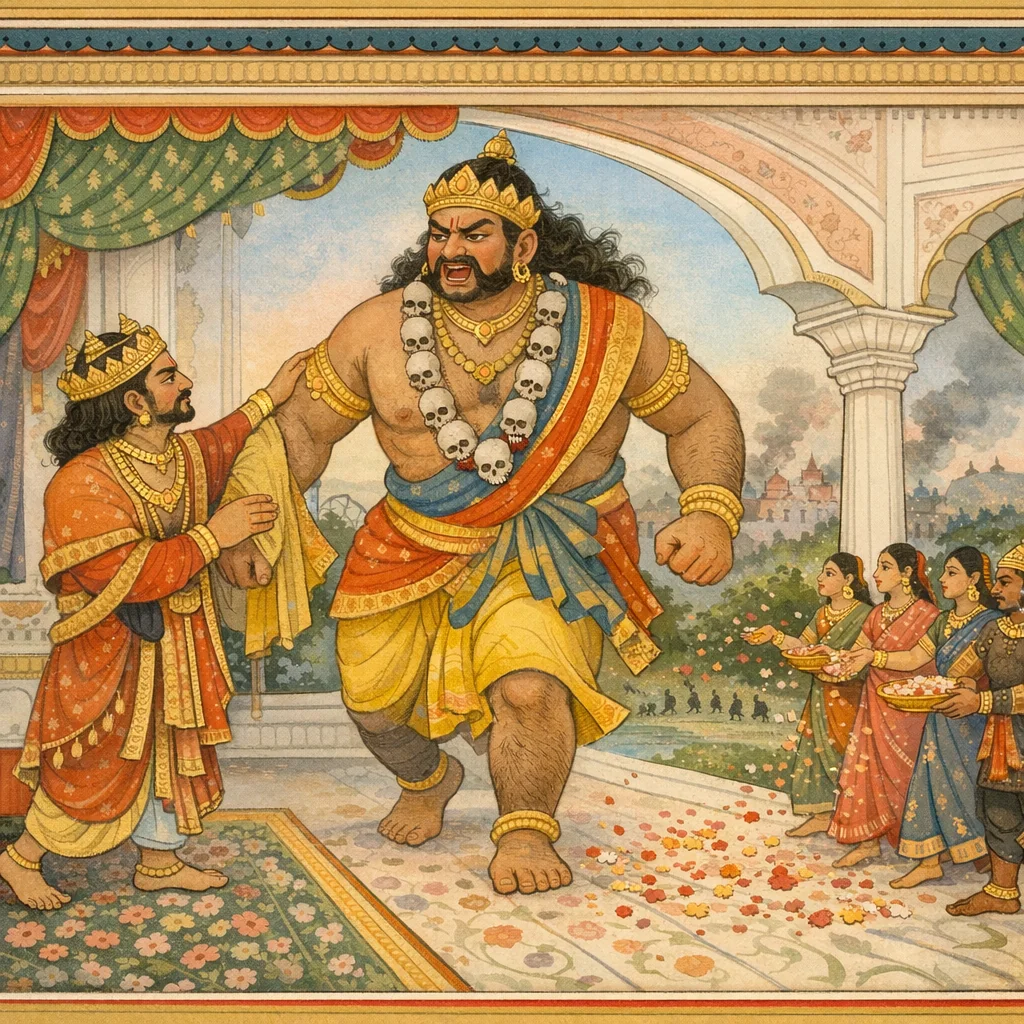
Sarga 62 stages Kumbhakarṇa’s mobilization as a political-psychological episode inside Laṅkā. Sleepy and intoxicated yet portrayed as a formidable rākṣasa “tiger,” he proceeds along the splendid royal road, escorted by thousands and honored with showers of flowers. He enters the resplendent rākṣasa-king’s residence—gold-latticed and sun-bright—and advances with such strides that the earth seems to shake. Rāvaṇa, seated in the Puṣpaka setting and visibly perturbed, rises with delight on seeing his brother, embraces him, and seats him with honor. Kumbhakarṇa, now enraged and blood-eyed, demands the reason for being awakened and asks whom Rāvaṇa fears. Rāvaṇa confesses fear of Rāma, explains that Rāma and Sugrīva have crossed the ocean with an army, and laments the devastation of Laṅkā’s groves and the rākṣasa losses while the vānaras appear unbroken in battle. He pleads for protection of an exhausted city with only children and elders remaining, praises Kumbhakarṇa’s past victories against devas and asuras, and commissions him to scatter the enemy host like wind dispersing rain-clouds.
Shlokas
Verse 1
स तुराक्षसशार्दूलोनिद्रामदसमाकुलः ।राजमार्गंश्रियाजुष्टंययौविपुलविक्रमः ।।6.62.1।।
But that tiger among rākṣasas—of vast prowess—dazed with sleep and intoxication, proceeded along the splendid royal road.
Verse 2
राक्षसानांसहस्रैश्चवृतःपरमदुर्जयः ।गृहेभ्यःपुष्पवर्षेणकीर्यमाणस्तदाययौ ।।6.62.2।।
Then Kumbhakarṇa—nearly invincible—advanced, surrounded by thousands of rākṣasas, while showers of flowers were cast down upon him from the houses.
Verse 3
स हेमजालविततंभानुभास्वरदर्शनम् ।ददर्शविपुलंरम्यंराक्षसेन्द्रनिवेशनम् ।।6.62.3।।
He beheld the vast and splendid dwelling of the lord of the Rākṣasas, spread with golden latticework and radiant to the eye like the morning sun.
Verse 4
स तत्तदासूर्यइवाभ्रजालंप्रविश्यरक्षोधिपतेर्निवेशम् ।ददर्शदूरेऽग्रजमासनस्थंस्वयम्भुवंशक्रवासनस्थम् ।।6.62.4।।
Then, entering the lord of the Rākṣasas’ abode like the sun piercing a mass of clouds, he saw from afar his elder brother seated upon the throne—like Indra beholding the Self-born Brahmā enthroned.
Verse 5
भ्रातुस्सभवनंगच्छन्रक्षोगणसमन्विम् ।कुम्भकर्णःपदन्यासैरकम्पयतमेदिनीम् ।।6.62.5।।
As Kumbhakarṇa proceeded to his brother’s mansion accompanied by hosts of Rākṣasas, the earth itself trembled beneath the weight of his strides.
Verse 6
सोऽभिगम्यगृहंभ्रातुःकक्ष्यामभिविगाह्य च ।ददर्शोद्विगन्नमासीनंविमानेपुष्पकेगुरुम् ।।6.62.6।।
Having reached his brother’s residence and entered the inner enclosure, he saw his elder brother seated in the Puṣpaka aerial car, troubled and uneasy in mind.
Verse 7
अथदृष्टवादशग्रीवःकुम्भकर्णमुपस्थितम् ।तूर्णमुत्थायसंहृष्टःसन्निकर्षमुपानयत् ।।6.62.7।।
Then Daśagrīva (Rāvaṇa), seeing Kumbhakarṇa standing before him, rose swiftly in delight and drew him close.
Verse 8
अथासीनस्यपर्यङ्केकुम्भकर्णोमहाबलः ।भ्रातुर्ववन्देचरणौकिंकृत्यमितिचाब्रवीत् ।।6.62.8।।
Then mighty Kumbhakarṇa, rising from his seat, bowed at his brother’s feet and asked, “What is it that must be done?”
Verse 9
उत्पत्यचैनंमुदितोरावणःपरिषस्वजे ।स भ्रात्रासम्परिष्वक्तोयथावच्छाभिनन्दितः ।।6.62.9।।कुम्भकर्णश्शुभंदिव्यंप्रतिपेदेवरासनम् ।
Rāvaṇa, rising up in delight, embraced him. Kumbhakarṇa too—embraced by his brother and duly welcomed—then took his seat, splendid and exalted.
Verse 10
स तदासनमाश्रित्यकुम्भकर्णोमहाबलः ।।6.62.10।।संरक्तनयनःक्रोधाद्रावणंवाक्यमब्रवीत् ।
Taking his seat, the mighty Kumbhakarṇa—his eyes reddened with anger—addressed words to Rāvaṇa.
Verse 11
किमर्थमहमादृत्यत्वयाराजन्विबोधितः ।।6.62.11।।शंसकस्माद्भयंतेऽत्रकोऽद्यप्रेतोभविष्यति ।
“O King, for what purpose have I been roused with such urgency by you? Tell me—what fear has arisen here for you, and who is it that is to fall dead today?”
Verse 12
भ्रातरंरावणःक्रुद्धंकुम्भकर्णमवस्थितम् ।।6.62.12।।ईषत्तुपरिवृत्ताभ्यांनेत्राभ्यांवाक्यमब्रवीत् ।
Rāvaṇa then spoke to his brother Kumbhakarṇa, who stood there in anger, while Rāvaṇa’s eyes rolled slightly with agitation.
Verse 13
अद्यतेसुमहान्कालश्शयानस्यमहाबल ।।6.62.13।।सुखितस्त्वं न जानीषेममरामकृतंभयम् ।
“O mighty one, you have slept long and comfortably; you do not know the fear that Rāma has brought upon me.”
Verse 14
एषदाशरथीरामःसुग्रीवसहितोबली ।।6.62.14।।समुद्रंसबलस्तीर्त्वामूलंनःपरिकृन्तति ।
“This powerful Rāma, son of Daśaratha, accompanied by Sugrīva, has crossed the ocean with his army and is cutting at the very root of our power.”
Verse 15
हन्तपश्यस्वलङ्कायावनान्युपवनानि च ।।6.62.15।।सेतुनासुखमागम्यवानरैकार्णवीकृतम् ।
“Alas, look at Laṅkā’s forests and pleasure-groves—having come easily by the bridge, the vānaras have laid them waste.”
Verse 16
येराक्षसामुख्यतमाहतास्तेवानरैर्युधि ।।6.62.16।।वानराणांक्षयंयुद्धे न पश्यामिकदाचन ।नचापिवानरायुद्धेजितपूर्वाःकदाचन ।।6.62.17।।
“The foremost of our rākṣasas have been slain in battle by the vānaras. Yet I do not see the vānaras suffering destruction in war; nor have the vānaras ever before been found defeated in this fighting.”
Verse 17
येराक्षसामुख्यतमाहतास्तेवानरैर्युधि ।।6.62.16।।वानराणांक्षयंयुद्धे न पश्यामिकदाचन ।नचापिवानरायुद्धेजितपूर्वाःकदाचन ।।6.62.17।।
“The foremost of our rākṣasas have been slain in battle by the vānaras. Yet I do not see the vānaras suffering destruction in war; nor have the vānaras ever before been found defeated in this fighting.”
Verse 18
तदेतद्भयमुत्पन्नंत्रायस्वेमांमहबल ।नाशयत्वमिमानद्यतदर्थंबोधितोभवान् ।।6.62.18।।
“Thus this fear has arisen. Protect me, O mighty one. Destroy them today—this is the very purpose for which you have been awakened.”
Verse 19
सर्वक्षपितकोशं च स त्वमभ्यवपद्यमाम् ।त्रायस्वेमांपुरींलङ्कांबालवृद्धावशेषिताम् ।।6.62.19।।
“My resources are utterly spent. Therefore stand by me and strike back; save this city of Laṅkā, now left with only children and the aged.”
Verse 20
भ्रातुरर्थेमहाबाहो कुरुकर्मसुदुष्करम् ।मयैवंनोक्तपूर्वोहिकश्चिद्भ्रातः परन्तप ।।6.62.20।।
O mighty-armed brother, for your brother’s sake do this deed—one most difficult. For never before, O brother, scourge of foes, have I asked you for anything like this.
Verse 21
त्वय्यस्तिममस्नेहःपरासम्भावना च मे ।दैवासुरेषुयुद्धेषुबहुशोराक्षसर्षभ ।।6.62.21।।त्वयादेवाःप्रतिव्यूह्यनिर्जिताश्चासुरायुधि ।
In you I have affection, and for you I hold the highest esteem, O bull among Rākṣasas. Many a time in wars between Devas and Asuras, you have met them in battle-array and prevailed—over the Devas, and over the Asuras in their own warfare.
Verse 22
तदेतत्सर्वमातिष्ठवीर्यंभीमपराक्रम ।।6.62.22।।न हितेसर्वभूतेषुदृश्यतेसदृशोबली ।
Therefore, muster all that might, O you of dreadful prowess. For among all beings, none is seen who equals you in strength.
Verse 23
कुरुष्वमेप्रियहितमेतदुत्तमंयथाप्रियंप्रियरणबान्धवप्रिय ।स्वतेजसाविधमसपत्नवाहिनींशरद्घनंपवनइवोद्यतोमहान् ।।6.62.23।।
Do for me this highest act of benefit, you who are dear—lover of battle and dear to your kinsmen. With your own splendor, scatter the enemy host, like a mighty wind rising and driving away the autumn rain-clouds.
Frequently Asked Questions
The pivotal action is Rāvaṇa’s decision to awaken and deploy Kumbhakarṇa as a last-resort defender, framing war as protection of a depleted city—yet rooted in earlier adharma, revealing a crisis where political survival conflicts with moral accountability.
The dialogue teaches that fear can expose the true condition of leadership: even a powerful ruler must confront consequences, seek support, and acknowledge reality; valor without ethical grounding becomes reactive, not restorative.
Laṅkā’s royal road and palace complex (including the Puṣpaka setting), the ocean-crossing, and the Setu (bridge) are emphasized as cultural-geographic markers that signal the transition from defensive isolation to full-scale siege.