Sarga 58
प्रहस्तवधः (The Slaying of Prahasta)
युद्धकाण्ड
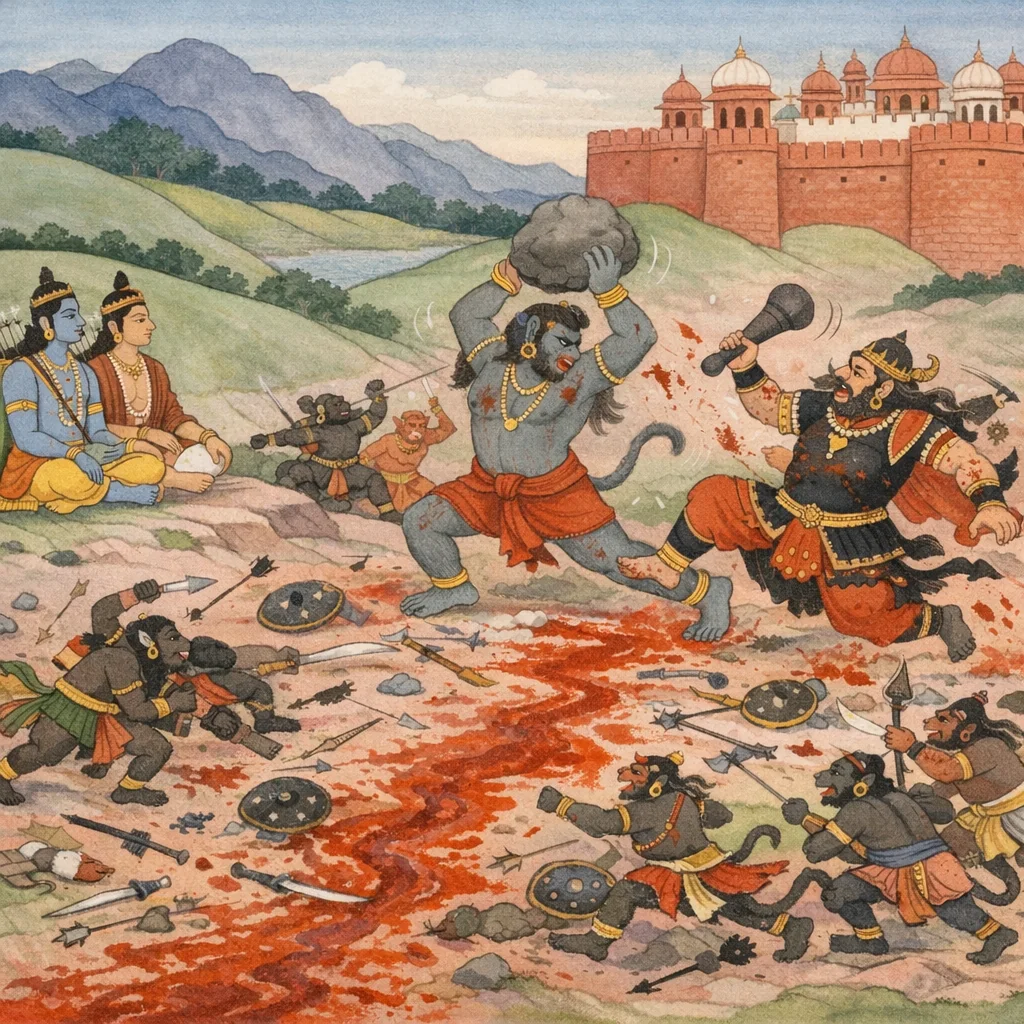
Sarga 58 opens with Rama observing the formidable rākṣasa general Prahasta advancing with a large force and, with composed confidence, asking Vibhīṣaṇa to identify him. Vibhīṣaṇa replies that Prahasta is Ravana’s senāpati, famed for prowess and weapon-mastery, commanding a substantial portion of Lanka’s army. A massive mêlée follows: both sides close in with showers of rocks and arrows, and the battlefield becomes a catalogue of weapons (swords, spears, pikes, mallets, iron bars) and casualties. The narration intensifies into a grim extended simile portraying the war-ground as a “river” of blood, bodies, and broken arms, emphasizing the epic’s realism about war’s cost. Prahasta then enters direct combat, causing havoc among the vānaras with arrow-storms. Nīla confronts him; despite being pierced by arrows, Nīla strikes back with uprooted trees, breaks Prahasta’s bow, and forces him into close-quarters fighting with a heavy mallet. In the culminating exchange, Nīla drops a massive rock onto Prahasta’s head, shattering it and killing him. The rākṣasa troops, demoralized by the fall of their commander, withdraw toward Lanka and become speechless with grief, while Nīla is praised by Rama and Lakshmana and the vānaras rejoice at the strategic victory.
Shlokas
Verse 1
ततःप्रहस्तंनिर्यान्तंदृष्टवाभीमपराक्रमम् ।उवाचसस्मितंरामोविभीषणमरिन्दमः ।।।।
Then Rāma—tamer of foes—seeing Prahasta advancing, a warrior of dreadful prowess, spoke to Vibhīṣaṇa with a gentle smile.
Verse 2
कएषस्सुमहाकायोबलेनमहतावृतः ।आचक्ष्वमेमहाबाहो वीर्यवन्तंनिशाचरम् ।।।।
“Who is this mighty, gigantic one, surrounded by a great force? Tell me, O strong-armed one, about this valiant night-roamer.”
Verse 3
राघवस्यवचश्श्रुत्वाप्रत्युवाचविभीषणः ।।।।एषसेनापतिस्तस्यप्रहस्तोनामराक्षसः ।लङ्कायांराक्षसेन्द्रस्यत्रिभागबलसम्वृतः ।।।।वीर्यवानस्त्रविच्छूरःसुप्रख्याश्चपराक्रमे ।
Hearing Rāghava’s words, Vibhīṣaṇa replied: “This is the rākṣasa named Prahasta, commander of that king’s army. In Laṅkā he is backed by a third part of the rākṣasa host—valiant, skilled in weapons, heroic, and famed for his prowess.”
Verse 4
राघवस्यवचश्श्रुत्वाप्रत्युवाचविभीषणः ।।6.58.3।।एषसेनापतिस्तस्यप्रहस्तोनामराक्षसः ।लङ्कायांराक्षसेन्द्रस्यत्रिभागबलसम्वृतः ।।6.58.4।।वीर्यवानस्त्रविच्छूरःसुप्रख्याश्चपराक्रमे ।
“This is the rākṣasa named Prahastha—commander of that rākṣasa-king’s forces in Laṅkā—surrounded by a third part of the army. He is powerful, skilled in weapons, heroic, and widely famed for his valor.”
Verse 5
ततःप्रहस्तंनिर्यान्तंभीमंभीमपराक्रमम् ।।।।गर्जन्तंसुमहाकायंराक्षसैरभिसम्वृतम् ।ददर्शमहतीसेनावानराणांबलीयसाम् ।।।।अभिसञ्जातरोषाणांप्रहस्तमभिगर्जताम् ।
Then the mighty army of the Vānara warriors saw Prahasta advancing—terrible in form and terrible in prowess—roaring loudly, of enormous body, and surrounded by Rākṣasas, as he bellowed at the enraged Vānaras.
Verse 6
ततःप्रहस्तंनिर्यान्तंभीमंभीमपराक्रमम् ।।6.58.5।।गर्जन्तंसुमहाकायंराक्षसैरभिसम्वृतम् ।ददर्शमहतीसेनावानराणांबलीयसाम् ।।6.58.6।।अभिसञ्जातरोषाणांप्रहस्तमभिगर्जताम् ।
Then the mighty Vanara host beheld Prahastha advancing—terrible and of dreadful prowess—roaring, huge-bodied, and surrounded by Rakshasas, as the enraged warriors roared back at him.
Verse 7
खडगशक्त्यृष्णिबाणाश्चशूलानिमुसलानिच ।।।।गदाश्चपरिघाःप्रासाविविधाश्चपरिश्वधाः ।नूंषिचविचित्राणिराक्षसानांजयैषिणाम् ।।।।प्रगृहीतान्यशोभन्तवानरानभिधावताम् ।
Seeking victory, the Rakshasas rushed upon the Vanaras; weapons of many kinds—swords, javelins, spears, arrows, pikes, mallets, maces, iron bars, and axes—were seized and gleamed as they charged.
Verse 8
खडगशक्त्यृष्णिबाणाश्चशूलानिमुसलानिच ।।6.58.7।।गदाश्चपरिघाःप्रासाविविधाश्चपरिश्वधाः ।नूंषिचविचित्राणिराक्षसानांजयैषिणाम् ।।6.58.8।।प्रगृहीतान्यशोभन्तवानरानभिधावताम् ।
Seeking victory, the Rakshasas rushed upon the Vanaras; weapons of many kinds—swords, javelins, spears, arrows, pikes, mallets, maces, iron bars, and axes—were seized and gleamed as they charged.
Verse 9
जगृहुःपादपांश्चापिपुष्पितान्वानरर्षभाः ।।।।शिलाश्चविपुलादीर्घायोद्धुकामाःप्लवङ्गमाः ।
Eager to fight, the best of the Vanaras seized flowering trees, and also huge, long rocks, preparing to meet the onrush.
Verse 10
तेषामन्योन्यमासाद्यसङ्ग्रामःसुमहानभूत् ।।।।बहूनामश्मवृष्टिंचशरवर्षंचवर्षताम् ।
When they closed upon one another, a vast battle erupted, as many on both sides rained down showers of stones and torrents of arrows.
Verse 11
बहवोराक्षसायुद्धेबहून्वानरयूधपान् ।।।।वानराराक्षसांश्चापिनिजघ्नुर्बहवोबहून् ।
When they closed upon one another, a vast battle erupted, as many on both sides rained down showers of stones and torrents of arrows.
Verse 12
शूलैःप्रमथिताःकेचित्केचिच्चपरमायुधैः ।।।।परिघैराहताःकेचित्केचिच्छिन्नाःपरश्वधैः ।
Some were crushed down by pikes; some were struck with supreme weapons; some were beaten with iron bars; and some were hewn apart with axes.
Verse 13
निरुच्छवासाःकृता: केचित्पतिताधरणीतले ।।।।विभिन्नहृदयाःकेचिदिषुसन्धानसन्दिताः ।
Some were left without breath and fell upon the ground; others, pierced by well-aimed arrows, had their hearts split apart.
Verse 14
केचिव्दिधाकृताःखडगैःस्फुरन्तःपतिताभुवि ।।।।वानराराक्षसैश्शूलैपार्श्वतश्चावदारिताः ।
Some were cleft in two by swords and fell twitching upon the earth; and some Vānaras, ripped open at the sides by Rākṣasas with pikes, collapsed.
Verse 15
वानरैश्चापिसङ्क्रुद्धैराक्षसौघाःसमन्ततः ।।।।पादपैर्गिरिशृङ्गैश्चसम्पिष्टावसुधातले ।
And the enraged Vānaras, on every side, crushed whole troops of Rākṣasas down upon the earth with trees and with mountain-peaks.
Verse 16
वज्रस्पर्शतलैर्हस्स्सैर्मुष्टिभिश्चहताभृशम् ।।।।वेमुश्शोणितमास्येभ्योविशीर्णदशनेक्षणाः ।
Smitten hard by hands whose blows were like thunderbolts, and by fists as well, they spewed blood from their mouths—teeth and eyes shattered.
Verse 17
आर्तस्वनंचस्वनतांसिंहनादंचनर्दताम् ।।।।बभूवतुमुलश्शब्दोहरीणांरक्षसांयुधि ।
In that battle there rose a tumultuous roar—cries of anguish, clamouring shouts, and lion-like bellows—from both the Vānaras and the Rākṣasas.
Verse 18
वानराराक्षसाःक्रुद्धावीरमार्गमनुव्रताः ।।।।विवृत्तनयनाःक्रूराश्चक्रुःकर्माण्यभीतवत् ।
Enraged and treading the hero’s path, Vānaras and Rākṣasas—eyes rolling, fierce in aspect—performed their war-deeds without fear.
Verse 19
नरान्तकःकुम्भहनुर्महानादस्समुन्नतः ।।।।एतेप्रहस्तसचिवास्सर्वेजघ्नुर्वनौकसः ।
Nārāntaka, Kumbhahanu, Mahānāda, and Samunnata—these all, ministers and companions of Prahasta—slew the Vānara warriors.
Verse 20
तेषामापततांशीघ्रंनिघ्नतांचापिवानरान् ।।।।द्विविदोगिरिशृङ्गेणजघानैकंनरान्तकम् ।
As those Rākṣasas charged swiftly and cut down the Vānaras, Dwivida struck down Narāntaka—alone—with a mountain-peak.
Verse 21
दुर्मुखःपुनरुत्थायकपिस्सविपुलद्रुमम् ।।।।राक्षसंक्षिप्रहस्तस्तुसमुन्नतमपोथयत् ।
Rising again, the monkey Durmukha uprooted a massive tree; with swift hands he struck down the rākṣasa Samunnata, who stood raised up (for battle).
Verse 22
जाम्बवांस्तुसुसङ्क्रुद्धःप्रगृह्यमहतींशिलाम् ।।।।पातयामासतेजस्वीमहानादस्यवक्षसि ।
Then the radiant Jāmbavān, fiercely enraged, seized a great rock and brought it crashing down upon the chest of Mahānāda.
Verse 23
अथकुम्भहनुस्तत्रतारेणासाद्यवीर्यवान् ।।।।वृक्षेणाभिहतोमूर्ध्निप्राणान्सन्त्याजयद्रणे ।
Then, on that battlefield, the valiant Kumbhahanu was confronted by Tārā; struck on the head with a tree, he gave up his life in the fight.
Verse 24
अमृष्यमाणस्तत्कर्मप्रहस्तोरथमाश्रितः ।।।।चकारकदनंघोरंधनुष्पाणिर्वनौकसाम् ।
Unable to bear that feat, Prahasta mounted his chariot; bow in hand, he unleashed dreadful destruction among the forest-dwellers (the monkeys).
Verse 25
आवर्तइवसञ्जज्ञेसेनयोरुभयोस्तदा ।।।।क्षुभितस्याप्रमेयस्यसागरस्येवनिस्स्वनः ।
Then the roar of the two armies rose like the whirl and thunder of a boundless ocean churned into agitation.
Verse 26
महताहिशरौघेणप्रहस्तोयुद्धकोविदः ।।।।अर्दयामाससङ्क्रुद्धोवानरान् परमाहवे ।
In that great clash, Prahasta—skilled in warfare—furiously harried the monkeys with a heavy torrent of arrows.
Verse 27
वानराणांशरीरैश्चराक्षसानांचमेदिनी ।।।।बभून्विचिताघोराःपतितैरिवपर्वतै ।
The earth lay strewn with the dreadful bodies of monkeys and rākṣasas, as though fallen mountains had been scattered upon it.
Verse 28
सामहीरुधिरौघेणप्रच्छन्नासम्प्रकाशते ।।।।सञ्छन्नामाधवेमासिपलाशैरिवपुष्पितैः ।
That earth, covered in torrents of blood, gleamed—like ground veiled in the month of Māgha by blossoming palāśa flowers.
Verse 29
हतवीरौघवस्रांतुभग्नायुधमहाद्रुमाम् ।।।।शोणितौघमहातोयांयमसागरगामिनीम् ।यकृत् प्लीहमहापङ्कान्वििकीर्णान्त्रशैवलाम् ।।।।भिन्नकायशिरोमीनामङ्गावयवशाद्वलाम् ।गृध्रहंसगणाकीर्णांकङ्कसारससेविताम् ।।।।मेदःफेनसमाकीर्णामार्तस्न्तितस्वनाम् ।तांकापुरषुदुस्तारांयुद्धभूमिमयींनदीम् ।।।।नदीमिवघनापायेहंससारससेविताम् ।राक्षसाःकपिमुख्याश्चतेरुस्तांदुस्तरांनदीम् ।।।।यथापद्मरजोध्वस्तांनळिनींगजयूथपाः ।
The battlefield became like a river: its banks were heaps of fallen heroes; shattered weapons were its great trees; torrents of blood its vast waters rushing toward Yama’s ocean. Livers and spleens formed its mire; scattered entrails its water-plants; severed trunks and heads its fish; limbs and body-parts its grass. Vultures gathered like swans, and carrion-birds moved like cranes; fat spread like foam, and the cries of the wounded became its murmur. Hard for cowards to cross, it was like a river at monsoon’s end frequented by swans and cranes. Yet the rākṣasas and the foremost monkeys crossed that difficult river—like leaders of elephant herds crossing a lotus-pond dusted with lotus pollen.
Verse 30
हतवीरौघवस्रांतुभग्नायुधमहाद्रुमाम् ।।6.58.29।।शोणितौघमहातोयांयमसागरगामिनीम् ।यकृत् प्लीहमहापङ्कान्वििकीर्णान्त्रशैवलाम् ।।6.58.30।।भिन्नकायशिरोमीनामङ्गावयवशाद्वलाम् ।गृध्रहंसगणाकीर्णांकङ्कसारससेविताम् ।।6.58.31।।मेदःफेनसमाकीर्णामार्तस्न्तितस्वनाम् ।तांकापुरषुदुस्तारांयुद्धभूमिमयींनदीम् ।।6.58.32।।नदीमिवघनापायेहंससारससेविताम् ।राक्षसाःकपिमुख्याश्चतेरुस्तांदुस्तरांनदीम् ।।6.58.33।।यथापद्मरजोध्वस्तांनळिनींगजयूथपाः ।
It was like a river whose vast waters were torrents of blood, flowing toward the ocean of Yama (death)—with liver and spleen as its deep mire, and scattered entrails drifting like water-weeds.
Verse 31
हतवीरौघवस्रांतुभग्नायुधमहाद्रुमाम् ।।6.58.29।।शोणितौघमहातोयांयमसागरगामिनीम् ।यकृत् प्लीहमहापङ्कान्वििकीर्णान्त्रशैवलाम् ।।6.58.30।।भिन्नकायशिरोमीनामङ्गावयवशाद्वलाम् ।गृध्रहंसगणाकीर्णांकङ्कसारससेविताम् ।।6.58.31।।मेदःफेनसमाकीर्णामार्तस्न्तितस्वनाम् ।तांकापुरषुदुस्तारांयुद्धभूमिमयींनदीम् ।।6.58.32।।नदीमिवघनापायेहंससारससेविताम् ।राक्षसाःकपिमुख्याश्चतेरुस्तांदुस्तरांनदीम् ।।6.58.33।।यथापद्मरजोध्वस्तांनळिनींगजयूथपाः ।
In that ‘river,’ severed bodies and heads were the fish; torn limbs formed its grassy banks—crowded with ‘swans’ that were vultures, and frequented by cranes that were carrion-birds.
Verse 32
हतवीरौघवस्रांतुभग्नायुधमहाद्रुमाम् ।।6.58.29।।शोणितौघमहातोयांयमसागरगामिनीम् ।यकृत् प्लीहमहापङ्कान्वििकीर्णान्त्रशैवलाम् ।।6.58.30।।भिन्नकायशिरोमीनामङ्गावयवशाद्वलाम् ।गृध्रहंसगणाकीर्णांकङ्कसारससेविताम् ।।6.58.31।।मेदःफेनसमाकीर्णामार्तस्न्तितस्वनाम् ।तांकापुरषुदुस्तारांयुद्धभूमिमयींनदीम् ।।6.58.32।।नदीमिवघनापायेहंससारससेविताम् ।राक्षसाःकपिमुख्याश्चतेरुस्तांदुस्तरांनदीम् ।।6.58.33।।यथापद्मरजोध्वस्तांनळिनींगजयूथपाः ।
Foam-like fat covered it everywhere, and the groans of the wounded became its rumbling sound. That river made of the battlefield was hard to cross for the cowardly.
Verse 33
हतवीरौघवस्रांतुभग्नायुधमहाद्रुमाम् ।।6.58.29।।शोणितौघमहातोयांयमसागरगामिनीम् ।यकृत् प्लीहमहापङ्कान्वििकीर्णान्त्रशैवलाम् ।।6.58.30।।भिन्नकायशिरोमीनामङ्गावयवशाद्वलाम् ।गृध्रहंसगणाकीर्णांकङ्कसारससेविताम् ।।6.58.31।।मेदःफेनसमाकीर्णामार्तस्न्तितस्वनाम् ।तांकापुरषुदुस्तारांयुद्धभूमिमयींनदीम् ।।6.58.32।।नदीमिवघनापायेहंससारससेविताम् ।राक्षसाःकपिमुख्याश्चतेरुस्तांदुस्तरांनदीम् ।।6.58.33।।यथापद्मरजोध्वस्तांनळिनींगजयूथपाः ।
Like a river at the end of the rainy season, visited by swans and cranes, the Rākṣasas and the foremost of the Vānara hosts crossed that difficult river (the battlefield).
Verse 34
ततःसृजन्तंबाणौघान्प्रहस्तंस्यन्दनेस्थितम् ।।।।ददर्शतरसानीलोनिघ्नन्तंप्लवङ्गमान् ।
Then Nīla saw Prahasta, stationed on his chariot, pouring forth volleys of arrows and cutting down the monkey-warriors with fierce speed.
Verse 35
उद्धूतइववायुःखेमहदभ्रबलंबलात् ।।।।समीक्ष्याभिद्रुतंयुद्धेप्रहस्तोवाहिनीपतिः ।रथेनादित्यवर्णेननीलमेवाभिदुद्रुवे ।।।।
As a fierce wind in the sky drives away a great mass of clouds, so did Prahasta, the army-commander—seeing Nīla rushing forward in battle—charge straight at him in a chariot radiant like the sun.
Verse 36
उद्धूतइववायुःखेमहदभ्रबलंबलात् ।।6.58.35।।समीक्ष्याभिद्रुतंयुद्धेप्रहस्तोवाहिनीपतिः ।रथेनादित्यवर्णेननीलमेवाभिदुद्रुवे ।।6.58.36।।
As a fierce wind in the sky drives away a great mass of clouds, so did Prahasta, the army-commander—seeing Nīla rushing forward in battle—charge straight at him in a chariot radiant like the sun.
Verse 37
सधनुर्धन्विनांश्रेष्ठोविकृष्यपरमाहवे ।।।।नीलायव्यसृजद्बाणान्प्रहस्तोवाहिनीपतिः ।
Prahasta, commander of the host—foremost among bowmen—drew his bow in that fierce combat and released arrows at Nīla.
Verse 38
तेप्राप्यविशिखानीलंविनिर्भिद्यसमाहिताः ।।।।महींजग्मुर्महावेगारुषिताइवपन्नगाः ।
Those well-aimed arrows reached Nīla, pierced him through, and—rushing with great speed like enraged serpents—drove on into the earth.
Verse 39
नीलःशरैरभिहतोनिशितैर्ज्वलनोपमैः ।।।।सतंपरमदुर्धर्षमापतन्तंमहाकपिः ।प्रहस्तंताडयामासवृक्षमुत्पाट्यवीर्यवान् ।।।।
Nīla, struck by sharp arrows blazing like fire, the mighty great Vānara, uprooted a tree and smote Prahasta as he charged—Prahasta being exceedingly hard to withstand.
Verse 40
नीलःशरैरभिहतोनिशितैर्ज्वलनोपमैः ।।6.58.39।।सतंपरमदुर्धर्षमापतन्तंमहाकपिः ।प्रहस्तंताडयामासवृक्षमुत्पाट्यवीर्यवान् ।।6.58.40।।
Nīla, struck by sharp arrows blazing like fire, the mighty great Vānara, uprooted a tree and smote Prahasta as he charged—Prahasta being exceedingly hard to withstand.
Verse 41
सतेनाभिहतःक्रुद्धोनदन्राक्षसपुङ्गवः ।ववर्षशरवर्षाणिप्लवङ्गानांचमूपतौ ।।।।
Struck by him, the foremost of rākṣasas grew enraged; roaring, he poured down volleys of arrows upon the Vānara host and its leader.
Verse 42
तस्यबाणगणान्घारान्राक्षसस्यमहाबलः ।अपारयन्वारयितुंप्रत्यगृह्णान्निमीलितः ।।।।
Unable to check the dreadful volleys of arrows from that rākṣasa, the mighty one endured them—receiving the blows with eyes closed.
Verse 43
यथैवगोवृषोवर्षंशारदंशीघ्रमागतम् ।एवमेवप्रहस्तस्यशरवर्षंदुरासदम् ।।।।निमीलिताक्षस्सहसानीलस्सेहेदुरासदान् ।
As a strong bull withstands a sudden autumn downpour, so did Nīla—eyes closed—endure Prahastha’s fierce, hard-to-face rain of arrows.
Verse 44
रोषितश्शरवर्षेणसालेनमहतामहान् ।प्रजघानहयाननीलःप्रहस्तस्यमहाबलः ।।।।
Enraged by the arrow-storm, the mighty Nīla struck down Prahastha’s horses with a huge sāla tree.
Verse 45
ततन्सचापमुद्गृह्यप्रहस्तस्यमहाबलः ।बभञ्जतरसानीलोननादचपुनःपुनः ।।।।
Then Nīla seized the mighty Prahastha’s drawn bow and broke it with force, roaring again and again.
Verse 46
विधनुस्तुकृतस्तेनप्रहस्तोवाहिनीपतिः ।प्रगृह्यमुसलंघोरंस्यन्दनादवपुप्लुवे ।।।।
Made bowless by him, Prahastha—the army commander—grasped a dreadful mallet and leapt down from his chariot.
Verse 47
तावुभौवाहिनीमुख्यौजातवैरौतरस्विनौ ।स्थितौक्षतजगदिग्धाङ्गौप्रभिन्नाविवकुञ्जरौ ।।।।
Those two mighty leaders of their armies, now sworn enemies, stood with limbs smeared in blood—like wounded elephants facing each other.
Verse 48
उल्लिखन्तौसुतीक्ष्णाभिर्दंष्ट्राभिरितरेतरम् ।सिंहशार्दूलसदृशौसिंहशार्दूलचेष्टितौ ।।।।विक्रान्तविजयौवीरौसमरेष्न्विवर्तिनौ ।काङ्क्षमाणौयशःप्राप्तुंवृत्रवासवयोस्सह ।।।।
Tearing at each other with razor-sharp fangs, they moved like a lion and a tiger. Both were heroes of proven victories, never turning back in battle, striving for fame like Vṛtra and Vāsava (Indra) in their clash.
Verse 49
उल्लिखन्तौसुतीक्ष्णाभिर्दंष्ट्राभिरितरेतरम् ।सिंहशार्दूलसदृशौसिंहशार्दूलचेष्टितौ ।।6.58.48।।विक्रान्तविजयौवीरौसमरेष्न्विवर्तिनौ ।काङ्क्षमाणौयशःप्राप्तुंवृत्रवासवयोस्सह ।।6.58.49।।
Those two heroes—bold and victorious—never turning back in battle, longed to win fame, like Vṛtra and Vāsava (Indra) contending together.
Verse 50
आजघानतदानीलंललाटेमुसलेनसः ।प्रहस्तःपरमायत्तस्ततस्सुस्रावशोणितम् ।।।।
Then Prahasta, striking swiftly, smote Nīla on the forehead with a mallet; at once blood streamed forth.
Verse 51
ततःशोणितदिग्धाङ्गःप्रगृह्यसुमहातरुम् ।प्रहस्तस्योरसिक्रुद्धोविससर्जमहाकपिः ।।।।
Then the great Vānara, his body smeared with blood, enraged, seized a massive tree and hurled it at Prahasta’s chest.
Verse 52
तमचिन्त्यप्रहारंसप्रगृह्यमुसलंमहत् ।अभिदुद्रावबलिनंबलाननीलंप्लवङ्गमम् ।।।।
Ignoring that blow, he seized his great mallet and charged straight at the powerful Nīla, the monkey-warrior, with force.
Verse 53
तमुग्रवेगंसंरब्धमापतन्तंमहाकपिः ।ततस्सम्प्रेक्ष्यजग्राहमहावेगोमहाशिलाम् ।।।।
Seeing him rushing in—fierce and impetuous—the great monkey, swift in movement, seized a massive rock.
Verse 54
तस्ययुद्धाभिकामस्यमृथेमुसलयोधिन ।प्रहस्तस्यशिलांनीलोमूर्ध्नितूर्णमपातयत् ।।।।
As Prahasta, the mallet-fighter, pressed eagerly for battle, Nīla swiftly brought the rock down upon his head.
Verse 55
सातेनकपिमुख्येनविमुक्तामहतीशिला ।बिभेदबहुधाघोराप्रहस्तस्यशिरस्तदा ।।।।
That dreadful, enormous rock, released by the foremost of monkeys, shattered Prahasta’s head into many pieces.
Verse 56
सगतासुर्गतश्रीकोगतसत्त्वोगतेन्द्रियः ।पपातसहसाभूमौछिन्नमूलइवद्रुमः ।।।।
With life gone, splendor gone, strength gone, and senses gone, he fell suddenly to the earth like a tree cut at the root.
Verse 57
विभिन्नशिरसस्तस्यबहुसुस्रावशोणितम् ।शरीरादपिसुस्रावगिरेःप्रस्रवणंयथा ।।।।
From his shattered head, much blood flowed; indeed it streamed from his body as well, like a spring issuing from a mountain.
Verse 58
हतेप्रहस्तेनीलेनतदकम्प्यंमहाबलम् ।राक्षसानामहृष्टानांलङ्कामभिजगामह ।।।।
When Prahastha had been slain by Nīla, the cheerless Rakshasas—even that great, seemingly unshakable host—could no longer hold their ground in Laṅkā and began to give way.
Verse 59
नशेकुस्समवस्थातुंनिहतेवाहिनीपतौ ।सेतुबन्धंसमासाद्यविशीर्णंसलिलंयथा ।।।।
With their commander-in-chief slain, they could not remain steady—like water that, reaching a breached embankment, cannot be held back.
Verse 60
हतेतस्मिंश्चमूमुख्येराक्षसास्तेनिरुद्यमाः ।रक्षःपतिगृहंगत्वाध्यानमूकत्वमास्थिताः ।।।।प्राप्ताश्शोकार्णवंतीव्रंनिस्सज्ञौइवतेऽभवन् ।
When that chief of the host was slain, those Rakshasas, their initiative broken, went to the abode of their lord; struck by a fierce ocean of grief, they fell into stunned silence, as if senseless.
Verse 61
ततस्तुनीलोविजयीमहाबलःप्रशस्यमानःसुकृतेनकर्मणा ।समेत्यरामेणसलक्ष्मणेनप्रहृष्टरूपस्तुबभूवयूथपः ।।।।
Then Nīla, victorious and greatly strong, met Rāma together with Lakṣmaṇa; praised for his well-accomplished deed, the troop-leader appeared radiant with joy.
Frequently Asked Questions
The pivotal action is the targeted neutralization of an enemy commander (Prahasta) amid mass warfare, framed as a legitimate wartime necessity: removing oppressive command capability while maintaining disciplined leadership on Rama’s side.
The brief Rama–Vibhīṣaṇa exchange models composed inquiry and informed counsel in crisis; the ensuing narrative underscores that victory is not merely force but coordinated duty, endurance, and the collapse of adharma when its leadership is ethically and strategically isolated.
Laṅkā is the strategic backdrop as the rākṣasa power-center; culturally, the chapter highlights epic warfare conventions—named weapons, heroic single-combat within mass battle, and extended battlefield similes (the “river” of war) used as a literary device for ethical reflection.