Sarga 57
प्रहस्तनिर्याणम् — Prahasta’s Departure and the Muster of the Rakshasa Host
युद्धकाण्ड
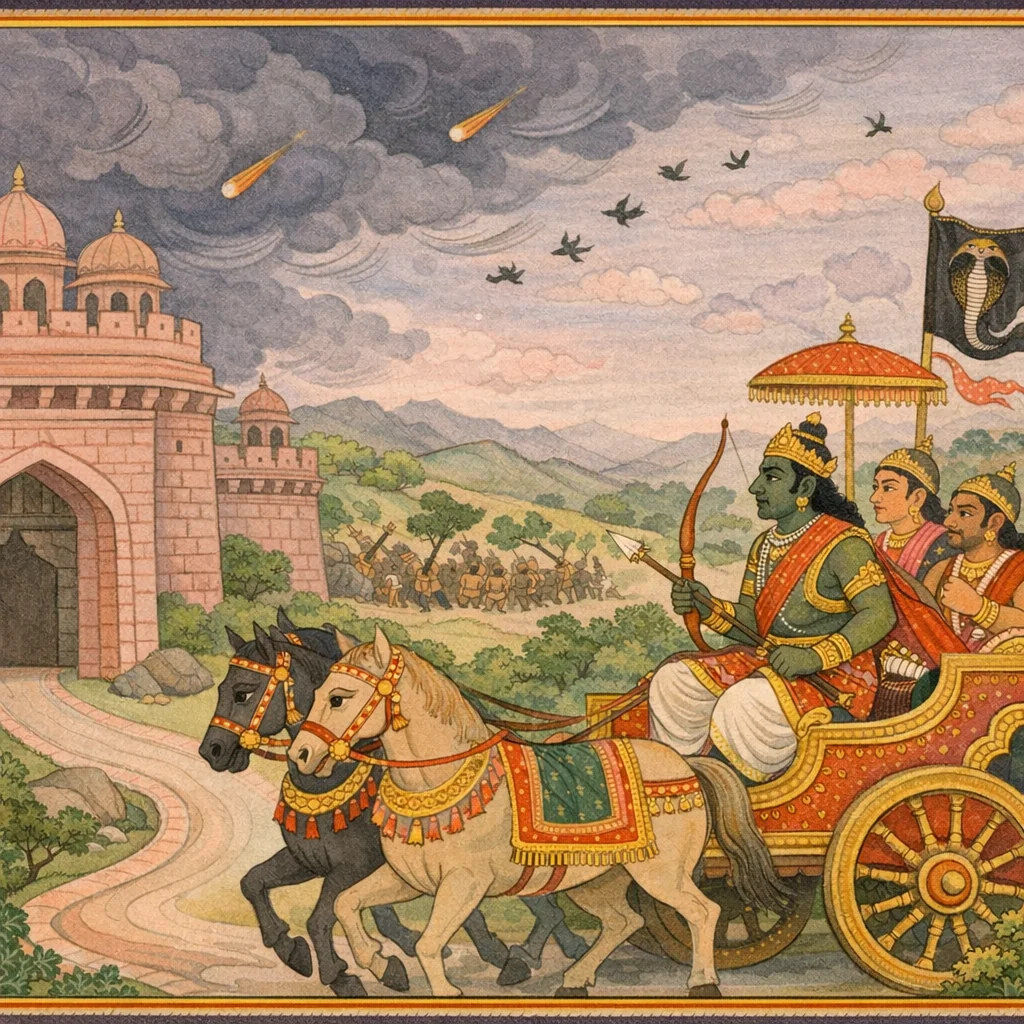
Sarga 57 pivots from the shock of Akampana’s death to a formal rākṣasa counteroffensive. Rāvaṇa, described as simultaneously enraged and pallid, confers with ministers and inspects Laṅkā’s defensive posts, then addresses Prahasta as the war-expert capable of relieving a suddenly oppressed city. He frames the crisis as solvable only through decisive battle-leadership and names alternate burden-bearers (himself, Kumbhakarṇa, Indrajit, Nikumbha), yet commissions Prahasta to mobilize immediately. Prahasta replies in a counsel-heavy register: he recalls prior deliberations and asserts that returning Sītā would be the beneficial course, while refusal makes war inevitable; nevertheless, he pledges loyalty, gifts-and-honors acknowledged, and offers his life in battle. He then orders the army chiefs to assemble the great host; Laṅkā rapidly fills with heavily armed, elephantine warriors amid ritual acts (fire offerings, honoring brāhmaṇas, consecrated garlands). Prahasta mounts a richly described chariot (serpent-banner, gold netting, thunderous sound), departs with adjutants, and the march is accompanied by a sonic panorama of drums, conches, and terrifying cries. A dense cluster of ominous signs follows—anticlockwise circling carrion birds, meteors, violent winds, jackals, blood-rain, a vulture on the banner, and the charioteer’s whip slipping—signaling impending ruin despite outward splendor. The vānar army braces with trees and rocks; mutual challenges swell, and Prahasta, likened to a moth entering flame, plunges into the monkey host seeking victory, marking the sarga’s thematic lesson on hubris, ill-omened aggression, and the tragic momentum of war.
Shlokas
Verse 1
अकम्पनवधंश्रुत्वाक्रुद्धोवैराक्षसेश्वरः ।किञ्चिददीनमुखश्चापिसचिवांस्तानुदैक्षत ।।।।
Hearing of Akampana’s killing, the lord of the Rākṣasas grew angry; yet with a face turned somewhat pale, he looked upon those ministers of his.
Verse 2
सतुध्यात्वामुहूर्तंतुमन्त्रिभिस्संविचार्यच ।ततस्तुरावणःपूर्वदिवसेराक्षसाधिपः ।।।।पुरींपरिययौलङ्कांसर्वगुल्मानवेक्षितुम् ।
Rāvaṇa, lord of the Rākṣasas, reflected for a while and, after deliberating with his ministers, went out in the forenoon to tour Laṅkā and inspect all the military posts.
Verse 3
तांराक्षसगणैर्गुप्तांगुल्मैर्बहुभिरावृताम् ।।।।ददर्शनगरींलङ्कांपताकाध्वजमालिनीम् ।
He beheld the city of Lanka—well-guarded by companies of rākṣasas, ringed with many outposts, and adorned with rows of banners and standards.
Verse 4
रुद्धांतुनगरींदृष्टवारावणोराक्षसेश्वरः ।।।।उवाचात्महितंकालेप्रहस्तंयुद्धकोविदम् ।
Seeing the city besieged, Rāvaṇa, lord of the Rākṣasas, at that critical moment spoke for his own advantage to Prahasta, who was skilled in warfare.
Verse 5
पुरस्योपनिविष्टस्यसहसापीडितस्यवा ।।।।नान्यंयुद्धात्प्रपश्यामिमोक्षंयुद्धविशारद ।
For this city—besieged and suddenly hard-pressed—I see no deliverance except through battle, O expert in war.
Verse 6
अहंवाकुम्भकर्णोवात्वंवासेनापतिर्मम ।।।।इन्द्रजिद्वानिकुम्भोवावहेयुर्भारमीदृशम् ।
Either I, or Kumbhakarṇa, or you—my commander—or Indrajit, or Nikumbha could bear a burden such as this.
Verse 7
सत्वंबलमतश्शीघ्रमादायपरिगृह्यच ।।।।विजयायाभिनिर्याहियत्रसर्वेवनौकसः ।
Therefore you—quickly take up the forces, assume command, and march out for victory to where all the Vānara warriors are gathered.
Verse 8
निर्याणायादेवतेनूनंचपलाहरिवाहिनी ।।।।नर्दतांराक्षसेन्द्राणांश्रुत्वानादंद्रविष्यति ।
The moment you march out, surely the restless Vānara host will flee when it hears the tumult and roar of the rākṣasa-lords.
Verse 9
चपलाह्यविनीताश्चचलचित्ताश्चवानराः ।।।।नसहिष्यन्तितेनादंसिंहनादमिवद्विपाः ।
For the Vānaras are fickle, undisciplined, and unstable in mind; they will not withstand your roar—just as elephants cannot endure a lion’s roar.
Verse 10
विद्रुतेचबलेतस्मिन् रामःसौमित्रिणासह ।।।।अवशस्तेनिरालम्बःप्रहस्तवशमेष्यति ।
"When that force is put to flight, Rāma—together with Saumitri—will be helpless, without support, and will fall under your power, O Prahasta."
Verse 11
आपत्संशयिताश्रेयोनात्रनिस्संशयीकृता ।।।।प्रतिलोमानुलोमंवायद्वानोमन्यसेहितम् ।
"In calamity, what is ‘better’ becomes uncertain—nothing here is fixed beyond doubt. Consider, then, whether a course is contrary or agreeable, and decide what you judge to be truly beneficial."
Verse 12
रावणेनैवमुक्तस्तुप्रहस्तोवाहिनीपतिः ।।।।राक्षसेन्द्रमुवाचेदमसुरेन्द्रमिवोशना ।
Thus addressed by Rāvaṇa, Prahasta—the commander of the host—spoke these words to the lord of the Rākṣasas, as Uśanā once spoke to the lord of the Asuras.
Verse 13
राजन्मन्त्रितपूर्वंनःकुशलैस्सहमन्त्रिभिः ।।।।विवादश्चापिनोवृत्तस्समवेक्ष्यपरस्परम् ।
"O King, we had earlier deliberated on this together with capable ministers; and after weighing matters among ourselves, disagreement too arose."
Verse 14
प्रदानेनतुसीतायाःश्रेयोव्यवसितंमया ।।।।अप्रदानेपुनर्युद्धंदृष्टमेत्तथैवनः ।
"I concluded that the better course is to give Sītā back; but if she is not given, then war—so it appears to us—will inevitably follow."
Verse 15
सोऽहंदानैश्चमानैश्चसततंपूजितस्त्वया ।।।।सान्त्वैश्चविविधैःकालेकिंनकुर्यांहितंतव ।
"Since I have been continually honored by you with gifts, respect, and many kinds of conciliatory words, why should I not, when the time has come, do what is for your good?"
Verse 16
नहिमेजीवितंरक्ष्यंपुत्रदारधनानिच ।।।।त्वंपश्यमांजुहूषन्तंत्वदर्थेजीवितंयुधि ।
"For me, life is not something to be guarded—nor sons, wife, or wealth. Watch me: for your sake, in battle, I am prepared to offer up my life."
Verse 17
एवमुक्त्वातुभर्तारंरावणंवाहिनीपतिः ।।।।उवाचेदंबलाध्यक्षान्प्रहस्तःपुरतःस्थितान् ।
Having spoken thus to his lord Rāvaṇa, Prahasta—the commander of the host—then addressed the chiefs of the forces who were standing before him.
Verse 18
मेशीघ्रंराक्षसानांमहाद्बलम् ।।।।मद्भाणाब्दावेगेनहतानांशनिचरणाजिरे ।अद्यहृष्यन्तुमांसादाःपक्षिणःकाननौकसां ।।।।
“Quickly assemble the great Rākṣasa host with me and bring it to the battlefield. Today, the flesh-eating birds of the forest will rejoice over those slain by the storm-speed of my arrows,” (said Prahastha).
Verse 19
मेशीघ्रंराक्षसानांमहाद्बलम् ।।6.57.18।।मद्भाणाब्दावेगेनहतानांशनिचरणाजिरे ।अद्यहृष्यन्तुमांसादाःपक्षिणःकाननौकसां ।।6.57.19।।
“Quickly assemble the great Rākṣasa host with me and bring it to the battlefield. Today, the flesh-eating birds of the forest will rejoice over those slain by the storm-speed of my arrows,” (said Prahastha).
Verse 20
इत्युक्तास्तेप्रहस्तेनबलाध्यक्षा: कृतत्वरा: ।बलमुद्योजयामासुस्तस्मिन्राक्षसमन्दिरे ।।।।
Thus addressed by Prahastha, the commanders hurried at once and began to mobilize the troops within that Rākṣasa stronghold.
Verse 21
साबभूवमुहूर्तेननिग्मर्नानाविधायुधैः ।लङ्काराक्षसवीरैस्तैर्गजैरिवसमाकुला ।।।।
In a short time, Laṅkā became crowded with those Rākṣasa heroes—armed with many kinds of weapons—like a place thronged with elephants.
Verse 22
हुताशनंतर्पयतांब्राह्मणांश्चनमस्यताम् ।आज्यगन्धप्रतिवहःसुरभिर्मारुतोववौ ।।।।
As they propitiated the sacred fire with offerings and bowed to the brāhmaṇas, a pleasant breeze blew, carrying the fragrance of ghee.
Verse 23
स्रजश्चविविधाकाराजगृहुस्त्वभिमन्त्रिताः ।सङ्ग्रामसज्जाःसम्हृष्टाधरायन्राक्षसास्तदा ।।।।
Then the Rākṣasas, delighted and ready for battle, took up garlands of many forms—consecrated with incantations—and put them on.
Verse 24
सधनुष्काःकवचिनोवेगादाप्लुत्यराक्षसाः ।रावणंप्रेक्ष्यराजानंप्रहस्तंपर्यवारयन् ।।।।
Bearing bows and armor, the Rākṣasas rushed forward; after looking upon King Rāvaṇa, they swiftly gathered around Prahastha.
Verse 25
अथामन्त्ऱ्यतुराजानंभेरीमाहत्यभैरवाम् ।आरुरोहरथंयुक्तःप्रहस्तस्सज्जकल्पितम् ।।।।हयैर्महाजवैर्युक्तंसम्यक्सूतसुसंयतम् ।महाजलदनिर्घोषंसाक्षाच्चन्द्रार्कभास्वरम् ।।।।उरगध्वजदुर्धर्षंसुवरूथंस्ववस्करम् ।सुवर्णजालसंयुक्तंप्रहसन्तमिवश्रिया ।।।।
Then, after taking leave of the king and having the dreadful war-drums beaten, Prahastha mounted a chariot made ready for combat—yoked to swift horses, well-controlled by an able charioteer, roaring like a great thundercloud, radiant like sun and moon, bearing a serpent emblem on its banner, hard to assail, protected by railings and guards, and adorned with a net of gold, as though laughing with splendor.
Verse 26
अथामन्त्ऱ्यतुराजानंभेरीमाहत्यभैरवाम् ।आरुरोहरथंयुक्तःप्रहस्तस्सज्जकल्पितम् ।।6.57.25।।हयैर्महाजवैर्युक्तंसम्यक्सूतसुसंयतम् ।महाजलदनिर्घोषंसाक्षाच्चन्द्रार्कभास्वरम् ।।6.57.26।।उरगध्वजदुर्धर्षंसुवरूथंस्ववस्करम् ।सुवर्णजालसंयुक्तंप्रहसन्तमिवश्रिया ।।6.57.27।।
Then Prahasta mounted his chariot—yoked to swift horses, expertly handled by a skilled charioteer—rumbling like a great thundercloud and shining like the very moon and sun.
Verse 27
अथामन्त्ऱ्यतुराजानंभेरीमाहत्यभैरवाम् ।आरुरोहरथंयुक्तःप्रहस्तस्सज्जकल्पितम् ।।6.57.25।।हयैर्महाजवैर्युक्तंसम्यक्सूतसुसंयतम् ।महाजलदनिर्घोषंसाक्षाच्चन्द्रार्कभास्वरम् ।।6.57.26।।उरगध्वजदुर्धर्षंसुवरूथंस्ववस्करम् ।सुवर्णजालसंयुक्तंप्रहसन्तमिवश्रिया ।।6.57.27।।
That chariot—bearing a serpent emblem on its banner—was hard to assail, fitted with protective railings and safeguards against collision, and overlaid with a golden lattice; in its splendor it seemed to smile.
Verse 28
ततस्तंरथमास्थायरावणार्पितशासनः ।लङ्कायानिर्ययौतूर्णंबलेनमहतावृतः ।।।।
Then, having taken his seat upon that chariot, and acting under Rāvaṇa’s command, he swiftly departed from Lanka, surrounded by a great host.
Verse 29
ततोदुन्धुभिनिर्घोषःपर्जन्यनिनदोपमः ।वादित्राणांचनिनदःपूरयन्निवमेदिनीम् ।।।।शुश्रुवेशङ्खशब्दश्चप्रयातेवाहिनीपतौ ।
As the commander of the host set forth, the boom of kettle-drums—like thunder—rose, along with the blare of instruments; even conch-calls were heard, as though the very earth were being filled with sound.
Verse 30
निनदन्तस्स्वरान्घोरान्राक्षसाजग्मुरग्रतः ।।।।भीमरूपामहाकायाःप्रहस्तस्यपुरस्सराः ।
Rākṣasas of terrifying form and massive bodies, roaring with dreadful cries, marched in front as Prahastha’s vanguard.
Verse 31
नरान्तकःकुम्भहनुर्महानादस्समुन्नतः ।।।।प्रहस्तसचिवाह्येतेनिर्ययुःपरिवार्यतम् ।
Narantaka, Kumbhahanu, Mahanada, and Samunnata—these aides of Prahastha—set out, surrounding him as they went.
Verse 32
व्यूढेनेवसुघोरेणपूर्वद्वारात्सनिर्ययौ ।।।।गजयूथनिकाशेनबलेनमहतावृतः ।
He emerged from the eastern gate, surrounded by a vast force—grim and arrayed for battle—resembling a herd of elephants.
Verse 33
सागरप्रतिमौघेनवृतस्तेनबलेनसः ।।।।प्रहस्तोनिर्ययौक्रुद्धःकालान्तकयमोपमः ।
Encircled by that host—like an ocean in surge—Prahastha went forth in wrath, resembling Kāla, Antaka, and Yama in his deadly aspect.
Verse 34
तस्यनिर्याणघोषेणराक्षसानांचनर्दताम् ।।।।लङ्कायांसर्वभूतानिविनेदुर्विकृतैस्स्वरैः ।
At the uproar of his departure—and the rākṣasas’ roaring—every creature in Lanka cried out in distorted, unnatural tones.
Verse 35
व्यभ्रमाकाशमाविश्यमांसशोणितभोजनाः ।।।।मण्डलान्यपसव्यानिखगाश्चक्रूरथंप्रति ।
Carrion birds—feeders on flesh and blood—rose into the sky and wheeled in circles, moving counterclockwise around the chariot: a grim portent.
Verse 36
सम्नत्यःपावकज्वालाःशिवाघोराववाशिरे ।।।।अन्तरिक्षात्पपातोल्कावायुश्चपरुषंवनौ ।
Dreadful jackals howled, as though vomiting tongues of fire; a meteor fell from the sky, and a harsh wind blew—portents foretelling ruin for the unrighteous host.
Verse 37
अन्योन्यमभिसंरब्धाग्रहाश्चनचकाशिरे ।।।।मेघाश्चखरनिर्घोषारथस्योपरिरक्षसः ।ववृषंरुधिरंचास्यसिषिचुश्चपुरस्सरान् ।।।।
The planets, as if colliding with one another, shone no more; clouds roared harshly, and upon the Rākṣasa’s chariot they rained blood, drenching those marching in front.
Verse 38
अन्योन्यमभिसंरब्धाग्रहाश्चनचकाशिरे ।।6.57.37।।मेघाश्चखरनिर्घोषारथस्योपरिरक्षसः ।ववृषंरुधिरंचास्यसिषिचुश्चपुरस्सरान् ।।6.57.38।।
The planets seemed to clash and lost their radiance; the clouds, roaring harshly, poured down blood upon the Rākṣasa’s chariot and drenched the vanguard—an emphatic repetition of the same ill-omen.
Verse 39
केतुर्मूर्धनिगृध्रोऽस्यनिलीनोदक्षिणामुखः ।तुदन्नुभयतःपार्श्वंसमग्रामहरत्प्रभाम् ।।।।
On the top of his banner a vulture settled, facing south; pecking at both sides, it seemed to steal away all his radiance—an unmistakable sign of impending loss.
Verse 40
सारथेर्भहुशश्चास्यसङ्ग्राममवगाहतः ।प्रतोदोन्यपतद्धस्तात्सूतस्यहयसादिनः ।।।।
As he entered the battle, the charioteer—skilled at handling the horses—again and again let the whip slip from his hand, another ill sign of failing control.
Verse 41
निर्याणश्रीश्चयाऽस्यासीद्भास्वरावसुदुर्लभाः ।साननाशमुहूर्तेनसमेचस्खलिताहयाः ।।।।
The brilliant martial splendor that attended his march—hard to obtain—vanished in an instant; even on level ground the horses stumbled, as if fortune itself withdrew.
Verse 42
प्रहस्तंत्वभिनिर्यान्तंप्रख्यातबलपौरुषम् ।युधिनानाप्रहरणाकपिसेनाऽभ्यवर्तत ।।।।
But as Prahasta came forth—renowned for strength and manly valor—the monkey army, armed with many kinds of weapons, moved to meet him in battle.
Verse 43
अथघोषस्सुतुमुलोहरीणांसमजायत ।वृक्षानारुजतांचैवगुर्वीरागृह्णतांशिलाः ।।।।
Then a tremendous uproar arose among the monkeys, as they tore up trees and seized heavy rocks to hurl in combat.
Verse 44
नदतांराक्षसानांचवानराणांचगर्जताम् ।उभेप्रमुदितेसैन्येरक्षोगणवनौकसाम् ।।।।वेगितानांसमर्थानामन्योन्यवधकाङ् क्षिणाम् ।परस्परंचाह्वयतांनिनाद्शूयतेमहान् ।।।।
As the Rākṣasas shouted and the Vānaras roared, both armies—Rākṣasa hosts and forest-dwellers—exultant, swift, and powerful, longing to strike each other down, challenged one another; and a vast, thunderous din was heard.
Verse 45
नदतांराक्षसानांचवानराणांचगर्जताम् ।उभेप्रमुदितेसैन्येरक्षोगणवनौकसाम् ।।6.57.44।।वेगितानांसमर्थानामन्योन्यवधकाङ् क्षिणाम् ।परस्परंचाह्वयतांनिनाद्शूयतेमहान् ।।6.57.45।।
Among those swift and capable warriors—each intent on the other’s downfall—there arose a mighty din as they challenged one another again and again.
Verse 46
ततःप्रहस्तःकपिराजवाहिनीमभिप्रतस्थेविजयायदुर्मतिः ।विवृद्धवेगंश्चविवेशतांचमूंयथामुमूर्षुश्शलभोविभावसुम् ।।।।
Then Prahasta—ill-minded in his purpose—advanced to win victory and plunged, his momentum grown fierce, into the Monkey-King’s host, like a moth rushing into fire, bent on its own death.
Frequently Asked Questions
The sarga stages a governance dilemma: Prahasta states that returning Sītā is the beneficial option, while refusal makes war inevitable; yet he still accepts command out of loyalty, illustrating tension between prudent counsel and compelled martial duty.
Counsel ignored and omens dismissed intensify self-destructive momentum: outward splendor and confidence cannot neutralize adharma-driven resolve, and aggressive certainty may resemble a “moth to flame” when moral and cosmic indicators warn of ruin.
Laṅkā’s fortified posts and the eastern gate are emphasized, alongside wartime ritual culture—fire offerings, honoring brāhmaṇas, consecration of garlands and equipment—framing military mobilization as both civic and sacral activity.