Sarga 54
वज्रदंष्ट्रवधः — The Slaying of Vajradaṃṣṭra (Angada’s Duel)
युद्धकाण्ड
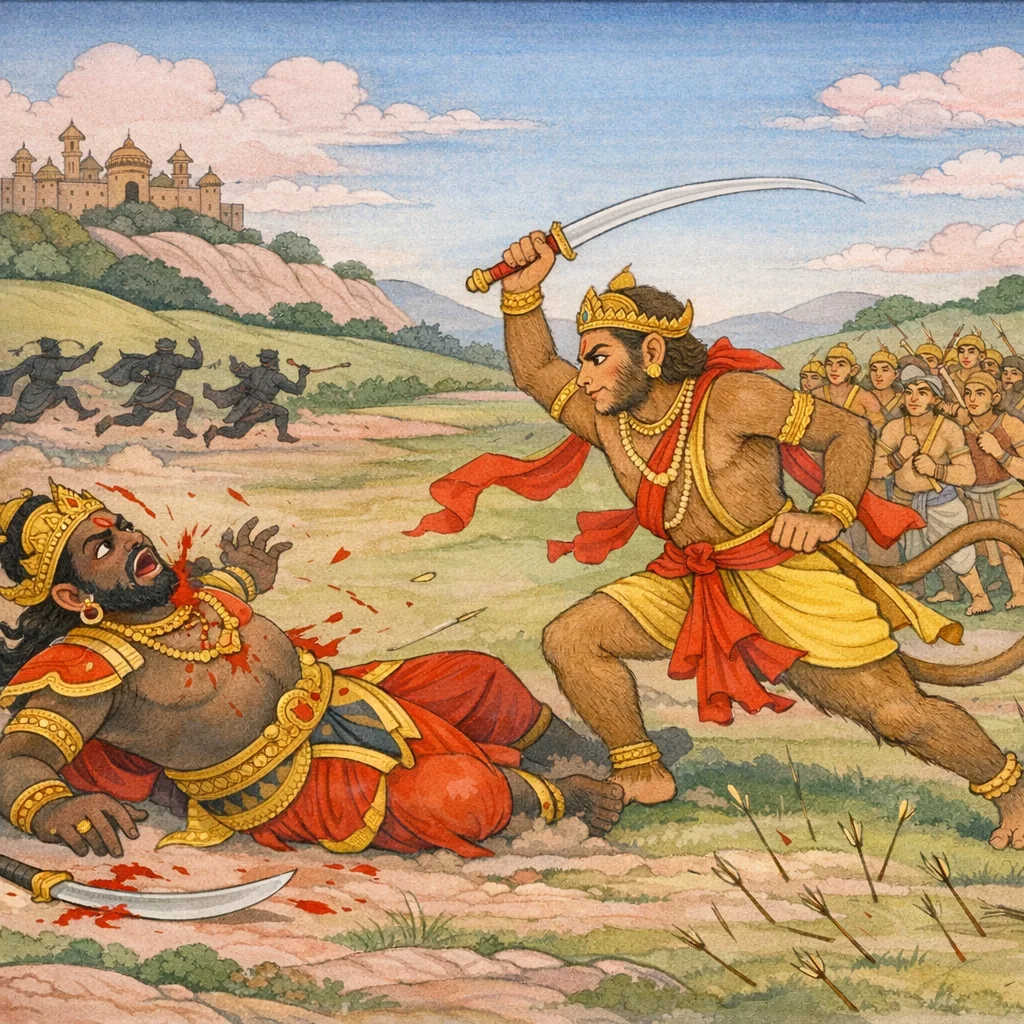
Sarga 54 presents a concentrated combat episode within the Laṅkā war: the rākṣasa Vajradaṃṣṭra, enraged by the destruction of his forces and Aṅgada’s successes, intensifies the conflict by showering accurate arrows into the Vānara ranks. The battlefield is depicted with stark forensic imagery—severed limbs, headless trunks, and routed troops—establishing the cost of war and the psychological collapse of morale. As frightened Vānaras seek refuge with Aṅgada, Vāli’s son assumes command presence, directly confronting Vajradaṃṣṭra. The duel escalates through successive weapon-phases: missile volleys, improvised arboreal and rocky projectiles (tree and hill/peak), chariot destruction, and finally close-quarters combat (mace-strike and fist-fight). The climax arrives when Aṅgada rises rapidly from exhaustion and decapitates Vajradaṃṣṭra with a clean sword-stroke. The rākṣasas, witnessing their champion’s fall, flee toward Laṅkā in fear and shame, while Aṅgada is honored amid the Vānara host—an episode that frames leadership as protective courage and decisive restraint within a brutal theater.
Shlokas
Verse 1
बलस्यचविघातेनअङ्गदस्यजयेनच ।राक्षसःक्रोधमाविष्टोवज्रदंष्ट्रोमहाबलः ।।6.54.1।।
Enraged by the ruin of his forces and by Aṅgada’s victory, the mighty rākṣasa Vajradaṃṣṭra was seized by wrath.
Verse 2
विष्पार्यचधनुर्घोरंशक्राशनिसमस्वनम् ।वानराणामनीकानिप्राकिरच्छरवृष्टिभिः ।।6.54.2।।
Stretching his dreadful bow, whose roar was like Indra’s thunderbolt, Vajradaṃṣṭra rained down volleys of arrows and scattered the monkey battalions.
Verse 3
राक्षसाश्चापिमुख्यास्तेरथेषुसमवस्थिताः ।नानाप्रहरणाश्शूराःप्रायुध्यन्तस्तदारणे ।।6.54.3।।
The chief rākṣasas too, stationed upon their chariots—heroes bearing many kinds of weapons—fought on steadily then in the battle.
Verse 4
वानराणांचशूरायेतेसर्वेप्लवगर्षभाः ।आयुध्यन्तशिलाहस्तास्समवेतास्समन्ततः ।।6.54.4।।
All those heroic vānara-bulls assembled on every side, fighting with rocks in their hands.
Verse 5
तत्रायुधसहस्राणितस्मिन्नायोधनेभृशम् ।राक्षसाःकपिमुख्येषुपातयांचक्रिरेतदा ।।6.54.5।।
There, in that fierce battle, the rākṣasas then hurled thousands of weapons at the foremost vānara leaders.
Verse 6
वानराश्चापिरक्षस्सुगिरवृक्षान्महाशिलाः ।प्रवीराःपातयामासुर्मत्तमातङ्गसन्निभाः ।।6.54.6।।
The heroic vānara champions—like rutting elephants in their fury—also rained down trees, mountain-boulders, and massive rocks upon the rākṣasas.
Verse 7
शूराणांयुद्यमानानांसमरेष्न्विवर्तिनाम् ।तद्राक्षसगणानांचसुयुद्धंसमवर्तत ।।6.54.7।।
Among heroes locked in combat—unyielding in the clash—the struggle between the rākṣasa hosts (and their foes) became a truly fierce war.
Verse 8
प्रभिन्नशिरसःकेचिछचिन्नैःपादैश्चबाहुभिः ।शस्स्रैरर्दितदेहाभ्यरुधिरेणसमुक्षिताः ।।6.54.8।।हरयोराक्षसाश्चैवशेरतेगांसमाश्रिताः ।कङ्कगृध्रवळैराढ्याश्चगोमायुगलसङ्कुलाः ।।6.54.9।।
Some lay with shattered heads, severed feet and arms; their bodies torn by weapons and drenched in blood. Thus monkeys and rākṣasas alike lay strewn upon the earth, surrounded by crows and vultures, and crowded with packs of jackals.
Verse 9
प्रभिन्नशिरसःकेचिछचिन्नैःपादैश्चबाहुभिः ।शस्स्रैरर्दितदेहाभ्यरुधिरेणसमुक्षिताः ।।6.54.8।।हरयोराक्षसाश्चैवशेरतेगांसमाश्रिताः ।कङ्कगृध्रवळैराढ्याश्चगोमायुगलसङ्कुलाः ।।6.54.9।।
Some lay with their heads split open, their legs and arms severed; their bodies torn by weapons and drenched in blood. Monkeys and rākṣasas alike lay scattered upon the ground, surrounded by crows and vultures, and thronged by packs of jackals.
Verse 10
कबन्धानिसमुत्पेतुर्भीमाणांभीषणानिवै ।भुजपाणिशिरश्छिन्नकायाश्चभूतले ।।6.54.10।।वानराराक्षसाश्चापिनिपेतुस्तत्रवैरणे ।
On that battlefield, dreadful headless trunks rose up—bodies severed of arms, hands, and heads—while both vānaras and rākṣasas fell there in the fight.
Verse 11
ततोवानरसैन्येनहन्यमानंनिशाचरम् ।।6.54.11।।प्राभज्यतबलंसर्वंवज्रदंष्ट्रस्यपश्यतः ।
Then, as the night-rangers were being struck down by the vānaras, the entire force broke and scattered—while Vajradaṃṣṭra looked on.
Verse 12
राक्षसान्भयवित्रस्तान्हन्यमानान् प्लवङ्गमैः ।।6.54.12।।दृष्टवासरोषताम्राक्षोवज्रदंष्ट्रःप्रतापवान् ।प्रविवेशधनुष्पाणिस्त्रासयन्हरिवाहिनीम् ।।6.54.13।।
Seeing the rākṣasas—panic-stricken and being cut down by the monkeys—the valiant Vajradaṃṣṭra, his eyes reddened with rage, entered the vānaras’ ranks with bow in hand, terrifying the monkey-host.
Verse 13
राक्षसान्भयवित्रस्तान्हन्यमानान् प्लवङ्गमैः ।।6.54.12।।दृष्टवासरोषताम्राक्षोवज्रदंष्ट्रःप्रतापवान् ।प्रविवेशधनुष्पाणिस्त्रासयन्हरिवाहिनीम् ।।6.54.13।।
Seeing the rākṣasas—panic-stricken and being cut down by the monkeys—the valiant Vajradaṃṣṭra, his eyes reddened with rage, entered the vānaras’ ranks with bow in hand, terrifying the monkey-host.
Verse 14
शरैर्विदारयामासकङ्कपत्रैरजिह्मगैः ।बिभेदवानरांस्तत्रसप्ताष्टौनवपञ्चच ।।6.54.14।।विव्याधपरमक्रुद्धोवज्रदंष्ट्रःप्रतापवान् ।
Fiercely enraged, the valiant Vajradaṃṣṭra tore into the vānaras there, striking them with unerring arrows feathered with vulture-plumes—seven, eight, nine, even five at a time.
Verse 15
त्रस्ताःसर्वेहरिगणाःशरैःसङ्कृत्तकन्दरा:।। 6.54.15।।अङ्गदंसम्प्रधावन्तिप्रजापतिमिवप्रजाः ।
All the vānaras, terrified and with their bodies cut and torn by arrows, ran toward Aṅgada for refuge—like creatures hastening to Prajāpati.
Verse 16
ततोहरिगणान् भग्नान् दृष्टवावालिसुतस्तदा ।।6.54.16।।क्रोधेनवज्रदंष्ट्रंतमुदीक्षन्तमुदैक्षत ।
Then Vāli’s son, seeing the monkey ranks broken, turned in anger to face Vajradaṃṣṭra, who was glaring at them.
Verse 17
वज्रदंष्ट्रोऽङ्गदश्चोभौसङ्गतौहरिराक्षसौ ।।6.54.17।।चेरतुःपरमक्रुद्धौहरिमत्तगजाविव ।
Vajradaṃṣṭra and Aṅgada—rākṣasa and vānara—closed with each other, both fiercely enraged, like a lion and a rut-maddened elephant.
Verse 18
ततश्शतसहस्रेणहरिपुत्रंमहाबलः ।।6.54.18।।जघानमर्मदेशेषुमातङ्गमिवतोमरैः ।
Then the mighty one struck the monkey prince again and again—by the hundred-thousand—at vital points, as an elephant is pierced with spears.
Verse 19
रुधिरोक्षितसर्वाङ्गोवालिसूनुर्महाबलः ।।6.54.19।।चिक्षेपवज्रदंष्ट्रायवृक्षंभीमपराक्रमः ।
Aṅgada, Vāli’s mighty son—his whole body drenched in blood, yet terrible in valor—hurled a tree at Vajradaṃṣṭra.
Verse 20
दृष्टापतन्तंतंवृक्षमसम्भ्रान्तश्चराक्षसः ।।6.54.20।।चिच्छेदबहुधासोऽपिमथितःप्रादतद्भुवि ।
Seeing that tree hurtling toward him, the rākṣasa did not lose his composure; he cut it into many pieces, and the shattered mass fell to the ground.
Verse 21
तंदृष्टवावज्रदंष्ट्रस्यविक्रमंप्लवगर्षभ ।।6.54.21।।प्रगृह्यविपुलंशैलंचिक्षेपचननादच ।
Seeing Vajradaṃṣṭra’s prowess, Aṅgada—the bull among monkeys—seized a massive rock and hurled it, roaring aloud.
Verse 22
समापतन्तंदृष्टवासरथादाप्लुत्यवीर्यवान् ।।6.54.22।।गदापाणिरसम्भ्रान्तःपृथिव्यांसमतिष्ठत ।
Seeing it rushing toward him, the valiant one leapt down from his chariot; mace in hand and unshaken, he took his stand upon the ground.
Verse 23
साङ्गदेनगदाक्षिप्तागत्वातुरणमूर्धनि ।।6.54.23।।सचक्रकूबरंसाश्वंप्रममाथरथंतदा ।
Hurled by Aṅgada, it sped to the very forefront of the battle and then smashed that chariot—together with its wheels, its pole, and its horses.
Verse 24
ततोऽन्यच्छिखरंगृह्यविपुलंद्रुमभूषितम् ।।6.54.24।।वज्रदंष्ट्रस्यशिरसिपातयामाससाऽङ्गदः ।
Then Aṅgada seized yet another enormous, tree-clad peak and brought it down upon Vajradaṃṣṭra’s head.
Verse 25
अभवच्छोणितोद्गारीवज्रदंष्ट्रस्समूर्छितः ।।6.54.25।।मुहूर्तमभवन्मूढोगदामालिङ् ग्यनिश्श्वसन् ।
Vajradaṁṣṭra, spewing blood, fell unconscious; and for a while he lay senseless, clasping his mace and breathing heavily.
Verse 26
संलब्दसंज्ञोगदयावालिपुत्रमवस्थितम् ।।6.54.26।।जघानपरमक्रुद्धोवक्षोदेशेनिशाचरः ।
Regaining consciousness, the night-ranger—furious—struck Vāli’s son, who stood firm, on the chest with his mace.
Verse 27
गदांत्यक्त्वाततस्तत्रमुष्टियुद्धमवर्तत ।।6.54.27।।अन्योन्यंजघ्नतुस्तत्रतावुभौहरिराक्षसौ ।
Then, casting aside the mace, the two—monkey and rākṣasa—began a fist-fight there, striking each other blow for blow.
Verse 28
रुधिरोद्गारिणौतौतुप्रहारैर्जनितश्रमौ ।।6.54.28।।बभूवतुस्सुविक्रान्तावङ्गारकबुधाविव ।
Both of them, spitting blood and wearied by the blows, still stood as mighty warriors—like Aṅgāraka and Budha in conflict.
Verse 29
ततःपरमतेजस्वीअङ्गदःप्लवगर्षभः ।।6.54.29।।उत्पाट्यवृक्षंस्थितवान् बहुपुष्पफलाञ्चितम् ।
Then Angada—radiant in power, the bull among monkeys—uprooted a tree laden with many flowers and fruits, and stood ready.
Verse 30
जग्राहचार्षभंचर्मखडगंचविपुलंशुभम् ।।6.54.30।।किङ्किणाजालसञ्छन्नंचर्मणाचपरिष्कृतम् ।
He seized a vast, gleaming sword, and a bull-hide shield—covered with a net of small bells and well-finished with leatherwork.
Verse 31
चित्रांश्चरुचिरान्मार्गांश्चेरतुःकपिराक्षसौ ।।6.54.31।।जघ्नतुश्चतदान्योन्यंनिर्दयंजयकाङ् क्षिणौ ।
Then the monkey and the rākṣasa, yearning for victory, moved in strikingly varied and skillful ways, and smote each other without mercy.
Verse 32
व्रणैस्सास्त्रैरशोभेतांपुष्पिताविवकिंशुकौ ।।6.54.32।।युध्यमानौपरिश्रान्तौजानुभ्यामवनींगतौ ।
With wounds oozing blood they appeared like two blossoming kiṁśuka trees; yet, as they fought on and grew weary, they sank to the earth upon their knees.
Verse 33
निमेषान्तरमात्रेणअङ्गदःकपिकुञ्जरः ।।6.54.33।।उदतिष्ठतदीप्ताक्षोदण्डाहतइवोरगः ।
In but the space of a blink, Angada—the elephant among monkeys—sprang up, his eyes blazing, like a serpent struck with a staff.
Verse 34
निर्मलेनसुधौतेनखड्डेनास्यमहच्छिरः ।।6.54.34।।जघानवज्रदंष्ट्रस्यवालिसूमर्महाबलः ।
Then the mighty son of Vāli struck off Vajradaṃṣṭra’s great head with a spotless, well-honed sword.
Verse 35
रुधिरोक्षितगात्रस्यबभूवपतितंद्विधा ।।6.54.35।।सरोषपरिवृत्ताक्षंशुभंखडगहतंशिरः ।
His limbs were drenched in blood; the sword-struck head fell down split in two, its eyes rolling in wrathful shock.
Verse 36
वज्रदंष्ट्रंहतंदृष्टवाराक्षसाभयमोहिताः ।।6.54.36।।त्रस्ताह्यभ्यद्रवन् लङ्कांवध्यमानाःप्लवङ्गमैः ।विषण्णवदना: दीनाह्रियाकिञ्चिदवाङ्मुखाः ।।6.54.37।।
Seeing Vajradaṃṣṭra slain, the rākṣasas—bewildered by fear—fled in terror toward Laṅkā, beaten back by the monkeys; downcast and miserable, their faces sank and their heads bent in shame.
Verse 37
वज्रदंष्ट्रंहतंदृष्टवाराक्षसाभयमोहिताः ।।6.54.36।।त्रस्ताह्यभ्यद्रवन् लङ्कांवध्यमानाःप्लवङ्गमैः ।विषण्णवदना: दीनाह्रियाकिञ्चिदवाङ्मुखाः ।।6.54.37।।
Among heroes locked in combat—unyielding in the clash—the struggle between the rākṣasa hosts (and their foes) became a truly fierce war.
Verse 38
निहत्यतंवज्रधरप्रतापःसवालिसूनुःकपिसैन्यमध्ये ।जगामहर्षंमहितोमहाबलःसहस्रनेत्रस्त्रिदशैरिवावृतः ।।6.54.38।।
Having slain him, Vāli’s son—whose prowess rivaled the wielder of the thunderbolt—stood honored amid the monkey host, rejoicing like the thousand-eyed Indra surrounded by the gods.
Frequently Asked Questions
The pivotal action is Aṅgada’s assumption of protective leadership when the Vānara ranks panic under Vajradaṃṣṭra’s arrow-assault; he converts fear into organized resistance by personally engaging the threat and ending it decisively.
Dharma in conflict is shown as responsibility toward the vulnerable: courage is not mere aggression but the disciplined willingness to absorb risk for collective stability, restoring morale and order without prolonging needless harm.
Laṅkā functions as the strategic horizon of retreat and defense; culturally, the chapter highlights battlefield norms—chariots, bows, mace, sword-and-shield, and improvised weapons (trees, hill-peaks)—as a catalog of kṣātra material culture.