Sarga 52
धूम्राक्षवधः (The Slaying of Dhumrākṣa)
युद्धकाण्ड
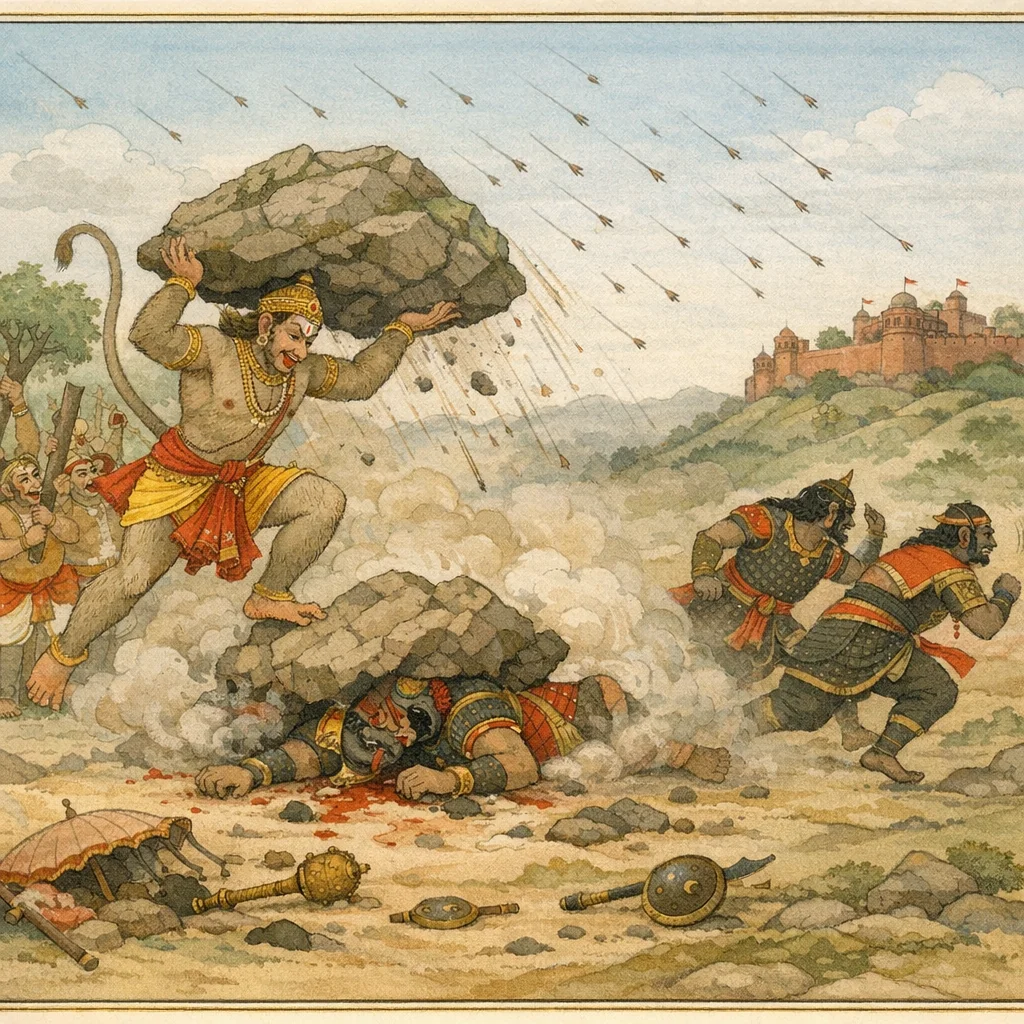
Sarga 52 depicts a concentrated battlefield episode in which the rākṣasa commander Dhumrākṣa returns to the front, provoking the vānaras’ war-cry and initiating a tumultuous engagement characterized by close-quarters violence and massed projectile fire. The chapter escalates through alternating descriptions of rākṣasa weaponry (arrows, tridents, clubs, iron bars, maces) and vānaras’ improvised martial ecology (trees, rocks, mountain fragments, fists, feet, teeth, nails). The soundscape is explicitly aestheticized: the twang of bowstrings, neighing, and elephant calls are framed as a kind of “battle-gāndharva” (symphonic metaphor), converting chaos into epic poetics. Dhumrākṣa briefly gains advantage by dispersing the vānaras with arrow-showers; Hanumān, seeing the allied army harassed, intervenes decisively. He hurls a massive rock at Dhumrākṣa’s chariot, forcing the rākṣasa to leap down; the chariot is crushed. The duel then sharpens: Dhumrākṣa strikes Hanumān with a spiked mace, but Hanumān, undeterred, drops a mountain peak onto Dhumrākṣa’s head, killing him. The surviving rākṣasas retreat into Laṅkā in fear, while the vānaras honor Hanumān, marking a morale and command shift within the war’s larger arc.
Shlokas
Verse 1
धूम्राक्षंप्रेक्ष्यनिर्यान्तंराक्षसंभीमविक्रमम् ।विनेदुर्वानरास्सर्वेप्रहृष्टायुद्धकाङ् क्षिणः ।।6.52.1।।
Seeing Dhumrākṣa—the rākṣasa of terrifying prowess—coming forth, all the vānara warriors roared aloud, exhilarated and eager for battle.
Verse 2
तेषांसुतुमुलंयुद्धंसञ्जज्ञेकपिरक्षसाम् ।अन्योन्यंपादपैर्घोरंनिघ्नतांशूलमुद्गरैः ।।6.52.2।।
A most tumultuous battle arose between the Vanaras and the Rakshasas, as they struck one another fiercely—Vanaras with dreadful trees, and Rakshasas with tridents and clubs.
Verse 3
राक्षसैर्वानराघोराविनिकृत्तस्समन्ततः ।वानरैराक्षसाश्चापिद्रुमैर्भूमिसमीकृताः ।।6.52.3।।
On all sides the fierce Vānaras were cut down by the Rākṣasas; and the Rākṣasas too were felled to the ground by Vānaras wielding trees.
Verse 4
राक्षसास्त्वभिसङ्क्रुद्धावानरान्निशितैश्शरैः ।विव्यथुर्घोरसङ्काशैःकङ्कपत्रैरजिह्मगैः ।।6.52.4।।
The rākṣasas, enraged, struck at the vānaras with sharp arrows—dreadful to behold, feathered with vulture-plumes, and flying straight to their mark.
Verse 5
तेगदाभिश्चभीमाभिःपट्टसै: कूटमुद्गरैः ।घोरैश्चपरिघैश्चित्रैस्त्रिशूलैश्चापिसंश्रितैः ।।6.52.5।।विदार्यमाणारक्षोभिर्वानरास्तेमहाबलाः ।अमर्षाज्जनितोद्धर्षाश्चक्रुःकर्माण्यभीतवत् ।।6.52.6।।
Those mighty vānaras, though being wounded by the rākṣasas, took up fearsome weapons—maces, axes, crushing hammers, dreadful iron bars, and many kinds of tridents—and, their ardor rising from indignation, carried out their combat-deeds without fear.
Verse 6
तेगदाभिश्चभीमाभिःपट्टसै: कूटमुद्गरैः ।घोरैश्चपरिघैश्चित्रैस्त्रिशूलैश्चापिसंश्रितैः ।।6.52.5।।विदार्यमाणारक्षोभिर्वानरास्तेमहाबलाः ।अमर्षाज्जनितोद्धर्षाश्चक्रुःकर्माण्यभीतवत् ।।6.52.6।।
Smashed by the mountain-peak, his limbs splayed and shattered, he fell suddenly to the ground—like a mountain collapsing into fragments.
Verse 7
शरनिर्भिन्नगात्रास्तेशूलनिर्भिन्नदेहिनः ।जगृहुस्तेद्रुमांस्तत्रशिलाश्चहरियूथपाः ।।6.52.7।।
Though their limbs were pierced by arrows and their bodies rent by tridents, the monkey-leaders there seized trees and rocks (as weapons).
Verse 8
तेभीमवेगाहरयोनर्दमानास्ततस्ततः ।ममन्थूराक्षसान्वीरान्नामानिचबभाषिरे ।।6.52.8।।
Those monkeys, swift with terrible force, roared as they surged from place to place; they crushed the rākṣasa champions and shouted out their own names.
Verse 9
तद्भभूवाद्भुतंघोरंयुद्धंवानररक्षसाम् ।शिलाभिर्विविधाभिश्चबहुभिश्चैवपादपैः ।।6.52.9।।
Then there arose a battle—wondrous yet terrifying—between vānaras and rākṣasas, fought with many kinds of rocks and with countless trees.
Verse 10
राक्षसामथिताःकेचिद्वानरैर्जितकाशिभिः ।ववमूरुधिरंकेचिन्मुखैरुधिरभोजनाः ।।6.52.10।।
Some rākṣasas were smashed into pulp by the vānara warriors who had mastered fear; others—blood-eaters—spewed blood from their mouths.
Verse 11
पार्श्वेषुदारिताःकेचित्केचिद्राशीकृताद्रुमैः ।शिलाभिश्चूर्णिताःकेचित्केचिद्धन्तैर्विदारिताः ।।6.52.11।।
Some were ripped open at the flanks; some were heaped and crushed by trees; some were ground to powder by rocks; and some were torn apart by teeth.
Verse 12
ध्वजैर्विमथितैर्भग्नैःखङ्गैश्चविनिपातितैः ।रथैर्विध्वंसितैश्चापिपतितैःरजनीचरैः ।।6.52.12।।
With standards shattered, swords struck down, chariots wrecked, and the night-rangers fallen, the field was strewn with ruin.
Verse 13
गजेन्द्रैःपर्वताकारैःपर्वताग्रैर्वनौकसाम् ।मथितैर्वाजिभिःकीर्णंसारोहैर्वसुधातलम् ।।6.52.13।।
The earth’s surface was covered with horses and riders crushed, and with lordly elephants—mountain-like in form—smashed by the vānara warriors hurling mountain-peaks.
Verse 14
वानरैर्भीमविक्रान्स्सैराप्लुत्याऽप्लुत्यवेगितैः ।राक्षसाःकरजैस्तीक्ष्णैर्मुखेषुविनिर्तिताः ।।6.52.14।।
Leaping again and again with swift force, the vānara heroes of dreadful prowess clawed the rākṣasas, wounding their faces with sharp nails.
Verse 15
विषण्णवदनाभूयोविप्रकीर्णशिरोरुहाः ।मूढाश्शोणितगन्धेननिपेतुर्धरणीतले ।।6.52.15।।
Others, their faces drained and their hair disheveled, lost their senses amid the stench of blood and fell upon the ground.
Verse 16
अन्येतुपरमसङ्कृक्रुद्धाराक्षसाभीमनिश्वना: ।तलैरेवाभिधावन्तिवज्रस्पर्शसमैर्हरीन् ।।6.52.16।।
But other rākṣasas, roaring terribly and enraged to the extreme, charged the vānara warriors and struck them with their palms—hard to the touch like a thunderbolt.
Verse 17
वानरैरापतन्तस्तेवेगितावेगवत्तरैः ।मुष्टिभिश्चरणैर्दन्स्सैःपादपैश्चावपोथिता ।।6.52.17।।
The Vanaras—swift and swifter still—fell upon them, knocking the Rakshasas down with fists, feet, teeth, and even with trees.
Verse 18
सैन्यंतुविद्रुतंदृष्टवाधूम्राक्षोराक्षसर्षभः ।रोषेणकदनंचक्रेवानराणांयुयुत्सताम् ।।6.52.18।।
Seeing the army in flight, Dhūmrākṣa—bull among the Rakshasas—burning with rage, wrought destruction among the Vanaras who were pressing for battle.
Verse 19
प्तासैःप्रमथिताःकेचिद्वानराश्शोणितस्रवाः ।मुद्गरैराहताःकेचित्पातिताधरणीतले ।।6.52.19।।
Some Vanaras, mangled by spears, streamed with blood; others, struck by clubs, fell upon the ground.
Verse 20
परिघैर्मथिताःकेचिद्भिण्डिवालैर्विदारिताः ।पट्टसैराहता: केचिद्विह्वलन्तोगतासवः ।।6.52.20।।
Some were crushed by iron bars; some were torn open by bhiṇḍivāla weapons; some were struck with axes—staggering, they lost their lives.
Verse 21
केचिद्विनिहताश्शूलैरुधिरार्द्रावनौकसः ।केचिद्विद्रावितानष्टाःसङ्क्रुद्धैराक्षसैर्युधि ।।6.52.21।।
In battle, some Vanaras were slain by tridents and lay drenched in blood; others were driven back and destroyed by enraged Rakshasas.
Verse 22
विभिन्नहृदयाःकेचिदेकपार्श्वेनदारिताः ।विदारितास्त्रिशूलैश्चकेचिदान्स्रैर्विनिःसृताः ।।6.52.22।।
Some had their hearts split; some were torn open along one side; some were ripped by tridents, their entrails spilling out.
Verse 23
तत्सुभीमंमहायुद्धंहरिराक्षससङ्कुलम् ।प्रबभौशब्दबहुलंशिलापादपसङ्कुलम् ।।6.52.23।।
That great battle, crowded with Vanaras and Rakshasas, blazed forth—deafening with noise and thick with rocks and trees.
Verse 24
धनुर्ज्यातन्त्रिमधुरंहिक्कातालसमन्वितम् ।मन्धस्न्तितसङ्गीतंतद्युद्धगान्धर्वमाबभौ ।।6.52.24।।
The battle sounded like a gāndharva performance: sweet with the bowstring’s twang as with a lute, accompanied by the horses’ cries as though by cymbals, and with elephant-trumpeting as its deep music.
Verse 25
धूम्राक्षस्तुधनुष्पाणिर्वानरान्रणमूर्धनि ।हसन्विद्रावयामासदिशस्तुशरवृष्टिभिः ।।6.52.25।।
Dhūmrākṣa, bow in hand at the forefront of battle, laughing as he loosed showers of arrows, drove the Vanaras to scatter in all directions.
Verse 26
धूम्राक्षेणार्दितंसैन्यंव्यथितंप्रेक्ष्यमारुतिः ।अभ्यवर्ततसङ्क्रुद्धःप्रगृह्यविपुलांशिलाम् ।।6.52.26।।
Seeing the army harried and shaken by Dhūmrākṣa, Māruti (Hanumān), inflamed with anger, seized a massive rock and turned to face him.
Verse 27
क्रोधाद् द्विद्द्विगुणताम्राक्षःपितृस्तुल्यपराक्रमः ।शिलांतांपातयामासधूम्राक्षस्यरथंप्रति ।।6.52.27।।
In anger, the copper-eyed hero—whose prowess matched his father’s—hurled that rock straight at Dhūmrākṣa’s chariot.
Verse 28
आपततनींशिलांदृष्टवागदामुद्यम्यसम्भ्रमात् ।रथादाप्लुत्यवेगेनवसुधायांव्यतिष्ठत ।।6.52.28।।
Seeing the rock rushing down upon him, he snatched up his mace in alarm, leapt quickly from the chariot, and took his stand upon the ground.
Verse 29
साप्रमथ्यरथंतस्यनिपपातशिलाभुवि ।सचक्रकूबरसाश्वंसध्वजंसशरासनम् ।।6.52.29।।
That rock smashed his chariot and crashed to the earth—chariot with its wheels and axle, with its horses, with its banner, and with its bow-gear.
Verse 30
सभङ् क्त्वातुरथंतस्यहनुमान् मारुतात्मजः ।रक्षसांकदनंचक्रेसस्कन्धविटपैर्द्रुमैः ।।6.52.30।।
After breaking his chariot, Hanumān—the son of the Wind-god—wrought havoc among the Rākṣasas with trees, trunks and branching boughs.
Verse 31
विभिन्नशिरसोभूत्वाराक्षसाश्शोणितोक्षिता: ।द्रुमैःप्रमथिताश्चान्येनिपेतुर्धरणीतले ।।6.52.31।।
With their heads split and drenched in blood, those Rākṣasas—crushed by trees—fell upon the surface of the earth.
Verse 32
विद्राव्यराक्षसंसैन्यंहनुमान्मारुतात्मजः ।गिरिशशिखरमादायधूम्राक्षमभिदुद्रुवे ।।6.52.32।।
Having routed the Rākṣasa host, Hanumān, son of the Wind-god, tore up a mountain peak and rushed straight at Dhūmrākṣa.
Verse 33
तमापतन्तंधूम्राक्षोगदामुद्यम्यवीर्यवान् ।विनर्दमानःसहसाहनूमन्तमभिद्रवत् ।।6.52.33।।
Seeing him charging in, the mighty Dhūmrākṣa raised his mace and, roaring fiercely, rushed headlong against Hanumān.
Verse 34
तस्यक्रुद्धस्यरोषेणगदांतांबहुकण्टकाम् ।पातयामासधूम्राक्षोमस्तकेऽथहनूमतः ।।6.52.34।।
Then Dhūmrākṣa, in rage, brought down that mace studded with many spikes upon Hanumān’s head.
Verse 35
ताडितःसतयातत्रगदयाभीमरूपया ।सकपिर्मारुतबलस्तंप्रहारमचिन्तयन् ।।6.52.35।।धूम्राक्षस्यशिरोमध्येगिरिशृङ्गमपातयत् ।
Struck there by that fearsome mace, the monkey—mighty as the Wind—paid no heed to the blow and hurled a mountain-peak down upon the middle of Dhūmrākṣa’s head.
Verse 36
सविस्फारितसर्वाङ्गोगिरिशृङ्गेणताडितः ।पपातसहसाभूमौविकीर्णइवपर्वतः ।।6.52.36।।
Smashed by the mountain-peak, his limbs splayed and shattered, he fell suddenly to the ground—like a mountain collapsing into fragments.
Verse 37
धूम्राक्षंनिहतंदृष्टवाहतशेषानिशाचराः ।।6.52.37।।त्रस्ताःप्रविविशुर्लङ्कांवध्यमानाःप्लवङ्गमैः ।
Seeing Dhūmrākṣa slain, the surviving night-rangers fled in fear back into Laṅkā, even as the vānaras continued to strike them down.
Verse 38
सतुपवनसुतोनिहत्यशत्रून्क्षतजवहरिस्सरितश्चसन्निकीर्य ।रिपुवधजनितश्रमोमहात्मामुदमगमत्कपिभिःसुपूज्यमानः ।।6.52.38।।
But the son of the Wind, having slain his foes and strewn about a river of blood upon the field, grew weary from the destruction of enemies; honored by the monkeys, that great-souled one entered into joy.
Frequently Asked Questions
The pivotal action is protective intervention under battlefield distress: Hanumān responds to the allied army’s dispersion by targeting the enemy commander’s mobility (the chariot) and then neutralizing the commander himself, illustrating a war-ethic of safeguarding the collective while ending immediate harm efficiently.
Though largely non-dialogic, the chapter’s upadeśa is conveyed through narrative causality: steadfastness under injury, disciplined courage, and timely leadership can reverse panic. Valor is framed not as rage alone but as purposeful action that restores order and protects allies.
Laṅkā functions as the strategic landmark—both the contested city and the psychological refuge for routed rākṣasas. The repeated use of mountains, rocks, and trees as weapons also foregrounds the epic’s ‘martial landscape,’ where terrain becomes an active instrument of combat.