Sarga 49
शरबन्धनविलापः (The Lament under the Net of Arrows)
युद्धकाण्ड
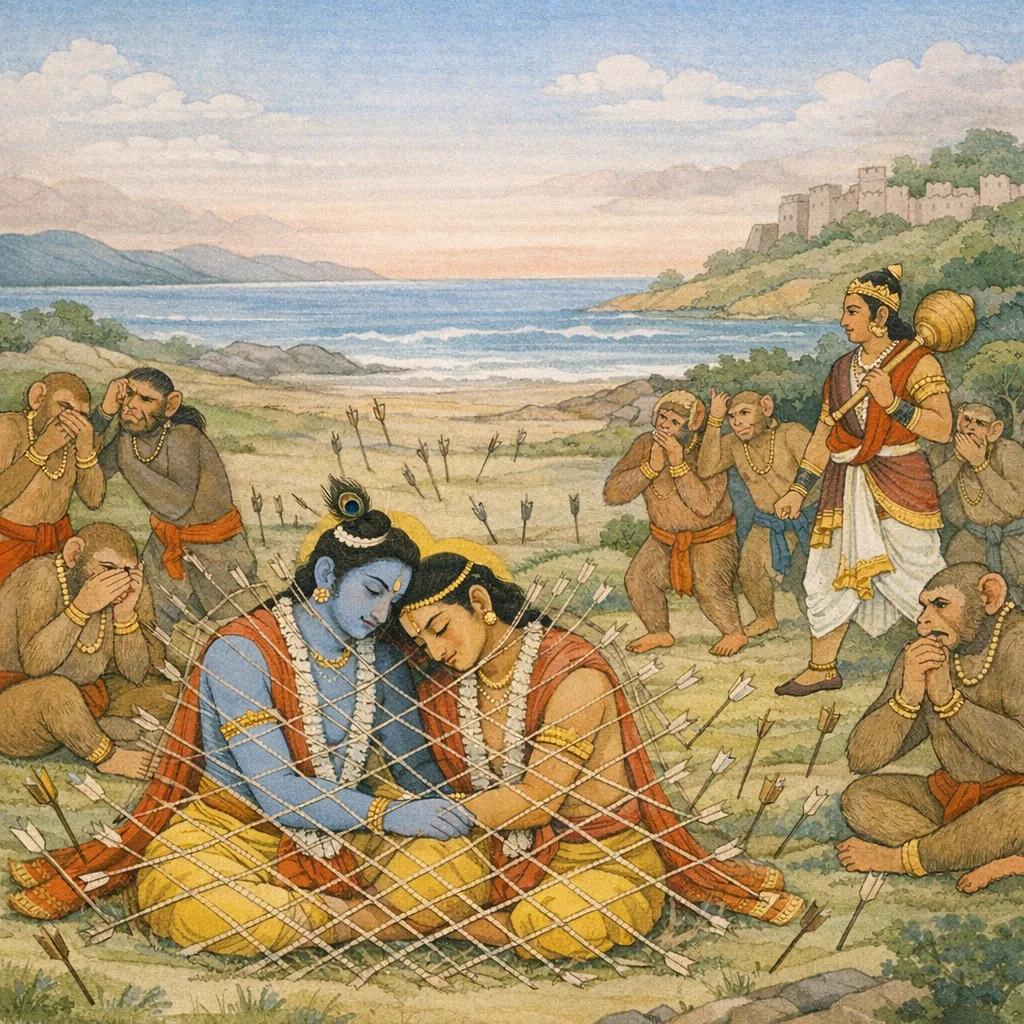
This sarga depicts the aftermath of a devastating missile-attack in which Rāma and Lakṣmaṇa lie on the battlefield bound by a terrifying “network of arrows” (śarabandha), bleeding and sighing like serpents. Sugrīva and the vānaras surround them in grief. Rāma, regaining consciousness through fortitude and disciplined resolve, sees Lakṣmaṇa’s condition and breaks into sustained lamentation: he questions the value of life and even Sītā’s recovery without his brother, and anticipates the unbearable task of speaking to Kausalyā, Kaikeyī, and Sumitrā. He condemns himself as ignoble and sinful, praises Lakṣmaṇa’s unwavering gentleness even when provoked, and recalls his martial excellence (including hyperbolic comparisons to Kārtavīrya and even Indra’s weaponry). Rāma instructs Sugrīva to withdraw across the ocean with the army—placing Aṅgada, Nīla, and Nala in the lead—framing the calamity as daiva that humans cannot override, while affirming the allies’ fulfilled duty. The vānaras weep upon hearing the lament. Vibhīṣaṇa arrives mace-in-hand; the vānaras briefly panic, mistaking him for Indrajit, underscoring wartime confusion and the fragility of morale.
Shlokas
Verse 1
घोरेणशरबन्धेनबद्धौदशरथात्मजौ ।निःश्वसन्तौयथानागौशयानौरुधिरोक्षितौ ।।6.49.1।।सर्वेतेवानरश्रेष्ठास्ससुग्रीवामहाबलाः ।परिवार्यमहात्मानौतस्थुश्शोकपरिप्लुताः ।।6.49.2।।
Rāma and Lakṣmaṇa, the sons of Daśaratha, lay on the ground bound fast by a dreadful net of arrows—sighing like great serpents and drenched with blood. Around those great-souled brothers stood Sugrīva and all the foremost, mighty Vānara leaders, overwhelmed with grief.
Verse 2
घोरेणशरबन्धेनबद्धौदशरथात्मजौ ।निःश्वसन्तौयथानागौशयानौरुधिरोक्षितौ ।।6.49.1।।सर्वेतेवानरश्रेष्ठास्ससुग्रीवामहाबलाः ।परिवार्यमहात्मानौतस्थुश्शोकपरिप्लुताः ।।6.49.2।।
Rāma and Lakṣmaṇa, the sons of Daśaratha, lay on the ground bound fast by a dreadful net of arrows—sighing like great serpents and drenched with blood. Around those great-souled brothers stood Sugrīva and all the foremost, mighty Vānara leaders, overwhelmed with grief.
Verse 3
एतस्मिन्नन्तरेरामःप्रत्यबुध्यतवीर्यवान् ।स्थिरत्वात्सत्त्वयोगाच्चशरैस्सन्दानितोऽपिसन् ।।6.49.3।।
Meanwhile, heroic Rāma regained consciousness; though fastened and pinned by arrows, by steadiness and by the discipline of inner strength he came back to himself.
Verse 4
ततोदृष्टवासरुधिरंनिषण्णंगाढमर्पितम् ।भ्रातरंदीनवदनंपर्यदेवयदातुरः ।।6.49.4।।
Then, seeing his brother—bloodied, sunk down, tightly bound, his face wretched—Rāma, stricken with anguish, began to lament.
Verse 5
किंनुमेसीतयाकार्यंकिंकार्यंजीवितेनवा ।शयानंयोऽद्यपश्यामिभ्रातरंयुधिनिर्जितम् ।।6.49.5।।
What use is Sītā to me—what use even is life—when today I behold my brother lying defeated on the battlefield?
Verse 6
शक्यासीतासमानारीमर्त्यलोकेविचिन्वता ।नलक्ष्मणसमोभ्रातासचिवस्साम्पपरायिकः ।।6.49.6।।
In the mortal world, one might search and find a woman like Sītā; but a brother—an unfailing helper—equal to Lakṣmaṇa cannot be found.
Verse 7
परित्यक्षाम्यहंप्राणान्वानराणांतुपश्याताम् ।यदिपञ्चत्वमापन्नस्सुमित्रानन्दवर्धनः ।।6.49.7।।
If Sumitrā’s joy—Lakṣmaṇa—has indeed gone to the state of the five elements, then I will abandon my life, even as the Vānaras look on.
Verse 8
किंनुवक्ष्यामिकौसल्यांमातरंकिंनुकैकयीम् ।कथमम्बांसुमित्रांचपुत्रदर्शनलालसाम् ।।6.49.8।।
What shall I say to mother Kausalyā—and what to Kaikeyī? And how shall I face mother Sumitrā, who longs to behold her son?
Verse 9
विवत्सांवेपमानांचक्रोशन्तींकुररीमिव ।कथमाश्वासयिष्यामियदियास्यामितंविना ।।6.49.9।।
If I were to go without him, how could I console her—bereft of her child, trembling, and crying out like a female osprey?
Verse 10
कथंवक्ष्यामिशत्रुघ्नंभरतंचयशस्विनम् ।मयासहवनंयातोविनातेनापुनमागतः ।।6.49.10।।
How could I speak to Śatrughna—and to the famed Bharata—when I return without him, though he went with me into the forest?
Verse 11
उपालम्बंनशक्ष्यामिसोढुंबतसुमित्रया ।इहैवदेहंत्यक्ष्यामिनहिजीवितुमुत्सहे ।।6.49.11।।
Alas, I will not be able to endure Sumitrā’s reproach. Here itself I shall give up this body—for I have no will to go on living.
Verse 12
धिङ्मांदुष्कृतकर्माणमनार्यंमत्कृतेह्यसौ ।लक्ष्मणःपतितश्शेतेशरतल्पेगतासुवत् ।।6.49.12।।
Shame on me—sinful in deed and ignoble! For my sake, Lakṣmaṇa has fallen and lies upon a bed of arrows, as though life has departed from him.
Verse 13
त्वंनित्यंसुविषण्णंमामाश्वासयसिलक्ष्मण ।गतासुर्नाद्यशक्तोऽसिमामार्तमभिभाषितुम् ।।6.49.13।।
Lakṣmaṇa, you always consoled me when I was despondent. But now, with your life-breath gone, you are no longer able to speak to me in my anguish.
Verse 14
येनाद्यबहवोयुद्धेनिहताराक्षसाविनिपातिताः ।तस्यामेवाद्यशूरस्त्वंशेषेविनिहतःपरैः ।।6.49.14।।
You by whom, today in battle, so many Rākṣasas were slain and cast down—on that very ground you now, the hero, lie struck down by others, senseless.
Verse 15
शयानःशरतल्पेऽस्मिन् सशोणितपरिप्लुतः ।शरजालैचशितोभासिभास्करोऽस्तमिवव्रजन् ।।6.49.15।।
Lying on this bed of arrows and drenched in blood, covered over by a mesh of shafts, you still shine—like the sun as it sinks toward setting.
Verse 16
बाणाभिहतमर्मत्वान्नशक्नोत्यभिभाषितुम् ।रुजाचाब्रुवतोऽप्यस्यदृष्टिरागेणसूच्यते ।।6.49.16।।
Because his vital points are pierced by arrows, he cannot speak; yet though he says nothing, his pain is revealed by his eyes and their fevered redness.
Verse 17
यथैवमांवनंयान्तमनुयातोमहाद्युतिः ।अहमप्यनुयास्यामितथैवैनंयमक्ष्यम् ।।6.49.17।।
Just as that radiant one followed me when I went to the forest, so too will I follow him now—along the same path to Yama’s realm.
Verse 18
इष्टबन्धुजनोनित्यंमांचनित्यमनुव्रतः ।इमामद्यगतोऽवस्थांममानार्यस्यदुर्नयैः ।।6.49.18।।
He who was ever dear to kinsmen, and who ever followed me with steadfast devotion—has today come to this condition because of the misguided course of me, the ignoble one.
Verse 19
सुरुष्टेनापिवीरेणलक्ष्मणेननसंस्मरे ।परुषंविप्रियंवापिश्रावितंनकदाचन ।।6.49.19।।
Even when greatly angered, I do not recall the heroic Lakṣmaṇa ever having spoken a harsh or hateful word—not at any time.
Verse 20
विससर्जैकवेगेनपञ्चबाणशतानियः ।इष्वस्त्रष्वधिकस्तस्मात्कार्तवीर्याच्चलक्ष्मणः ।।6.49.20।।
He who, in a single rush, released five hundred arrows—Lakṣmaṇa is therefore superior in archery even to Kārtavīrya.
Verse 21
अस्स्रैरस्त्राणियोहन्याच्छक्रस्यापिमहात्मनः ।सोऽयमुर्व्यांहतश्शेतेमहार्हशयनोचितः ।।6.49.21।।
He who could, with his own weapons, strike down even the weapons of great Indra—he, worthy of a noble bed, now lies slain upon the earth.
Verse 22
तच्चमिथ्याप्रलप्तंमांप्रधक्ष्यतिनसंशयः ।यन्मयानकृतोराजाराक्षसानांविभीषणः ।।6.49.22।।
That false utterance of mine will burn me up—there is no doubt—since I have not made Vibhīṣaṇa king of the Rākṣasas.
Verse 23
अस्मिन्मुहूर्तेसुग्रीव प्रतियातुमितोऽर्हसि ।मत्वाहीनंराजन् रावणोऽभिद्रवेद्बली ।।6.49.23।।
Sugrīva, you should withdraw from here at once; for, thinking me weakened, the powerful Rāvaṇa may rush upon you, O king.
Verse 24
अङ्गदंतुपुरस्कत्यससैन्यस्सपरिच्छदम् ।सागरंतरसुग्रीव नीलेनचनलेनच ।।6.49.24।।
Sugrīva, cross back over the ocean with your army and all your equipment—placing Aṅgada in the forefront, along with Nīla and Nala.
Verse 25
कृतंहनुमताकार्यंयदन्यैर्दुष्करंरणे ।ऋक्षराजेनतुष्यामिगोलाङ्गूलाधिपेनच ।।6.49.25।।
Hanumān has accomplished a deed in battle that is hard for others to achieve. I am satisfied with the King of Bears and with the lord of the Golāṅgūlas as well.
Verse 26
अङ्गदेनकृतंकर्ममैन्देनद्विविदेनच ।युद्धंकेसरिणासङ् ख्येघोरंसम्पातिनाकृतम् ।।6.49.26।।
Deeds were done by Aṅgada, by Mainda, and by Dvivida; and in the thick of battle, a fierce fight was waged by Keśarī and by Sampāti as well.
Verse 27
गवयेनगवाक्षेणशरभेणगजेनच ।अन्यैश्चहरिभिर्युद्धंमदर्थेत्यक्तजीवितैः ।।6.49.27।।
Deeds were done by Aṅgada, by Mainda, and by Dvivida; and in the thick of battle, a fierce fight was waged by Keśarī and by Sampāti as well.
Verse 28
नचातिक्रमितुंशक्यंदैवंसुग्रीव मानुषैः ।यत्तुशक्यंवयस्येनसुहृदाचपरन्तप ।।6.49.28।।कृतंसुग्रीव तत्सर्वंभवताधर्मभीरुणा ।
O Sugrīva, destiny cannot be overstepped by human effort. But whatever could be done by a companion and true friend—O scorcher of foes—you have done all of it, righteously and with reverence for dharma.
Verse 29
मित्रकार्यंकृतमिदंभवद्भिर्वानरर्षभाः ।।6.49.29।।अनुज्ञातामयासर्वेयथेष्टंगन्तुमर्हथ ।
O best of Vānaras, you have accomplished the work of a friend. All of you are now released by my leave; you may go wherever you wish.
Verse 30
शुश्रुवुस्तस्यतेसर्वेवानराःपरिदेवनम् ।।6.49.30।।वर्तयाञ्चक्रूरश्रूणिनेत्रैःकृष्णेतरेक्षणाः ।
Hearing his lament, all those Vānaras—brown-eyed—began to let tears flow from their eyes.
Verse 31
ततस्सर्वाण्यनीकानिस्थापयित्वाविभीषणः ।।6.49.31।।आजगामगदापाणिस्त्वरितंयत्रराघवः ।
Thereupon Vibhīṣaṇa, having stationed all the divisions, hurried to where Rāghava was, mace in hand.
Verse 32
तंदृष्टवात्वरितंयान्तंनीलाञ्जनचयोपमम् ।।6.49.32।।वानरादुद्रुवुस्सर्वेमन्यमानास्तुरावणिम् ।
Seeing him hurrying along, dark as a mass of blue collyrium, all the Vānaras fled—mistaking him for Rāvaṇa’s son.
Frequently Asked Questions
Rāma confronts a dharma-sankat between personal grief and leadership duty: while desiring to abandon life after seeing Lakṣmaṇa struck down, he still issues strategic instructions to Sugrīva and acknowledges the allies’ fulfilled obligations, balancing sorrow with responsibility.
The sarga teaches that human excellence and righteous effort remain essential, yet outcomes may still be constrained by daiva; therefore one must act with integrity (mित्रधर्म, dharma-bhīrutā) and accept limits without abandoning moral accountability.
The key landmark is the सागर (ocean) as the strategic boundary for retreat and regrouping; culturally, the passage emphasizes Ayodhyā’s familial horizon through references to the queens (Kausalyā, Kaikeyī, Sumitrā) and the social weight of reporting loss to elders.