Sarga 48
सीताविलापः—त्रिजटासान्त्वनं च (Sita’s Lament and Trijata’s Consolation)
युद्धकाण्ड
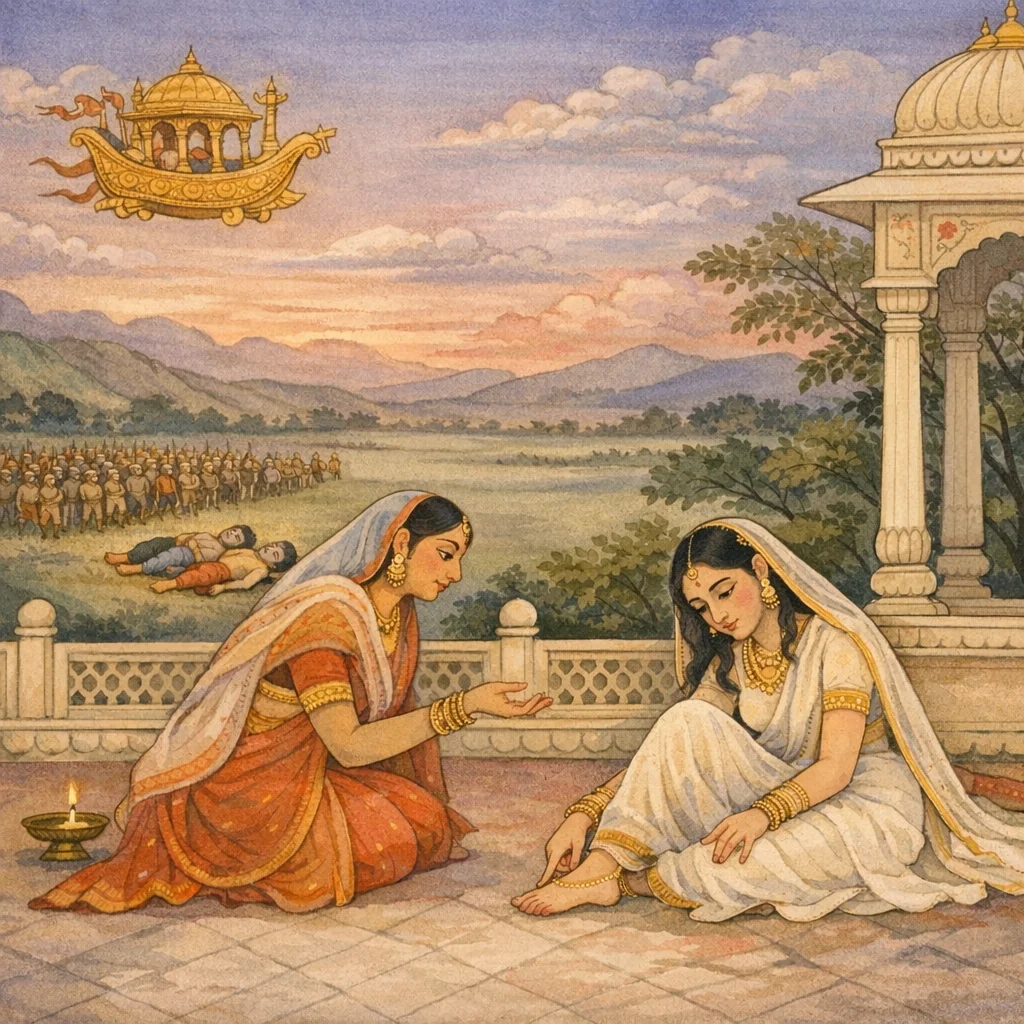
Sarga 48 presents an affective-analytic sequence in which Sītā, brought to witness the apparent fall of Rāma and Lakṣmaṇa under Indrajit’s māyā, collapses into lamentation and self-audit. She interprets the scene as widowhood and declares earlier prognostications (by brāhmaṇas, astrologers, and ritual experts) false, since they had predicted prosperity, motherhood, and royal consecration with her husband. In a distinctive catalog of auspicious bodily marks (strī-lakṣaṇa), Sītā enumerates features—lotus signs on the feet, gem-like complexion, proportional limbs, and other indicators—arguing that such marks should not coincide with catastrophe, thereby dramatizing tension between omen-science and lived suffering. Her grief then shifts from self to concern for Kauśalyā (her mother-in-law), whose ascetic life and expectation of reunion intensify Sītā’s moral anguish. Trijaṭā, a rākṣasī sympathetic to Sītā, counters the despair with observational reasoning: the warriors’ faces and bodily splendor do not resemble death, the army’s comportment lacks the collapse typical after a leader’s fall, and the auspicious Puṣpaka-vimāna would not bear Sītā if the brothers were truly dead. Trijaṭā asserts truthfulness and urges Sītā to abandon moha and śoka. The chapter ends with Sītā returning (via Puṣpaka) to Laṅkā and re-entering the Aśoka grove, where renewed contemplation of the ‘king’s sons’ (Rāma and Lakṣmaṇa) reawakens profound sorrow even amid consolation.
Shlokas
Verse 1
भर्तारंनिहतंदृष्टवालक्ष्मणंचमहाबलम् ।विललापभृशंसीताकरुणंशोककर्शिता ।।।।
Seeing her husband slain—and mighty Lakṣmaṇa as well—Sītā, consumed by grief, lamented intensely and piteously.
Verse 2
ऊचुर्लक्षणिकायेमांपुत्रिण्यविधवेतिच ।तेऽद्यसर्वेहतेरामेज्ञानिनोऽनृतवादिनः ।।।।
The soothsayers said of me, ‘She will bear sons; she will not become a widow.’ But if Rāma has been slain today, then all those ‘wise men’ have proved to be speakers of falsehood.
Verse 3
यज्वनोमहिषींयेमामूचुःपत्नींचसत्त्रिणः ।तेऽद्यसर्वेहतेरामेज्ञानिनोऽनृतवादिनः ।।।।
Those sacrificers and learned men who once told me that I would be a consecrated queen and a wife—today, if Rāma is slain, all those ‘wise’ men become speakers of falsehood.
Verse 4
ऊचुस्संश्रवणेयेमांद्विजाःकार्तान्तिकाश्शुभाम् ।तेऽद्यसर्वेहतेरामेज्ञानिनोऽनृतवादिनः ।।।।
“If Rama has been slain today, then those brahmins and astrologers who promised me auspicious destiny—those reputed as wise—have all spoken falsely.”
Verse 5
वीरपार्थिवपत्नीत्वांयेविदुर्भर्तृपूजिताम् ।तेऽद्यसर्वेहतेरामेज्ञानिनोऽनृतवादिनः ।।।।
“If Rama has been slain today, then all who declared that I would be the wife of a mighty king and honored by my husband—those called wise—have spoken untruth.”
Verse 6
इमानिखलुपद्मानिपादयोर्यैःकुलस्त्रियः ।अधिराज्येऽभिषिच्यन्तेनरेन्द्रैःपतिभिःसह ।।।।
“These lotus-marks indeed are on my feet—marks by which noble women are anointed to queenship, together with their kingly husbands.”
Verse 7
वैधव्यंयान्तियैर्नार्योऽलक्षणैर्भाग्यदुर्लभाः ।नात्मनन्तानिपश्यामिपश्यन्तीहतलक्षणा ।।।।
“Those inauspicious signs by which unfortunate women fall into widowhood—I do not see them in myself; nor do I perceive myself as one whose auspicious marks have perished.”
Verse 8
सत्यनामानिपद्मानिस्त्रीणामुक्तानिलक्षणैः ।तान्यद्यनिहतेरामेवितथानिभवन्तिमे ।।।।
“Those lotus-signs, spoken of in the teachings as ‘truth-bearing’ marks for women—if Rama is slain today—would become false in my case.”
Verse 9
केशास्सूक्ष्मास्समानीलाभ्रुवौचासंहतेमम ।वृत्तेचारोमकेजङ्घेदन्ताश्चाविरळामम ।।।।
“My hair is fine and evenly dark; my eyebrows are well-formed and not joined; my shanks are rounded and hairless; and my teeth are close-set.”
Verse 10
शङ्खेनेत्रेकरौपादौगुल्फावूरूचमेचितौ ।अनुवृत्तनखास्स्निग्धास्समाश्चाङ्गुलयोमम ।।।।
“My temples, eyes, hands and feet—my ankles and thighs too—are well-formed; and my fingers are smooth and even, with rounded nails.”
Verse 11
स्तनौचाविरळौमामकौमग्नचूचुकौ ।मग्नाचोत्सङ्गिनीनाभःपार्श्वोरस्कंचमेचितम् ।।।।
“My breasts are well-shaped, with nipples set inward; my navel is deep and well-set, and my sides and chest are full and well-formed.”
Verse 12
ममवर्णोमणिनिभोमृदून्यङ्गरुहाणिच ।प्रतिष्ठितांद्वादशभिर्मामूचुश्शुभलक्षणाम् ।।।।
“My complexion shines like a jewel, and the hairs upon my skin are soft. When I stand placing my twelve (fingers and toes) on the ground, they said I bear auspicious marks.”
Verse 13
समग्रयवमच्छ्रिद्रपाणिपादंचवर्णवत् ।मन्दस्मितेत्येवचमांकन्यालाक्षणिनोद्विजाः ।।।।
“They described my palms and feet as compact and without gaps—marks of auspiciousness; and they said my gentle smile too is a maiden’s auspicious sign.”
Verse 14
आधिराज्येऽभिषेकोमेब्राह्मणैःपतिनासह ।कृतान्तकुशलैरुक्तंतत्सर्वंवितथीकृतम् ।।।।
“The Brahmins—skilled in reading destiny—said I would be consecrated to royal sovereignty together with my husband; yet all of that has been made false.”
Verse 15
शोधयित्वाजनस्थानंप्रवृततिमुपलभ्यच ।तीर्त्वासागरमक्षोभ्यंभ्रातरौगोष्पदेहतौ ।।।।
“After searching in Janasthāna and learning news of me, after crossing the untraversable ocean—those two brothers have now been slain, as if by a mere ‘cow-hoofprint’ (trick),” (Sītā laments).
Verse 16
ननुवारुणमाग्नेयमैन्द्रंवायव्यमेवच ।अस्त्रंब्रह्मशिरश्चैवप्रत्यपद्यताम् ।।।।
Surely the two Rāghavas knew how to employ Varuṇa’s weapon, Agni’s weapon, Indra’s weapon, and even Vāyu’s—indeed, even the Brahmaśiras weapon. Why, then, did they not counter it?
Verse 17
अदृश्यमानेनरणेमाययावासवोपमौ ।ममनाथावनाथायानिहतौरामलक्ष्मणौ ।।।।
Invisible in battle, by a conjurer’s trick, he has slain Rāma and Lakṣmaṇa—those two like Vāsava (Indra) in prowess. Thus I, who had protectors, have become protectorless.
Verse 18
नहिदृष्टिपथंप्राप्यराघवस्यरणेरिपुः ।जीवन्प्रन्तिवर्तेतयद्यपिस्यान्मनोजवः ।।।।
For no enemy who comes within Rāghava’s line of sight in battle returns alive—even if he were swift as thought.
Verse 19
नकलस्यातिभारोऽस्तिकृतान्तश्चसुदुर्जयः ।यत्ररामःसहभ्रात्राशेतेयुधिनिपातितः ।।।।
There is no burden heavier than Time; and Death’s decree is hard to overcome—since even Rāma, with his brother, lies fallen on the battlefield.
Verse 20
नशोचामितथारामंलक्ष्मणंचमहारथम् ।वात्मानंजननींचापियथाश्वश्रूंतपस्विनीम् ।।।।
I do not grieve so much for Rāma, nor for Lakṣmaṇa the great chariot-warrior, nor even for myself or my own mother—as I grieve for my ascetic mother-in-law.
Verse 21
सातुचिन्तयतेनित्यंसमाप्तव्रतमागतम् ।कदाद्रक्ष्यामिसीतांचलक्ष्मणंचसराघवम् ।।।।
She (Kauśalyā) constantly thinks: ‘When will I see Rāghava returned with his vow fulfilled—along with Sītā and Lakṣmaṇa?’
Verse 22
परिदेवयमानांतांराक्षसीत्रिजटाब्रवीत् ।माविषादंकृथादेवी भर्ताऽयंतवजीवति ।।।।
As she lamented, the rākṣasī Trijaṭā said to her: “Do not fall into despair, O noble lady—your husband is alive.”
Verse 23
कारणानिचवक्ष्यामिमहान्तिसदृशानिच ।यथेमौजीवतोदेवीभ्रातरौरामलक्ष्मणौ ।।।।
And I shall tell you the reasons—great and convincing—by which it is so, O lady: these two brothers, Rāma and Lakṣmaṇa, are alive.
Verse 24
नहिकोपपरीतानिहर्षपर्युत्सुकानिच ।भवन्तियुधियोधानांमुखानिनिहतेपतौ ।।।।
For when a husband has been slain in battle, the faces of warriors do not appear filled with anger, nor with eager joy.
Verse 25
इदंविमानंवैदेही पुष्पकंनामनामतः ।दिव्यंत्वांदारयन्नैवंयद्येतौगतजीवितौ ।।।।
Vaidehī, this divine aerial car—named Puṣpaka—would not have carried you in this way, if those two had truly lost their lives.
Verse 26
हतवीरप्रधानाहिगतोत्साहानिरुद्यमा ।सेनाभ्रमतिसङ् ख्येषुहतकर्णेवनौर्जले ।।।।
When its chief heroes are slain, an army loses its spirit and becomes inert; it wanders in battle like a ship on the water whose helmsman has been lost.
Verse 27
इयंपुनरसम्भ्रान्तानिरुद्विग्नातरस्विनी ।सेनारक्षतिकाकुत्स्थौमयाप्रीत्यानिवेदितौ ।।।।
But this army is not in confusion and is not distressed, O resolute lady; it is guarding the two Kakutsthas—this I tell you affectionately.
Verse 28
सात्वंभवसुविस्रब्धाअनुमानैस्सुखोदयैः ।अहतौपश्यकाकुत्स्थौस्नेहादेतद्ब्र्रवीमिते ।।।।
So be fully reassured by these favorable inferences; see that the two Kakutsthas are unharmed. Out of affection, I say this to you.
Verse 29
अनृतंनोक्तपूर्वंमेनचवक्ष्येकदाचन ।चारित्रसुखशीलत्वात् प्रविष्टाअसिमनःमम ।।।।
I have never spoken falsehood before, nor will I ever speak it; because of your gentle and virtuous nature, you have entered my very heart.
Verse 30
नेमौशक्यारणेजेतुंसेन्द्रैरपिसुरासुरैः ।तादृशंदर्शनंदृष्टवामयाचावेदितंतव ।।।।
These two cannot be conquered in battle even by the gods and demons, even with Indra; having seen such signs with my own eyes, I have informed you.
Verse 31
इदंचसुमहचचित्रंशरैःपश्यस्वमैथिलि ।निस्संज्ञावप्युभावेतौनैवलक्ष्मीर्विमुञ्चति ।।।।
And see this great marvel, O Maithilī: though both lie unconscious under a rain of arrows, their splendor has not left them at all.
Verse 32
प्रायेणगतसत्त्वानांपुरुषाणांगतायुषाम् ।दृश्यमानेषुवक्त्रेषुपरंभवतिवैकृतम् ।।।।
Usually, in men whose life has departed and whose vital force has ceased, the face—when looked upon—shows a marked distortion and ugliness.
Verse 33
त्यजशोकंचमोहंचदुःखंचजनकात्मजे ।रामलक्ष्मणयोरर्थेनाद्यशक्यमजीवितुम् ।।।।
Cast away sorrow, delusion, and grief, O daughter of Janaka; for Rāma and Lakṣmaṇa, it is not possible today that they are not alive.
Verse 34
शुत्वातुवचनंतस्याःसीतासुरसुतोपमा ।कृताञ्जलिरुवाचेमामेवमस्त्वितिमैथिलि ।।।।
Sita, radiant like a daughter of the gods, having heard Trijata’s consoling words, joined her palms in reverence and replied: “So be it, O Maithili.”
Verse 35
विमानंपुष्पकंतत्तुसन्निवर्त्यमनोजवम् ।दीनात्रिजटयासीतालङ्कामेवप्रवेशिता ।।।।
Then, turning back that mind-swift Pushpaka aerial car, the distressed Sita—led by Trijata—was brought into Lanka.
Verse 36
ततस्त्रिजटयासार्थंपुष्पकादवरुह्यसा ।अशोकवनिकामेवराक्षसीभिःप्रवेशिता ।।।।
Thereafter, she alighted from the Pushpaka together with Trijata, and was taken by the rākṣasī women into the Ashoka Grove.
Verse 37
प्रविश्यसीताबहुवृक्षषण्डांतांराक्षसेन्द्रस्यविहारभूमिम् ।सम्प्रेक्ष्यसञ्चिन्त्यचराजपुत्रौपरंविषादंसमुपाजगाम ।।।।
Entering that pleasure-garden of the lord of rākṣasas, dense with many clusters of trees, Sita—after looking about and brooding on the two princes—fell into profound sorrow.
Frequently Asked Questions
Sītā faces a dharma-crisis of perception: whether to accept apparent evidence of Rāma’s death (leading to despair and the collapse of hope) or to hold to disciplined endurance until truth is verified. The action centers on grief-management and interpretive responsibility under deceptive conditions (Indrajit’s māyā).
The chapter contrasts two epistemic modes—omen-based prediction and inference from present signs. Trijaṭā models pratyakṣa/anumāna-style reasoning (faces, splendor, army behavior, Puṣpaka’s auspiciousness) to restrain moha and śoka, teaching that ethical steadiness requires verification and truthful counsel during crisis.
Laṅkā and the Aśoka-vāṭikā frame Sītā’s captivity space; Puṣpaka-vimāna functions as a significant object linking battlefield spectacle to interior lament; Janasthāna and the ocean-crossing are recalled as narrative milestones underscoring the improbability of defeat and the scale of Rāma’s quest.