Sarga 47
पुष्पकविमानेन सीताया युद्धभूमिदर्शनम् (Sita Shown the Battlefield in the Pushpaka)
युद्धकाण्ड
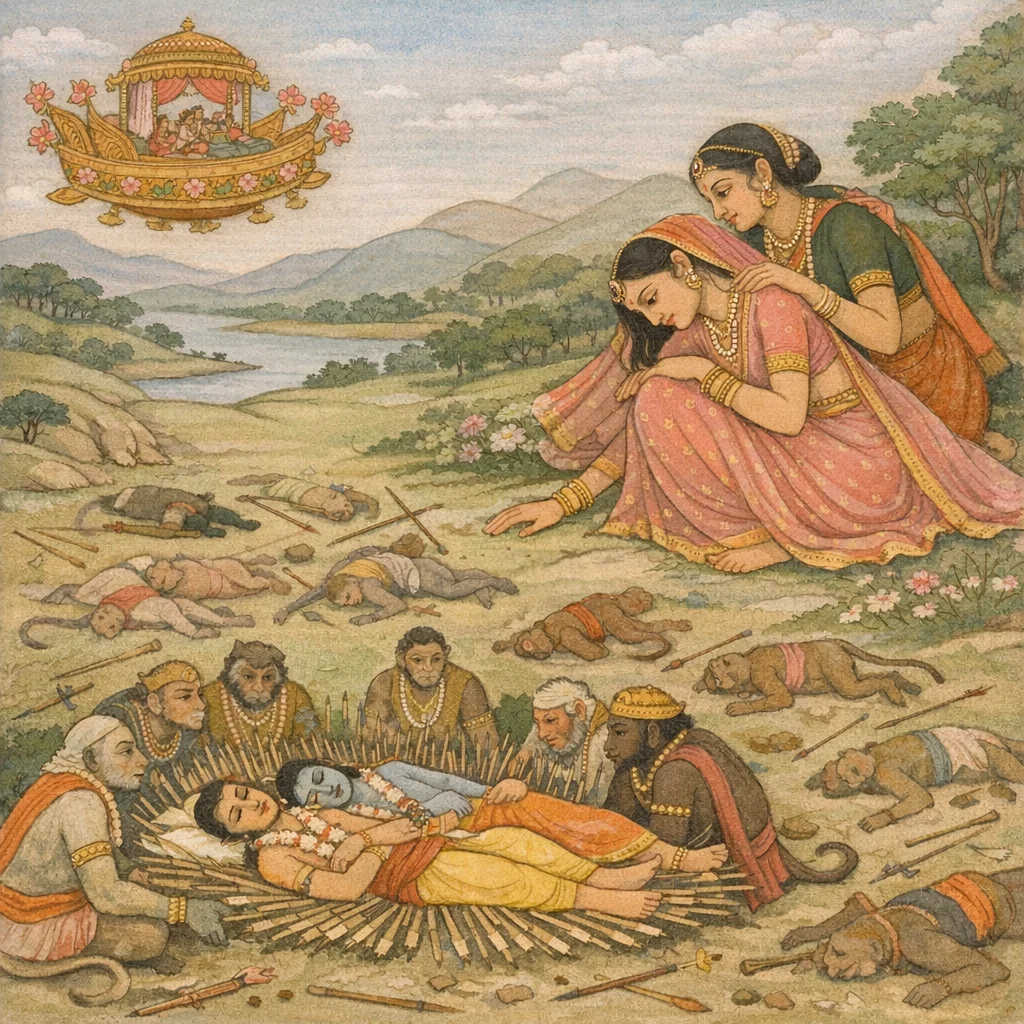
This sarga presents a psychological and informational operation conducted by Rāvaṇa after Indrajit’s apparent success. With Indrajit returning to Laṅkā “having accomplished the task,” Vānara leaders form a vigilant protective ring around Rāghava, treating even minor movement as potential rākṣasa intrusion. Rāvaṇa, rejoicing, orders Sītā’s attendants—rākṣasīs including Trijaṭā—to bring Sītā from Aśokavanikā using the Puṣpaka vimāna, intending to break her resolve by showing Rāma and Lakṣmaṇa as if slain. Laṅkā is decorated and proclamations are made that the brothers have been killed in battle. Sītā, accompanied by Trijaṭā, views the fallen Vānara forces and the rākṣasas’ celebratory demeanor, then sees Rāma and Lakṣmaṇa unconscious on a “bed of arrows,” their armor and bows shattered. Interpreting the scene as death, Sītā collapses into intense lamentation, articulating grief and uncertainty. The chapter’s thematic lesson contrasts deceptive triumphalism with steadfast loyalty and the ethical cost of manipulating a captive’s hope.
Shlokas
Verse 1
प्रतिप्रविष्टेलङ्कायांकृतार्थेरावणात्मजे ।राघवंपरिवार्यार्तुरक्षुर्वानरर्षभाः ।।।।
When Rāvaṇa’s son, having achieved his aim, re-entered Laṅkā, the foremost of the vānara heroes surrounded and guarded Rāghava in his distress.
Verse 2
हनुमानङ्गदोनीलःसुषेणःकुमुदोनलः ।गजोगवाक्षोगवयश्शरभोगन्धमादनः ।।।।जाम्बवानृषभःसुन्दोरम्भःशतवलिःपृथुः ।व्यूढानीकाश्चयत्ताश्चद्रुमानादायसर्वतः ।।।।वीक्षमाणादिशस्सर्वास्तिर्यगूर्ध्वंचवानराः ।तृणेष्वपिचचेष्टत्सुराक्षसाइतिमेनिरे ।।।।
Having drawn up the monkey-forces in ordered formation, Hanumān, Aṅgada, Nīla, Suṣeṇa, Kumuda, Nala, Gaja, Gavākṣa, Gavaya, Śarabha, Gandhamādana, Jāmbavān, Ṛṣabha, Sunda, Rambha, Śatavali, and Pṛthu stood on every side holding uprooted trees as weapons. Keeping watch in all directions—sideways and above—they guarded Rāma; and if even a blade of grass stirred, they suspected it to be a rākṣasa’s movement.
Verse 3
हनुमानङ्गदोनीलःसुषेणःकुमुदोनलः ।गजोगवाक्षोगवयश्शरभोगन्धमादनः ।।6.47.2।।जाम्बवानृषभःसुन्दोरम्भःशतवलिःपृथुः ।व्यूढानीकाश्चयत्ताश्चद्रुमानादायसर्वतः ।।6.47.3।।वीक्षमाणादिशस्सर्वास्तिर्यगूर्ध्वंचवानराः ।तृणेष्वपिचचेष्टत्सुराक्षसाइतिमेनिरे ।।6.47.4।।
Jāmbavān, Ṛṣabha, Sunda, Rambha, Śatavali, and Pṛthu—having the forces arrayed and stationed—took up trees from every side (as weapons and defenses).
Verse 4
हनुमानङ्गदोनीलःसुषेणःकुमुदोनलः ।गजोगवाक्षोगवयश्शरभोगन्धमादनः ।।6.47.2।।जाम्बवानृषभःसुन्दोरम्भःशतवलिःपृथुः ।व्यूढानीकाश्चयत्ताश्चद्रुमानादायसर्वतः ।।6.47.3।।वीक्षमाणादिशस्सर्वास्तिर्यगूर्ध्वंचवानराः ।तृणेष्वपिचचेष्टत्सुराक्षसाइतिमेनिरे ।।6.47.4।।
The vānaras kept watch in every direction—horizontally and upward as well—and if even a blade of grass moved, they took it to be a rākṣasa.
Verse 5
रावणश्चापिसम्हृष्टोविसृज्येन्द्रजितंसुतम् ।अजुहावततस्सीताक्षिणीराक्षसीस्तदा ।।।।
Rāvaṇa too, delighted, sent off his son Indrajit; then he summoned the rākṣasī women who were charged with guarding Sītā.
Verse 6
राक्षस्यस्त्रिजटाचैवशासनात्समुपस्थिताः ।ताउवाचततोहृष्टोराक्षसीराक्षसाधमः ।।।।
The rākṣasī women—including Trijaṭā—came forward in obedience to his command. Then that base rākṣasa, delighted, addressed the rākṣasīs.
Verse 7
हताविन्द्रजिताख्यातवैदेह्यारामलक्ष्मणौ ।पुष्पकंतत्समारोप्यदर्शयध्वंहतौरणे ।।।।
“Rāma and Lakṣmaṇa have been slain in battle by Indrajit. Put Vaidehī into that Puṣpaka chariot and show her the two as slain on the battlefield.”
Verse 8
यदाश्रयादवष्टब्धामामुपतिष्ठति ।सोऽस्याभर्तासहभ्रात्रानिहतोरणमूर्धनि ।।।।
“Relying on whom she stood proud and would not yield to me—her husband—he has been struck down on the field of battle, together with his brother.”
Verse 9
निर्विशङ्कानिरुद्विग्नानिरपेक्षाचमैथिली ।मामुपस्थास्यतेसीतासर्वाभरणभूषिता ।।।।
“Then Maithilī—free of doubt, untroubled, and having abandoned hope—Sītā, adorned with every ornament, will wait upon me.”
Verse 10
अद्यकालवशंप्राप्तंरणेरामंसलक्ष्मणम् ।अवेक्ष्यविनिवृत्तासाचान्यांगतिमपश्यती ।।।।निरपेक्षाविशालाक्षीमामुपस्थास्यतेस्वयम् ।
Rāvaṇa reasoned: “In time, when the wide-eyed Sītā sees Rāma in battle together with Lakṣmaṇa brought under the power of fate, she will turn back, find no other refuge, abandon hope, and come to me of her own accord.”
Verse 11
तस्यतद्वचनंश्रुत्वारावणस्यदुरात्मनः ।।।।राक्षस्यस्तास्तथेत्युक्त्वाजग्मुर्वैयत्रपुष्पकम् ।
Hearing those words of the evil-minded Rāvaṇa, those rākṣasī women replied, “So be it,” and went to where the Puṣpaka chariot was.
Verse 12
ततःपुष्पकमादायराक्षस्योरावणाज्ञया ।।।।अशोकवनिकास्थांतांमैथिलींसमुपानयन् ।
Then, by Rāvaṇa’s order, the rākṣasī women took the Puṣpaka and approached Maithilī, who was staying in the Aśoka grove.
Verse 13
तामादायतुराक्षस्योभर्तृशोकपराजिताम् ।।।।सीतामारोपयामासुर्विमानंपुष्पकंतदा ।
Taking Sītā—overcome by grief for her husband—the rākṣasī women then made her mount the Puṣpaka aerial chariot.
Verse 14
ततःपुष्पकमारोप्यसीतांत्रिजटयासह ।।।।जग्मुर्दर्शयितुंतस्यैराक्षस्योरामलक्ष्मणौ ।
Thereafter, placing Sītā in the Puṣpaka along with Trijaṭā, the rākṣasī women went to show her Rāma and Lakṣmaṇa.
Verse 15
रावणोऽकारयल्लङ्कांपताकाध्वजमालिनीम् ।।।।प्राघोषयतहृष्टश्चलङ्कायांराक्षसेश्वरः ।राघवोलक्ष्मणश्चैवहताविन्द्रजितारणे ।।।।
Rejoicing, Rāvaṇa—the lord of the rākṣasas—had Laṅkā adorned with banners and flags, and proclaimed throughout the city that Rāghava and Lakṣmaṇa had been slain in battle by Indrajit.
Verse 16
रावणोऽकारयल्लङ्कांपताकाध्वजमालिनीम् ।।6.47.15।।प्राघोषयतहृष्टश्चलङ्कायांराक्षसेश्वरः ।राघवोलक्ष्मणश्चैवहताविन्द्रजितारणे ।।6.47.16।।
This verse repeats the proclamation: exulting, Rāvaṇa had Laṅkā decorated with banners and announced that Indrajit had slain Rāma and Lakṣmaṇa in battle.
Verse 17
विमानेनापिगत्वातुसीतात्रिजटयासह ।ददर्शवानराणांतुसर्वंसैन्यंनिपातितम् ।।।।
Travelling by the aerial chariot with Trijaṭā, Sītā saw the entire army of the vānaras lying fallen.
Verse 18
प्रहृष्टमनसश्चापिददर्शपिशिताशनान् ।वानरांश्चातिदुःखार्तान्रामलक्ष्मणपार्श्वतः ।।।।
She also saw the flesh-eating rākṣasas exultant, and the vānaras near Rāma and Lakṣmaṇa afflicted with intense sorrow.
Verse 19
ततस्सीताददर्शोभौशयानौशरतल्पगौ ।लक्ष्मणंचापिरामंचविसंज्ञौशरपीडितौ ।।।।विध्वस्तकवचौवीरौविप्रविद्धशरासनौ ।सायकैचशिन्नसर्वाङ्गौशरस्तम्बमयौक्षितौ ।।।।
Then Sītā saw both of them—Rāma and Lakṣmaṇa—lying on a bed of arrows, unconscious and tormented by shafts; the two heroes had their armour shattered and their bows flung away, their limbs cut and pierced by missiles, as though they were bodies made of arrow-reeds upon the ground.
Verse 20
ततस्सीताददर्शोभौशयानौशरतल्पगौ ।लक्ष्मणंचापिरामंचविसंज्ञौशरपीडितौ ।।6.47.19।।विध्वस्तकवचौवीरौविप्रविद्धशरासनौ ।सायकैचशिन्नसर्वाङ्गौशरस्तम्बमयौक्षितौ ।।6.47.20।।
Their armor was shattered; their bows had been flung away. Those two heroes lay on the ground, their limbs torn by arrows, seeming as though formed of thickets of shafts.
Verse 21
तौदृष्टवाभ्रातरौतत्रप्रवीरौपुरुषर्षभौ ।शयानौपुण्डरीकाक्षौकुमाराविवपावकी ।।।।शरतल्पगतौवीरौतथाभूतानरर्षभौ ।दुःखार्ताकरुणंसीतासुभृशंविललापह ।।।।
Seeing there the two brothers—great heroes, foremost among men, lotus-eyed—lying as if they were the youthful sons of the Fire-god, fallen upon a bed of arrows in that condition, Sītā, overwhelmed by grief, lamented piteously and at length.
Verse 22
तौदृष्टवाभ्रातरौतत्रप्रवीरौपुरुषर्षभौ ।शयानौपुण्डरीकाक्षौकुमाराविवपावकी ।।6.47.21।।शरतल्पगतौवीरौतथाभूतानरर्षभौ ।दुःखार्ताकरुणंसीतासुभृशंविललापह ।।6.47.22।।
This verse repeats the description: seeing the two heroic brothers, lotus-eyed, lying upon a bed of arrows in such a state, Sītā—struck by sorrow—lamented piteously and intensely.
Verse 23
भर्तारमनवद्याङ्गीलक्ष्मणंचासितेक्षणा ।प्रेक्ष्यपांसुषुचेष्टन्तौरुरोदजनकात्मजा ।।।।
Janaka’s daughter—faultless-limbed and dark-eyed—seeing her husband and Lakṣmaṇa stirring in the dust, broke into loud weeping.
Verse 24
सबाष्पशोकाभिहतासमीक्ष्यतौभ्रातरौदेवसमप्रभावौ ।वितर्कयन्तीनिधनंतयोस्सादुःखान्वितावाक्यमिदंजगाद ।।।।
Struck by grief and choked with tears, beholding the two brothers whose splendor was like that of the gods, and suspecting that they had died, she—immersed in sorrow—spoke these words.
Frequently Asked Questions
Rāvaṇa deploys psychological coercion: he stages public celebration and forces Sītā to witness Rāma and Lakṣmaṇa appearing dead, aiming to collapse her consent through despair rather than persuasion—raising a clear dharma-question about manipulation of a captive’s agency.
The sarga juxtaposes deceptive appearances with inner fidelity: external “proof” of defeat can be engineered, but dharmic loyalty persists as a moral stance; Sītā’s lament functions as testimony of devotion and the human cost of adharma-driven strategy.
Key landmarks include Laṅkā (as a propagandized civic space decorated with standards), Aśokavanikā (Sītā’s captivity locus), and the battlefield viewed from the Puṣpaka vimāna; culturally, the vimāna and proclamation rituals underscore royal spectacle used for wartime messaging.