Sarga 45
इन्द्रजितः अन्तर्धानयुद्धं — Indrajit’s Concealed Assault and the Fall of Rama and Lakshmana
युद्धकाण्ड
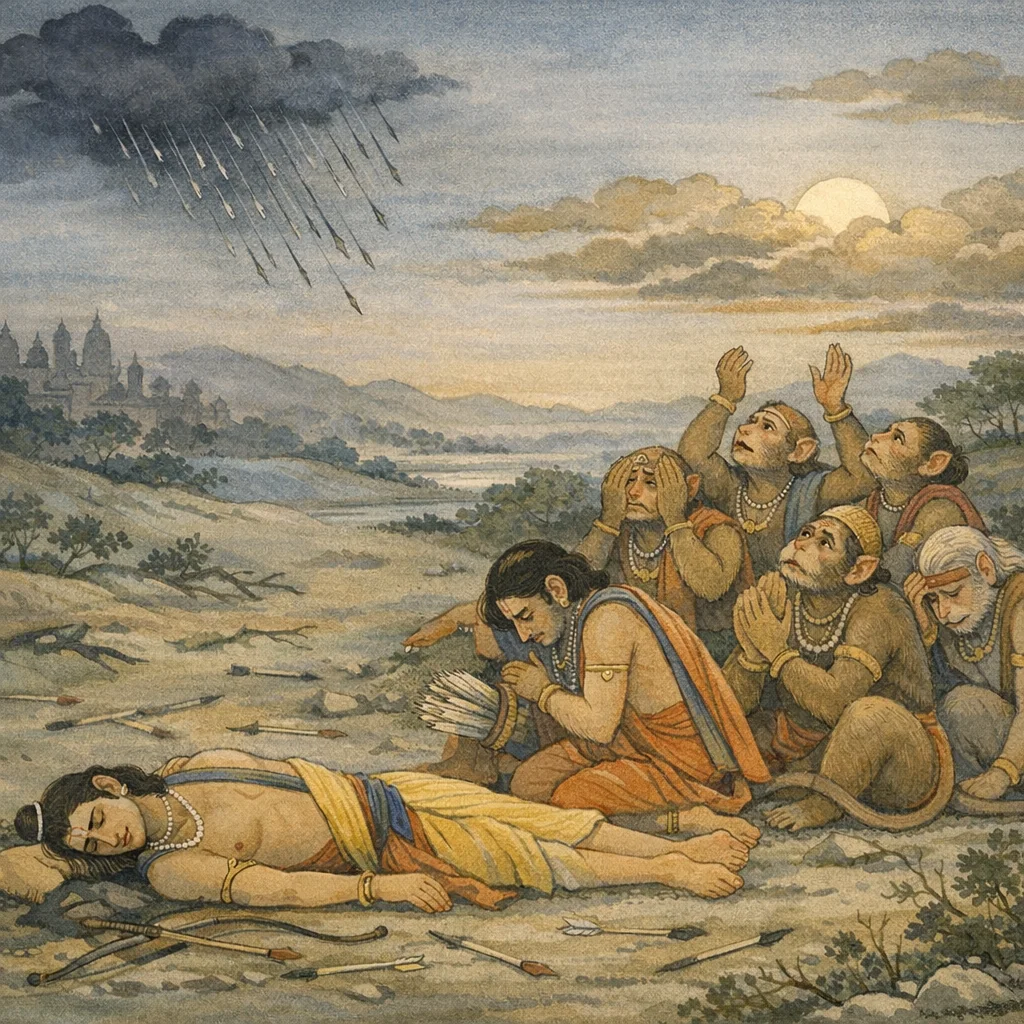
This sarga stages a tactical reversal driven by Indrajit’s concealment (antardhāna) and missile-saturation. Rama, seeking Indrajit’s whereabouts, deploys ten Vanara leaders in multiple directions for reconnaissance. The Vanaras surge skyward with uprooted trees as improvised weapons, but are checked by Indrajit’s swift, expertly released arrows; darkness and concealment prevent visual acquisition of the attacker, likened to the sun obscured by clouds. Indrajit then addresses Rama and Lakshmana from concealment, asserting that even Indra cannot discern him in battle, and declares his intent to send the brothers to Yama’s abode. He follows with sustained volleys—varied arrowheads and serpent-like missiles—driving shafts into vital points (marma), binding and exhausting the brothers so rapidly they cannot retaliate. Rama falls first; Lakshmana, seeing Rama down, collapses emotionally. The battlefield response is communal: Vanaras gather around the fallen princes in grief, while the text emphasizes the total bodily saturation of wounds—no fingerbreadth left unpierced—presenting a grim meditation on vulnerability, endurance, and the ethical weight of deceptive warfare.
Shlokas
Verse 1
सतस्यगतिमन्विच्छन्राजपुत्रःप्रतापवान् ।दिदेशातिबलोरामोदशवानरयूथपान् ।।6.45.1।।
Seeking to learn his movements, Rama—the mighty prince—dispatched ten leaders of Vanara troops to find out his whereabouts.
Verse 2
द्वौसुषेणस्यदायादौनीलंचप्लवगर्षपम् ।अङ्गदंवालिपुत्रंचशरभंचतरस्विनम् ।।6.45.2।।विनतंजाम्बवन्तंचसानुप्रस्थंमहाबलम् ।ऋषभंचर्षभस्कन्थमादिदेशपरन्तपः ।।6.45.3।।
Rāma, the scorcher of foes, issued orders—(to muster and act): the two heirs of Suṣeṇa, and Nīla the foremost of the Vānaras; Aṅgada, Vāli’s son; the swift Śarabha; Vinata; Jāmbavān; mighty Sānuprastha; and also Ṛṣabha and Ṛṣabhaskandha.
Verse 3
द्वौसुषेणस्यदायादौनीलंचप्लवगर्षपम् ।अङ्गदंवालिपुत्रंचशरभंचतरस्विनम् ।।6.45.2।।विनतंजाम्बवन्तंचसानुप्रस्थंमहाबलम् ।ऋषभंचर्षभस्कन्थमादिदेशपरन्तपः ।।6.45.3।।
Rāma, the scorcher of enemies, commanded the two heirs of Suṣeṇa, as well as Nīla the foremost of the monkeys, Aṅgada the son of Vāli, the swift Śarabha, Vinata, Jāmbavān, mighty Sānuprastha, and also Ṛṣabha and Ṛṣabhaskandha.
Verse 4
तेसम्प्रहृष्टाहरयोभीमानुद्यम्यपादपान् ।आकाशंविविशुस्सर्वेमार्गमाणादिशोदशः ।।6.45.4।।
Those monkeys, greatly exhilarated, lifted up huge trees and all sprang into the sky, searching through the ten directions.
Verse 5
तेषांवेगवतांवेगमिषुभिर्वेगवत्तरैः ।अस्त्रवित्परमास्तैरैस्तुवारयामासरावणिः ।।6.45.5।।
But Rāvaṇi—skilled in weapons and master of supreme missiles—checked the onrush of those swift Vānaras with arrows swifter still.
Verse 6
तंभीममार्गमाणादिशोदशःवेगाहरयोनाराचैःक्षतविग्रहाः ।अन्धकारेनददृशुर्मेघैस्सूर्यमिवावृतम् ।।6.45.6।।
Though rushing in terror and searching the ten directions, the Vānara warriors—their bodies torn by iron shafts—could not see him in the darkness, like the sun hidden by clouds.
Verse 7
रामलक्ष्मणयोरेवसर्वदेहभिदश्शरान् ।भृशमावेशयामासरावणिस्समितिञ्जयः ।।6.45.7।।
Rāvaṇi, victorious in battle, drove piercing arrows again and again into the bodies of Rāma and Lakṣmaṇa.
Verse 8
निरन्तरशीरीरौतुतावुभौरामलक्ष्मणौ ।क्रुद्धेनेन्द्रजितावीरौपन्नगैश्शरतांगतैः ।।6.45.8।।
Both the heroic Rāma and Lakṣmaṇa were struck all over by the enraged Indrajit with arrows that had taken the form of serpents.
Verse 9
तयोःक्षतजमार्गेणसुस्रावरुधिरंबहु ।तावुभौचप्रकाशेतेपुष्पिताविवकिंशुकौ ।।6.45.9।।
From their many wounds, blood flowed in abundance; yet the two brothers shone, like kiṃśuka trees in full bloom.
Verse 10
ततःपर्यन्तरक्ताक्षोभिन्नाञ्जनचयोपमः ।रावणिर्भ्रातरौवाक्यमन्तर्धानगतोऽब्रवीत् ।।6.45.10।।
Then Ravana’s son—his eyes reddened at the corners, dark like a crushed mass of collyrium—vanished from sight and spoke these words to the two brothers.
Verse 11
युध्यमानमनालक्षयंशक्रोऽपित्रिदशेश्वरः ।द्रष्टुमासादितुंवापिनशक्तःकिंपुनर्युवाम् ।।6.45.11।।
“Even Śakra, lord of the gods, cannot see me—or reach me—while I fight unseen; how much less can you two?”
Verse 12
प्रावृताविषुजालेनराघवौकङ्कपत्रिणा ।एषरोषपरीतात्मानयामियमसादनम् ।।6.45.12।।
“O Rāghavas, covered over by a net of arrows feathered with heron-plumes—now, possessed by wrath, I shall send you to Yama’s abode.”
Verse 13
एवमुक्त्वातुधर्मज्ञौभ्रातरौरामलक्ष्मणौ ।निर्बिभेदशितैर्बाणैःप्रजहर्षननादच ।।6.45.13।।
Having spoken thus, he pierced the two righteous brothers, Rama and Lakshmana, with sharp arrows; exulting, he roared aloud.
Verse 14
भिन्नाञ्जनचयश्यामोविष्फार्यविपुलंधनुः ।भूयोभूयश्शरान्घोरान् विससर्जमहामृथे ।।6.45.14।।
Dark as a crushed heap of collyrium, he drew his great bow and, again and again, loosed dreadful arrows in that mighty battle.
Verse 15
ततोमर्मसुमर्मज्ञोमज्जयननिशितान् शरान् ।रामलक्ष्मणयोर्वीरोननदाचमुहुर्मुहुः ।।6.45.15।।
Then that warrior, skilled in striking vital points, drove sharp arrows into the vulnerable spots of Rama and Lakshmana, roaring again and again.
Verse 16
बद्धौतुशरशब्देनतावुभौरणमूर्धनि ।निमेषान्तरमात्रेणनशेकतुदीक्षितुम् ।।6.45.16।।
In the very forefront of battle, in no more than the space of a blink, both of them were bound by the arrow-storm and could not respond in counterattack.
Verse 17
ततोविभिन्नसर्वाङ्गौशरशल्याचितावुभौ ।ध्वजाविवमहेन्द्रस्यरज्जुमुक्तौप्रकम्पितौ ।।6.45.17।।तौसम्प्रचलितौवीरौमर्मभेदेनकर्शितौ ।निपेततुर्महेष्वासौजगत्यांजगतीपती ।।6.45.18।।
Then both heroes, their bodies pierced everywhere and bristling with arrow-heads, shook violently—like Indra’s banners when freed from their cords. Yet, tormented by wounds to vital parts, the two great archers, lords of the world, collapsed upon the earth.
Verse 18
ततोविभिन्नसर्वाङ्गौशरशल्याचितावुभौ ।ध्वजाविवमहेन्द्रस्यरज्जुमुक्तौप्रकम्पितौ ।।6.45.17।।तौसम्प्रचलितौवीरौमर्मभेदेनकर्शितौ ।निपेततुर्महेष्वासौजगत्यांजगतीपती ।।6.45.18।।
Those two heroic, great bowmen—lords of the world—staggered, tormented by wounds that pierced their vital points, and then fell upon the earth.
Verse 19
तौवीरशयनेवीरौशयानौरुधिरोक्षितौ ।शरवेष्टितसर्वाङ्गैवार्तौपरमपीडितौ ।।6.45.19।।
There the two heroes lay upon the warriors’ bed, drenched in blood—every limb wrapped round with arrows—anguished and grievously distressed.
Verse 20
नह्यविद्धंतयोर्गात्रेबभूवाङ्गुळमन्तरम् ।नानिर्भिन्नंनचास्तब्दमाकराग्रादजिह्मगैः ।।6.45.20।।
On their bodies not even a finger’s breadth remained unpierced; from head to toe there was no spot left unbroken or unshaken by those straight-flying shafts.
Verse 21
तौतुक्रूरेणनिहतौरक्षसाकामरूपिणा ।असृक्सुस्रुवतुस्तीव्रंजलंप्रस्रवणाविव ।।6.45.21।।
Struck down by that cruel rākṣasa who could assume forms at will, the two poured forth blood in torrents—like water gushing from twin springs.
Verse 22
पपातप्रथमंरामोविद्धोमर्मसुमार्गणैः ।क्रोधादिन्द्रजितायेनपुराशक्रोविनिर्जितः ।।6.45.22।।
Rāma fell first, pierced in his vital points by keen arrows loosed in fury by Indrajit—the same who in former days had utterly defeated Śakra (Indra).
Verse 23
रुक्मपुङ्खैःप्रसन्नाग्रैरधोगतिभिराशुगैः ।नाराचैरर्धनाराचैर्भल्लैरञ्जलिकैरपि ।।6.45.23।।विव्याधवत्सदन्तैश्चसिंहदंष्ट्रैःक्षुरैस्तथा ।
He pierced him with arrows whose shafts were gold-feathered and whose tips shone bright—swift and plunging straight—using nārācas, half-nārācas, bhallas, añjalikas, and also those shaped like a calf’s teeth, a lion’s fangs, and razor-edged blades.
Verse 24
सवीरशयनेशिश्येविज्यमादायकार्मुकम् ।।6.45.24।।भिन्नमुष्टिपरीणाहंत्रिणतंरुक्मभूषितम् ।
He lay upon the warriors’ bed, having let his bow go slack—the gold-adorned weapon, thick at the grip and bent in three places.
Verse 25
बाणपातान्तरेरामंपतितंपुरुषर्षभम् ।।6.45.25।।सतत्रलक्ष्मणोदृष्टवानिराशोजीवितेऽभवत् ।
Seeing Rāma—the best of men—fallen within an arrow’s range, Lakṣmaṇa there lost hope even for his own life.
Verse 26
रामंकमलपत्राक्षंशरबन्धपरिक्षतम् ।।6.45.26।।शुशोचभ्रातरंदृष्टवापतितंधरणीतले ।
Beholding his brother Rāma—lotus-petalled-eyed—torn by the bondage of arrows and fallen upon the earth, Lakṣmaṇa grieved deeply.
Verse 27
हरयश्चापितंदृष्टवासन्तापंपरमंगताः ।।6.45.27।।शोकार्ताश्चुक्रशुर्घोरमश्रुपूरितलोचनाः ।
Even the Vānaras, seeing him thus, were seized by extreme anguish; tormented by grief, they cried out terribly, their eyes brimming with tears.
Verse 28
बद्धौतुवीरौपतितौशयानौतेवानरास्सम्परिवार्यतस्थुः ।समागतावायुसुतप्रमुख्याविषादमार्ताःपरमंचजग्मुः ।।6.45.28।।
When the two heroes lay fallen and bound, those Vānaras stood all around them; gathered together under the lead of the son of the Wind, they were afflicted and sank into the deepest despondency.
Frequently Asked Questions
The pivotal action is Indrajit’s use of concealment and massed missile tactics to disable opponents who cannot visually target him, raising an epic-level tension between kṣātra valor (face-to-face combat ideals) and victory through deceptive or asymmetric means.
The sarga underscores that power without moral transparency can create temporary dominance, yet it also highlights the fragility of embodied heroes and the necessity of steadfast allies; dharma is tested not only by intent but by method, especially when visibility, truth, and agency are impaired.
The setting is the Laṅkā warfront (battlefield/raṇa-mūrdhan) framed by cultural-theological references rather than place names: Yama’s abode as a death-horizon, Indra/Mahendra as a benchmark of divine perception, and the banner-simile that encodes royal-military iconography.