Sarga 44
चतुश्चत्वारिंशः सर्गः (Sarga 44): निशायुद्धम्, धूलिरुधिरप्रवाहः, इन्द्रजितो मायायुद्धम्
युद्धकाण्ड
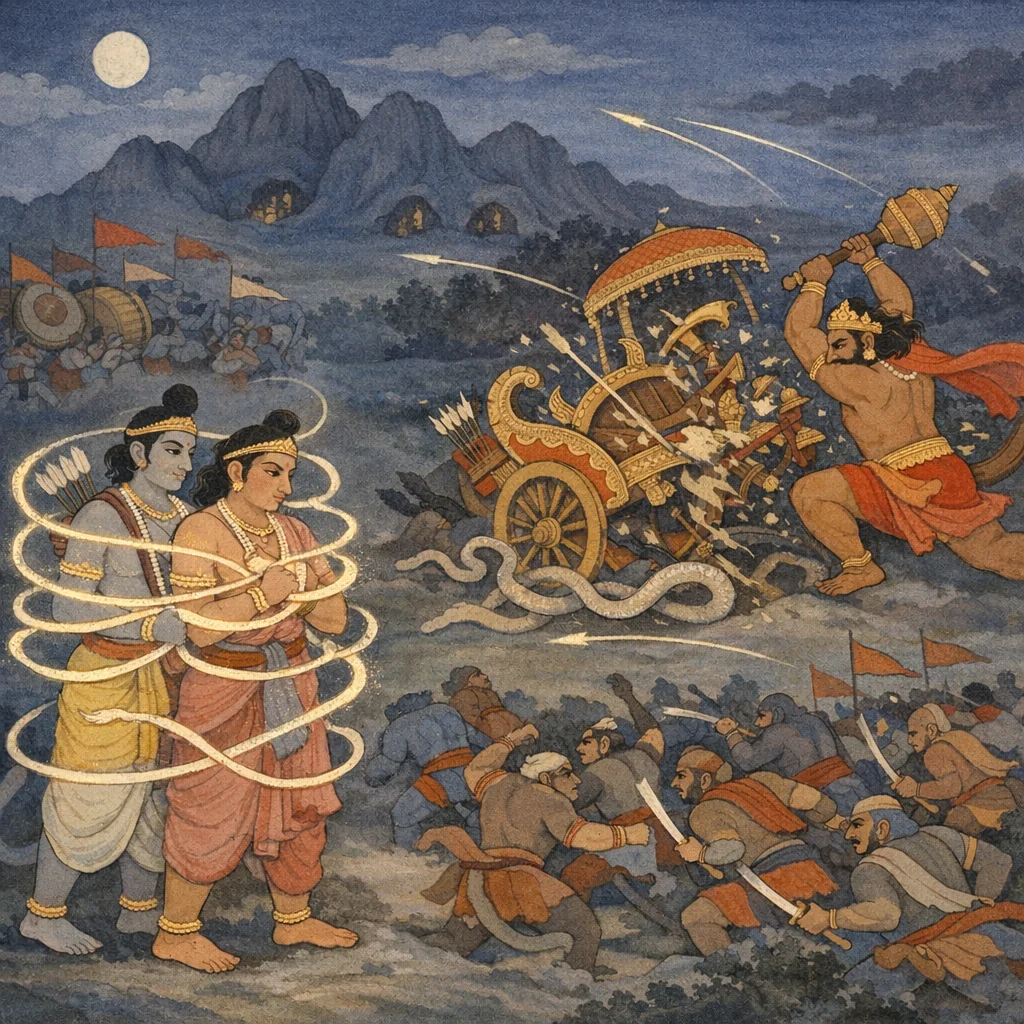
As vānaras and rākṣasas clash, sunset initiates a lethal night phase for the combatants, and the engagement turns into a confused nocturnal melee. Dust churned by horses and chariot wheels obscures sight and hearing; the field is depicted as a mud of blood with terrifying soundscapes—drums, conches, flutes, roars, and echoing caves of Trikūṭa. In darkness, misrecognition intensifies: fighters strike their own, mistaking friend for foe. Rāma’s arrows illuminate directions and destroy rākṣasas who rush him; several named rākṣasas are struck and withdraw with residual life. Angada decisively disrupts Indrajit’s chariot by killing his horses and charioteer, prompting celestial and allied praise. Indrajit, enraged, shifts to covert warfare: becoming invisible, he shoots serpent-like arrows, wounds Rāma and Lakṣmaṇa, and finally binds the brothers with a network of arrows—an escalation from open combat to māyā-driven, psychologically destabilizing tactics.
Shlokas
Verse 1
युध्यतामेनतेषांतुतदावानरराक्षसाम् ।रविरस्तंगतोरात्रिःप्रवृत्ताप्राणहारिणी ।।।।
While those vānaras and rākṣasas were still locked in combat, the sun went down, and night began—deadly to life amid the turmoil of war.
Verse 2
अन्योन्यंबद्धवैराणांघोराणांजयमिच्छताम् ।सम्प्रवृत्तंनिशायुद्धंतदावानररक्षसाम् ।।।।
Then, the Vānaras and the fearsome Rākṣasas—locked in mutual enmity and each yearning for victory—began a battle in the night.
Verse 3
राक्षसोऽसीतिहरयोहरिश्चाऽसीतिराक्षसाः ।अन्योन्यंसमरेजघ्नुस्तस्मिंस्तमसिदारुणे ।।।।
In that dreadful darkness, the monkeys struck one another thinking, “He is a rākṣasa,” and the rākṣasas struck one another thinking, “He is a monkey,” as confusion seized the battle.
Verse 4
जहिदारयचैहीतिकथंविद्रवसीतिच ।एवंसुतुमुलश्शब्दस्तस्मिंस्तमसिशुश्रुवे ।।।।कालाःकाञ्चनसन्नाहास्तस्मिंस्तमसिराक्षसाः ।सम्प्रदृश्यन्तशैलेन्द्रादीप्तौषधिवनाइव ।।।।
In the darkness, cries such as “Strike!” “Tear him apart!” and “Why do you flee?” rang out in a tumultuous roar. In that same night, the rākṣasas—dark-hued yet clad in golden armour—appeared like mountains whose forests of medicinal herbs gleam with light.
Verse 5
जहिदारयचैहीतिकथंविद्रवसीतिच ।एवंसुतुमुलश्शब्दस्तस्मिंस्तमसिशुश्रुवे ।।6.44.4।।कालाःकाञ्चनसन्नाहास्तस्मिंस्तमसिराक्षसाः ।सम्प्रदृश्यन्तशैलेन्द्रादीप्तौषधिवनाइव ।।6.44.5।।
In the dark of night, the uproar of battle—“Strike!” “Tear him!” “Why do you run?”—was heard everywhere. The rākṣasas, black in hue yet glittering in golden armour, looked like mountain-masses lit by shining herb-forests.
Verse 6
तस्मिंस्तमसिदुष्पारेराक्षसाःक्रोधमूर्छिताः ।परिपेतुर्महावेगाभक्षयन्तःप्लवङ्गमान् ।।।।
In that darkness, hard to pass through, the rākṣasas—senseless with wrath—ranged about at great speed, devouring the vānaras.
Verse 7
तेहयान् काञ्चनापीडान् ध्वजांश्चाशीविषोपमान् ।आप्लुत्यदशनैस्तीक्ष्णैर्भीमकोपाव्यदारयन् ।।।।वानराबलिनोयुद्धेऽक्षोभयन् राक्षसींचमूम् ।
Then the mighty vānaras, terrible in their wrath, sprang upon the horses adorned with golden head-gear and upon the standards like venomous serpents, and tore them apart with their sharp teeth—throwing the rākṣasa ranks into turmoil in the battle.
Verse 8
कुञ्जरान् कुञ्जरारोहान् पताकाध्वजिनोरथान् ।।।।कर्षुश्चददंशुश्चदशनैःक्रोधमूर्छिताः ।
Overcome by battle-fury, they dragged down elephants and their riders, and chariots set with flags and standards; biting with their teeth, they mauled and shattered them.
Verse 9
लक्ष्मणश्चापिरामश्चशरैराशीविषोपमैः ।।।।दृश्यादृश्यानिरक्षांसिप्रवराणिनिजघ्नतुः ।
Rama and Lakshmana, too, with arrows like venomous serpents, struck down the foremost Rakshasas—both those who were visible and those who moved unseen.
Verse 10
तुरङ्गखुरविध्वस्तंरथनेमिसमुत्थितम् ।।।।रुरोधकर्णनेत्राणियुध्यतांधरणीरजः ।
Dust from the earth—pounded up by horses’ hooves and churned by chariot wheels—rose and clogged the ears and eyes of the fighters.
Verse 11
वर्तमानेतथाघोरेसङ्ग्रामेरोमहर्षणे ।।।।रुधिरोधामहाघोरानद्यस्तत्रप्रसुस्रुवुः ।
As that dreadful, hair-raising battle raged on, terrifying rivers of blood flowed there.
Verse 12
ततोभेरीमृदङ्गानांपणवानांचनिस्स्वनः ।।।।शङ्खवेणुस्वनोन्मिश्रस्सम्भूवाद्भुतोपमः ।
Then arose a wondrous uproar—kettledrums and mṛdaṅgas, paṇavas, and the blended sounds of conches and flutes.
Verse 13
हतानांस्तनमानानांराक्षसानांचनिःस्वनः ।।।।शस्तानांवानराणांचसम्बभूवातिदारुणः ।
A most dreadful roar arose—the cries and groans of fallen rākṣasas, and of the stricken vānaras as well.
Verse 14
हतैर्वानरवीरैश्चशक्तिशूलपरश्वधैः ।।।।निहतैःपर्वताकारैराक्षसैःकामरूपिभिः ।शस्त्रपुष्पोपहाराचतत्रासीद्युद्धमेदिनी ।।।।दुर् ज्ञेयादुर्निवेशाचशोणितास्रावकर्दमा ।
There the battlefield was strewn as though with offerings of ‘flower-like’ weapons: vānara heroes struck down by javelins, tridents, and axes, and mountain-sized rākṣasas—shapeshifters—felled as well. The ground became hard to make out and hard to traverse, a mire churned with streaming blood.
Verse 15
हतैर्वानरवीरैश्चशक्तिशूलपरश्वधैः ।।6.44.14।।निहतैःपर्वताकारैराक्षसैःकामरूपिभिः ।शस्त्रपुष्पोपहाराचतत्रासीद्युद्धमेदिनी ।।6.44.15।।दुर् ज्ञेयादुर्निवेशाचशोणितास्रावकर्दमा ।
This Southern Recension transmission repeats/overlaps the preceding description: the battlefield lay heaped with slain vānara heroes and fallen, mountain-like shapeshifting rākṣasas; it became difficult to discern and to cross, turned into a bloody mire.
Verse 16
साबभूवनिशाघोराहरिराक्षसहारिणी ।।।।कालरात्रीवभूतानांसर्वेषांदुरतिक्रमा ।
That night became fearsome, destroying both vānaras and rākṣasas alike—like Kālarātri for all beings, a passage difficult to endure.
Verse 17
ततस्तेराक्षसास्तत्रतस्मिंस्तमसिदारुणे ।।।।राममेवाभ्यवर्तन्तसम्हृष्टाश्शरवृष्टिभिः ।
After that, there on that dreadful darkness of night, those Rākṣasas—exultant—rushed upon Rāma himself, showering him with volleys of arrows.
Verse 18
तेषामापततांशब्दःक्रुद्धानामपिगर्जताम् ।।।।उद्वर्तइवसत्त्व, नांसमुद्राणांप्रशुश्रुवे ।
The roar of those enraged ones as they charged—thundering as they came—was heard like the upheaval of the seas themselves.
Verse 19
तेषांरामश्शरैःषडिभःषडजघाननिशाचरान् ।।।।निमेषान्तरमात्रेणशितैरग्निशिखोपमैः ।यमशत्रुश्चदुर्धर्षोमहापार्श्वमहोदरौ ।।।।वज्रदंष्ट्रोमहाकायस्तौचोभौशुकसारणौ ।तेतुरामेणबाणौघैस्सर्वेमर्मसुताडिताः ।।।।युद्धादपसृतास्तत्रसावशेषायुषोऽभवन् ।
Rāma struck down six night-ranging Rākṣasas with six arrows—keen as tongues of flame—in the mere space of a blink: Yamaśatru, the hard-to-face (Durdharṣa), Mahāpārśva, Mahodara, Vajradaṃṣṭra, and Mahākāya, along with the two—Śuka and Sāraṇa. Pierced by Rāma’s volleys in their vital spots, they withdrew from the fight there, surviving only with life still remaining.
Verse 20
तेषांरामश्शरैःषडिभःषडजघाननिशाचरान् ।।6.44.19।।निमेषान्तरमात्रेणशितैरग्निशिखोपमैः ।यमशत्रुश्चदुर्धर्षोमहापार्श्वमहोदरौ ।।6.44.20।।वज्रदंष्ट्रोमहाकायस्तौचोभौशुकसारणौ ।तेतुरामेणबाणौघैस्सर्वेमर्मसुताडिताः ।।6.44.21।।युद्धादपसृतास्तत्रसावशेषायुषोऽभवन् ।
There, the great charioteer made the quarters and the intermediate directions shine clear, with arrows like tongues of fire, richly adorned with gold.
Verse 21
तेषांरामश्शरैःषडिभःषडजघाननिशाचरान् ।।6.44.19।।निमेषान्तरमात्रेणशितैरग्निशिखोपमैः ।यमशत्रुश्चदुर्धर्षोमहापार्श्वमहोदरौ ।।6.44.20।।वज्रदंष्ट्रोमहाकायस्तौचोभौशुकसारणौ ।तेतुरामेणबाणौघैस्सर्वेमर्मसुताडिताः ।।6.44.21।।युद्धादपसृतास्तत्रसावशेषायुषोऽभवन् ।
And whatever other fierce Rākṣasas stood facing Rāma—those too were destroyed, like moths that rush into a flame.
Verse 22
तत्रकाञ्चनचित्राङ्गैश्शरैरग्निशिखोपमैः ।।।।दिशश्चकारविमलाःप्रदिशश्चमहारथः ।
There, the great charioteer made the quarters and the intermediate directions shine clear, with arrows like tongues of fire, richly adorned with gold.
Verse 23
येत्वन्येराक्षसाभीमारामस्याभिमुखेस्थिताः ।।।।तेऽपिनष्टाःसमासाद्यपतङ्गाइवपावकम् ।
And whatever other fierce Rākṣasas stood facing Rāma—those too were destroyed, like moths that rush into a flame.
Verse 24
सुवर्णपुङ्खैर्विशिखैस्सपतद्भिस्सहस्रशः ।।।।बभूवरजनीचित्राखद्योतैरिवशारदी ।
With thousands of golden-feathered arrows raining down, the night looked wondrous—like an autumn night glittering with fireflies.
Verse 25
राक्षसानांचनिनदैर्हरीणांचापिनिस्स्वनैः ।।।।साबभूवनिशाघोराभूयोघोरतरातदा ।
With the clamour of the Rākṣasas and the loud cries of the Vānaras, that fearsome night became more fearsome still.
Verse 26
तेनशब्देनमहताप्रवृद्धेनसमन्ततः ।।।।त्रिकूटःकन्दराकीर्णःप्रव्याहरदिवाचलः ।
With that immense sound swelling on every side, Trikūṭa—its slopes packed with caves—echoed back, as though the mountain itself were answering a call.
Verse 27
गोलाङ्गूलामहाकायास्तमसातुल्यवर्चसः ।।।।सम्परिष्वज्यबाहुभ्यांभक्षयन्रजनीचरान् ।
The long-tailed, huge-bodied warriors—dark as night in their radiance—clasped the night-roaming rākṣasas in their arms and, holding them fast, devoured them.
Verse 28
अङ्गदस्तुरणेशत्रूननिहन्तुंसमुपस्थितः ।।।।रावणिंनिजघानाशुसारथिंचहयानपि ।
But Aṅgada, resolved to slay the foes in battle, swiftly struck down Rāvaṇa’s son’s charioteer—and the horses as well.
Verse 29
वर्तमानेतदाघोरेसङ्ग्रामेभृशदारुणे ।।।।इन्द्रजित्तुरथंत्यक्त्वाहताश्वोहतसारथिः ।अङ्गदेनमहामायस्तत्रैवान्तरधीयत ।।।।
While that dreadful, intensely violent battle raged on, Indrajit—his horses slain and his charioteer killed by Aṅgada—abandoned the chariot and, the great master of illusion, vanished on the spot.
Verse 30
वर्तमानेतदाघोरेसङ्ग्रामेभृशदारुणे ।।6.44.29।।इन्द्रजित्तुरथंत्यक्त्वाहताश्वोहतसारथिः ।अङ्गदेनमहामायस्तत्रैवान्तरधीयत ।।6.44.30।।
As that dreadful and fiercely violent battle continued, Indrajit—his horses and charioteer slain by Aṅgada—left the chariot and, wielding great illusion, disappeared then and there.
Verse 31
तत्कर्मवालिपुत्रस्यसर्वेदेवास्सहर्षिभिः ।तुष्टुवुःपूजनार्हस्यतौचोभौरामलक्ष्मणौ ।।।।
That deed of Vāli’s son—worthy of honor—was praised by all the gods together with the sages, and by both Rāma and Lakṣmaṇa as well.
Verse 32
प्रभावंसर्वभूतानिविदुरिन्द्रजितोयुधि ।तेनतेतंमहात्मानंतुष्टाःदृष्टवाप्रधर्षितम् ।।।।
All beings knew Indrajit’s power in war; therefore, seeing that great one humbled, they rejoiced in satisfaction.
Verse 33
ततःप्रहृष्टाःकपयस्ससुग्रीवविभीषणाः ।साधुसाध्वितिनेदुश्चदृष्टवाशत्रुंप्रधर्षितम् ।।।।
Then the monkeys—together with Sugrīva and Vibhīṣaṇa—were thrilled, and, seeing the enemy humbled, cried out, “Well done! Well done!”
Verse 34
इन्द्रजित्तुतदातेननिर्जितोभीमकर्मणा ।संयुगेवालिपुत्रेणक्रोधंचक्रेसुदारुणम् ।।।।
But Indrajit, then defeated in combat by Vāli’s son—doer of dreadful deeds—was seized by a most terrible rage.
Verse 35
सोऽन्तर्धानगतःपापोरावणीरणकर्कशः ।अदृश्योनिशितान्बाणान्मुमोचाशनिवर्चसः ।।।।
That sinful Rāvaṇi—harsh in battle—having entered concealment, became invisible and loosed sharp arrows blazing like a thunderbolt.
Verse 36
सरामंलक्ष्मणंचैवघोरैर्नागमयैश्शरैः ।बिभेदसमरेक्रुद्धःसर्वगात्रेषुराक्षसः ।।।।
Enraged in battle, that rākṣasa struck and pierced both Rāma and Lakṣmaṇa all over their bodies with dreadful arrows wrought with serpentine power.
Verse 37
माययासम्वृतस्तत्रमोहयन्राघवौयुधि ।अदृश्यस्सर्वभूतानांकूटयोधीनिशाचरः ।।।।बबन्धशरबन्धेनभ्रातरौरामलक्ष्मणौ ।
There, shrouded by sorcery and deluding the two Rāghavas in the fight, the night-stalker—an invisible, treacherous combatant to all beings—bound the brothers Rāma and Lakṣmaṇa in a net of arrows.
Verse 38
तेनतौपुरुषव्याघ्रौक्रुद्धेनाशीविषैश्शरैः ।।।।सहसानिहतौवीरौतदाप्रैक्षन्तवानराः ।
Then the vānaras beheld those two heroes—tigers among men—suddenly struck down by him with arrows like venomous serpents, shot in wrath.
Verse 39
प्रकाशरूपस्तुतदानशक्तस्तौबाधितुंराक्षसराजपुत्रः ।मायांप्रयोक्तुंसमुपाजगामबबन्धतौराजसुतौदुरात्मा ।।।।
But then the rākṣasa prince, unable to overpower the two in open, visible combat, resorted to sorcery; that evil-minded one bound the two royal sons by deceit.
Frequently Asked Questions
The sarga highlights the dharmic hazard of night warfare: obscured perception leads to misrecognition and accidental harm, while Indrajit’s shift to invisibility and binding tactics raises questions of fair combat versus deceptive necessity.
When clarity (prakāśa) collapses—literally through darkness and metaphorically through fear—discipline and discernment become moral safeguards; the narrative contrasts open heroism with māyā-driven assault to stress vigilance and steadiness under confusion.
Trikūṭa mountain is foregrounded as an acoustic landmark whose caves echo the battle; the sarga also preserves cultural sound-markers of war (bherī, mṛdaṅga, paṇava, śaṅkha, veṇu) that function as identifiers of epic battlefield ritual and morale.