Sarga 41
युद्धलक्षण-निमित्तदर्शनं तथा लङ्काद्वारव्यूहः (War Omens and the Encirclement of Lanka’s Gates)
युद्धकाण्ड
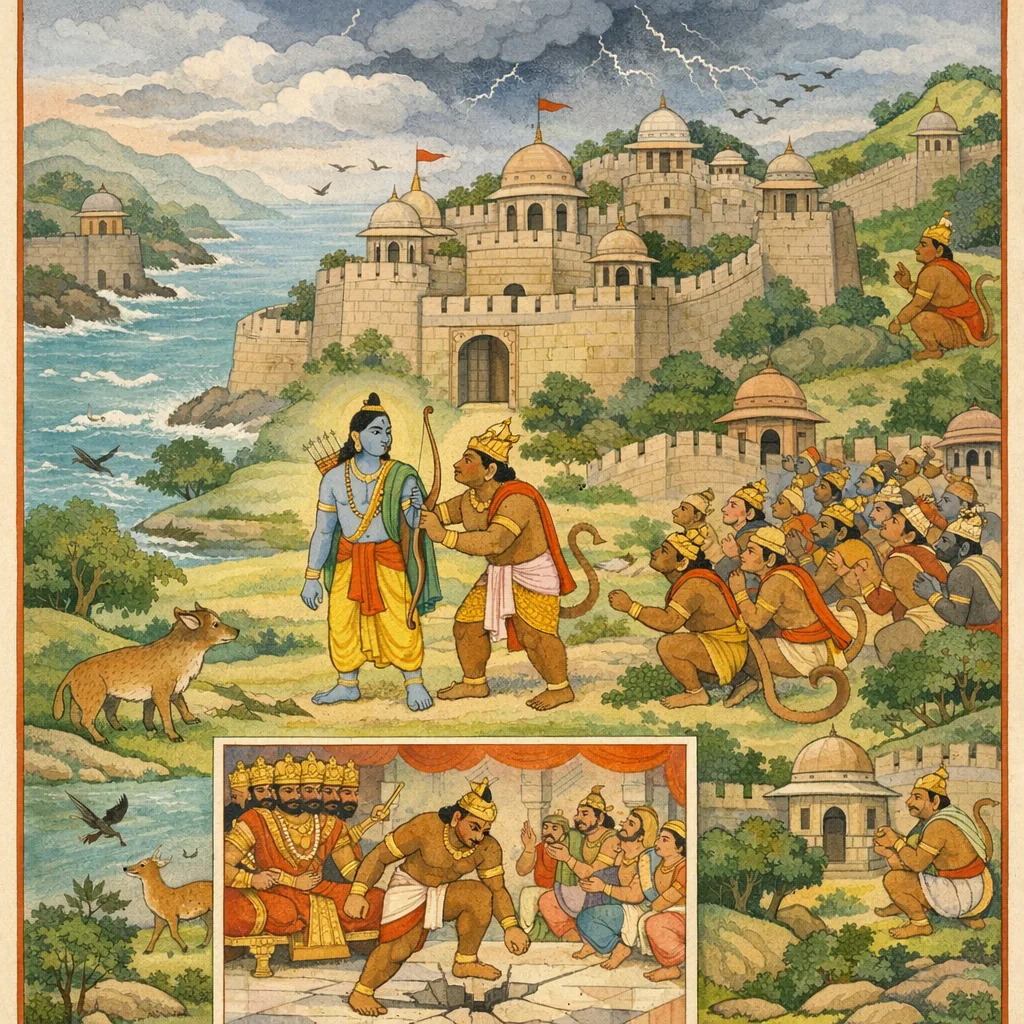
Sarga 41 stages the transition from anticipation to open siege. Rāma, observing ominous portents of war, embraces Sugrīva and then instructs Lakṣmaṇa to secure a resource-rich position (cool water, fruit-bearing woods), divide the forces, and stand in ordered formations. A catalogue of apocalyptic signs follows—violent winds, trembling earth and mountains, blood-mixed rain, inauspicious animal cries, darkened celestial bodies—framing war as a cosmic-moral crisis rather than mere politics. The vānaras advance rapidly and Laṅkā is approached; the city’s beauty and fortifications are described, emphasizing its near-impregnability. Rāma blocks the northern gate; Neela holds the east, Aṅgada the south, Hanumān the west, while Sugrīva anchors the center and Lakṣmaṇa with Vibhīṣaṇa posts troops in immense numbers. The text then shifts to diplomacy as strategy: Rāma summons Aṅgada as envoy with a severe, dharma-based message to Daśagrīva—return Vaidehī or face lawful destruction and Vibhīṣaṇa’s rightful rule. Aṅgada delivers the message, is seized to test strength, shatters part of the palace with his foot, and returns—provoking Rāvaṇa’s rage and confirming the siege’s irreversible momentum.
Shlokas
Verse 1
अथतस्मिन्निमित्तानिदृष्टवालक्ष्मणपूर्वजः ।सुग्रीवंसम्परिष्वज्यतथावचनमब्रवीत् ।।6.41.1।।
Then Rāma—the elder brother of Lakṣmaṇa—having observed those omens, embraced Sugrīva and spoke as follows.
Verse 2
असन्त्ऱ्यमयासार्थंतदिदंसाहसंकृतम् ।एवंसाहसुक्तानिनकुर्वन्तिजनेश्वराः ।।6.41.2।।
This bold deed has been done without consulting me. Kings and leaders do not undertake daring actions in such a manner.
Verse 3
संशयेस्थाप्यमांचेदंबलंचसविभीषणम् ।कष्टंकृतमिदंवीर साहसंसाहसप्रिय ।।6.41.3।।
“O hero, lover of daring deeds! By this bold act of yours you have thrown me—and the army along with Vibhīṣaṇa—into grave uncertainty; you have done something perilous indeed.”
Verse 4
इदानींमाकृथावीर एवंविधमचिन्तितम् ।त्वयिकिञ्चित्समापन्नेकिंकार्यंसीतयामम ।।6.41.4।।भरतेनमहाबाहो लक्ष्मणेनयवीयसा ।शत्रुघ्नेनचशत्रुघ्नस्वशरीरेणवापुन:।। 6.41.5।।
Nīla, the valiant commander of the monkey host, reached the eastern gate and held position there together with Mainda and Dvivida.
Verse 5
इदानींमाकृथावीर एवंविधमचिन्तितम् ।त्वयिकिञ्चित्समापन्नेकिंकार्यंसीतयामम ।।6.41.4।।भरतेनमहाबाहो लक्ष्मणेनयवीयसा ।शत्रुघ्नेनचशत्रुघ्नस्वशरीरेणवापुन:।। 6.41.5।।
“Now, O hero, do not do anything rash of this kind. If even a little harm should befall you, what would life mean for me—or for Sītā? What would it mean for Bharata, for the younger Lakṣmaṇa, for Śatrughna, or even for my own body?”
Verse 6
त्वयिचानागतेपूर्वमितिमेनिश्चितामतिः ।जानतश्चापितेवीर्यंमहेन्द्रवरुणोसम ।।6.41.6।।हत्वाऽहंरावणंयुद्धेसपुत्रबलवाहनम् ।अभिषिच्यचलङ्कायांविभीषणमथापिच ।।6.41.7।।भरतेराज्यमावेश्यत्यक्ष्येदेहंमहाबल ।
Even before you arrived, this resolve was fixed in my mind; and though I already know your valor—O mighty one, equal to Mahendra and Varuṇa—still I stand by that decision.
Verse 7
त्वयिचानागतेपूर्वमितिमेनिश्चितामतिः ।जानतश्चापितेवीर्यंमहेन्द्रवरुणोसम ।।6.41.6।।हत्वाऽहंरावणंयुद्धेसपुत्रबलवाहनम् ।अभिषिच्यचलङ्कायांविभीषणमथापिच ।।6.41.7।।भरतेराज्यमावेश्यत्यक्ष्येदेहंमहाबल ।
After I have slain Rāvaṇa in battle—together with his sons, forces, and vehicles—and after I have consecrated Vibhīṣaṇa in Laṅkā, I shall restore the kingdom to Bharata; then, O mighty one, I will relinquish my body.
Verse 8
तमेवंवादिनंरामंसुग्रीवःप्रत्यभाषत ।।6.41.8।।तवभार्यापहर्तारंदृष्टवाराघव रावणम् ।मर्षयामिकथंवीरजानपौरुषमात्मनः ।।6.41.9।।
As Rama spoke thus, Sugriva replied: “O hero Raghava, having seen Ravana, the abductor of your wife—knowing my own manly strength—how could I possibly endure it?”
Verse 9
तमेवंवादिनंरामंसुग्रीवःप्रत्यभाषत ।।6.41.8।।तवभार्यापहर्तारंदृष्टवाराघव रावणम् ।मर्षयामिकथंवीरजानपौरुषमात्मनः ।।6.41.9।।
O Rāghava, hero—having seen Rāvaṇa, the abductor of your wife—how could I endure it, knowing my own manly strength?
Verse 10
इत्येवंवादिनंवीरमभिनन्द्यचराघवः ।लक्ष्मणंलक्षीसम्पन्नमिदंवचनमब्रवीत् ।।6.41.10।।
Thus, having commended the hero who spoke in that manner, Rāghava (Rāma) said these words to Lakṣmaṇa, endowed with auspicious fortune.
Verse 11
परिगृह्योदकंशीतंवनानिफलवन्तिच ।बलौघंसंविभज्येमंव्यूह्यतिष्ठेमलक्ष्मण ।।6.41.11।।
“Lakṣmaṇa, let us secure a position where there is cool water and fruit-bearing woods; then, dividing this massed army and arranging it in formation, let us stand ready.”
Verse 12
लोकक्षयकरंभीमंभयंपश्याम्युपस्थितम् ।निबर्हणंप्रवीराणामृक्षवानररक्षसाम् ।।6.41.12।।
“I see a dreadful fear approaching—world-destroying in its effects—a slaughter of the foremost warriors among bears, monkeys, and rākṣasas.”
Verse 13
वाताश्चहिपरुषांवान्तिकम्पतेचवसुन्धरा ।पर्वताग्राणिवेपन्तेपतन्तिधरणीधराः ।।6.41.13।।
“For harsh winds are blowing, the earth is trembling; mountain-peaks shudder, and the world-bearing elephants are falling.”
Verse 14
मेघाःक्रवादसङ्काशाःपरुषाःपरुषस्वनाः ।क्रूराःक्रूरंप्रवर्षन्तिमिश्रंशोणितबिन्दुभिः ।।6.41.14।।
“The clouds, like flesh-eating birds, harsh and harsh-sounding, pour down a dreadful rain—mingled with drops of blood.”
Verse 15
रक्तचन्दनसङ्काशासन्ध्यापरमदारुणा ।ज्वलच्चनिपतत्येतदादित्यादग्निमण्डलम् ।।6.41.15।।
“The twilight is most dreadful, glowing like red sandalwood; and from the sun there seems to fall a blazing circle of fire.”
Verse 16
आदित्यमभिवाश्यन्तिजनयन्तोमहद्भयम् ।दीनादीनस्वराःघोरानप्रशस्तामृगद्विजाः ।।6.41.16।।
“Facing the sun, inauspicious beasts and birds cry out—dreadful, pitiful-voiced—creating great fear.”
Verse 17
रजन्यामप्रकाशश्चसन्तापयतिचन्द्रमाः ।कृष्णरक्तांशुपर्यन्तोयथालोकस्यसंक्ष्ये ।।6.41.17।।
“At night the moon gives no light and seems oppressive, encircled by black and red rays—like the time of the world’s dissolution.”
Verse 18
ह्रस्वोरूक्षोऽप्रशस्तश्चपरिवेषस्सुलोहितः ।आदित्यमण्डलेनीलंलक्ष्मलक्ष्मण दृश्यते ।।6.41.18।।
Lakṣmaṇa, a short, harsh-looking, inauspicious, copper-red halo is seen around the sun; and within the solar disc a dark mark is visible.
Verse 19
दृश्यन्तेनयथावच्छनक्षत्राण्यभिवर्तते ।युगान्तमिवलोकस्यपश्यलक्ष्मण शंसति ।।6.41.19।।
See, Lakṣmaṇa: the stars are not appearing as they should, and the sky seems clouded and disturbed—like a sign proclaiming the world’s end.
Verse 20
काकाश्येनास्तथागृध्रानीचैःपरिपतन्तिच ।शिवाश्चाप्यशिवावाचःप्रवदन्तिमहास्वनाः ।।6.41.20।।
Crows, hawks, and vultures are circling low; and jackals, with loud cries, utter inauspicious sounds.
Verse 21
क्षिप्रमद्यदुराधर्षांलङ्कांरावणपालिताम् ।अभियामजवेनैवसर्वतोहरिभिर्वृताः ।।6.41.21।।
Today, quickly—surrounded on all sides by the Vānara hosts—let us advance at speed against Laṅkā, hard to assail and ruled by Rāvaṇa.
Verse 22
शैलैःशूलैश्चखडगैश्चविमुक्स्सैःकपिराक्षसैः ।भविष्यत्यावृताभूमिर्मांसशोणितकर्दमा ।।6.41.22।।
With rocks, tridents, and swords hurled by Vānaras and Rākṣasas, the earth will be covered—turned into mire of flesh and blood.
Verse 23
इत्येवंतुवदवनीर्वोलक्ष्मणंलक्ष्मणाग्रजः ।तस्मादवातरच्छीघ्रंपर्वताग्रान्महाबलः ।।6.41.23।।
Having spoken thus to Lakṣmaṇa, the mighty hero—Lakṣmaṇa’s elder brother—quickly descended from the mountain peak.
Verse 24
अवतीर्यचधर्मात्मातस्माच्छैलात्सराघवः ।परैःपरमदुर्धर्षंददर्शबलमात्मनः ।।6.41.24।।
Descending from that mountain, righteous Rāghava considered and reviewed his own army—formidable and exceedingly hard for enemies to withstand.
Verse 25
सन्नह्यतुससुग्रीवःकपिराजबलंमहत् ।कालज्ञोराघवःकालेसंयुगायाभ्यचोदयत् ।।6.41.25।।
“Let Sugrīva ready the great army of the Vānara-king.” Rāghava, knowing the right time, urged them on to battle at the proper moment.
Verse 26
ततःकालेमहाबाहुर्बलेनमहतावृतः ।प्रस्थितःपुरतोधवनीलङ्कामभिमुखःपुरीम् ।।6.41.26।।
Then, at the appointed time, the broad-armed Rāma—surrounded by a great host—set out at the head of the march, facing the city of Laṅkā.
Verse 27
तंविभीषणसुग्रीवौहनूमाञ्जाम्बवान्नळ ।ऋक्षराजस्तथानीलोलक्ष्मणश्चान्वयुस्तदा ।।6.41.27।।
Then Vibhīṣaṇa and Sugrīva followed him—along with Hanumān, Jāmbavān, Nala, the king of bears, Nīla, and Lakṣmaṇa as well.
Verse 28
ततःपशचात्सुमहतीपृतनर् क्षवनौकसाम् ।प्रच्छाद्यमहतींभूमिमनुयातिस्मराघवम् ।।6.41.28।।
After that, the vast host of bears and monkeys followed Rāghava, spreading out and covering the great expanse of the ground behind him.
Verse 29
शैलशृङ्गाणिशतशःप्रवृद्धांश्चमहीरुहान् ।जगृहुःकुञ्जरप्रख्यावानराःपरवारणाः ।।6.41.29।।
The mighty monkeys—huge as elephants and able to repel the enemy—seized mountain crags and great full-grown trees by the hundreds.
Verse 30
तौत्वदीर्घेणकालेनभ्रातरौरामलक्ष्मणौ ।रावणस्यपुरींलङ्कामसेदतुररिन्दमौ ।।6.41.30।।
Before long, the two brothers—Rāma and Lakṣmaṇa, tamers of foes—reached Laṅkā, the city of Rāvaṇa.
Verse 31
पताकामालिनींरम्यामुद्यानवनशोभिताम् ।चित्रवप्रासुदुष्प्रापमुच्चैःप्राकारतोरणाम् ।।6.41.31।।तांसुरैरपिदुर्धर्षांरामवाक्यप्रचोदिताः ।यथानिदेशंसम्पीड्यन्यविशन्तवनौकसः ।।6.41.32।।
They beheld lovely Laṅkā, adorned with garlands of banners and beautified by gardens and groves—yet hard to approach, with wondrous ramparts and lofty walls and gateways.
Verse 32
पताकामालिनींरम्यामुद्यानवनशोभिताम् ।चित्रवप्रासुदुष्प्रापमुच्चैःप्राकारतोरणाम् ।।6.41.31।।तांसुरैरपिदुर्धर्षांरामवाक्यप्रचोदिताः ।यथानिदेशंसम्पीड्यन्यविशन्तवनौकसः ।।6.41.32।।
Urged on by Rama’s command, the forest-dwellers entered that city—hard to assail even for the gods—holding their positions in accordance with the orders given.
Verse 33
लङ्कायास्तूत्तरंद्वारंशैलशृङ्गमिवोन्नतम् ।रामःसहानुजोधन्वीजुगोपचरुरोधच ।।6.41.33।।
Rama, bow in hand and accompanied by his younger brother, secured and blocked Lanka’s northern gate, towering like a mountain peak.
Verse 34
लङ्कामुपनिविष्टस्तुरामोदशरथात्मजः ।लक्ष्मणानुचरोवीरःपुरींरावणपालिताम् ।।6.41.34।।उत्तरद्वारमासाद्ययत्रतिष्ठतिरावणः ।नान्योरामाद्धितद् द्वारंसमर्थःपरिरक्षितुम् ।।6.41.35।।सायुथैराक्षसैर्भीमैरभिगुप्तंसमन्ततः ।लघूनांत्रासजननंपाताळमिवदानवैः ।।6.41.36।।
Rama, the heroic son of Daśaratha, with Lakṣmaṇa at his side, took position at Laṅkā—Rāvaṇa’s guarded city.
Verse 35
लङ्कामुपनिविष्टस्तुरामोदशरथात्मजः ।लक्ष्मणानुचरोवीरःपुरींरावणपालिताम् ।।6.41.34।।उत्तरद्वारमासाद्ययत्रतिष्ठतिरावणः ।नान्योरामाद्धितद् द्वारंसमर्थःपरिरक्षितुम् ।।6.41.35।।सायुथैराक्षसैर्भीमैरभिगुप्तंसमन्ततः ।लघूनांत्रासजननंपाताळमिवदानवैः ।।6.41.36।।
Reaching the northern gate—where Rāvaṇa stood—none but Rama was truly capable of holding and guarding that gateway.
Verse 36
लङ्कामुपनिविष्टस्तुरामोदशरथात्मजः ।लक्ष्मणानुचरोवीरःपुरींरावणपालिताम् ।।6.41.34।।उत्तरद्वारमासाद्ययत्रतिष्ठतिरावणः ।नान्योरामाद्धितद् द्वारंसमर्थःपरिरक्षितुम् ।।6.41.35।।सायुथैराक्षसैर्भीमैरभिगुप्तंसमन्ततः ।लघूनांत्रासजननंपाताळमिवदानवैः ।।6.41.36।।
All around, it was heavily guarded by fearsome rākṣasas in troops—terrifying to the lightly armed—like Pātāla (the netherworld) swarming with dānavas.
Verse 37
विन्यस्तानिचयोधानांबहूनिविविधानिच ।ददर्शाऽयुधजालानितत्रैवकवचानिच ।।6.41.37।।
He saw there many kinds of weapons laid out for the fighters, and likewise armor laid ready on the spot.
Verse 38
पूर्वंतुद्वारमासाद्यनीलोहरिचमूपतिः ।अतिष्ठत्सहमैन्देनद्विविदेनचवीर्यवान् ।।6.41.38।।
Nīla, the valiant commander of the monkey host, reached the eastern gate and held position there together with Mainda and Dvivida.
Verse 39
अङ्गदोदक्षिणद्वारंजग्राहसुमहाबलः ।ऋषभेणगवाक्षेणगजेनगवयेनच ।।6.41.39।।
Angada, of tremendous strength, took charge of the southern gate, together with Ṛṣabha, Gavākṣa, Gaja, and Gavaya.
Verse 40
हनुमान् पश्चिमद्वारंररक्षबलवान्कपिः ।प्रमाथिप्रषुभ्यांचवीरैरन्यैश्चसङ्गतः ।।6.41.40।।
Hanumān, the mighty monkey, guarded the western gate, joined by the heroes Pramāthi and Praṣu and by other warriors as well.
Verse 41
मध्यमेचस्वयंगुल्मेसुग्रीवस्समतिष्ठत ।सहसर्वैर्हरिश्रेष्ठैस्सुपर्णश्वसनोपमैः ।।6.41.41।।
Sugrīva himself held the central post, together with all the foremost of the monkeys—swift as Garuḍa and as fast as the wind.
Verse 42
वानराणांतुषटित्रंशत्कोट्यःप्रख्यातयूथपाः ।निपीड्योपनिविष्टाश्चसुग्रीवोयत्रवानरः ।।6.41.42।।
There—where Sugrīva the vānara was positioned—were encamped the renowned troop-leaders and (in all) thirty-six crores of vānara forces, massed together.
Verse 43
शासनेनतुरामस्यलक्ष्मणस्सविभीषणः ।द्वारेद्वारेहरीणांतुकोटिंकोटिंन्यवेशयेत् ।।6.41.43।।
By Rāma’s command, Lakṣmaṇa—together with Vibhīṣaṇa—stationed the vānara forces in crores at each and every gate.
Verse 44
पश्चिमेनतुरामस्यसुषेणःसहजाम्बवान् ।।6.41.44।।आदूरान्मध्यमेगुल्मेतस्थौबहुबलानुगः ।
By Rāma’s command, Lakṣmaṇa—together with Vibhīṣaṇa—stationed the vānara forces in crores at each and every gate.
Verse 45
तेतुवानरशार्धूलाःशार्दूलाइवदंष्ट्रिणः ।।6.41.45।।गृहीत्वाद्रुमशैलाग्रान्हृष्टायुद्धायतस्थिरे ।
Those tiger-like leaders among the Vānaras—fanged like tigers—stood exultant for battle, gripping uprooted trees and the crags of mountains.
Verse 46
सर्वेविकृतलाङ्गूलास्सर्वेदंष्ट्रानखायुधा:।। 6.41.46।।सर्वेविकृतचित्राङ्गास्सर्वेचविकृताननाः ।
All of them bore tails raised and bristling; all had teeth and nails as weapons. All looked fierce in their bodies’ strange markings, and all wore grim, distorted faces in fury.
Verse 47
दशनागबलाःकेचित्केचिद्धशगुणोत्तराः ।।6.41.47।।केचिन्नागसहस्रस्यबभूवुस्तुल्यविक्रमाः ।
Some had the strength of ten elephants; some were tenfold stronger still; and some displayed prowess equal to a thousand elephants.
Verse 48
सन्तिचौघबलाःकेचित्केचिच्छतगुणोत्तराः ।।6.41.48।।अप्रमेयबलाश्चान्येतत्रासन्हरियूथपाः
There were some with the force of a surging flood; some were a hundred times stronger; and there too stood other Vānara commanders whose strength was beyond measure.
Verse 49
अद्भुतश्चविचित्रश्चतेषामासीत्समागमः ।।6.41.49।।तत्रवानरसैन्यानांशलभानामिवोद्यमः ।
Wondrous and astonishing was their assembly; there the Vānara host surged into motion like a swarm of locusts.
Verse 50
प्रतिपूर्णमिवाकाशंसञ्छन्नेवचमेदिनी ।।6.41.50।।लङ्कापुमनिविष्टैश्चसम्पतद्भिश्चवानरैः ।
With Vānaras already stationed and others still rushing in, the sky seemed packed full and the earth seemed completely covered all around Laṅkā.
Verse 51
शतंशतसहस्राणांपृथगृक्षवनौकसाम् ।।6.41.51।।लङ्काद्वाराङयुपाजग्मुरन्येयोद्धुंसमन्ततः ।
Others—separate contingents of bears and forest-dwelling Vānaras, numbering in the hundreds of thousands—advanced from every side toward the gates of Laṅkā to fight.
Verse 52
आवृतस्सगिरिस्सर्वैस्सैस्समन्तात् प्लवङ्गमैः ।।6.41.52।।अयुतानांसहस्रंचपुरींतामभ्यवर्तत ।
That mountain was encircled on every side by those leaping Vānaras, as they pressed up toward the city and its vast defensive perimeter.
Verse 53
वानरैर्बलवद्भिश्चबभूवद्रुमपाणिभिः ।।6.41.53।।सम्वृतासर्वतोलङ्कादुष्प्रवेशाऽपिवायुना ।
Laṅkā became enclosed on every side by mighty Vānaras with trees in their hands—so sealed that even the wind would find entry difficult.
Verse 54
राक्षसाविस्मयंजग्मुःसहसाऽभिनिपीडिताः ।।6.41.54।।वानरैर्मेघसङ्काशैश्शक्रतुल्यपराक्रमैः ।
Hard-pressed all at once by the Vānara warriors—cloud-like in mass and equal to Indra in valor—the Rākṣasas were struck with astonishment and gave way.
Verse 55
महान् शब्दोऽभवत्तत्रबलौघस्याभिवर्ततः ।।6.41.55।।सागरस्येवभिन्नस्ययथास्यात्सलिलस्वनः ।
Then a tremendous roar arose as the massed forces advanced—like the thunderous sound of waters when the ocean’s bounds are broken.
Verse 56
तेनशब्देनमहतासप्राकारासतोरणा ।।6.41.56।।लङ्काप्रचलितासर्वासशैलवनकानना ।
By that mighty roar, all of Laṅkā shook—its ramparts and gateways, its hills and forest-groves trembling together.
Verse 57
रामलक्ष्मणगुप्तासासुग्रीवेणचवाहिनी ।।6.41.57।।बभूवदुर्धर्षतरासर्वैरपिसुरासुरैः ।
Guarded by Rāma and Lakṣmaṇa, and led by Sugrīva, that army became all the more unassailable—even to gods and anti-gods alike.
Verse 58
राघवःसन्निवेश्यैवंस्वसैन्यंरक्षसांवधे ।।6.41.58।।सम्मन्त्ऱ्यमन्त्रिभिस्सार्थंनिश्चित्यचपुनःपुनः ।आनन्तर्यमभिप्रेप्सुःक्रमयोगार्थतत्त्ववित् ।।6.41.59।।विभीषणस्यानुमतेराजधर्ममनुस्मरन् ।अङ्गदंवालितनयंसमाहूयेदमब्रवीत् ।।6.41.60।।
Thus Rāghava, having arranged his own forces for the slaying of the Rākṣasas, repeatedly consulted with his ministers and reached a firm decision.
Verse 59
राघवःसन्निवेश्यैवंस्वसैन्यंरक्षसांवधे ।।6.41.58।।सम्मन्त्ऱ्यमन्त्रिभिस्सार्थंनिश्चित्यचपुनःपुनः ।आनन्तर्यमभिप्रेप्सुःक्रमयोगार्थतत्त्ववित् ।।6.41.59।।विभीषणस्यानुमतेराजधर्ममनुस्मरन् ।अङ्गदंवालितनयंसमाहूयेदमब्रवीत् ।।6.41.60।।
Seeking the proper sequence of what should follow, he—knower of the true principles of ordered action—looked ahead to the next step.
Verse 60
राघवःसन्निवेश्यैवंस्वसैन्यंरक्षसांवधे ।।6.41.58।।सम्मन्त्ऱ्यमन्त्रिभिस्सार्थंनिश्चित्यचपुनःपुनः ।आनन्तर्यमभिप्रेप्सुःक्रमयोगार्थतत्त्ववित् ।।6.41.59।।विभीषणस्यानुमतेराजधर्ममनुस्मरन् ।अङ्गदंवालितनयंसमाहूयेदमब्रवीत् ।।6.41.60।।
With Vibhīṣaṇa’s approval, and mindful of the duties of kingship, he summoned Aṅgada—the son of Vāli—and spoke these words.
Verse 61
गत्वासौम्य दशग्रीवंब्रूहिमद्वचनात्कपे ।लङ्घयित्वापुरींलङ्कांभयंत्यक्त्वागतव्यधः ।।6.41.61।।भ्रष्टश्रीक गतैश्वर्य मुमूर्षो नष्टचेतनः ।
“Go, gentle one—O monkey—and from my words address Daśagrīva. Having leapt into the city of Laṅkā, casting off fear and distress, speak to that man who has lost his splendor and power, whose mind is ruined, and who is rushing toward death.”
Verse 62
ऋषीणांदेवतानांचगन्धर्वाप्सरसांतथा ।।6.41.62।।नागानामथयक्षाणांराज्ञांचरजनीचर ।यच्चपापंकृतंमोहादवलिप्तेनराक्षस ।।6.41.63।।नूनंतेविगतोदर्पःस्वयम्भुवरदानजः ।तस्यपापस्यसम्प्राप्ताव्युष्टिरद्यदुरसदा ।।6.41.64।।
“O night-ranger! The time has arrived for the hard, inescapable reckoning of the sins you committed—through delusion and arrogance—against sages, gods, Gandharvas and Apsarases, Nāgas, Yakṣas, and kings. Surely today your pride, born of boons granted by the Self-born (Brahmā), will be brought low.”
Verse 63
ऋषीणांदेवतानांचगन्धर्वाप्सरसांतथा ।।6.41.62।।नागानामथयक्षाणांराज्ञांचरजनीचर ।यच्चपापंकृतंमोहादवलिप्तेनराक्षस ।।6.41.63।।नूनंतेविगतोदर्पःस्वयम्भुवरदानजः ।तस्यपापस्यसम्प्राप्ताव्युष्टिरद्यदुरसदा ।।6.41.64।।
O night-roaming Rākṣasa! Whatever sin you committed—out of delusion and arrogant pride—against the Nāgas, the Yakṣas, and the kings: for that wrongdoing the time of requital has now drawn near.
Verse 64
ऋषीणांदेवतानांचगन्धर्वाप्सरसांतथा ।।6.41.62।।नागानामथयक्षाणांराज्ञांचरजनीचर ।यच्चपापंकृतंमोहादवलिप्तेनराक्षस ।।6.41.63।।नूनंतेविगतोदर्पःस्वयम्भुवरदानजः ।तस्यपापस्यसम्प्राप्ताव्युष्टिरद्यदुरसदा ।।6.41.64।।
Surely today your pride—born of boons granted by the Self-born (Brahmā)—will be shattered; for the fearful fruition of that sin has now come upon you.
Verse 65
तस्यदण्डधरस्तेऽहंदाराहरकर्शितः ।दण्डंधारयमाणस्तुलङ्काद्वारेव्यवस्थितः ।।6.41.65।।
I—tormented by the abduction of my wife—stand here at the very gate of Laṅkā as your chastiser, bearing the rod of punishment for you.
Verse 66
पदवींदेवतानांचमहर्षीणांचराक्षस ।राजर्षीणांचसर्वेषांगमिष्यसिमयाहतः ।।6.41.66।।
O Rākṣasa! When slain by me, you will go to the very state attained by all—Devas, great sages, and royal sages alike.
Verse 67
बलेनयेनवैसीतांमाययाराक्षसाधम ।यामतिक्रामयित्वात्वंहृतवांस्तद्विदर्शय ।।6.41.67।।
O vilest of Rākṣasas! The strength and deceit by which you outwitted me and carried Sītā away—show that now.
Verse 68
अराक्षसमिमंलोकंकर्तास्मिनिशितैःशरैः ।नचेच्छरणमभ्येषितामादायतुमैथिलीम् ।।6.41.68।।
With my sharpened arrows I will make this world free of Rākṣasas—unless you seek refuge and return Maithilī (Sītā).
Verse 69
धर्मात्माराक्षसश्रेष्ठःसम्प्राप्तोऽयंविभीषणः ।लङ्कैश्वर्यंधृवंश्रीमानयंप्राप्नोत्यकण्डकम् ।।6.41.69।।
This Vibhīṣaṇa—righteous and the best among Rākṣasas—has come (to me). He will surely obtain the sovereignty of Laṅkā, in unbroken prosperity.
Verse 70
नहिराज्यमधर्मेणभोक्तुंक्षणमपित्वया ।शक्यंमूर्खसहायेनपापेनाविदितात्मना ।।6.41.70।।
Indeed, one who is sinful, self-ignorant, and aided by fools cannot enjoy a kingdom through unrighteousness—even for a single moment.
Verse 71
युध्यस्ववाधृतिंकृत्वाशौर्यमालम्ब्यराक्षस ।मच्छरैस्त्वंरणेशान्तस्ततःशान्तोभविष्यसि ।।6.41.71।।
Fight on, O Rākṣasa—steady your resolve and cling to your valor. In battle my arrows will make you ‘quiet’; thereafter you will find ‘peace’ (in death).
Verse 72
यद्वाविशसिलोकांस्त्रीन्पक्षीभूतोमनोजवः ।ममचक्षुष्पथंप्राप्यनजीवन्प्रतियास्यसि ।।6.41.72।।
O swift-minded one, even if you were to enter the three worlds—becoming like a bird—once you come within the range of my sight, you will not return alive.
Verse 73
ब्रवीमित्वांहितंवाक्यंक्रियतामौर्ध्वदैहिकम् ।सुदृष्टाक्रियतांलङ्काजीवितंतेमयिस्थितम् ।।6.41.73।।
I speak to you for your good: prepare the rites for what follows death. Let Lanka see to the final obsequies—your life now rests in my hands.
Verse 74
इत्युक्तःसतुतारेयोरामेणाक्लिष्टकर्मणा ।जगामाकाशामाविश्यमूर्तिमानिवहव्यवाट् ।।6.41.74।।
Thus addressed by Rama of tireless deeds, Tara’s son entered the sky and departed—radiant like embodied fire.
Verse 75
सोऽतिपत्यमुहूर्तेनश्रीमान्रावणमन्दिरम् ।ददर्शासीनमव्यग्रंरावणंसचिवैःसह ।।6.41.75।।
In but a moment, the illustrious one reached Ravana’s palace and saw Ravana seated there, composed, together with his ministers.
Verse 76
ततस्तस्य I विदूरेणनिपत्यसहरिपुङ्गवः ।दीप्ताग्निसदृशस्तस्थावङ्गदःकनकाङ्गदः ।।6.41.76।।
Then, landing not far from him, Angada—the foremost of the monkeys, wearing golden armlets—stood blazing like fire.
Verse 77
तद्रामवचनंसर्वमन्यूनाधिकमुत्तमम् ।सामात्यंश्रावयामासनिवेद्यात्मानमात्मना ।।6.41.77।।
After identifying himself, he recited all of Rama’s excellent words to Ravana and his ministers—without adding or omitting anything.
Verse 78
दूतोऽहंकोशलेन्द्रस्यरामस्याक्लिष्टकर्मणः ।वालिपुत्रोऽङ्गदोनामयदितेश्रोत्रमागतः ।।6.41.78।।
I am the envoy of Rama, lord of Kosala, tireless in action—Vali’s son, named Angada, as you may have heard.
Verse 79
अहत्वांराघवोरामःकौसल्यानन्दवर्धनः ।निष्पत्यप्रतियुध्यस्वनृशंस पुरुषोभव ।।6.41.79।।
Rama of the Raghus, who increases Kausalya’s joy, says to you: come out and fight—cruel one—be a man.
Verse 80
हन्तास्मित्वांसहामात्यंसपुत्रज्ञातिबान्धवम् ।निरुद्विग्नास्त्रयोलोकाभविष्यन्तिहतेत्वयि ।।6.41.80।।
I will slay you along with your ministers, your sons, kinsmen, and allies; when you are killed, the three worlds will be free from fear.
Verse 81
देवदानवयक्षाणांगन्धर्वोरगरक्षसाम् ।शत्रुमद्योद्धरिष्यामित्वामृषीणांचकण्टकम् ।।6.41.81।।
Today I will uproot you—an enemy to gods, Dānavas, Yakṣas, Gandharvas, Nāgas, and Rākṣasas alike—who have become a thorn in the throat of the sages.
Verse 82
विभीषणस्यचैश्वर्यंभविष्यतिहतेत्वयि ।नचेत्सत्कृत्यवैदेहींप्रणिपत्यप्रदास्यसि ।।6.41.82।।
If you do not return Vaidehī with due honor—bowing down—then when you are slain, sovereignty will fall to Vibhīṣaṇa.
Verse 83
इत्येवंपरुषंवाक्यंब्रुवाणेहरिपुङ्गवे ।अमर्षवशमापन्नोनिशाचरगणेश्वरः ।।6.41.83।।
As the foremost of monkeys spoke such harsh words, the lord of the night-roamers was seized by uncontrollable rage.
Verse 84
ततस्सरोषताम्राक्षश्शशापसचिवांन्नोस्तदा ।गृह्यतामेषदुर्मेधावध्यतामितिचासकृत् ।।6.41.84।।
Then, his eyes reddened with rage, the rākṣasa berated his ministers again and again: “Seize this ill-witted one; kill him!”
Verse 85
रावणस्यवच्शुत्वादीप्ताग्निसमतेजसा ।जगृहुस्तंततोघोराश्चत्वारोरजनीचराः ।।6.41.85।।
Hearing Rāvaṇa’s command, four fearsome night-roamers seized Aṅgada, who blazed with the splendor of fire.
Verse 86
ग्राहयामासतारेयस्स्वयमात्मनमात्मवान् ।बलंदर्शयितुंवीरोयातुधानगणेतदा ।।6.41.86।।
Then the heroic son of Tārā, self-possessed, allowed himself to be seized—wishing to display his strength in the midst of the rākṣasa host.
Verse 87
सतान्बाहुद्वयासक्तानादायपतगानिव ।प्रासादंशैलसङ्कामुत्पपाताङ्गदस्तदा ।।6.41.87।।
Then Aṅgada, bearing those clinging to his two arms as if they were birds, sprang up onto the palace that rose like a mountain.
Verse 88
तेन्तरिक्षाद्विनिर्धूतास्तस्यवेगेनराक्षसाः ।भूमौनिपतिताःसर्वेराक्षसेन्द्रस्यपश्यतः ।।6.41.88।।
Hurled away from the air by his momentum, all those rākṣasas fell to the ground—while the lord of rākṣasas looked on.
Verse 89
ततःप्रासादशिखरंशैलशृङ्गमिवोन्नतम् ।ददर्शराक्षसेन्द्रस्यवालिपुत्रःप्रतापवान् ।।6.41.89।।
Then the mighty Vālin’s son looked upon the palace-peak of the rākṣasa-king, towering like a mountain summit.
Verse 90
तत्पफालपदाक्रान्तंदशग्रीवस्यपश्यतः ।पुराहिमवतश्शृङ्गंवज्रिणेवविदारितम् ।।6.41.90।।
As Daśagrīva watched, the structure split under the trampling of his foot—like a peak of Himavat long ago shattered by Vajrin (Indra).
Verse 91
भङ् क्त्वाप्रासादशिखरंनामविश्राव्यचात्मनः ।विनद्यसुमहानादमुत्पपातविहायसम् ।।6.41.91।।
After striking the palace-peak, he proclaimed his own name; then, roaring with a mighty cry, he sprang up into the sky.
Verse 92
व्यथयन्राक्षसान्सर्वान्हर्षयंश्चापिवानरान् ।सवानराणांमध्येतुरामपार्श्वमुपागतः ।।6.41.92।।
Having shaken all the rākṣasas and gladdened the vānaras, he returned to the midst of the monkeys, coming near Rāma’s side.
Verse 93
रावणस्तुपरंचक्रेक्रोधंप्रासादधर्षणात् ।विनाशंचात्मनःपश्यन्निश्श्वासपरमोऽभवत् ।।6.41.93।।
But Rāvaṇa flared into extreme rage at the outrage done to his palace; and, foreseeing his own ruin, he fell into deep, heavy sighing.
Verse 94
रामस्तुबहुभिर्हृष्टर्निनदद्भिःप्लवङ्गमैः ।वृतोरिपुवधाकाङ्क्षीयुद्धायैवाभ्यवर्तत ।।6.41.94।।
Rāma, surrounded by many delighted, roaring monkeys, intent on the destruction of the foe, stood ready—awaiting battle itself.
Verse 95
सुषेणस्तुमहावीर्योगिरिकूटोपमोहरिः ।बहुभिःसम्वृतस्तत्रवानरैःकामरूपिभिः ।।6.41.95।।
There stood Suṣeṇa, a monkey of great prowess, like a mountain-peak in might, surrounded by many vānaras able to assume forms at will.
Verse 96
सचतुर्द्वाराणिसर्वाणिसुग्रीववचनात्कपिः ।पर्यक्रामतदुर्धर्षोनक्षत्राणीवचन्द्रमाः ।।6.41.96।।
That unassailable monkey, on Sugrīva’s command, moved around all four gates—like the moon moving among the stars.
Verse 97
तेषामक्षौहिणिशतंसमवेक्ष्यवनौकसाम् ।लङ्कामुपनिविष्टानांसागरंचानिवर्तताम् ।।6.41.97।।राक्षसाविस्मयंजग्मुस्त्रासंजग्मुस्तथापरे ।अपरेसमरोध्धर्षाद्धर्षमेवप्रपेदिरे ।।6.41.98।।
Seeing that forest-dwelling host—an entire hundred akṣauhiṇīs—encamped near Laṅkā and stretching out even toward the sea without turning back,
Verse 98
तेषामक्षौहिणिशतंसमवेक्ष्यवनौकसाम् ।लङ्कामुपनिविष्टानांसागरंचानिवर्तताम् ।।6.41.97।।राक्षसाविस्मयंजग्मुस्त्रासंजग्मुस्तथापरे ।अपरेसमरोध्धर्षाद्धर्षमेवप्रपेदिरे ।।6.41.98।।
the rākṣasas were driven to astonishment; others fell into terror; and others, exhilarated by the prospect of battle, surged into sheer excitement.
Verse 99
कृत्स्नंहिकपिभिर्व्याप्तंप्राकारपरिखान्तरम् ।ददृशूराक्षसादीनाःप्राकारंनानरीकृतम् ।।6.41.99।।हाहाकारंप्रकुर्वन्तिराक्षसाभयमोहिताः ।
The rākṣasas, now despondent, saw the entire space between rampart and moat filled with monkeys, as though the very rampart had become a mass of vānaras; and, deluded by fear, the rākṣasas raised cries of alarm.
Verse 100
When that exceedingly dreadful uproar had arisen in the royal city of the rākṣasas, the rākṣasas—grasping their great weapons for defense—moved forth like the winds that blow at the end of an age.
Frequently Asked Questions
The pivotal action is Rāma’s choice to combine disciplined siege tactics with a final diplomatic ultimatum: he authorizes force as daṇḍa (lawful punishment) while still offering Rāvaṇa the dharmic exit—return Vaidehī respectfully—before total war.
The chapter teaches that righteous leadership integrates foresight, restraint, and accountability: omens warn of collective loss, strategy prevents chaos, and punishment is framed as moral necessity rather than personal vengeance—especially when the protection of Sītā and public order are at stake.
Laṅkā’s fortification system is mapped in detail—its four gates, high walls (prākāra), moats (parikhā), and toranas—along with Rāvaṇa’s palace as a political center; these landmarks structure both the siege’s logistics and the envoy encounter.