Sarga 40
सुवेलारोहणं रावण-सुग्रीव-नियुद्धम् (Ascent of Suvela and the Ravana–Sugriva Duel)
युद्धकाण्ड
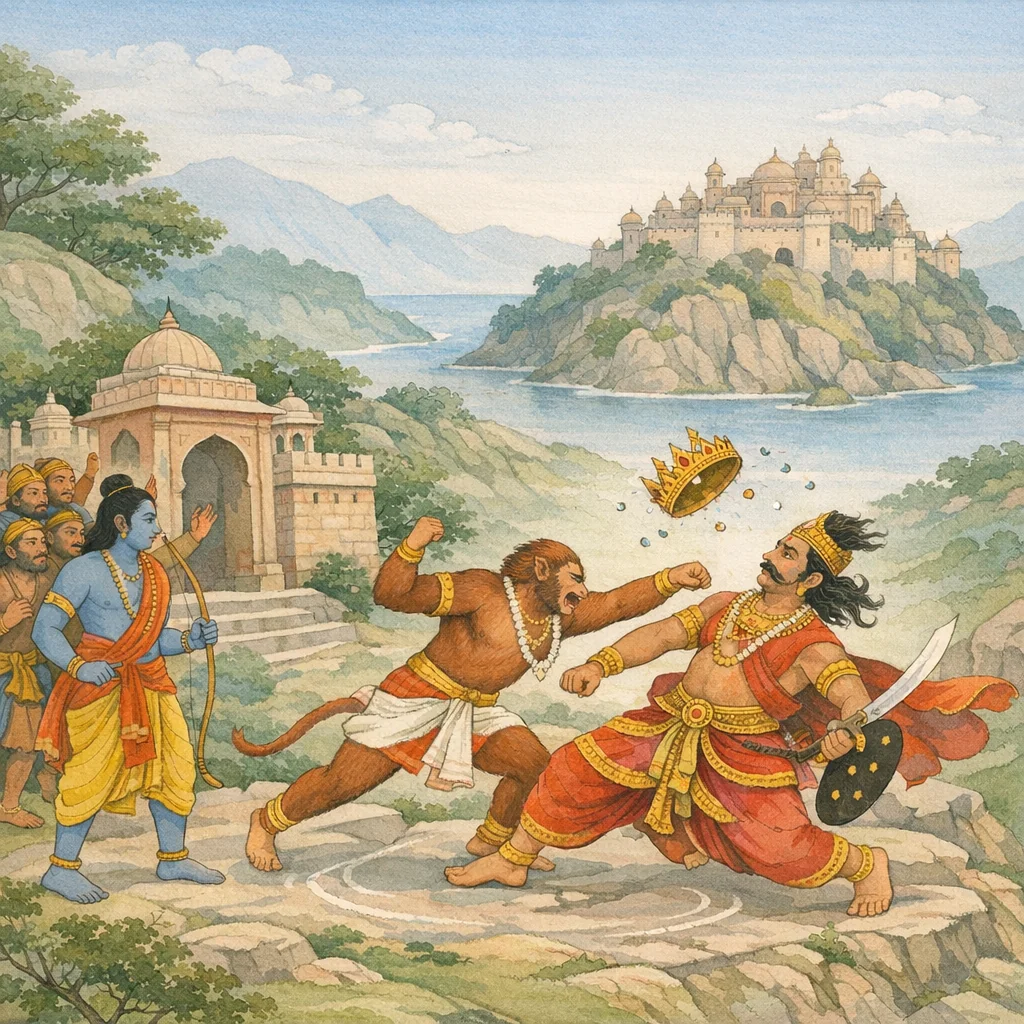
Sarga 40 situates the combat narrative within a strategic vantage point: Rāma, accompanied by Sugrīva and the vānaras, ascends the Suvelā peak and surveys Laṅkā on Trikūṭa, attributed to Viśvakarmā’s craftsmanship. Rāma beholds Rāvaṇa stationed upon a lofty gopura, described with royal insignia—white cāmaras, a victory parasol, red sandal paste, ornaments, and scar-marks linked to Airāvata—casting the rākṣasa king as both sovereign and formidable target. Provoked by the sight, Sugrīva rises in controlled anger, addresses Rāvaṇa with a declaration of loyal service to the “lord of the world” (Rāma), and initiates a direct assault, seizing and casting down Rāvaṇa’s diadem as a symbolic humiliation. A close-quarters wrestling match follows: throws, counters, grappling embraces, circular footwork, feints, and enumerated “war-paths” (yuddha-mārga) display technical combat literacy and vīra-rasa intensity. Rāvaṇa threatens lethal retaliation, and when he attempts to shift advantage through māyā (jugglery/illusion), Sugrīva anticipates the tactic, disengages after exhausting him, and returns through the vānaras to Rāma, amplifying Rāma’s battle-ardor and allied morale. The chapter thus binds geography (Suvelā/Laṅkā) to ethics (service and restraint) and to semiotics of kingship (the fallen crown) as a narrative map of power contested.
Shlokas
Verse 1
ततोरामस्सुवेलाग्रंयोजनद्वयमण्डलम् ।अरुरोहससुग्रीवोहरियूधपसम्वृतः ।।।।
Thereupon Rāma, surrounded by the leaders of the Vānara hosts and accompanied by Sugrīva, ascended the peak of Suvelā, whose expanse measured two yojanas.
Verse 2
स्थित्वामुहूर्तंतत्रैवदिशोदशविलोकयन् ।त्रिकूटशिखरेरम्येनिर्मितांविश्वकर्मणा ।।।।ददर्शलङ्कांसुन्यस्तांरम्यकाननशोभिताम् ।
After pausing there a moment and looking out in all ten directions, Rāma beheld Laṅkā—built by Viśvakarman upon the lovely summit of Trikūṭa—well-fortified and beautified by delightful groves.
Verse 3
तस्यांगोपुरशृङ्गस्थंराक्षसेन्द्रंदुरासदम् ।।।।श्वेतचामरपर्यन्तंविजयच्छत्रशोभितम् ।रक्तचन्दनसंलिप्तंरत्नाभरणभूषितम् ।।।।नीलजीमूतसङ्काशंहेमसञ्छादिताम्बरम् ।ऐरावतविषाणाग्रैरुत्कृष्टकिणवक्षसम् ।।।।शशलोहितरागेणसंवीतंरक्तवाससा ।सन्ध्यातपेनसंवीतंमेघराशिमिवाम्बरे ।।।।
Rāma beheld the lord of the rākṣasas standing upon the summit of the palace-gateway—hard to approach—attended by white fly-whisks and shaded by a triumphal parasol. Smeared with red sandal and adorned with jeweled ornaments, clad in a garment embroidered with gold, he looked like a dark mass of cloud. His chest bore raised scars, as if scored by the tips of Airāvata’s tusks; wrapped in crimson cloth, he shone like a cloud-bank in the sky lit by the ruddy glow of sunset.
Verse 4
तस्यांगोपुरशृङ्गस्थंराक्षसेन्द्रंदुरासदम् ।।6.40.3।।श्वेतचामरपर्यन्तंविजयच्छत्रशोभितम् ।रक्तचन्दनसंलिप्तंरत्नाभरणभूषितम् ।।6.40.4।।नीलजीमूतसङ्काशंहेमसञ्छादिताम्बरम् ।ऐरावतविषाणाग्रैरुत्कृष्टकिणवक्षसम् ।।6.40.5।।शशलोहितरागेणसंवीतंरक्तवाससा ।सन्ध्यातपेनसंवीतंमेघराशिमिवाम्बरे ।।6.40.6।।
Rāma beheld the lord of the rākṣasas standing upon the summit of the palace-gateway—hard to approach—attended by white fly-whisks and shaded by a triumphal parasol. Smeared with red sandal and adorned with jeweled ornaments, clad in a garment embroidered with gold, he looked like a dark mass of cloud. His chest bore raised scars, as if scored by the tips of Airāvata’s tusks; wrapped in crimson cloth, he shone like a cloud-bank in the sky lit by the ruddy glow of sunset.
Verse 5
तस्यांगोपुरशृङ्गस्थंराक्षसेन्द्रंदुरासदम् ।।6.40.3।।श्वेतचामरपर्यन्तंविजयच्छत्रशोभितम् ।रक्तचन्दनसंलिप्तंरत्नाभरणभूषितम् ।।6.40.4।।नीलजीमूतसङ्काशंहेमसञ्छादिताम्बरम् ।ऐरावतविषाणाग्रैरुत्कृष्टकिणवक्षसम् ।।6.40.5।।शशलोहितरागेणसंवीतंरक्तवाससा ।सन्ध्यातपेनसंवीतंमेघराशिमिवाम्बरे ।।6.40.6।।
Rāma beheld the lord of the rākṣasas standing upon the summit of the palace-gateway—hard to approach—attended by white fly-whisks and shaded by a triumphal parasol. Smeared with red sandal and adorned with jeweled ornaments, clad in a garment embroidered with gold, he looked like a dark mass of cloud. His chest bore raised scars, as if scored by the tips of Airāvata’s tusks; wrapped in crimson cloth, he shone like a cloud-bank in the sky lit by the ruddy glow of sunset.
Verse 6
तस्यांगोपुरशृङ्गस्थंराक्षसेन्द्रंदुरासदम् ।।6.40.3।।श्वेतचामरपर्यन्तंविजयच्छत्रशोभितम् ।रक्तचन्दनसंलिप्तंरत्नाभरणभूषितम् ।।6.40.4।।नीलजीमूतसङ्काशंहेमसञ्छादिताम्बरम् ।ऐरावतविषाणाग्रैरुत्कृष्टकिणवक्षसम् ।।6.40.5।।शशलोहितरागेणसंवीतंरक्तवाससा ।सन्ध्यातपेनसंवीतंमेघराशिमिवाम्बरे ।।6.40.6।।
Rāma beheld the lord of the rākṣasas standing upon the summit of the palace-gateway—hard to approach—attended by white fly-whisks and shaded by a triumphal parasol. Smeared with red sandal and adorned with jeweled ornaments, clad in a garment embroidered with gold, he looked like a dark mass of cloud. His chest bore raised scars, as if scored by the tips of Airāvata’s tusks; wrapped in crimson cloth, he shone like a cloud-bank in the sky lit by the ruddy glow of sunset.
Verse 7
पश्यतांवानरेन्द्राणांराघवस्यापिपश्यतः ।दर्शनाद्राक्षसेन्द्रस्यसुग्रीवस्सहसोत्थितः ।।।।
While the vānara chiefs looked on—and Rāghava himself watched—Sugrīva sprang up at the very sight of the rākṣasa king.
Verse 8
क्रोधवेगेनसंयुक्तस्सत्त्वेनचबलेनच ।अचलाग्रादथोत्थायपुप्लुवेगोपुरस्थले ।।।।
Driven by the surge of anger—yet also by courage and strength—he rose from the mountain-top and leapt onto the palace-gateway platform.
Verse 9
स्थित्वामुहूर्तंसम्प्रेक्ष्यनिर्भयेनान्तरात्मना ।तृणीकृत्यचतद्रक्षस्सोऽब्रवीत्परुषंवचः ।।।।
Pausing for a moment and looking him over with a fearless heart, he made light of that rākṣasa and spoke harsh words.
Verse 10
लोकनाथस्यरामस्यसखादासोऽस्मिराक्षस ।नमयामोक्ष्यसेऽद्यत्वंपार्थिवेन्द्रस्यतेजसा ।।।।
“O Rākṣasa! I am both friend and servant of Rāma, the lord of the world. By the might of that king among kings, you shall not escape from me today!” said Sugrīva.
Verse 11
इत्युक्त्वासहसोत्पत्यपुप्लुवेतस्यचोपरि ।आकृष्यमुकुटंचित्रंपातयित्वाऽपतद्भुवि ।।।।
Having spoken thus, Sugrīva sprang up at once, leapt upon him, seized that splendid diadem, and dashed it down so that it fell to the ground.
Verse 12
समीक्ष्यतूर्णमायान्तमबभाषेनिशाचरः ।सुग्रीवस्त्वपरोक्षम् मेहीनग्रीवोभविष्यसि ।।।।
Seeing Sugrīva rushing toward him, the night-ranger (Rāvaṇa) spoke: “Sugrīva, now that you are before my very eyes, you shall become neckless.”
Verse 13
इत्युक्त्वोत्थायतंक्षिप्रंबाहुभ्यामाक्षिपत्तले ।कन्तुवत्तंसमुत्थायबाहुभ्यामाक्षिपद्धरि ।।।।
So saying, he rose and swiftly hurled him down with his arms. But the Vānara sprang up again like a ball and, with both arms, flung him back down in return.
Verse 14
परस्परंस्वेदविदग्धगात्रौपरस्परंशोणितदिग्धदेहौ ।परस्परंलशिष्टनिरुद्धचेष्टौपरस्परंशाल्मलिकिंशुकौयधा ।।।।मुष्टिप्रहारैश्चतलप्रहारैररत्निघातैश्चकराग्रघातैः ।तौचक्रतुर्युद्धमसह्यरूपंमहाबलौराक्षसवानरेन्द्रौ ।।।।
Locked against one another—limbs scorched with sweat, bodies smeared with blood—those two mighty kings, the Rākṣasa and the Vānara, stood entwined and momentarily checked in movement, like red śālmali and kiṃśuka trees. Then they waged a dreadful struggle with fists, open palms, forearm blows, and slashing strikes of the fingertips.
Verse 15
परस्परंस्वेदविदग्धगात्रौपरस्परंशोणितदिग्धदेहौ ।परस्परंलशिष्टनिरुद्धचेष्टौपरस्परंशाल्मलिकिंशुकौयधा ।।6.40.14।।मुष्टिप्रहारैश्चतलप्रहारैररत्निघातैश्चकराग्रघातैः ।तौचक्रतुर्युद्धमसह्यरूपंमहाबलौराक्षसवानरेन्द्रौ ।।6.40.15।।
After engaging in fierce wrestling for a long time in the middle of the gate-tower terrace, the two, with violent momentum, repeatedly heaved and hurled each other, bending their bodies and shifting their footing as they kept their stand upon the tower-platform.
Verse 16
कृत्वानियुद्धंभृशमुग्रवेगौकालंचिर, गोपुरवेदिमध्ये ।उत्क्षिप्यचोत्क्षिप्यविनम्यदेहौपादक्रमाद्गोपुरवेदिलग्नौ ।।।।
After engaging in fierce wrestling for a long time in the middle of the gate-tower terrace, the two, with violent momentum, repeatedly heaved and hurled each other, bending their bodies and shifting their footing as they kept their stand upon the tower-platform.
Verse 17
अन्योन्यमाविध्यवेदिलग्नौतौपेततुस्सालनिखातमध्ये ।उत्पेततुर्भूतलमस्पृशन्तौस्थित्वामुहूर्तंत्वभिनिश्श्वसन्तौ ।।।।
Striking and wrenching one another while still clinging to the tower-terrace, the two fell into the space between the palisade and the moat. For a moment they stood there, panting heavily, their bodies still pressed close, and then sprang up again without touching the ground.
Verse 18
आलिङ् ग्यचालिङ् ग्यचबाहुयोक्स्रैस्संयोजयामासतुराहवेतौ ।सम्रम्भशिक्षाबलसम्प्रयुक्तौसंचेरतुस्सम्प्रतियुद्धमार्गैः ।।।।
Embracing and re-embracing, pressing chest to chest with the force of their arms, the two joined battle again and again. Driven by fury, training, and strength, they moved through the various methods of close combat.
Verse 19
शार्दूरसिंहाविवजातदर्पौगजेन्द्रपोताविवसम्प्रयुक्तौ ।संहत्यचापीड्यचतावुरोभ्यांनिपेततुर्वैयुगपद्धरण्याम् ।।।।
Like a tiger and a lion roused by pride, like two young lordly elephants locked together, the pair closed in and crushed chest-to-chest, and both fell to the earth at the same instant.
Verse 20
उद्यम्यचान्योन्यमधिक्षिपन्तौसञ्चक्रमातेबहुयुद्धमार्गे: ।व्यायामशिक्षाबलसम्प्रयुक्तौक्लमंनतौजग्मतुराशुवीरौ ।।।।
Gripping each other and taunting one another, the two heroes moved through many modes of combat. Trained and strengthened by rigorous practice, they quickly felt no fatigue.
Verse 21
बाहूत्तमैर्वारणवारणाभैर्निवारयन्तौवरवारणाभौ ।चिरेणकालेनतुसम्प्रयुक्तौसञ्चेरतुर्मण्डलमार्गमाशु ।।।।
With superb arms, the two—like rival elephants—kept checking and holding each other back. Locked in combat for a long time, they swiftly circled in a ring-like course.
Verse 22
तौपरस्परमासाद्ययत्तावन्योन्यसूदने ।मार्जाराविवभक्ष्यार्थेऽवितस्थातेमुहुर्मुहुः ।।।।
Closing in upon each other, eager to destroy the other, the two kept darting back and forth again and again—like cats circling over prey for food.
Verse 23
मण्डलानिविचित्राणिस्थानानिविविधानिच ।मूत्रकाणिचित्राणिगतप्रत्यागतानिच ।।।।तिरच्शीनगतान्येवतथावक्रगतानिच ।परिमोक्षंप्रहाराणांवर्जनंपरिधावनम् ।।।।अभिद्रवणमाप्लावमावस्थानंसविग्रहम् ।परावृत्तमपावृत्तमपद्रुतमवप्लुतम् ।।।।उपन्यस्तपमन्यस्तंयुद्धमार्गविशारदौ ।तौसञ्चेचेरतुरन्योन्यंवानरेन्द्रश्चरावणः ।।।।
Skilled in the ways of combat, Rāvaṇa and the lord of Vānaras displayed wondrous circles and varied stances—winding patterns, advances and retreats, sideways and crooked movements; the releasing and the avoiding of blows; rushing about and striking; charging and leaping; standing firm in stillness; turning away and turning back; withdrawing and springing aside; setting and unsetting their holds—thus the two ranged against each other, exhibiting their mastery of battle.
Verse 24
मण्डलानिविचित्राणिस्थानानिविविधानिच ।मूत्रकाणिचित्राणिगतप्रत्यागतानिच ।।6.40.23।।तिरच्शीनगतान्येवतथावक्रगतानिच ।परिमोक्षंप्रहाराणांवर्जनंपरिधावनम् ।।6.40.24।।अभिद्रवणमाप्लावमावस्थानंसविग्रहम् ।परावृत्तमपावृत्तमपद्रुतमवप्लुतम् ।।6.40.25।।उपन्यस्तपमन्यस्तंयुद्धमार्गविशारदौ ।तौसञ्चेचेरतुरन्योन्यंवानरेन्द्रश्चरावणः ।।6.40.26।।
In that interval, the rākṣasa sought to set in motion the power of his own māyā. Perceiving this, the lord of Vānaras—wearing the air of victory and free from weariness—leapt up into the sky. Rāvaṇa remained there, as though outwitted by the monkey-king.
Verse 25
मण्डलानिविचित्राणिस्थानानिविविधानिच ।मूत्रकाणिचित्राणिगतप्रत्यागतानिच ।।6.40.23।।तिरच्शीनगतान्येवतथावक्रगतानिच ।परिमोक्षंप्रहाराणांवर्जनंपरिधावनम् ।।6.40.24।।अभिद्रवणमाप्लावमावस्थानंसविग्रहम् ।परावृत्तमपावृत्तमपद्रुतमवप्लुतम् ।।6.40.25।।उपन्यस्तपमन्यस्तंयुद्धमार्गविशारदौ ।तौसञ्चेचेरतुरन्योन्यंवानरेन्द्रश्चरावणः ।।6.40.26।।
They displayed the maneuvers of battle—charging and leaping, standing firm with controlled poise; wheeling about and circling away, retreating and springing aside—each seeking advantage over the other in that righteous contest of arms.
Verse 26
मण्डलानिविचित्राणिस्थानानिविविधानिच ।मूत्रकाणिचित्राणिगतप्रत्यागतानिच ।।6.40.23।।तिरच्शीनगतान्येवतथावक्रगतानिच ।परिमोक्षंप्रहाराणांवर्जनंपरिधावनम् ।।6.40.24।।अभिद्रवणमाप्लावमावस्थानंसविग्रहम् ।परावृत्तमपावृत्तमपद्रुतमवप्लुतम् ।।6.40.25।।उपन्यस्तपमन्यस्तंयुद्धमार्गविशारदौ ।तौसञ्चेचेरतुरन्योन्यंवानरेन्द्रश्चरावणः ।।6.40.26।।
Skilled in the ways of battle, Rāvaṇa and the lord of the Vānaras circled in wondrous patterns—forming rings like the “cow’s-urine” spiral—taking many striking stances. They advanced and withdrew, moved sideways and at angles, feinted and curved away; they launched and avoided blows, chased and checked each other; they rushed, leapt, held firm without yielding, turned away and turned back, retreated and sprang aside—now setting their hands to strike, now drawing them back—each displaying mastery of combat against the other.
Verse 27
एतस्मिन्नन्तरेरक्षोमायाबलमथात्मनः ।आरब्धुमुपसंपेदेज्ञात्वातंवानराधिपः ।।।।उत्पपाततदाकाशंजितकाशीजितक्लमः ।रावणःस्थितएवात्रहरिराजेववञ्चितः ।।।।
In that interval, the rākṣasa sought to set in motion the power of his own māyā. Perceiving this, the lord of Vānaras—wearing the air of victory and free from weariness—leapt up into the sky. Rāvaṇa remained there, as though outwitted by the monkey-king.
Verse 28
एतस्मिन्नन्तरेरक्षोमायाबलमथात्मनः ।आरब्धुमुपसंपेदेज्ञात्वातंवानराधिपः ।।6.40.27।।उत्पपाततदाकाशंजितकाशीजितक्लमः ।रावणःस्थितएवात्रहरिराजेववञ्चितः ।।6.40.28।।
Meanwhile, that rākṣasa (Rāvaṇa) resolved to display the power of his own illusion. But the lord of the Vānaras, understanding his intent, leapt up into the sky—wearing the look of victory and unwearied. Rāvaṇa, however, remained there on the spot, as though outwitted by the monkey-king.
Verse 29
अथहरिवरनाथःप्राप्यसङ्ग्रामकीर्तिंनिशिचरपतिमाजौयोजयित्वाश्रमेण ।गगनमतिविशालंलङ्घयित्वार्कसूनुर्हरिगणमध्येरामपार्श्वंजगाम ।।।।
Then Sugrīva—the lord among the vānara chiefs, the Sun’s son—having won renown in battle by wearing down the lord of the night-rangers in combat, crossed the vast sky and went to Rāma, who stood amid the vānara hosts.
Verse 30
इतिससवितृसूनुस्तत्रतत्कर्मकृत्वापवनगतिरनीकंप्राविशत्ससम्प्रहृष्टः ।रघुवरनृपसूनोद्वर्धयन्युद्धहर्षंतरुमृगगणमुख्यैःपूज्यमानोहरीन्द्रः ।।।।
Thus Sugrīva, the Sun’s son—swift as the wind—having accomplished that deed, entered the vānara host in high delight, increasing the battle-joy of Rāma, the princely scion of the Raghu line, while being honored by the foremost leaders among the tree-dwelling troops.
Frequently Asked Questions
Sugrīva’s action tests allied dharma: he must balance personal fury against disciplined service. He initiates combat to challenge Rāvaṇa’s arrogance and signal allegiance to Rāma, yet disengages after exhausting the enemy rather than pursuing uncontrolled escalation, aligning valor with strategic restraint.
The dialogue frames legitimate power as moral and relational: Sugrīva defines his identity through seva to a dharmic ruler (“lokanātha” Rāma), while the fallen diadem dramatizes that sovereignty without righteousness can be publicly unseated, even before final defeat.
Key landmarks include Suvelā (the observation peak), Laṅkā on Trikūṭa (city-topography and fortification), and the gopura (towered battlement). Cultural markers of kingship—cāmara, victory parasol, crown, sandal paste, and ornamentation—function as visual metadata for royal presence and contested legitimacy.