Sarga 36
माल्यवानुपदेशः—रावणक्रोधः तथा लङ्काद्वाररक्षा-व्यवस्था (Malyavan’s Counsel, Ravana’s Anger, and the Fortification of Lanka)
युद्धकाण्ड
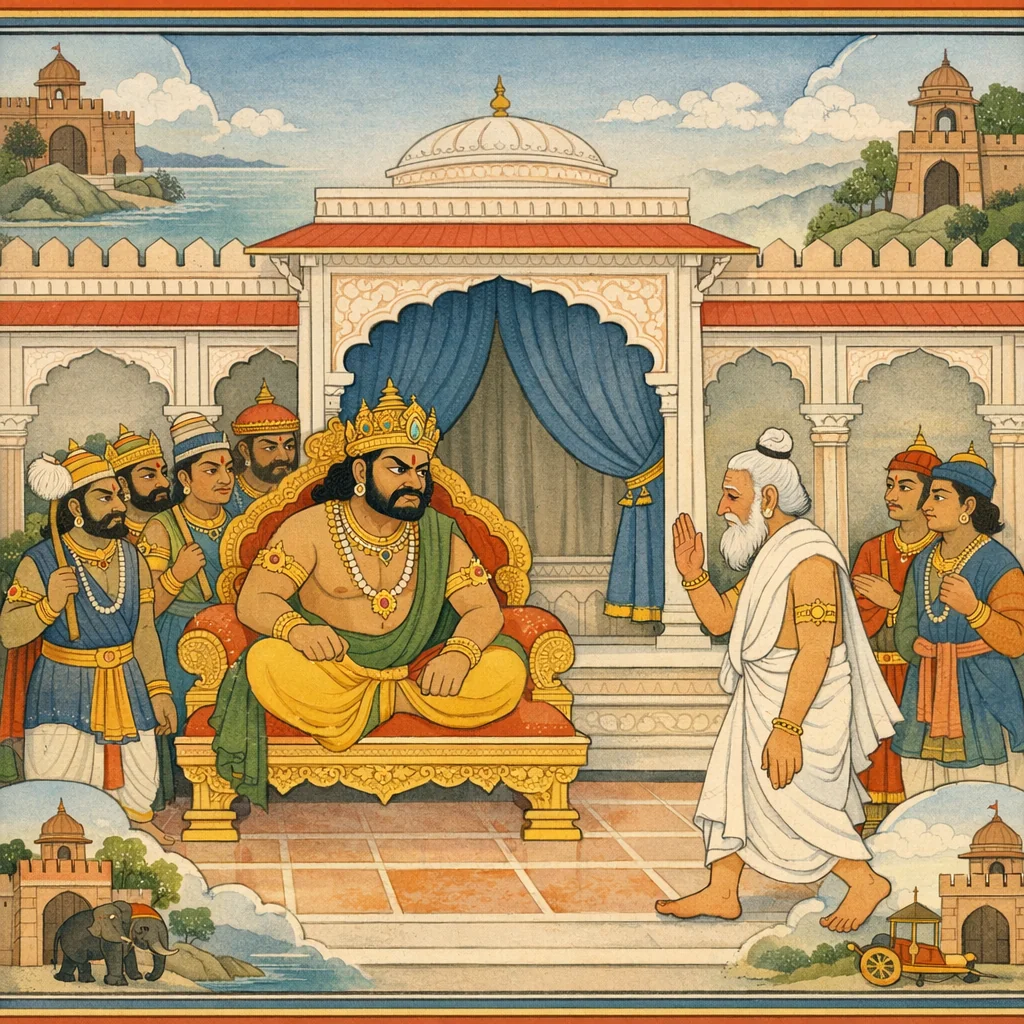
Sarga 36 stages a compact political-ethical drama. Ravana, described as having come under the sway of death (kāla), refuses to tolerate Mālyavān’s salutary advice (6.36.1). He responds with visible signs of anger—knitted brows and rolling eyes—and accuses the counselor of speaking harshly from enemy-partisanship or instigation (6.36.2–6.36.7). Ravana then asserts his inviolable pride: he would rather break than bow, presenting stubbornness as an inborn trait difficult to overcome (6.36.11). He dismisses the bridge-building as mere chance and claims Rama will not return alive after crossing with the vānaras (6.36.12–6.36.13). Recognizing Ravana’s rage, Mālyavān withdraws without reply, offering conventional blessings and departing (6.36.14–6.36.15). The chapter then pivots from rhetoric to logistics: Ravana consults ministers and institutes “unequalled” security for Laṅkā—posting Prahasta at the eastern gate, Mahāpārśva and Mahodara at the southern gate, Indrajit (and Mahāmāya) at the western gate, and Śuka-Sāraṇa at the northern gate; Virūpākṣa is stationed in the city’s center as a strong reserve (6.36.16–6.36.21). Having ordered these defenses, Ravana, driven by destiny, feels his task complete and enters the inner palace after dismissing ministers who bless him (6.36.22).
Shlokas
Verse 1
तत्तुमाल्यवतोवाक्यंहितमुक्तंदशाननः ।नमर्षयतिदुष्टात्माकालस्यवशमागतः ।।।।
But the ten-headed one, evil-minded and now under the sway of Death, could not endure the wholesome words spoken by Mālyavān.
Verse 2
नबद् ध्वाभ्रुकुटींवक्त्रेक्रोधस्यवशमागतः ।अमर्षात्परिवृत्ताक्षोमाल्यवन्तमथाब्रवीत् ।।।।
Overcome by anger, knitting his brows and rolling his eyes in impatience, Rāvaṇa then spoke to Mālyavān.
Verse 3
हितबुध्यायदहितंवचःपरुषमुच्यते ।परपक्षंप्रनिश्यैवनैतच्च्रोत्रगतंमम ।।।।
“With a pretence of good sense, you have spoken harsh words that do not serve my good, as though you had taken the enemy’s side. I will not let such talk enter my ears.”
Verse 4
मानुषंकृपणंराममेकंशाखामृगाश्रयम् ।समर्थंमन्यसेकेनत्यक्तंपित्रावनालयम् ।।।।
“On what grounds do you deem Rāma—only a wretched human, standing alone, dependent on the forest-dwelling monkeys—capable, when he was cast out by his father and made the forest his abode?”
Verse 5
रक्षसामीश्वरंमांचदेवानांचभयङ्करम् ।हीनंमांमन्यसेकेनह्यहीनंसर्वविक्रमैः ।।।।
“I am the lord of the rākṣasas and a terror even to the devas. Endowed with every kind of prowess, why do you think me lacking?”
Verse 6
वीरद्वेषेणवाशङ्केपक्षपातेनवारिपोः ।त्वयाहंपरुषाण्युक्तःपरप्रोत्साहनेनवा ।।।।
“I suspect you speak to me harshly either from hatred toward a hero, or from partisanship for the enemy, or because you have been urged on by others.”
Verse 7
प्रभवन्तंपदस्थंहिपरुषंकोऽभिभाषते ।पण्डितश्शास्त्रतत्त्वज्ञोविनाप्रोत्साहनाद्रिपोः ।।।।
“Who, being learned and knowing the truth of the śāstras, would address harshly one who is powerful and established—unless stirred up by the enemy?”
Verse 8
आनीयचवनासतीतांपद्महीनामिवश्रियम् ।किमर्थंप्रतिदास्यामिराघवस्यभयादहम् ।।।।
“Having brought Sītā from the forest—like Śrī bereft of her lotus—why should I give her back out of fear of Rāghava?”
Verse 9
वृतंवानरकोटीभिस्ससुग्रीवंसलक्ष्मणम् ।पश्यकैश्चिदहोभिस्त्वंराघवंनिहतंमया ।।।।
“You will see—within only a few days—Rāghava slain by me, along with Lakṣmaṇa and Sugrīva, even though surrounded by crores of vānaras.”
Verse 10
द्वन्द्वेयस्यनतिष्ठन्तिदैवतान्यपिसंयुगे ।सकस्माद्रावणोयुद्धेभयमाहारयिष्यति ।।।।
Even the gods cannot stand firm against him in single combat on the battlefield—so from whom would Rāvaṇa ever take fear in war?
Verse 11
द्विधाभज्येयमप्येवंननमेयंतुकस्यचित् ।एषमेसहजोदोषस्स्वभावोदुरतिक्रमः ।।।।
Even if I were to be split in two, I would not bow to anyone. This is my inborn flaw—my nature, hard to overcome.
Verse 12
यदितावत्समुद्रेतुसेतुर्बद्धोयदृच्छया ।रामेणविस्मयःकोऽत्रयेवमेभयमागतम् ।।।।
If, by mere chance, Rāma has built a bridge upon the ocean—what is so astonishing in that, that fear has seized you (because of it)?
Verse 13
सतुतीर्त्वार्णवंरामस्सहवानरसेनया ।प्रतिजानामितेसत्यंनजीवन्प्रतियास्यति ।।।।
But once Rāma has crossed the ocean together with the Vānara host, I tell you truly—he will not turn back alive.
Verse 14
एवंब्रुवाणंसंरब्धंरुष्टंविज्ञायरावणम् ।व्रीळितोमाल्यवान्वाक्यंनोत्तरंप्रत्यपद्यत ।।।।
Seeing Rāvaṇa speaking so, agitated and enraged, Mālyavān—ashamed—did not offer any reply.
Verse 15
जयाशिषाचराजानंवर्धयित्वायथोचितम् ।माल्यवानभ्यनुज्ञातोजगामस्वंनिवेशनम् ।।।।
Having, as custom requires, offered the king blessings for victory, Mālyavān—dismissed with leave—returned to his own dwelling.
Verse 16
रावणस्तुसहामात्योमन्त्रयित्वाविमृश्यच ।लङ्कायामतुलांगुप्तिंकारयामासराक्षसः ।।।।
Then Rāvaṇa, together with his ministers, having consulted and deliberated, ordered unparalleled defensive measures to be made in Laṅkā.
Verse 17
व्यादिदेशसपूर्वस्यांप्रहस्तंद्वारिराक्षसम् ।दक्षिणस्यांमहावीर्यौमहापार्श्वमहादरौ ।।।।पश्चिमायामथोद्वारिपुत्रमिन्द्रजितंतदा ।व्यादिदेशमयामायंबहूभीराक्षसैर्भहुभिर्वृतम् ।।।।
He stationed the rākṣasa Prahasta at the eastern gate; and at the southern gate he posted the mighty Mahāpārśva and Mahodara.
Verse 18
व्यादिदेशसपूर्वस्यांप्रहस्तंद्वारिराक्षसम् ।दक्षिणस्यांमहावीर्यौमहापार्श्वमहादरौ ।।6.36.17।।पश्चिमायामथोद्वारिपुत्रमिन्द्रजितंतदा ।व्यादिदेशमयामायंबहूभीराक्षसैर्भहुभिर्वृतम् ।।6.36.18।।
Then, at the western gate, he stationed his son Indrajit—Mahamāya—surrounded by many rākṣasas.
Verse 19
उतरस्यांपुरद्वारिव्यादिश्यशुकसारणौ ।स्वयंचात्रगमिष्यामिमन्त्रिणस्तानुवाचह ।।।।
Posting Śuka and Sāraṇa at the northern city-gate, he told his ministers: “I myself will go there as well.”
Verse 20
राक्षसांतुविरूपाक्षंमहावीर्यपराक्रमम् ।मध्यमेऽस्थापयद्गुल्मेबहुभिस्सहराक्षसैः ।।।।
In the city’s central sector, he stationed Virūpākṣa—mighty in strength and valor—together with many rākṣasas.
Verse 21
एवंविधानंलङ्कायांकृत्वाराक्षसपुङ्गवः ।कृतकृत्यमिवात्मानंमन्यतेकालचोदितः ।।।।
Having thus set matters in order in Laṅkā, the foremost of rākṣasas—driven by the pressure of fate—thought of himself as though his task were accomplished.
Verse 22
विसर्जयामासततस्समन्त्रिणोविधानमाज्ञाप्यपुरस्यपुष्कलम् ।जयाशिषामन्त्रिगणेनपूजितोविवेशचाऽन्तःपुरमृद्धिमन्महत् ।।।।
Then, after issuing ample orders for the city’s arrangements, he dismissed the ministers; honored by the council with blessings for victory and welfare, he entered the great, prosperous inner palace chambers.
Frequently Asked Questions
The dilemma is governance under warning: whether a ruler accepts corrective counsel that may avert disaster. Ravana chooses anger and suspicion over deliberation, treating prudent advice as betrayal, and thereby models how power can misread truth as hostility.
Speech and pride are framed as fate-amplifiers: when ego becomes “naturalized” as unchangeable character, it blocks self-correction. The sarga implies that kāla (destiny) operates through inner dispositions—especially refusal to bend—turning strategic situations into moral inevitabilities.
Key landmarks are Laṅkā’s city gates (east, south, west, north) as a tactical map of defense, the ocean-crossing context, and the bridge (setu) whose construction becomes a contested symbol—dismissed by Ravana yet central to Rama’s arrival and the war’s logistics.