Sarga 35
माल्यवानुपदेशः — Malyavan’s Counsel, Portents in Laṅkā, and the Proposal of Alliance
युद्धकाण्ड
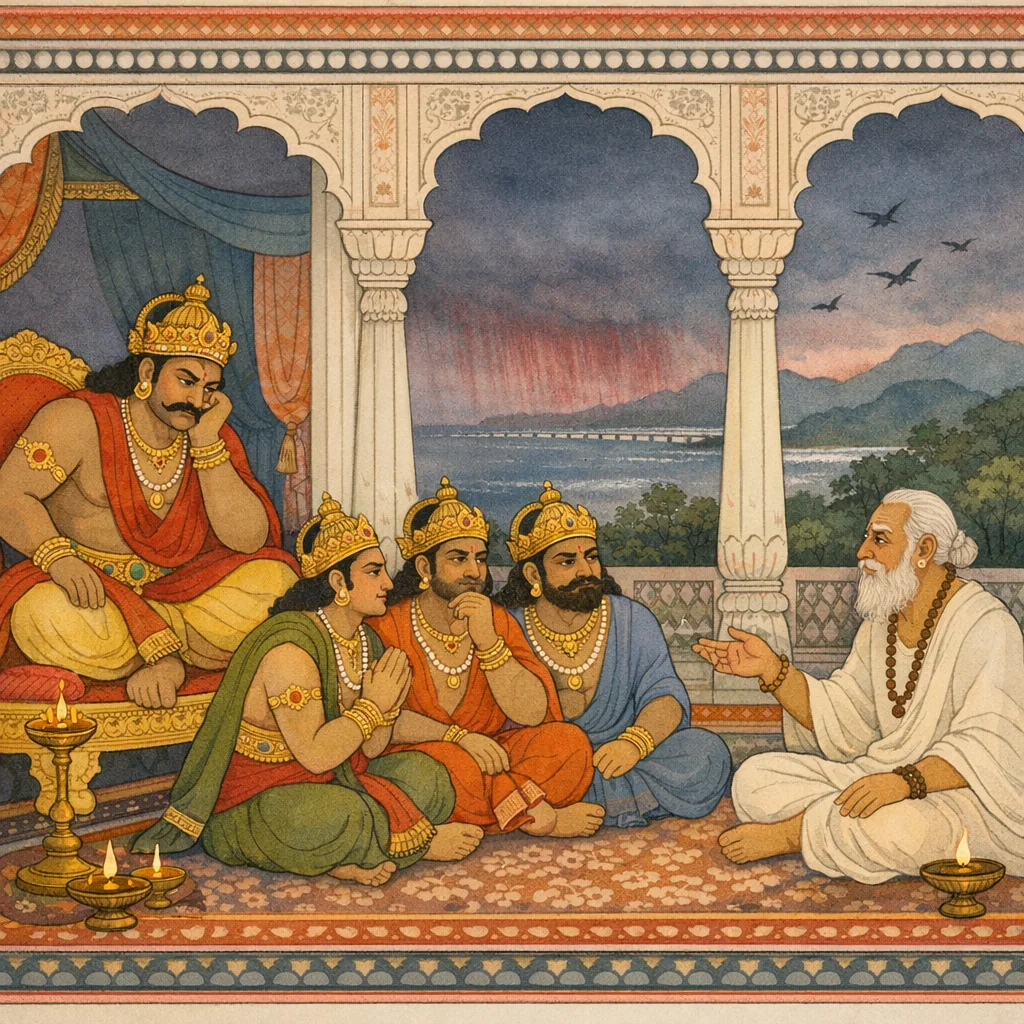
Sarga 35 opens with Rāma’s martial advance, marked by conches and drums, and shifts immediately to Laṅkā’s court where Rāvaṇa, hearing the ominous din, consults his ministers. Rāvaṇa rebukes them for their silence despite their reputed valor, and a catalogue of adverse nimittas (portents) is introduced—unnatural minglings, disordered domestic rites, frightening dreams, hostile cries of birds and beasts, and blood-rain—signaling systemic collapse. Against this atmosphere, the elder counsellor Mālyavān (Rāvaṇa’s maternal grandsire) delivers a structured nīti discourse: a ruler grounded in learning and justice maintains sovereignty; when strength wanes, prudent kings seek sandhi (alliance) rather than contemptuous vigraha (hostility). Mālyavān urges the restoration of Sītā—the casus belli—and argues that cosmic forces favor Rāma, identifying him as Viṣṇu in human form, evidenced by the extraordinary ocean-bridge. The chapter concludes with Mālyavān observing Rāvaṇa’s unwillingness and falling silent, underscoring the tragic motif of rejected counsel.
Shlokas
Verse 1
तेनशङ्खविमिश्रेणभेरीशब्देनराघवः ।उपयातिमहाबाहूरामःपरपुरञ्जयः ।।।।
Amid the mingled sound of conch-blasts and the rolling beat of kettledrums, Rāma—mighty-armed Rāghava, conqueror of enemy strongholds—marched forth.
Verse 2
तंनिनादंनिशम्याथरावणोराक्षसेश्वरः ।मुहूर्तंध्यानमास्थायसचिवानभ्युदैक्षत ।।।।
Hearing that uproar, Rāvaṇa—the lord of the Rākṣasas—paused for a moment in reflection, and then looked toward his ministers.
Verse 3
अथतान्सचिवांस्तत्रसर्वानाभाष्यरावणः ।सभांसन्नादयन् सर्वामित्युवाचमहाबलः ।।।।जगत्सन्तापन्क्रूरोगर्हयन्राक्षसेश्वरः ।
Then Rāvaṇa—lord of the Rākṣasas, cruel and a torment to the world—addressed all the ministers there; making the whole assembly resound, the mighty one spoke, reproaching them.
Verse 4
तरणंसागरस्यापिविक्रमंबलसञ्जियम् ।।।।यदुक्तवन्तोरामस्यभवन्तस्तन्मयाश्रुतम् ।
I have heard what you have said—about the sea being crossed and about the valor and strength-gathering prowess displayed in Rāma’s cause.
Verse 5
भवतश्चाप्यहंवेमदियुद्धेसत्यपराक्रमान् ।।।।तूषिकानीक्षतोऽन्योन्यंविदित्वारामविक्रमम् ।
I know you too to be truly valorous in war; yet, having understood Rāma’s prowess, you stand silent, looking at one another.
Verse 6
ततस्तुसुमहाप्राज्ञोमाल्यवान्नामराक्षसः ।।।।रावणस्यवचश्श्रुत्वामातुःपैतामहोऽब्रवीत् ।
Then the exceedingly wise rākṣasa named Mālyavān—Rāvaṇa’s maternal grandsire—having heard Rāvaṇa’s words, spoke in reply.
Verse 7
विद्यास्वभिविनीतोयोराजाराजन्नयानुगः ।।।।सशास्तिचिरमैश्वर्यमरींश्चकुरुतेवशे ।
O King, the ruler who is well-trained in the sciences and follows sound policy governs long in sovereignty and brings even enemies under control.
Verse 8
सन्दधानोहिकालेनविगृह्णंश्चारिभिस्सह ।।।।स्वपक्षवर्थनंकुर्वन्महदैश्वर्यमश्नुते ।
For, by making alliances at the proper time and by opposing foes when necessary, and by strengthening one’s own side, a ruler attains great sovereignty.
Verse 9
हीयमानेनकर्तव्योराज्ञासन्धिस्समेवच ।।।।नशत्रुमवमन्येतज्यायान्कुर्वीतविग्रहम् ।
When a king’s power is declining, he should make peace with an equal; he should not despise an enemy—and if the opponent is stronger, he should refrain from hostility.
Verse 10
तन्मह्यंरोचतेसन्धिस्सहरामेणरावण ।।।।यदर्थमभियुक्ता: स्मसीतातस्मैप्रदीयताम् ।
“O Rāvaṇa, reconciliation with Rāma is acceptable to us. Let Sītā—on whose account we have been attacked—be restored to him.”
Verse 11
यस्यदेवर्षयस्सर्वेगन्धर्वाश्चजयैषिणः ।।।।विरोथंमागमस्तेनसन्धिस्तेतेनरोचताम् ।
“All the celestial seers and the Gandharvas desire his victory. Therefore do not enter into hostility with him; let alliance with him be pleasing to you.”
Verse 12
असृजद्भगवान्पक्षौद्वावेनहिपितामहः ।।।।सुराणामसुराणांचधर्माधर्मौतदाश्रयौ ।
“For the blessed Pitāmaha (Brahmā) indeed created two opposing sides—gods and asuras—who took their stand upon dharma and adharma respectively.”
Verse 13
धर्मोहिश्रूयतेपक्षीह्यमराणांमहात्मनाम् ।।।।अधर्मोरक्षसांपक्षोह्यसुराणांचराक्षस ।
“Dharma, it is said, is the side of the noble immortals; adharma is the side of the rākṣasas and asuras, O Rākṣasa.”
Verse 14
धर्मोवैग्रसतेऽधर्मंततःकृतमभूद्युगम् ।।।।अधर्मोग्रसतेधर्मंततस्तिष्यःप्रवर्तते ।
“When dharma consumes adharma, that age is called the Kṛta Yuga; when adharma overwhelms dharma, then the Tiṣya (Kali) age comes into force.”
Verse 15
तत्त्वयाचरयालोकान्धर्मोपिविनिहतोमहान् ।।।।अधर्मःप्रगृहीतश्चतेनास्मद्बलिनःपरे ।
“While you ranged through the worlds, you cast aside even great dharma and embraced adharma; therefore the foes—standing with righteousness—have become stronger than we.”
Verse 16
सप्रमादावदिवृद्धस्तेऽधर्मोहिग्रसतेहिनः ।।।।विवर्थयतिपक्षंचसुराणांसुरभावनः ।
“That adharma, nourished by your negligence, will indeed devour us; and it strengthens the side of the gods, becoming a cause of their increase in power.”
Verse 17
विषयेषुप्रसक्तेनयत्किञ्चित्कारणात्वया ।।।।ऋषीणामग्नकल्पानामुद्वेगोजनितोमहान् ।
“Because you are engrossed in sense-pleasures, you have, on some account or other, stirred great distress among the seers—those who are like fire in their ascetic power.”
Verse 18
तेषांप्रभावोदुर्धर्षःप्रदीप्तइवपावकः ।।।।तपसाभावितात्मानोधर्मस्यानुग्रहेरताः ।मुख्यर्यज्ञैर्यजन्त्येतेनित्यंतैस्सैर्द्विजातयः ।।।।जुह्वत्यनगींश्चविधिवद्वेदांश्चोच्चैरधीयते ।अभिभूयचरक्षांसिब्रह्मघोषानुदैरयन् ।।।।दिशोऽपिविद्रुतास्सर्वेस्तनयित्नुरिवोष्णगे ।
“Their spiritual power is hard to withstand—blazing like fire. Purified by austerity and devoted to the support of dharma, those twice-born continually perform principal sacrifices, offering oblations duly, and loudly reciting the Vedas. Having subdued the rākṣasas, they raise the sound of sacred formulae; and the rākṣasas flee in every direction, like clouds scattered in the heat of summer.”
Verse 19
तेषांप्रभावोदुर्धर्षःप्रदीप्तइवपावकः ।।6.35.18।।तपसाभावितात्मानोधर्मस्यानुग्रहेरताः ।मुख्यर्यज्ञैर्यजन्त्येतेनित्यंतैस्सैर्द्विजातयः ।।6.35.19।।जुह्वत्यनगींश्चविधिवद्वेदांश्चोच्चैरधीयते ।अभिभूयचरक्षांसिब्रह्मघोषानुदैरयन् ।।6.35.20।।दिशोऽपिविद्रुतास्सर्वेस्तनयित्नुरिवोष्णगे ।
Purified by austerity and devoted to the fostering of dharma, these twice-born sages continually perform the foremost sacrifices, steadfast in those sacred rites.
Verse 20
तेषांप्रभावोदुर्धर्षःप्रदीप्तइवपावकः ।।6.35.18।।तपसाभावितात्मानोधर्मस्यानुग्रहेरताः ।मुख्यर्यज्ञैर्यजन्त्येतेनित्यंतैस्सैर्द्विजातयः ।।6.35.19।।जुह्वत्यनगींश्चविधिवद्वेदांश्चोच्चैरधीयते ।अभिभूयचरक्षांसिब्रह्मघोषानुदैरयन् ।।6.35.20।।दिशोऽपिविद्रुतास्सर्वेस्तनयित्नुरिवोष्णगे ।
They duly offer oblations into the fires and loudly recite the Vedas; and, having overpowered the Rakshasas, they raise the resonant sounds of sacred formulae—so that the Rakshasas flee in every direction, like clouds scattering in the heat of summer.
Verse 21
ऋषीणामग्निकल्पानामग्निहोत्रासमुत्थितः ।।।।अदत्तेरक्षसांतेजोधूमोव्याप्यदिशोदश ।
The smoke rising from the agnihotra of the seers—who are like fire itself—spreads through the ten directions and steals away the radiance of the Rakshasas.
Verse 22
तेषुतेषुचदेशेषुपुण्येष्वेवदृढव्रतैः ।।।।चर्यमाणंतपस्तीव्रंसन्तापयतिराक्षसान् ।
In those many regions—especially in sacred places—the intense austerity practiced by the firm-vowed ascetics scorches and torments the Rakshasas.
Verse 23
देवदानवयक्षेभ्योगृहीतश्चवरस्त्वया ।।।।मनुषावानराऋक्षागोलाङ्गूलामहाबलाः ।बलवन्तइहागम्यगर्जन्तीदृढविक्रमाः ।।।।
You obtained a boon of safety from gods, Dānavas, and Yakṣas; yet here now come powerful humans, Vānaras, bears, and dark-faced monkeys—mighty and strong—roaring with unwavering valor.
Verse 24
देवदानवयक्षेभ्योगृहीतश्चवरस्त्वया ।।6.35.23।।मनुषावानराऋक्षागोलाङ्गूलामहाबलाः ।बलवन्तइहागम्यगर्जन्तीदृढविक्रमाः ।।6.35.24।।
You obtained a boon of safety from gods, Dānavas, and Yakṣas; yet here now come powerful humans, Vānaras, bears, and dark-faced monkeys—mighty and strong—roaring with unwavering valor.
Verse 25
उत्पातान्विविधान्दृष्टवाघोरन्बहुविधांस्तथा ।विनाशमनुपश्यामिसर्वेषांरक्षसामहम् ।।।।
Seeing many kinds of dreadful portents, I foresee the destruction of all the Rakshasas.
Verse 26
खराभिस्न्तिताघोरामेघाःप्रतिभयङ्कराः ।शोणितेनाभिवर्षन्तिलङ्कामुष्णेनसर्वतः ।।।।
Terrifying, dreadful clouds, crackling with harsh thunder, rain hot blood upon Laṅkā on every side.
Verse 27
रुदतांवाहनानांचप्रपवन्त्यौस्रबिन्दवः ।ध्वजाध्वस्ताविवर्णाश्चनप्रभान्तियथापुरम् ।।।।
From the mounts that seem to weep, teardrops fall; and the banners and the (dust-dulled) horses and elephants appear discolored, no longer shining as they once did.
Verse 28
व्याळागोमायवोगृध्रावाश्यन्तिचसुभैरवम् ।प्रविश्यलङ्कामनिशंसमवायांश्चकुर्वते ।।।।
Wicked beasts—jackals and vultures—have entered deep into Laṅkā; gathering together without pause, they cry out with terrifying sounds.
Verse 29
काळिकाःपाण्डुरैर्दन्तै: प्रहसन्त्यग्रतःस्थिताः ।स्त्रियस्स्वप्नेषुमुष्ण्नत्योगृहाणिप्रतिभाष्यच ।।।।
Coal-black women with pale teeth stand before us in dreams, laughing loudly; speaking ominously, they seem to plunder the very homes—an evil sign.
Verse 30
गृहाणांबलिकर्माणिश्वानःपर्युपभुञ्जते ।खरागोषुप्रजायन्तेमूषकानकुलैस्सह ।।।।
In the homes, dogs consume the food-offerings meant for worship; donkeys are born among cows, and rats are born together with mongooses—signs of nature’s inversion and impending calamity.
Verse 31
मार्जाराद्वीपिभिस्सार्थंसूकराश्शुनकैस्सह ।किन्नराराक्षसैश्चापिसमीयुर्मानुषैस्सह ।।।।
Cats consort with leopards, pigs with dogs; even Kinnaras mingle with Rākṣasas and with humans—confusions of kind that bode the collapse of order.
Verse 32
पाण्डुरारक्तपादाश्चविहङ्गाःकालचोदिताः ।राक्षसानांविनाशायकपोताविचरन्तिच ।।।।
White doves with red feet, driven by Time itself, roam about—foretelling the destruction of the Rākṣasas.
Verse 33
वीचीकूचीतिवाश्य्नत्यश्शारिकावेश्मसुस्थिताः ।पतन्तिग्रथिताश्चापिनिर्जिताःकलहैषिणः ।।।।
Mynas dwelling in the houses cry out with strange calls; even combative birds, tangled in conflict, fall down—defeated—another ominous sign.
Verse 34
पक्षिणश्चमृगास्सर्वेप्रत्यादित्यंरुदन्तिच ।कराळोविकटोमुण्डःपुरुषःकष्णपिङ्गळः ।।।।कालोगृहाणिसर्वेषांकालेकालेऽन्ववेक्षते ।एतान्यन्यानिदुष्टानिनिमित्तान्युत्पतन्तिच ।।।।
All birds and beasts cry out toward the sun as if in hostility. Time (Kāla) itself appears as a dreadful, grotesque, shaven-headed, dark-tawny figure, repeatedly looking into every household. These and other sinister portents keep arising.
Verse 35
पक्षिणश्चमृगास्सर्वेप्रत्यादित्यंरुदन्तिच ।कराळोविकटोमुण्डःपुरुषःकष्णपिङ्गळः ।।6.35.34।।कालोगृहाणिसर्वेषांकालेकालेऽन्ववेक्षते ।एतान्यन्यानिदुष्टानिनिमित्तान्युत्पतन्तिच ।।6.35.35।।
All birds and beasts cry out toward the sun in hostility; Kāla appears as a dreadful, grotesque, shaven-headed, dark-tawny figure, repeatedly peering into every home. These and other evil omens continue to manifest.
Verse 36
विष्णुंमन्यामहेरामंमानुषंरूपमास्थितम् ।नहिमानुषमात्रोऽसौराघवोदृढविक्रमः ।।।।येनबद्धःसमुद्रेचसेतुःसपरमाद्भुतः ।कुरुष्वनरराजेनसधनिंरामेणरावण ।।।।ज्ञात्वावधार्यकर्माणिक्रियतामायतिक्षमम् ।
We regard Rāma as Viṣṇu who has assumed a human form; that steadfast and mighty Rāghava is not merely human. He is the one by whom an astonishing bridge has been built upon the ocean. O Rāvaṇa, make peace with that king of men, Rāma; having understood and rightly determined the course of action, do what will endure for the future.
Verse 37
विष्णुंमन्यामहेरामंमानुषंरूपमास्थितम् ।नहिमानुषमात्रोऽसौराघवोदृढविक्रमः ।।6.35.36।।येनबद्धःसमुद्रेचसेतुःसपरमाद्भुतः ।कुरुष्वनरराजेनसधनिंरामेणरावण ।।6.35.37।।ज्ञात्वावधार्यकर्माणिक्रियतामायतिक्षमम् ।
He by whom that utterly wondrous bridge was bound across the ocean—make peace with that ruler of men, Rāma, O Rāvaṇa. Having understood and rightly judged the course of action, let what is beneficial for the future be done.
Verse 38
इदंवचस्तत्रनिशम्यमाल्यवान्परीक्ष्यरक्षोधिपतेर्मनःपुनः ।अनुत्तमेषूत्तमपौरुषोबलीबभूवतूष्णींसमवेक्ष्यरावणम् ।।।।
Having spoken thus, mighty Mālyavān—foremost in counsel among the eminent—again examined the rākṣasa-lord’s mind; and seeing Rāvaṇa, he fell silent.
Frequently Asked Questions
The central dharma-action is whether Rāvaṇa should abandon pride and hostility, restore Sītā to Rāma, and adopt sandhi (alliance/peace) as a legitimate royal response when strategic strength and moral standing are deteriorating.
Mālyavān teaches that sovereignty is sustained by learning, justice, and timely policy; when adharma is nourished, it empowers the opposing dhārmic side, and rejecting wise counsel—despite clear signs—accelerates ruin.
Laṅkā functions as the omen-saturated political center; the Samudra-setu (ocean-bridge) stands as a cultural-technological marvel validating Rāma’s extraordinary status; and agnihotra/yajña and Vedic recitation appear as ritual landmarks that symbolically weaken rākṣasa power.