Sarga 32
सीताविलापः (Sītā’s Lament over the Illusory Head and Bow)
युद्धकाण्ड
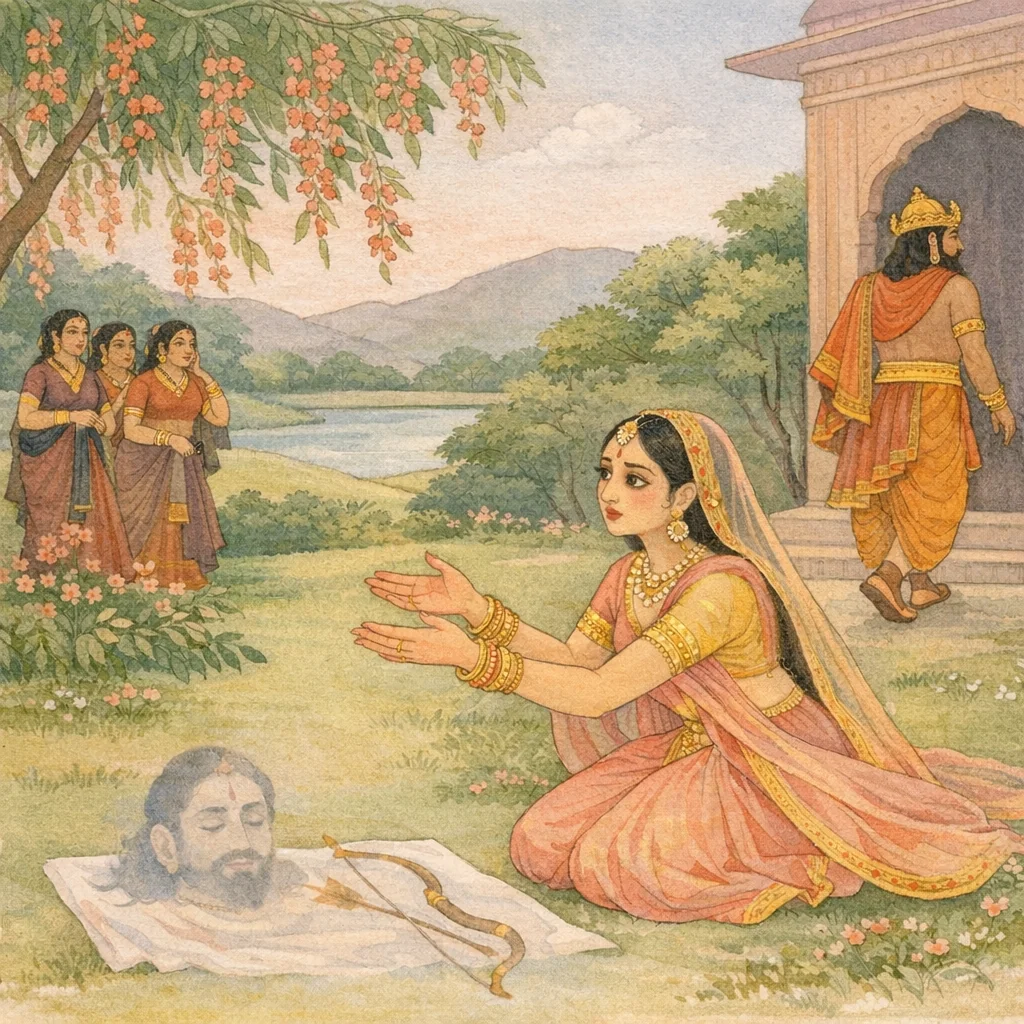
This sarga interleaves two narrative registers: (1) Sītā’s acute grief-response to a staged spectacle and (2) Rāvaṇa’s administrative turn toward war-counsel. In Aśoka-vatikā, Sītā is shown what appears to be Rāma’s severed head and his famed bow; she recognizes identifying marks (eyes, complexion, hair-curls) and the auspicious cūḍāmaṇi association, collapses, and then laments in sustained address. Her speech cycles through blame (especially toward Kaikeyī), self-reproach, and metaphysical reflection on kāla (time) as a dissolver of wisdom and protectorates. She frames a dharmic paradox: Rāma, a knower of polity and calamity-avoidance, has nonetheless been overtaken by death; she imagines Kausalyā’s devastation at Lakṣmaṇa’s lone return; and she articulates the social-religious rupture of a hero’s body being left to scavengers, deprived of proper saṃskāra. The lament culminates in appeals to Rāvaṇa to unite her with her husband in death. Immediately after Rāvaṇa departs to meet ministers, the head and bow vanish—revealing the episode’s illusory, coercive design. The scene then pivots to governance: a guard reports Prahasta’s arrival; Rāvaṇa convenes ministers, orders drum-signals to assemble troops without disclosing reasons, and begins formal deliberation on action against Rāma.
Shlokas
Verse 1
सासीतातच्छिरोदृष्टवातच्चकार्मुकमुत्तमम् ।सुग्रीवप्रतिसंपर्गमाख्यातंचहनूमता ।।6.32.1।।नयनेमुखवर्णंचभर्तुस्तत्सदृशंमुखम् ।केशान् केशान्तदेशंचतंचचूडामणिंशुभम् ।।6.32.2।।एतैस्सर्वेरभिज्ञानैरभिज्ञायसुदुःखिता ।निजगर्हेचकैकेयींक्रोशन्तीकुररीयथा ।।6.32.3।।
Sītā, seeing that head and the excellent bow—and recalling what Hanumān had described about Rāma’s alliance with Sugrīva—looked upon the eyes, the complexion, and the face resembling her husband’s, as well as the hair and its curling ends, and the auspicious crest-jewel. Recognizing these as identifying marks, she was overwhelmed with grief; crying out like a kurarī-bird, she bitterly reproached Kaikeyī.
Verse 2
सासीतातच्छिरोदृष्टवातच्चकार्मुकमुत्तमम् ।सुग्रीवप्रतिसंपर्गमाख्यातंचहनूमता ।।6.32.1।।नयनेमुखवर्णंचभर्तुस्तत्सदृशंमुखम् ।केशान् केशान्तदेशंचतंचचूडामणिंशुभम् ।।6.32.2।।एतैस्सर्वेरभिज्ञानैरभिज्ञायसुदुःखिता ।निजगर्हेचकैकेयींक्रोशन्तीकुररीयथा ।।6.32.3।।
Sītā, seeing that head and the excellent bow—and recalling what Hanumān had described about Rāma’s alliance with Sugrīva—looked upon the eyes, the complexion, and the face resembling her husband’s, as well as the hair and its curling ends, and the auspicious crest-jewel. Recognizing these as identifying marks, she was overwhelmed with grief; crying out like a kurarī-bird, she bitterly reproached Kaikeyī.
Verse 3
सासीतातच्छिरोदृष्टवातच्चकार्मुकमुत्तमम् ।सुग्रीवप्रतिसंपर्गमाख्यातंचहनूमता ।।6.32.1।।नयनेमुखवर्णंचभर्तुस्तत्सदृशंमुखम् ।केशान् केशान्तदेशंचतंचचूडामणिंशुभम् ।।6.32.2।।एतैस्सर्वेरभिज्ञानैरभिज्ञायसुदुःखिता ।निजगर्हेचकैकेयींक्रोशन्तीकुररीयथा ।।6.32.3।।
Sītā, seeing that head and the excellent bow—and recalling what Hanumān had described about Rāma’s alliance with Sugrīva—looked upon the eyes, the complexion, and the face resembling her husband’s, as well as the hair and its curling ends, and the auspicious crest-jewel. Recognizing these as identifying marks, she was overwhelmed with grief; crying out like a kurarī-bird, she bitterly reproached Kaikeyī.
Verse 4
सकामाभवकैकेयीहतोऽयंकुलनन्दनः ।कुलमुत्सादितंसर्वंत्वयाकलहशीलया ।।6.32.4।।
"Be satisfied, Kaikeyī—this delight of the dynasty has been slain. By you, ever inclined to strife, the whole lineage has been brought to ruin."
Verse 5
आर्येणकिंतेकैकेयी कृतंरामेणविप्रियम् ।यन्मयाचीरवसनस्त्वयाप्रस्थापितोवनम् ।।6.32.5।।
"Kaikeyī, what wrong did noble Rāma do to you, that he—clad in bark garments—was sent by you to the forest along with me?"
Verse 6
एवमुक्त्वातुवैदेहीवेपमानातपस्विनी ।जगामजगतींबालाछिन्नातुकदळीयथा ।।6.32.6।।
Having spoken thus, Vaidehī—the young, afflicted woman—trembling, collapsed to the earth like a banana plant cut down.
Verse 7
सामुहूर्तात्समाश्वास्यप्रतिलभ्यचचेतनाम् ।तच्छिरस्समुपाघ्रायविललासायतेक्षणा ।।6.32.7।।
After a brief while, broad-eyed Sītā regained consciousness; drawing close to Rāma’s head, she embraced it and began to lament.
Verse 8
हाहताऽस्मिमहाबाहो वीरव्रतमनुव्रत ।इमांतेपश्चिमावस्थांगताऽस्मिविधवाकृता ।।6.32.8।।
"Alas, O mighty-armed one! You have been slain while keeping a hero’s vow. I have lived to see you in this final condition—made a widow."
Verse 9
प्रथमंमरणंनार्याभर्तुर्वैगुण्यमुच्यते ।सुवृत्त: स्साधुवृत्तायास्सम्वृत्तस्त्वंममाग्रतः ।।6.32.9।।
"They say a husband’s death is first attributed to a woman’s failing; yet you—upright and vow-faithful—have fallen before me, though I have lived in good conduct."
Verse 10
दुःखाद्दुःखंप्रपन्नायामग्नायाश्शोकसागरे ।योहिमामुद्यतनिस्त्रातुंसोऽपित्वंविनिपातितः ।।6.32.10।।
Sunk in an ocean of sorrow, I have fallen from one grief into another; and you—who rose up to rescue me—have yourself been struck down.
Verse 11
साश्वश्रूर्ममकौसल्यात्वयापुत्रेणराघव: ।वत्सेनेवयथाधेनुर्विवत्सावत्सलाकृता ।।6.32.11।।
O Rāghava, my mother-in-law Kausalyā—bereft of you, her son—has become like a cow made calf-less, longing for her young.
Verse 12
आद्दिष्टंदीर्घमायुस्तेयैरचिन्त्यपराक्रम ।अनृतंवचनंतेषामल्पायुरपिराघव ।।6.32.12।।
O Rāghava of unimaginable valor—those who foretold you a long life have been proven false; even you, it seems, have met with a shortened span.
Verse 13
अथवानश्यतिप्रज्ञाप्राज्ञस्यापिसतस्तव ।पचत्येनंयथाकालोभूतानांप्रभवोऽह्ययम् ।।6.32.13।।
Or perhaps—even in a wise and virtuous man like you—discernment can be obscured; for Time, the source that governs all beings, ripens events to their destined end.
Verse 14
अदृष्टंमृत्युमापन्नःकस्मात्त्वंनयशास्त्रवित् ।व्यसनानामुपायज्ञःकुशलोह्यसिवर्जने ।।6.32.14।।
How did Death find an opening to seize you—when you are a knower of statecraft and the śāstras, skilled in discerning means and in averting calamities?
Verse 15
तथात्वंसम्परिष्वज्यरौद्रयाऽतिनृशंसया ।काळरात्य्राममाच्छिद्यहृतःकमललोचन:।। 6.32.15।।
And so, O lotus-eyed one—having torn you away from me, that fierce, most pitiless ‘Dark Night’ has carried you off.
Verse 16
उपशेषेमहाबाहो: मांविहायतपस्विनीम् ।प्रियामिवसमालशिष्यपृथिवींपुरुषर्षभ ।।6.32.16।।
O mighty-armed bull among men—leaving me, a woman of austerity, you lie there embracing the earth as though she were your beloved.
Verse 17
अर्चितंसततंयत्तद्गन्धमाल्यैर्मयातव ।इदंतेमप्रतियंवीरधनुःकाञ्चानभूषणम् ।।6.32.17।।
O hero—this very bow of yours, adorned with gold, which you and I always honored with perfumes and garlands in devoted worship—now lies here.
Verse 18
पित्रादशरथेनत्वंश्वशुरेणममानघ: ।सर्वैश्चपितृभिस्सार्थंनूनंस्वर्गेसमागतः ।।6.32.18।।
O sinless one—surely you have gone to heaven, reunited with your father Daśaratha, my father-in-law, and with all your forefathers.
Verse 19
दिविनक्षत्रभूतस्त्वंमहात्कर्मकृतप्रियम् ।पुण्यंराजर्षिवंशंत्वमात्मनस्समुपेक्षसे ।।6.32.19।।
In heaven, become like a star among the celestial lights, you will behold those dear ones who have performed great deeds and earned merit—along with the holy royal-sage lineage that is your own.
Verse 20
किंमांनप्रेक्षसेराजन् किंमांनप्रतिभाषसे ।बालांबाल्येनसम्प्राप्तांभार्यांमांसहचारिणीम् ।।6.32.20।।
“O King, why do you not look upon me? Why do you not speak to me—me, your wife, your companion, who came to you from my very youth?”
Verse 21
संश्रुतंगृह्णतापाणिंचरिष्यामीतियत्त्वया ।स्मरतन्ममकाकुत्स्थनयमामपिदुःखिताम् ।।6.32.21।।
“O Kākutstha, remember what you promised when you took my hand: ‘I shall walk with you.’ Take me too—now sorrowing—along that same path.”
Verse 22
कस्मान्मामपहायत्वंगतोगतिमतांवर ।अस्माल्लोकादमुंलोकंत्यक्त्वामामपिदुःखिताम् ।।6.32.22।।
“Why have you gone, abandoning me—O best among the noble? Leaving this world for that other world, why have you forsaken me too, in my sorrow?”
Verse 23
कल्याणैरुचितंयत्तत्परिष्वक्तंमयैवतु ।क्रव्यादैस्तच्छरीरंतेमानंविपरिकृष्यते ।।6.32.23।।
“That body of yours—fit for auspicious adornment and once embraced by me alone with reverence—is now being dragged about with indignity by flesh-eating creatures.”
Verse 24
अग्निष्टोमादिभिर्यज्ञैरिष्टवानाप्तदक्षिणैः ।अग्निहोत्रेणसंस्कारंकेनत्वंनतुलप्स्यसे ।।6.32.24।।
“You who performed Agniṣṭoma and other sacrifices, duly giving the priestly gifts—by what cause do you now fail to receive the final sanctifying rites, such as the agnihotra-related purifications?”
Verse 25
प्रव्रज्यामुपपन्नानांत्रयाणामेकमागतम् ।परिप्रक्ष्यतिकौसल्यालक्ष्मणंशोकलालसा ।।6.32.25।।
“Kauśalyā, consumed by grief, will question Lakṣmaṇa when she sees only one of the three who went into exile returning.”
Verse 26
सतस्याःपरिपृच्छन्त्यावधंमित्रबलस्यते ।तवचाख्यास्यतेनूनंनिशायांराक्षसैर्वधम् ।।6.32.26।।
“When she questions him, he will surely report that you—and the army of your allies—were slain at night by the Rākṣasas.”
Verse 27
सात्वांसुप्तंहतंश्रुत्वामांचरक्षोगृहंगताम् ।हृदयेनविदीर्णेननभविष्यतिराघव ।।6.32.27।।
“O Rāghava, hearing that you were slain while asleep and that I was taken to the Rākṣasas’ house, she will not survive—her heart torn apart.”
Verse 28
ममहेतोरनार्यायाह्यनर्हःपार्थिवात्म: ।रामस्सागरमुततीर्यसत्त्ववान् गोष्पदेहतः ।।6.32.28।।
“Because of me—an unworthy woman—Rāma, the valiant son of a king, who did not deserve such an end, has crossed the ocean only to be slain as easily as in a mere cow’s footprint.”
Verse 29
अहंदाशरथेनोढामोहात्स्वकुलपांसनी ।आर्यपुत्रस्यरामस्यभार्यामृत्युरजायत ।।6.32.29।।
In delusion, the son of Daśaratha married me—one who has become a disgrace to her own lineage; as Rāma’s wife, I have turned into his very death.
Verse 30
नूनमन्यांमयाजातिंवारितंदानमुत्तमम् ।याहमद्येहशोचामिभार्यासर्वतिथेरपि ।।6.32.30।।
Surely, in some other life I must have obstructed a supreme gift; therefore today I grieve here—even though I am the wife of one who is kind to all.
Verse 31
साधुपातयमांक्षिप्रंरामस्योपरिरावण ।समानयपतिंपन्त्याकुरुकल्याणमुत्तमम् ।।6.32.31।।
Do it then, Rāvaṇa—quickly cast me down upon Rāma; reunite husband and wife and perform what you call the ‘highest auspicious act’.
Verse 32
शिरसामेशिरश्चास्यकायंकायेनयोजय ।रावणानुगमिष्यामिगतिंभर्तुर्महात्मनः ।।6.32.32।।
O Rāvaṇa, join my head to his head and my body to his body; I will follow the path of my great-souled husband.
Verse 33
इतिसदुःखसन्तप्ताविललापायतेक्षणा ।भर्तुश्शिरोधनुस्तत्रसमीक्ष्यचपुनःपुनः ।।6.32.33।।
Thus, consumed by grievous sorrow, the wide-eyed Sītā lamented—again and again gazing there at her husband’s head and bow.
Verse 34
एवंलालप्यमानायांसीतायांतत्रराक्षसः ।अभिचक्रामभर्तारमनीकस्थःकृताञ्जलिः ।।6.32.34।।
While Sītā was lamenting in this way, a rākṣasa stationed there on guard approached his lord, with hands joined in salutation.
Verse 35
विजयस्वार्यपुत्रेतिसोऽभिवाद्यप्रसाद्यच ।न्यवेदयदनुप्राप्तंप्रहस्तंवाहिनीपतिम् ।।6.32.35।।
Greeting him with, “Be victorious, noble prince,” and showing due reverence, he reported: “Prahasta, commander of the host, has arrived.”
Verse 36
अमात्यैस्सहितस्सर्वैःप्रहस्तस्समुपस्थितः ।तेनदर्शनकामेनवयंप्रस्थापिताःप्रभो ।।6.32.36।।
“O Lord, Prahasta stands ready, accompanied by all the ministers; desiring to see you, he has sent us here.”
Verse 37
नूनमस्तिमहाराज राजभावात्क्षमान्वितं ।किञ्चिदात्ययिकंकार्यंतेषांत्वंदर्शनंकुरु ।।6.32.37।।
“Great king—endowed with royal dignity and forbearance—there is surely some urgent matter; grant them an audience.”
Verse 38
एतच्छ्रुत्वादशग्रीवोराक्षसप्रतिवेदितम् ।अशोकन्विकांत्यक्त्वामन्त्रिणांदर्शनंययौ ।।6.32.38।।
Hearing the report delivered by the rākṣasa, Daśagrīva (Rāvaṇa) left the Aśoka grove and went to meet with his ministers.
Verse 39
सतुसर्वंसमर्थ्यैवमन्त्रिभिःकृत्यमात्मनः ।सभांप्रविश्यविदधेविदित्वारामविक्रमम् ।।6.32.39।।
Having understood Rāma’s prowess, he—after weighing with his ministers what needed to be done—entered the assembly and set about the required measures.
Verse 40
अन्तर्थानंतुतच्छीर्षंतच्चकार्मुकमुत्तमम् ।जगामरावणस्यैवनिर्याणसमनन्तरम् ।।6.32.40।।
But as soon as Rāvaṇa had departed, that head and that excellent bow vanished from sight.
Verse 41
राक्षसेन्द्रस्तुतैस्सार्धंमन्त्रिभिर्भीमविक्रमैः ।समर्थयामासतदारामकार्यविनिश्चयम् ।।6.32.41।।
Then the lord of the rākṣasas, together with his ministers of dreadful prowess, deliberated and arrived at a decision regarding the measures to be taken against Rāma.
Verse 42
अविदूरस्थितान्सर्वान्बलाध्यक्षाहनितैषिणः ।अब्रवीत्कालसदृशोरावणोराक्षसाधिपः ।।6.32.42।।
Rāvaṇa, the rākṣasa-lord who seemed like Death itself, addressed all the commanders of the forces and his well-wishers standing nearby.
Verse 43
शीघ्रंभेरीनिनादेनस्फुटंकोणाहतेनमे ।समानयध्वंसैन्यानिवक्तव्यंचनकारणम् ।।6.32.43।।
"Quickly—let the drums be sounded sharply with firm strokes, and assemble the troops; and do not disclose the reason."
Verse 44
ततस्तथेतिप्रतिगृह्यतद्वचोबलाधिपास्तेमहदात्मनोबलम् ।समानयंश्चैवसमागमंचतेन्यवेदयन्भर्तरियुद्धकाङ्क्षिणि ।।6.32.44।।
Then the commanders, accepting his words with “So be it,” assembled the great host and reported the gathering to their lord, who longed for battle.
Frequently Asked Questions
The pivotal action is a coercive illusion: presenting Sītā with a false sign of Rāma’s death to break her resolve. Ethically, it contrasts psychological warfare and deception with Sītā’s steadfast marital fidelity and grief-bound reasoning, showing how adharma attempts to weaponize despair.
Sītā’s lament frames kāla (time) as a force that can overwhelm prudence and even diffuse the wisdom of the learned, while still affirming moral bonds and duty. The sarga teaches how grief can coexist with ethical clarity: her accusations, self-critique, and concern for Kausalyā map the human cost of political decisions.
The Aśoka grove (Aśoka-vatikā) functions as a captivity-space and psychological theatre within Laṅkā, while the sabhā (assembly hall) marks Rāvaṇa’s shift from private coercion to public statecraft. Cultural markers include funerary-saṃskāra expectations, the cūḍāmaṇi as an auspicious identity-token, and drum-based military mobilization (bhērī-nināda).