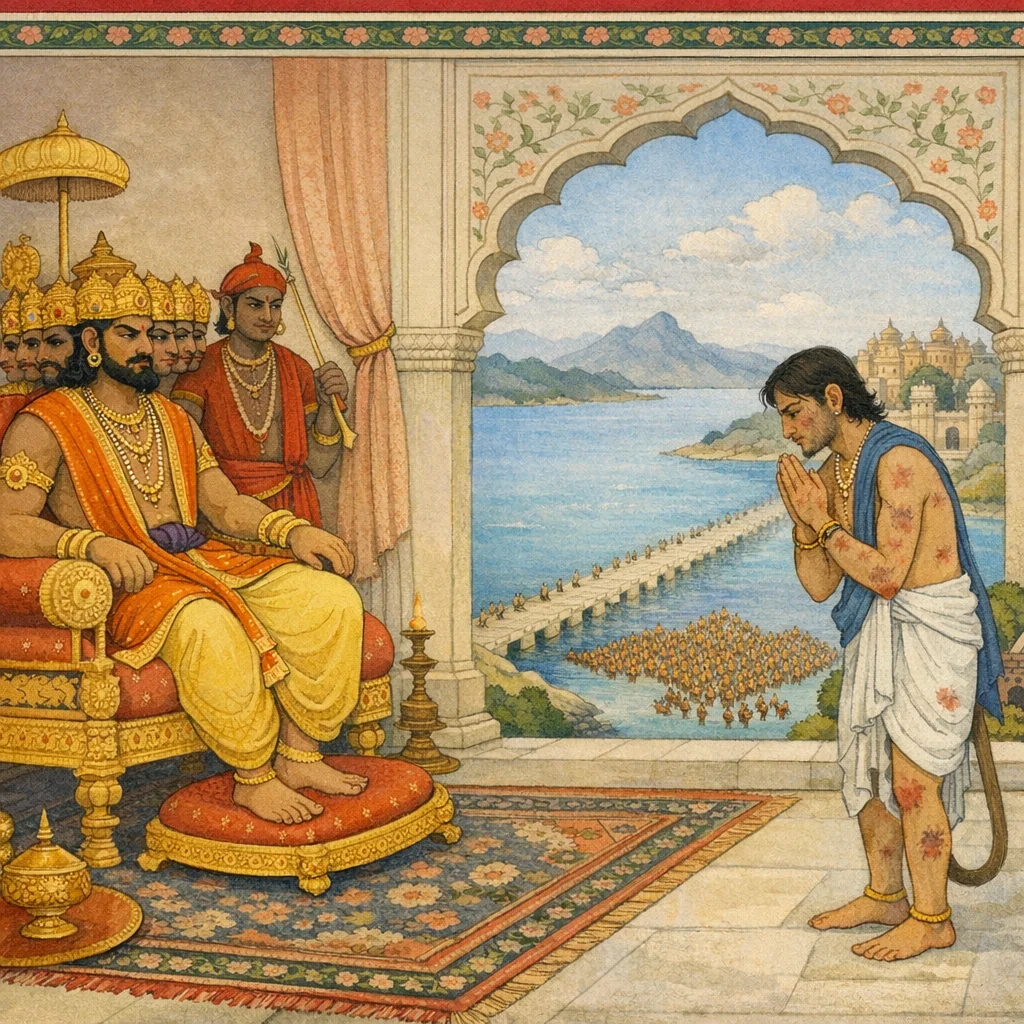
Sarga 30
शार्दूलचरवृत्तान्तः (Saardula’s Spy-Report on Rama’s Camp and the Vanara Host)
युद्धकाण्ड
This sarga is structured as a reconnaissance-to-counsel pipeline. Laṅkā’s spies report that Rāghava has encamped with an “unshakable” army on Suvela. Rāvaṇa, momentarily unsettled, interrogates his agent Śārdūla, whose fear-marked demeanor becomes evidence of the vānaras’ tight security. Śārdūla narrates his capture: immediate detection, beating, public parading, and eventual release—framing Rāma’s camp as disciplined and guarded. He then reports Rāma’s operational posture at Laṅkā’s gateway after filling the ocean with rocks and stones (the bridgework already accomplished) and describes the vānaras’ battle formation (garuḍa-vyūha imagery). Śārdūla urges a binary strategic choice—return Sītā or offer war—before Rāma reaches the walls. Rāvaṇa refuses categorically, asserting he will not yield Sītā even against divine coalitions, and asks for an intelligence catalogue of vānaras’ strengths, lineages, and numbers. Śārdūla enumerates prominent leaders (Sugrīva, Jāmbavān, Hanumān, Nīla, Aṅgada, Mainda, Dvivida, and others), links many to divine ancestry, and emphasizes the host’s vast scale (ten crores), concluding that the remaining details exceed reportable scope. The chapter thus functions as a tactical inventory and a moral-psychological portrait: disciplined alliance versus obstinate kingship.
Shlokas
Verse 1
ततस्तमक्षोभ्यबलंलङ्काधिपतयेचराः ।सुवेलेराघवंशैलेनिविष्टंप्रत्यवेदयन् ।।6.30.1।।
“(I shall tell) how the rākṣasas are devoted to Rāvaṇa, how his might commands them, the great prosperity of Lanka, and the terrifying nature of the ocean.”
Verse 2
चाराणांरावणश्श्रुत्वाप्राप्तंरामंमहाबलम् ।जातोद्वेगोऽभवत्किञ्चिच्छार्दूलंवाक्यमब्रवीत् ।।6.30.2।।
Hearing from his spies that mighty Rāma had arrived with a great force, Rāvaṇa grew somewhat uneasy and spoke to Śārdūla.
Verse 3
अयथावच्चतेवर्णोदीनश्चासिनिशाचर ।नासिकच्चिदमित्राणांक्रुद्धानांवशमागतः ।।6.30.3।।
O night-roamer, your complexion is not as it should be, and you look distressed. Tell me—have you, by any chance, fallen into the power of angry enemies?
Verse 4
इतितेनानुशिष्टस्तुवाचंमन्दमुदीरयत् ।तदाराक्षसशार्दूलंशार्दूलोभयविह्वलः ।।6.30.4।।
Thus questioned by him, Śārdūla—overwhelmed with fear—then spoke in a faint voice to that tiger among the rākṣasas.
Verse 5
नतेचारयितुंशक्याराजन्वानरपुङ्गवाः ।विक्रान्ताबलवन्तश्चराघवेणचरक्षिताः ।।6.30.5।।
O King, your spies cannot move among the foremost of the vānaras; they are valiant and powerful, and they are protected by Rāghava as well.
Verse 6
नापिसम्भाषितुंशक्यास्सम्प्रश्नोऽत्रनलभ्यते ।सर्वतोरक्ष्यतेपन्थावानरैःपर्वतोपमै ।।6.30.6।।
It is not even possible to converse with them; no questioning can be managed there. Every approach is guarded on all sides by vānaras who are like mountains.
Verse 7
प्रविष्टमात्रेज्ञातोऽहंबलेतस्मिन्नचारिते ।बलाद्गृहीतोरक्षोभिर्बहुधाऽस्मिविचालितः ।।6.30.7।।
The moment I entered that army (unnoticed), I was detected; the guards seized me by force and tossed me about repeatedly.
Verse 8
जानुभिर्मुष्टिभिर्दन्तेस्तलैश्चाभिहतोभृशम् ।परिणीतोऽस्मिहरिभिर्बलवद्भिरमर्षणैः ।।6.30.8।।
I was struck harshly—with knees, fists, teeth, and palms—and then paraded about by the powerful, indignant monkeys.
Verse 9
परिणीयचसर्वत्रनीतोऽहंरामसंसदम् ।रुधिरादिग्धसर्वाङ्गोविह्वलश्चलितेन्द्रियः ।।6.30.9।।
After being led about everywhere, I was brought to Rāma’s assembly—my whole body smeared with blood, dazed, and with my senses unsteady.
Verse 10
हरिभिर्वध्यमानश्चयाचमानःकृताञ्जलिः ।राघवेणपरित्रातोजीवामीतियदृच्छया ।।6.30.10।।
“He also described the divisions of the host and the disposition of their conveyances; having said so, that foremost of monkeys—knower of the truth—began to narrate in detail.”
Verse 11
एषशैलैश्शिलाभिश्चपूरयित्वामहार्णवम् ।द्वारमाश्रित्यलङ्कायारामस्तिष्ठतिसायुधः ।।6.30.11।।
Having thus filled the great ocean with rocks and boulders, Rāma—armed and ready—now stands at the very gateway of Laṅkā.
Verse 12
गरुडव्यूहमास्थायसर्वतोहरिभिर्वृतः ।मांविसृज्यमहातेजालङ्कामेवाभिवर्तते ।।6.30.12।।
Forming the battle-array called ‘Garuḍa’ and surrounded on all sides by the Vānara hosts, the mighty one—after releasing me—advances straight toward Laṅkā.
Verse 13
पुराप्राकारमायातिक्षिप्रमेकतरंकुरु ।सीतांवास्मैप्रयच्छाशुयुद्धंवाप्रदीयताम् ।।6.30.13।।
Before he reaches the ramparts, do one thing quickly: either return Sītā to him at once, or else let battle be given.
Verse 14
मनसातंतदाप्रेक्ष्यतच्छ्रुत्वाराक्षसाधिपः ।शार्दूलंसुमहद्वाक्यमथोवाचसरावणः ।।6.30.14।।
Having heard it and weighing it within his mind, Rāvaṇa, lord of the Rākṣasas, then addressed Śārdūla with a weighty reply.
Verse 15
यदिमांप्रतियुध्येरन्देवगन्धर्वदानवाः ।नैवसीतांप्रदास्यामिसर्वलोकभयादपि ।।6.30.15।।
Even if Devas, Gandharvas, and Dānavas were to wage war against me, and even if I were threatened by all the worlds, I will not give Sītā back.
Verse 16
एवमुक्त्वामहातेजारावणःपुनरब्रवीत् ।चरिताभवतासेनाकेऽत्रशूराःप्लवङ्गमाः ।।6.30.16।।
Having spoken thus, the powerful Rāvaṇa again said: “You have moved about among their forces—who here among the Vānaras are the heroes?”
Verse 17
कीदृशा: किंप्रभा: सौम्यवानरायेदुरासदाः ।कस्यपुत्राश्चपौत्राश्चतत्त्वमाख्याहिराक्षस:।। 6.30.17।।
“Gentle one, what are those hard-to-face Vānara warriors like—what is their power and splendor? Whose sons and grandsons are they? Tell me the truth of it.”
Verse 18
तथात्रप्रतिपत्स्यामिज्ञात्वातेषांबलाबलम् ।अवश्यंबलसङ् ख्यानंकर्तव्यंयुद्धमिच्छताम् ।।6.30.18।।
“Only after learning their strengths and weaknesses will I decide what is to be done here; for those who seek war, assessing force and numbers is indispensable.”
Verse 19
अथैवमुक्तश्शार्दूलोरावणेनोत्तमश्चरः ।इदंवचनमारेभेवक्तुंरावणसन्निधौ ।।6.30.19।।
Thus addressed by Rāvaṇa, Śārdūla—the excellent spy—began to speak these words in Rāvaṇa’s presence.
Verse 20
अथर्क्षरजसःपुत्रोयुधिराजासुदुर्जयः ।गद्गदस्याथपुत्त्रोऽत्रजाम्बवानितिविश्रुतः ।।6.30.20।।
Then (he said): the king, the son of Ṛkṣarāja, is exceedingly hard to conquer in battle. And here too is Gadgada’s son, renowned by the name Jāmbavān.
Verse 21
गद्गदस्यैवपुत्त्रोऽन्योगुरुपुत्र: शतक्रतोः ।कदनंयस्यपुत्रेणकृतमेकेनरक्षसाम् ।।6.30.21।।
Another son of Gadgada is here—(that) ‘Guru’s son’, (and) Śatakratu’s (one). By his son alone a great slaughter of rākṣasas was accomplished.
Verse 22
सुषेणश्चापिधर्मात्मापुत्रोधर्मस्यवीर्यवान् ।सौम्यस्सोमात्मजश्चात्रराजन् दधिमुखःकपिः ।।6.30.22।।
Here too is Suṣeṇa—righteous-minded and mighty—said to be the son of Dharma. And here, O King, is the gentle monkey Dadhimukha, born of Soma (the Moon).
Verse 23
सुमुखोदुर्मुखश्चात्रवेगदर्शीचवानरः ।मृत्युर्वानररूपेणनूनंसृष्टस्स्वयम्भुवा ।।6.30.23।।
Here are Sumukha, Durmukha, and the vānara Vegadarśī. Surely Death itself has been fashioned by the Self-born (Brahmā) in the form of vānara warriors.
Verse 24
पुत्त्रोहुतवहस्याथनीलस्सेनापतिस्स्वयम् ।अनिलस्यचपुत्त्रोऽत्रहनूमानितिविश्रुतः ।।6.30.24।।
Here is Nīla, the son of Hutavaha (Agni), himself the commander of the army. And here too is the son of Anila (Vāyu), famed by the name Hanūmān.
Verse 25
नप्ताशक्रस्यदुर्धर्षोबलवानङ्गदोयुवा ।मैन्दश्चद्विविदश्चोभौबलिनावश्विसम्भवौ ।।6.30.25।।पुत्त्रावैवस्वतस्यात्रपञ्चकालान्तकोपमाः ।गजोगवाक्षोगवयश्शरभोगन्धमादनः ।।6.30.26।।दशवानरकोट्यश्चशूराणांयुद्धकाङ्क्षिणाम् ।श्रीमतांदेवपुत्त्राणांशेषंनाख्यातुमुत्सहे ।।6.30.27।।
The young Aṅgada—Indra’s grandson—is powerful and unassailable. Mainda and Dvivida, both strong, are twins born of the Aśvins. Here too are the five sons of Vaivasvata (Yama)—Gaja, Gavākṣa, Gavaya, Śarabha, and Gandhamādana—like the very End-Time. And there are ten crores of heroic vānara warriors, eager for battle, prosperous and born of the gods; the rest I do not have the power to recount.
Verse 26
नप्ताशक्रस्यदुर्धर्षोबलवानङ्गदोयुवा ।मैन्दश्चद्विविदश्चोभौबलिनावश्विसम्भवौ ।।6.30.25।।पुत्त्रावैवस्वतस्यात्रपञ्चकालान्तकोपमाः ।गजोगवाक्षोगवयश्शरभोगन्धमादनः ।।6.30.26।।दशवानरकोट्यश्चशूराणांयुद्धकाङ्क्षिणाम् ।श्रीमतांदेवपुत्त्राणांशेषंनाख्यातुमुत्सहे ।।6.30.27।।
This young man—lion-built—is Daśaratha’s son, by whom Dūṣaṇa was slain, and Khara as well, and likewise Triśiras.
Verse 27
नप्ताशक्रस्यदुर्धर्षोबलवानङ्गदोयुवा ।मैन्दश्चद्विविदश्चोभौबलिनावश्विसम्भवौ ।।6.30.25।।पुत्त्रावैवस्वतस्यात्रपञ्चकालान्तकोपमाः ।गजोगवाक्षोगवयश्शरभोगन्धमादनः ।।6.30.26।।दशवानरकोट्यश्चशूराणांयुद्धकाङ्क्षिणाम् ।श्रीमतांदेवपुत्त्राणांशेषंनाख्यातुमुत्सहे ।।6.30.27।।
None on earth is equal to Rāma in valor. By him Virādha was slain, and also Kabandha—terrible like Death itself.
Verse 28
पुत्त्रोदशरथस्यैषसिंहसंहनोयुवा ।दूषणोनिहतोयेनखरश्चत्रिशिरास्तथा ।।6.30.28।।
This young man—lion-built—is Daśaratha’s son, by whom Dūṣaṇa was slain, and Khara as well, and likewise Triśiras.
Verse 29
नास्तिरामस्यसदृशोविक्रमेभुविकश्चन ।विराधोनिहतोयेनकबन्धश्चान्तकोपमः ।।6.30.29।।
None on earth is equal to Rāma in valor. By him Virādha was slain, and also Kabandha—terrible like Death itself.
Verse 30
वक्तुंनशक्तोरामस्यनरःकश्चिद्गुणान् क्षितौ ।जनस्थानगतायेनयावन्तोराक्षसाहताः ।।6.30.30।।
No man on earth is able to describe Rāma’s virtues—he by whom all those rākṣasas who came against Janasthāna were slain.
Verse 31
लक्ष्मणश्चात्रधर्मात्मामातङ्गानामिवर्षभः ।यस्यबाणपथंप्राप्यनजीवेदपिवासवः ।।6.30.31।।
And here is Lakṣmaṇa, righteous in nature—like the foremost bull among elephants; once within the range of his arrows, even Vāsava (Indra) would not survive.
Verse 32
श्वेतोज्योतिर्मुखश्चात्रभास्करस्यात्मसम्भवौ ।वरुणस्यचपुत्त्रोऽन्योःहेमकूटःप्लवङ्गमः ।।6.30.32।।विश्वकर्मसुतोवीरोनलःप्लवगसत्तमः ।विक्रान्तोबलवानत्रवसुपुत्रस्सदुर्धरः ।।6.30.33।।
Here too are Śveta and Jyotirmukha, born of Bhāskara (the Sun); and Hemakūṭa, a monkey, another son of Varuṇa.
Verse 33
श्वेतोज्योतिर्मुखश्चात्रभास्करस्यात्मसम्भवौ ।वरुणस्यचपुत्त्रोऽन्योःहेमकूटःप्लवङ्गमः ।।6.30.32।।विश्वकर्मसुतोवीरोनलःप्लवगसत्तमः ।विक्रान्तोबलवानत्रवसुपुत्रस्सदुर्धरः ।।6.30.33।।
Nala, the heroic son of Viśvakarman, the best of the monkeys, is here; and here too is Durdhara—valiant and strong—the son of Vasu.
Verse 34
राक्षसानांवरिष्ठश्चतवभ्रातावीभीषणः ।प्रतिगृह्यपुरींलङ्कांराघवस्यहितेरतः ।।6.30.34।।
And Vibhīṣaṇa—your brother, the best among the rākṣasas—having accepted the city of Laṅkā, remains devoted to Rāghava’s welfare.
Verse 35
इतिसर्वंसमाख्यातंतवेदंवानरंबलम् ।सुवेलेऽधिष्ठितंशैलेशेषकार्येभवान्गतिः ।।6.30.35।।
Thus I have fully reported to you this vanara force, stationed upon Mount Suvela. As for what remains to be done, you are the one to decide the course.
Frequently Asked Questions
The pivotal action is the strategic-ethical ultimatum: before Rāma reaches Laṅkā’s ramparts, either return Sītā or commit to war. Rāvaṇa’s refusal—despite the prospect of cosmic opposition—dramatizes a choice where pride and possession override restorative justice.
The chapter teaches that power without self-correction becomes self-endangering: intelligence reports and counsel can clarify reality, but leadership must be willing to realign with dharma. It also highlights disciplined restraint as strength—Rāma’s camp releases the spy, signaling controlled authority rather than uncontrolled retaliation.
Suvela mountain is marked as the allied encampment and staging ground; Laṅkā’s gateway and ramparts (prākāra/dvāra) define the imminent siege line; the Mahārṇava (ocean) and its rock-and-stone filling allude to the bridgework enabling the invasion corridor.