Sarga 3
लङ्कादुर्गवर्णनम् (Description of Lanka’s Fortifications and Forces)
युद्धकाण्ड
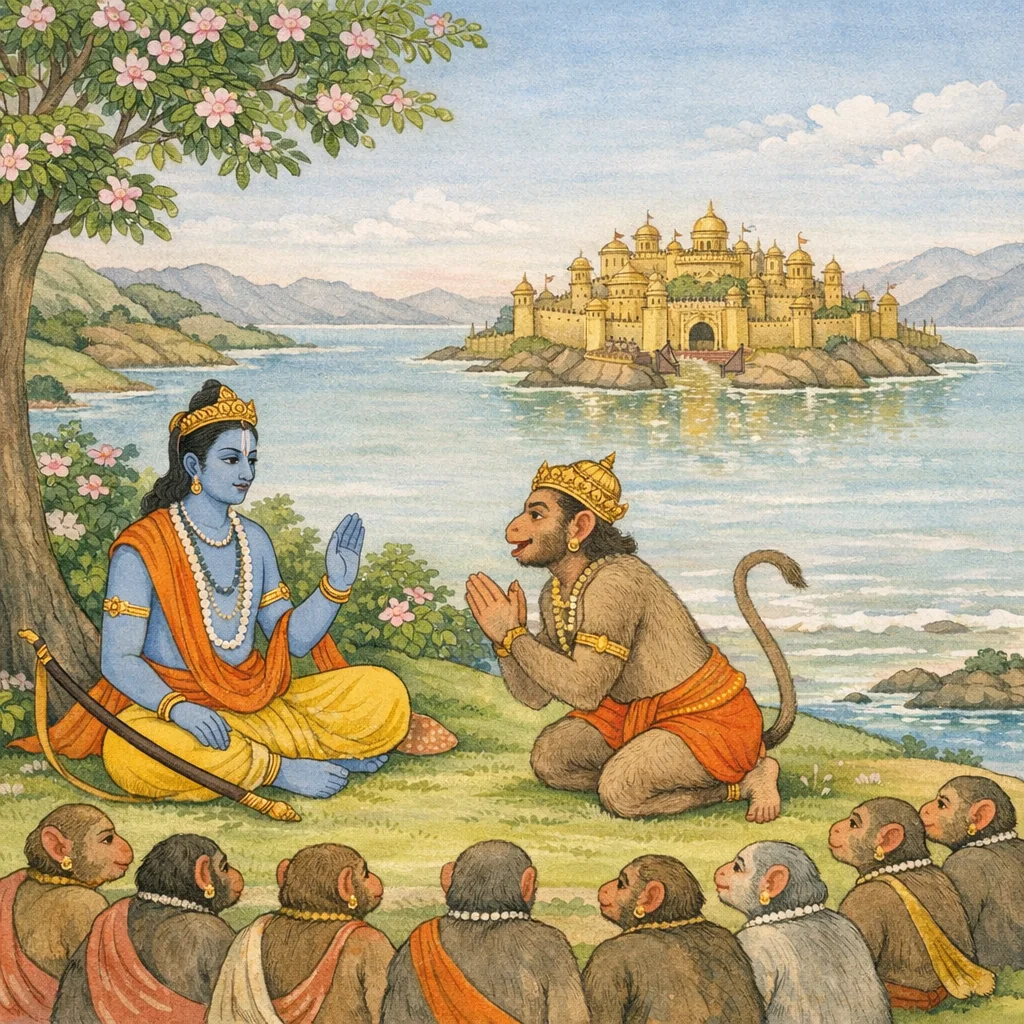
Sarga 3 is a structured intelligence-briefing framed as dialogue. After hearing Sugriva’s well-reasoned counsel, Rama turns to Hanuman and requests a precise report: the size of the enemy forces, the number and nature of hard-to-enter gateways, protective measures, and rakshasa dwellings. Hanuman, praised as foremost among skilled speakers, agrees to relate the fortification system methodically. He depicts Lanka as prosperous and militarily alert: chariots, rutting elephants, and innumerable rakshasas; lofty wide gateways with metal-fixed doors and iron bars; defensive engines that discharge darts and stones; and guards prepared with spiked missiles (śataghnī). The city is ringed by a lofty, gem-studded golden wall and deep moats with cold water, fish, and crocodiles. Movable bridges are raised by engines to deny entry. Hanuman further outlines Ravana’s constant vigilance and provides a gate-wise garrison distribution, culminating in the strategic inference that if the ocean crossing is achieved, Lanka’s fall is assured. The chapter closes with Hanuman urging swift mobilization at an auspicious time.
Shlokas
Verse 1
सुग्रीवस्यवचश्श्रुत्वाहेतुमत्परमार्थवत् ।प्रतिजग्राहकाकुत्स्थोहनूमन्तमथाब्रवीत् ।।।।
Hearing Sugrīva’s well-reasoned words, true in their deeper intent, Rāma of the Kakutstha line accepted them and then addressed Hanumān.
Verse 2
तपसासेतुबन्धेनसागरोच्छोषणेनच ।सर्वथासुसमर्थोऽस्मिसागरस्यास्यलङ्घने ।।।।
By austerity, by building a bridge, or even by drying up the ocean—by whatever means— I am fully capable of crossing this sea.
Verse 3
कतिदुर्गाणिदुर्गायालङ्कायाब्रूहितानिमे ।ज्ञातुमिच्छामितत्सर्वंदर्शनादिववानर ।।।।
Tell me, O Vānara—how many fortified strongholds does hard-to-assail Laṅkā possess? I wish to know everything, exactly as you have seen it.
Verse 4
बलस्यपरिमाणंचद्वारदुर्गक्रियामपि ।गुप्तिकर्मचलङ्कायारक्षसांसदनानिच ।।।।यथासुखंयथावच्छलङ्कायामसिदृष्टवान् ।सर्वमाचक्ष्वतत्त्वेनसर्वथाकुशलोह्यसि ।।।।
“Tell me also the measure of their forces, the arrangement of gates that are hard to penetrate, the methods by which Lanka is guarded, and the dwellings of the rākṣasas.”
Verse 5
बलस्यपरिमाणंचद्वारदुर्गक्रियामपि । गुप्तिकर्मचलङ्कायारक्षसांसदनानिच ।।6.3.4।।यथासुखंयथावच्छलङ्कायामसिदृष्टवान् ।सर्वमाचक्ष्वतत्त्वेनसर्वथाकुशलोह्यसि ।।6.3.5।।
“As you have seen in Lanka—clearly and in proper detail—report everything truthfully; for you are competent in every respect.”
Verse 6
श्रुत्वारामस्यवचनंहनुमान्मारुतात्मजः ।वाक्यंवाक्यविदांश्रेष्ठोरामंपुनरथाब्रवीत् ।।।।
Having heard Rama’s words, Hanuman—the son of Māruti, foremost among skilled speakers—then addressed Rama again.
Verse 7
श्रूयतांसर्वमाख्यास्येदुर्गकर्मविधानतः ।गुप्तापुरीयथालङ्कारक्षिताचयथाबलैः ।।।।
“Listen: I shall relate everything—how the fortifications are arranged, how Lanka is secured, and how she is protected by forces.”
Verse 8
राक्षसाश्चयथास्निग्धारावणस्यचतेजसा ।परांसमृद्धिंलङ्कायास्सागरस्यचभीमताम् ।।।।विभागंचबलौघस्यनिर्देशंवाहनस्यच ।एवमुक्त्वाकपिश्रेष्ठःकथयामासतत्त्ववित: ।।।।
“(I shall tell) how the rākṣasas are devoted to Rāvaṇa, how his might commands them, the great prosperity of Lanka, and the terrifying nature of the ocean.”
Verse 9
राक्षसाश्चयथास्निग्धारावणस्यचतेजसा ।परांसमृद्धिंलङ्कायास्सागरस्यचभीमताम् ।।6.3.8।।विभागंचबलौघस्यनिर्देशंवाहनस्यच ।एवमुक्त्वाकपिश्रेष्ठःकथयामासतत्त्ववित: ।।6.3.9।।
“He also described the divisions of the host and the disposition of their conveyances; having said so, that foremost of monkeys—knower of the truth—began to narrate in detail.”
Verse 10
हृष्टप्रमुदितालङ्कामत्तद्विपसमाकुला ।महतीरथसंपूर्णारक्षोगणसमाकुला ।।।।
Laṅkā—vast and exultant—was crowded with rutting elephants, filled with chariots, and thronged with hosts of rākṣasas.
Verse 11
दृढबद्धकवाटानिमहापरिघवन्तिच ।द्वाराणिविपुलान्यस्याश्चत्वारिसुमहान्तिच ।।।।
Its entrances were broad, with doors firmly fastened and reinforced by massive iron bars; and its four great gateways/courtyards were imposing.
Verse 12
तत्रेषूपलयन्त्राणिबलवन्तिमहान्तिच ।आगतंपरसैन्यंतैस्तत्रप्रतिनिवार्यते ।।।।
There were powerful, massive engines for hurling arrows and stones; by them, an approaching enemy army would be checked and driven back.
Verse 13
द्वारेषुसंस्कृताभीमाःकालायसमयाश्शिताः ।शतशोरचितावीरैश्शतघ्नयोरक्षसांगणै ।।।।
At the gates, fearsome śataghnīs—made of black iron and sharpened—were set out in hundreds by companies of rākṣasa warriors.
Verse 14
सौवर्णस्तुमहांस्तस्याःप्राकारोदुष्प्रधर्षणः ।मणीविद्रुमवैदूर्यमुक्ताविरचितान्तरः ।।।।
But its great rampart was golden and hard to assail, inlaid in places with gems, coral, vaidūrya stones, and pearls.
Verse 15
सर्वतश्चमहाभीमाश्शीततोयवहाश्शुभाः ।अगाधाग्राहवत्यश्चपरिखामीनसेविता ।।।।
All around it were splendid moats—terrifying in aspect—bearing icy-cold water, fathomless in depth, and inhabited by fish and crocodiles.
Verse 16
द्वारेषुतासांचत्वारस्सङ्क्रमाःपरमायताः ।यन्त्रैरुपेताबहुभिर्महद्भिर्गृहपङ्क्तिभिः ।।।।
At their gateways were four long causeways/bridges, fitted with many large mechanical devices, and flanked by great rows of buildings (for guarding and control).
Verse 17
त्रायन्तेसङ्क्रमास्तत्रपरसैन्यागतेसति ।यन्त्रैस्तैरवकीर्यन्तेपरिखासुसमन्ततः ।।।।
When an enemy force arrives there, those crossings are secured; by means of those mechanisms the approaches are swept away/withdrawn into the moats on every side, preventing entry.
Verse 18
एकस्त्वकम्प्योबलवान्सङ्क्रमस्सुमहादृढः ।काञ्चनै र्बहुभिस्स्तम्भैर्वेदिकाभिश्चशोभितः ।।।।
One particular crossing was unshakable—powerful and exceedingly firm—adorned with many golden pillars and platforms/altars.
Verse 19
स्वयंप्रकृतिमापन्नोयुयुत्सूराम रावण: ।उत्थितश्चाप्रमत्तश्चबलानामनुदर्शने ।।।।
O Rāma, Rāvaṇa himself—bent on fighting—has fallen into his own nature; he is up and active, ever vigilant, supervising the disposition of his forces.
Verse 20
लङ्कापुनर्निरालम्बादेवदुर्गाभयावहा ।नादेयंपार्वतंवान्यंकृत्रिमंचचतुर्विधम् ।।।।
And Laṅkā again is a fearsome stronghold, perched aloft and hard to approach—even for the gods—protected by a fourfold system of forts: river-fort, mountain-fort, forest-fort, and artificial fortifications.
Verse 21
स्थितापारेसमुद्रस्यदूरपारस्यराघव ।नौपथोपिश्चनास्त्यत्रनिरादेशश्चसर्वशः ।।।।
O Rāghava, it stands on the far shore of the ocean, a sea difficult to cross; there is not even a ship-route there, and on every side it is without access or approach.
Verse 22
शैलाग्रेरचितादुर्गासापुरैर्देवपुरोपमा ।वाजिवारणासम्पूर्णालङ्कापरमदुर्जया ।।।।
Built as a fortress upon a mountain peak, that city resembled a divine metropolis; filled with horses and elephants, Laṅkā was exceedingly hard to conquer.
Verse 23
परिखाश्चशतघ्नयश्चयन्त्राणिविविधानिच ।शोभयन्तिपुरींलङ्कांरावणस्यदुरात्मनः ।।।।
Moats, śataghnī weapons, and various machines adorned the city of Laṅkā—belonging to the evil-minded Rāvaṇa.
Verse 24
अयुतंरक्षसामत्रपूर्वद्वारंसमाश्रितम् ।शूलहस्तादुराधर्षास्सर्वेखङ्गाग्रयोधिनः ।।।।
There, at Laṅkā’s eastern gate, ten thousand Rākṣasas are stationed—trident-bearers, hard to overcome in battle, all fighting at the sword’s edge from the front line.
Verse 25
नियुतंरक्षसामत्रदक्षिणद्वारमाश्रितम् ।चतुरङ्गेणसैन्येनयोधास्तत्राप्यनुत्तमाः ।।।।
At the southern gate too, a niyuta of Rākṣasas is posted, supported by a fourfold army; the warriors there are likewise of the highest caliber.
Verse 26
प्रयुतंरक्षसामत्रपश्चिमद्वारमाश्रितम् ।चर्मखङ्गधरास्सर्वेतथासर्वास्त्रकोविदाः ।।।।
At the western gate, a prayuta of Rākṣasas is stationed—each bearing shield and sword, and all skilled in the use of many weapons.
Verse 27
न्यर्बुदंरक्षसामत्राप्युत्तरद्वारमाश्रितम् ।रथिनश्चाश्ववाहाश्चकुलपुत्त्रास्सुपूजिताः ।।।।
At the northern gate as well, a nyarbuda of Rākṣasas is posted—chariot-fighters and mounted troops, men of noble houses, honored and trusted.
Verse 28
शतशोऽथसहस्राणिमध्यमंस्कन्धमाश्रिताः ।यातुधानादुराधर्षास्साग्रकोटिश्चरक्षसाम् ।।।।
And in the city’s central sector, hundreds and thousands of unassailable Yātudhānas are massed—Rākṣasas in numbers reaching into crores and beyond.
Verse 29
तेमयासङ्क्रमाभग्नाःपरिखाश्चावपूरिताः ।दग्धाचनगरीलङ्काप्राकाराश्चावसादिताः ।।।।बलैकदेशःक्षपितोराक्षसानांमहात्मनाम् ।
I shattered those causeways, filled in the moats, and set the city of Laṅkā ablaze; its ramparts too were battered down. And a portion of the forces of those mighty Rākṣasas was destroyed.
Verse 30
येनकेनतुमार्गेणतरामवरुणालयम् ।हतेतिनगरीलङ्कावानरैरवधार्यताम् ।। ।।
By whatever route we manage to cross the ocean, Varuṇa’s abode—once the Vānaras have crossed, let it be understood that the city of Laṅkā is as good as destroyed.
Verse 31
अङ्गदोद्विविदोमैन्दोजाम्बवान्पनसोऽनलः ।नीलस्सेनापतिश्चेवबलशेषेणकिंतव ।।।।प्लवमानाहिगत्वातांरावणस्यमहापुरीम् ।।।।सपर्वतवनांभित्त्वासखातांचसप्रतोरणाम् ।सप्राकारांसभवनामानयिष्यन्तिराघव ।।।।
Why do you need the rest of the army, O Rāghava, when Aṅgada, Dvivida, Mainda, Jāmbavān, Panasa, Anala, and Nīla the commander are here? Leaping across, they will reach Rāvaṇa’s great city; breaking through its mountain-and-wooded defenses, its outer gates and archways, its ramparts and buildings, they will force their way in.
Verse 32
अङ्गदोद्विविदोमैन्दोजाम्बवान्पनसोऽनलः ।नीलस्सेनापतिश्चेवबलशेषेणकिंतव ।।6.3.31।।प्लवमानाहिगत्वातांरावणस्यमहापुरीम् ।।6.3.32।।सपर्वतवनांभित्त्वासखातांचसप्रतोरणाम् ।सप्राकारांसभवनामानयिष्यन्तिराघव ।।6.3.33।।
Why do you need the rest of the army, O Rāghava, when Aṅgada, Dvivida, Mainda, Jāmbavān, Panasa, Anala, and Nīla the commander are here? Leaping across, they will reach Rāvaṇa’s great city; breaking through its mountain-and-wooded defenses, its outer gates and archways, its ramparts and buildings, they will force their way in.
Verse 33
अङ्गदोद्विविदोमैन्दोजाम्बवान्पनसोऽनलः ।नीलस्सेनापतिश्चेवबलशेषेणकिंतव ।।6.3.31।।प्लवमानाहिगत्वातांरावणस्यमहापुरीम् ।।6.3.32।।सपर्वतवनांभित्त्वासखातांचसप्रतोरणाम् ।सप्राकारांसभवनामानयिष्यन्तिराघव ।।6.3.33।।
Why do you need the rest of the army, O Rāghava, when Aṅgada, Dvivida, Mainda, Jāmbavān, Panasa, Anala, and Nīla the commander are here? Leaping across, they will reach Rāvaṇa’s great city; breaking through its mountain-and-wooded defenses, its outer gates and archways, its ramparts and buildings, they will force their way in.
Verse 34
एवमाज्ञापयक्षिप्रंबलानांसर्वसङ्ग्रहम् ।मुहूर्तेनतुयुक्तेनप्रस्थानमभिरोचय ।।।।
“Therefore, command swiftly the complete mustering of the troops, and approve the departure at an auspicious, well-timed moment.”
Frequently Asked Questions
The pivotal action is Rama’s decision to ground warfare in verified intelligence: he formally requests detailed, truthful reconnaissance before committing the army, modeling rājadharma as evidence-based command rather than impulse.
The chapter teaches that dharmic action in crisis requires disciplined speech and accurate knowledge: Hanuman’s truthful, structured report and Rama’s careful inquiry show that moral intent must be paired with strategic clarity.
Lanka is mapped as an island-fortress across the ocean (Varuna’s abode), protected by golden walls, deep moats with crocodiles and fish, engineered movable bridges, and four major gates with massive garrisons—an archetype of a ‘city-as-fort’ in epic military geography.