Sarga 28
शुकवाक्यं (Śuka’s Report on the Vānara Host) / Śuka Describes the Allied Forces to Rāvaṇa
युद्धकाण्ड
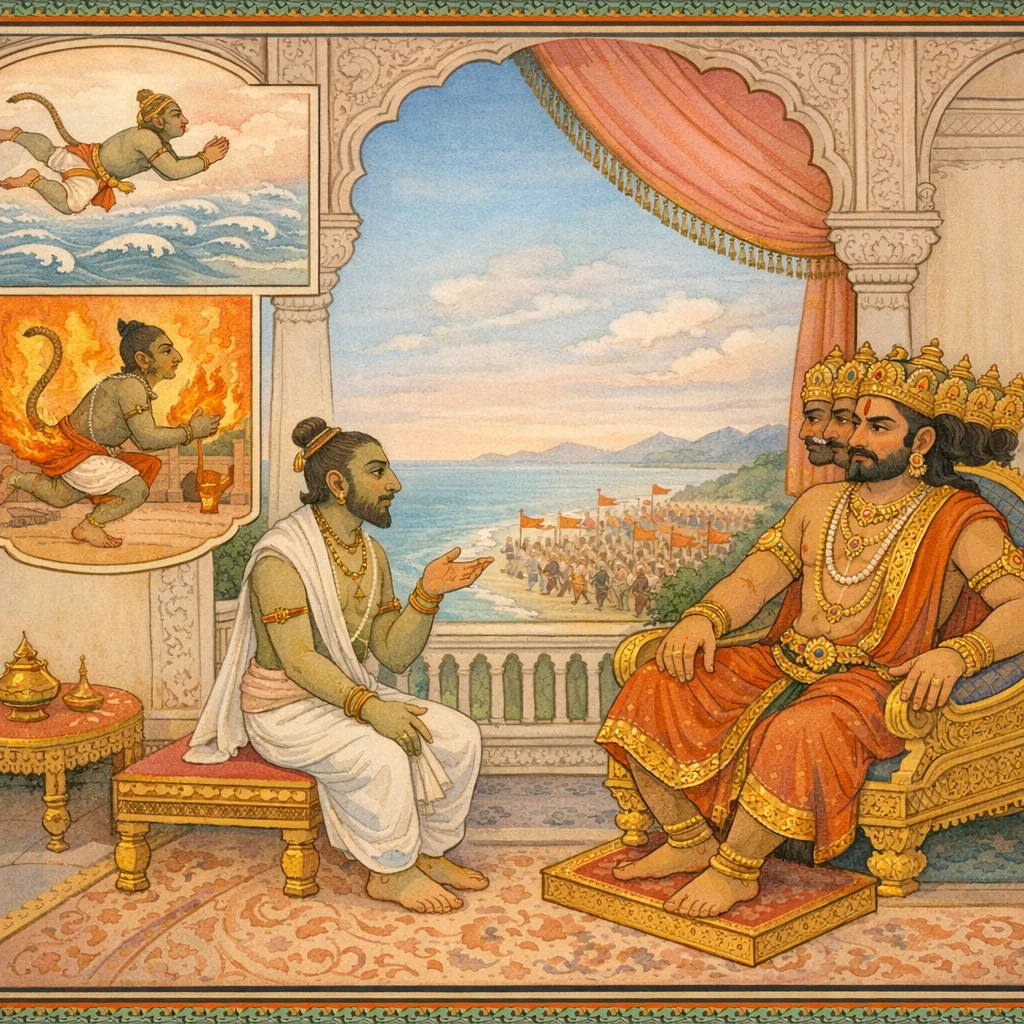
After Sāraṇa’s briefing, Śuka continues a structured intelligence report to Rāvaṇa, framing the approaching Vānara coalition as both tactically formidable and morally anchored. He first characterizes the Vānaras as hard to resist—shape-shifters with divine-like prowess—then identifies key leaders: Mainda and Dvivida as near-immortal combatants; Hanumān as wind-born, ocean-leaping, form-changing, and historically verified by his earlier mission to Laṅkā (including the tail-burning episode). Śuka then pivots to the human principals: Rāma as an Ikṣvāku atiratha whose dharma is unwavering and whose Brahmā-astras and archery are portrayed as world-piercing; Lakṣmaṇa as Rāma’s indispensable “right hand,” skilled in polity and warfare. Vibhīṣaṇa is noted on Rāma’s left as the consecrated king aligned against Rāvaṇa. The sarga further employs a numerical lexicon (śaṅkhu, mahāśaṅkhu, bṛnda, padma, kharva, samudra, ogha, mahaugha) to dramatize the army’s scale, culminating in an admonition: seeing this “blazing-planet-like” host, Rāvaṇa must exert supreme effort to avoid defeat.
Shlokas
Verse 1
साराणस्यवचश्श्रुत्वारावणंराक्षसाधिपम् ।बलमादिश्यतत्सर्वंशुकोवाक्यमथाब्रवीत् ।।6.28.1।।
After hearing Sāraṇa’s report, Śuka described in full the strength of the forces to Rāvaṇa, lord of the Rākṣasas, and then spoke further.
Verse 2
स्थितान्पश्यसियानेतान्मत्तानिवमहाद्विपान् ।न्यग्रोधानिवगाङ्गेयान् सालान् हैमवतानिव ।।6.28.2।।एतेदुष्प्रसहाराजन्बलिनःकामरूपिणः ।दैत्यदानवसङ्काशायुद्धेदेवपराक्रमाः ।।6.28.3।।
O King, you can see these forces standing firm—like mighty elephants in rut; like banyan trees by the Gaṅgā; like sāla-trees rooted in the Himālaya—steadfast and unshaken.
Verse 3
स्थितान्पश्यसियानेतान्मत्तानिवमहाद्विपान् ।न्यग्रोधानिवगाङ्गेयान् सालान् हैमवतानिव ।।6.28.2।।एतेदुष्प्रसहाराजन्बलिनःकामरूपिणः ।दैत्यदानवसङ्काशायुद्धेदेवपराक्रमाः ।।6.28.3।।
O King, these are hard to withstand—strong, able to take forms at will; resembling Daityas and Dānavas in appearance, yet in battle possessing the prowess of the gods.
Verse 4
एषांकोटिसहस्राणिनवपञ्चचसप्तच ।तथाशङ्खुसहस्राणितथाबृन्दशतानिच ।।6.28.4।।
Of these Vanaras, there are nine, five, and seven thousand crores; likewise, there are thousands of Shankus and hundreds of Vrindas.
Verse 5
एतेसुग्रीवसचिवाःकिष्किन्धानिलयास्सदा ।हरयोदेवगन्धर्वैरुत्पन्नाःकामरूपिणः ।।6.28.5।।
These monkeys, who are the ministers of Sugriva and always reside in Kishkindha, are born of celestial gods and Gandharvas, and possess the power to change their form at will.
Verse 6
यौतौपश्यसितिष्ठन्तौकुमारौदेवरूपिणौ ।मैन्दश्चद्विविदश्चोभौताभ्यांनास्तिसमोयुधि ।।6.28.6।।
Do you see those two standing there—youthful, godlike in form? They are Mainda and Dvivida; in battle there is none equal to those two.
Verse 7
ब्राह्मणासममज्ञातावमृतप्राशिनापुभौ ।आशंसेतेयुथालङ्कामेतौमर्दितुमोजसा ।।6.28.7।।
With Brahmā’s permission, both have drunk the nectar of immortality; as leaders of troops, these two expect—by their sheer might—to crush Laṅkā.
Verse 8
यंतुपश्यसितिष्टन्तंप्रभिन्नमिवकुञ्जरम् ।योबलात् क्षोभयेत् क्रुद्धस्समुद्रमपिवानरः ।।6.28.8।।एषोऽभिगन्तालङ्कायावैदेह्यास्तवचप्रभो: ।एनंपश्यपुरादृष्टंवानरंपुनरागतम् ।।6.28.9।।
But the one you see standing there, like a maddened elephant—when that Vānara is enraged, he could churn even the ocean by sheer force.
Verse 9
यंतुपश्यसितिष्टन्तंप्रभिन्नमिवकुञ्जरम् ।योबलात् क्षोभयेत् क्रुद्धस्समुद्रमपिवानरः ।।6.28.8।।एषोऽभिगन्तालङ्कायावैदेह्यास्तवचप्रभो: ।एनंपश्यपुरादृष्टंवानरंपुनरागतम् ।।6.28.9।।
This is the very Vānara who once entered Laṅkā, saw Vaidehī, and returned again. Look—he has come back once more, O Lord.
Verse 10
ज्येष्ठःकेसरिणःपुत्त्रोवातात्मजइतिश्रुतः ।हनूमानितिविख्यातोलङ्घितोयेनसागरः ।।6.28.10।।
He is said to be Kesarin’s eldest son, famed as the Wind-god’s offspring—known to the world as Hanumān, the one who leapt across the ocean.
Verse 11
कामरूपीहरिश्रेष्टोबलरूपसमन्वितः ।अनिवार्यगतिश्चैवयथासततगःप्रभुः ।।6.28.11।।
A foremost of the Vānaras, he can assume forms at will; endowed with strength and presence, his movement is irresistible—swift and unimpeded like the ever-moving wind.
Verse 12
उद्यन्तभास्करंदृष्टवाबालःकिलपिपासितः ।त्रियोजनसहस्रंतुअध्वानमवतीर्यहि ।।6.28.12।।आदित्यमाहरिष्यामिनमेक्षुत्प्रतियास्यति ।इतिसञ्चिन्त्यमनसापुरैषबलदर्पितः ।।6.28.13।।
As a child, it is said, when hunger seized him and he saw the rising sun, he set out and traversed three thousand yojanas, thinking, “I will seize the Sun—only then will my hunger be satisfied,” and he sprang forth, proud of his strength.
Verse 13
उद्यन्तभास्करंदृष्टवाबालःकिलपिपासितः ।त्रियोजनसहस्रंतुअध्वानमवतीर्यहि ।।6.28.12।।आदित्यमाहरिष्यामिनमेक्षुत्प्रतियास्यति ।इतिसञ्चिन्त्यमनसापुरैषबलदर्पितः ।।6.28.13।।
Though the Sun is most unassailable—even for gods, seers, and Dānavas—he fell, as if unable to attain it, upon a mountain near the Sun’s rising quarter.
Verse 14
अनाधृष्यतमंदेवमपिदेवर्षिदानवैः ।अनासाघैवपतितोभास्करोदयनेगिरौ ।।6.28.14।।
Though the Sun is most unassailable—even for gods, seers, and Dānavas—he fell, as if unable to attain it, upon a mountain near the Sun’s rising quarter.
Verse 15
पतितस्यकपेरस्यहनुरेकाशिलातले ।किञ्चिद्भिन्नादृढहनोर्हनूमानेषतेनवै ।।6.28.15।।
When that monkey fell upon the rock-surface, one jaw was slightly broken; therefore he—firm-jawed though he is—is indeed called Hanūmān.
Verse 16
सत्यमागमयोगेनममैषविदितोहरिः ।नास्यशक्यंबलंरूपंप्रभावोवाऽपिभाषितम् ।।6.28.16।।
Truly, through reliable sources I have come to know this Vānara; his strength, his form, and even his might cannot be adequately described.
Verse 17
एषआशंसतेलङ्कामेकोमर्दितुमोजसा ।येवजाज्वल्यतेऽपौवैधूमकेतुस्तवाद्यवै ।।6.28.17।।लङ्कायांनिहितश्चापिकथंविस्मरसेकपिम् ।
He intends, by his own prowess, to crush Laṅkā single-handed. How can you forget that very monkey—whose tail was set ablaze just now by Dhūmaketu, acting on your orders in Laṅkā?
Verse 18
यश्चैषोऽनन्तरश्शूरश्श्यामःपद्मनिभेक्षणः ।इक्ष्वाकूणामतिरथोलोकेविख्यातपौरुष ।।6.28.18।।यस्मिन्नचलतेधर्मोयोधर्मंनातिवर्तते ।योब्राह्ममस्त्रंवेदांश्चवेदवेदविदांवरः ।।6.28.19।।योभिन्द्याद्गगनंबाणैःपर्वतांश्चापिदारयेत् ।यस्यमृत्योरिवक्रोधश्शक्रस्येवपराक्रमः ।।6.28.20।।यस्यभार्याजनस्थानात्सीताचापिहृतात्वया ।सएषरामस्त्वांयोद्धुंराजन्समभिवर्तते ।।6.28.21।।
And near him stands that heroic warrior—dark-hued, lotus-eyed—an unsurpassed chariot-fighter of the Ikṣvāku line, famed in the world for his manliness. In him dharma stands unwavering; he does not transgress righteousness. He knows the Brahmā-ordained weapons and the Vedas, foremost among those who know sacred knowledge. With his arrows he could pierce the sky and split even mountains; his wrath is like Death itself, and his valor like Indra’s. It is his wife Sītā whom you carried off from Jana-sthāna—this is that very Rāma, O king, who now advances to fight you.
Verse 19
यश्चैषोऽनन्तरश्शूरश्श्यामःपद्मनिभेक्षणः ।इक्ष्वाकूणामतिरथोलोकेविख्यातपौरुष ।।6.28.18।।यस्मिन्नचलतेधर्मोयोधर्मंनातिवर्तते ।योब्राह्ममस्त्रंवेदांश्चवेदवेदविदांवरः ।।6.28.19।।योभिन्द्याद्गगनंबाणैःपर्वतांश्चापिदारयेत् ।यस्यमृत्योरिवक्रोधश्शक्रस्येवपराक्रमः ।।6.28.20।।यस्यभार्याजनस्थानात्सीताचापिहृतात्वया ।सएषरामस्त्वांयोद्धुंराजन्समभिवर्तते ।।6.28.21।।
O King—this hero, dark-hued and lotus-eyed, renowned in the world for his prowess, a foremost chariot-warrior of the Ikṣvāku line—he is one in whom dharma stands firm, who does not overstep righteousness; who knows the Vedas and is foremost among the knowers of the Veda; who knows the Brahmā-weapon; whose arrows could pierce the sky and even split mountains; whose wrath is like Death itself and whose valor is like Indra’s—whose wife Sītā was carried off by you from Jana-sthāna: that very Rāma is now advancing, O King, to fight you.
Verse 20
यश्चैषोऽनन्तरश्शूरश्श्यामःपद्मनिभेक्षणः ।इक्ष्वाकूणामतिरथोलोकेविख्यातपौरुष ।।6.28.18।।यस्मिन्नचलतेधर्मोयोधर्मंनातिवर्तते ।योब्राह्ममस्त्रंवेदांश्चवेदवेदविदांवरः ।।6.28.19।।योभिन्द्याद्गगनंबाणैःपर्वतांश्चापिदारयेत् ।यस्यमृत्योरिवक्रोधश्शक्रस्येवपराक्रमः ।।6.28.20।।यस्यभार्याजनस्थानात्सीताचापिहृतात्वया ।सएषरामस्त्वांयोद्धुंराजन्समभिवर्तते ।।6.28.21।।
O King—this hero, dark-hued and lotus-eyed, renowned in the world for his prowess, a foremost chariot-warrior of the Ikṣvāku line—he is one in whom dharma stands firm, who does not overstep righteousness; who knows the Vedas and is foremost among the knowers of the Veda; who knows the Brahmā-weapon; whose arrows could pierce the sky and even split mountains; whose wrath is like Death itself and whose valor is like Indra’s—whose wife Sītā was carried off by you from Jana-sthāna: that very Rāma is now advancing, O King, to fight you.
Verse 21
यश्चैषोऽनन्तरश्शूरश्श्यामःपद्मनिभेक्षणः ।इक्ष्वाकूणामतिरथोलोकेविख्यातपौरुष ।।6.28.18।।यस्मिन्नचलतेधर्मोयोधर्मंनातिवर्तते ।योब्राह्ममस्त्रंवेदांश्चवेदवेदविदांवरः ।।6.28.19।।योभिन्द्याद्गगनंबाणैःपर्वतांश्चापिदारयेत् ।यस्यमृत्योरिवक्रोधश्शक्रस्येवपराक्रमः ।।6.28.20।।यस्यभार्याजनस्थानात्सीताचापिहृतात्वया ।सएषरामस्त्वांयोद्धुंराजन्समभिवर्तते ।।6.28.21।।
O King—this hero, dark-hued and lotus-eyed, renowned in the world for his prowess, a foremost chariot-warrior of the Ikṣvāku line—he is one in whom dharma stands firm, who does not overstep righteousness; who knows the Vedas and is foremost among the knowers of the Veda; who knows the Brahmā-weapon; whose arrows could pierce the sky and even split mountains; whose wrath is like Death itself and whose valor is like Indra’s—whose wife Sītā was carried off by you from Jana-sthāna: that very Rāma is now advancing, O King, to fight you.
Verse 22
यस्यैषदक्षिणेपार्श्वेशुद्धजाम्बूनदप्रभः ।विशालवक्षास्ताम्राक्षोनीलकुञ्जितमूर्धजः ।।6.28.22।।एषोऽस्यलक्ष्मणोनामभ्राताप्राणसमःप्रियः ।नयेयुद्धेचकुशलस्सर्वशस्त्रभृतंवरः ।।6.28.23।।
On his right side stands one radiant like pure Jāmbūnada-gold—broad-chested, copper-eyed, with dark, curling hair.
Verse 23
यस्यैषदक्षिणेपार्श्वेशुद्धजाम्बूनदप्रभः ।विशालवक्षास्ताम्राक्षोनीलकुञ्जितमूर्धजः ।।6.28.22।।एषोऽस्यलक्ष्मणोनामभ्राताप्राणसमःप्रियः ।नयेयुद्धेचकुशलस्सर्वशस्त्रभृतंवरः ।।6.28.23।।
This is his brother, named Lakṣmaṇa—dear to him as life itself; skilled in statecraft and in war, the finest among all weapon-bearers.
Verse 24
अमर्षीदुर्जयोजेताविक्रान्तोबुद्धिमान् बली ।रामस्यदक्षिणोबाहुर्नित्यंप्राणोबहिश्चरः ।।6.28.24।।
Unforbearing toward enemies, hard to conquer, victorious; bold, intelligent, and strong—he is Rama’s right arm, ever like his outward-moving life-breath.
Verse 25
नह्येषराघवस्यार्थेजीवितंपरिरक्षति ।एषैवाशंसतेयुद्धेनिहन्तुंसर्वराक्षसान् ।।6.28.25।।
For Rama’s cause, he does not guard even his own life; indeed, in battle he is resolved to destroy all the Rākṣasas.
Verse 26
यस्तुसव्यमसौपक्षंरामस्याश्रित्यतिष्ठति ।रक्षोगणपरिक्षिप्तोराजाह्येषविभीषणः ।।6.28.26।।
And he who stands on Rama’s left, having taken refuge in him—surrounded by bands of Rākṣasas—is the king Vibhīṣaṇa.
Verse 27
श्रीमताराजराजेनलङ्कायामभिषेचितः ।त्वामेवप्रतिसंरब्दोयुद्धायैषोऽभिवर्तते ।।6.28.27।।
And he who stands on Rama’s left, having taken refuge in him—surrounded by bands of Rākṣasas—is the king Vibhīṣaṇa.
Verse 28
यंतुपस्यसितिष्ठन्तंमध्येगिरिमिवाचलम् ।सर्वशाखामृगेन्द्राणांभर्तारममितौजसम् ।।6.28.28।।तेजयशसाबुद् ध्याज्ञानेनाभिजनेनच ।यःकपीनतिबभ्राजहिमवानिवपर्वतान् ।।6.28.29।।किष्किन्धांयस्समध्यास्तेगुहांसगहनद्रुमाम् ।दुर्गांपर्वतदुर्गस्तांप्रधानैस्सहयूथपैः ।।6.28.30।।यस्यैषाकाञ्चनीमालाशोभितेशतपुष्करा ।कान्तादेवमनुष्याणांयस्यांलक्ष्मीप्रतिष्ठिता ।।6.28.31।।एतांचमालांतारांचकपिराज्यंचशाश्वतम् ।सुग्रीवोवालिनंहत्वारामेणप्रतिपादितः ।।6.28.32।।
But the one you see standing in the midst—steady like an unmoving mountain—is the lord of all the monkey-chiefs, a leader of immeasurable vigor.
Verse 29
यंतुपस्यसितिष्ठन्तंमध्येगिरिमिवाचलम् ।सर्वशाखामृगेन्द्राणांभर्तारममितौजसम् ।।6.28.28।।तेजयशसाबुद् ध्याज्ञानेनाभिजनेनच ।यःकपीनतिबभ्राजहिमवानिवपर्वतान् ।।6.28.29।।किष्किन्धांयस्समध्यास्तेगुहांसगहनद्रुमाम् ।दुर्गांपर्वतदुर्गस्तांप्रधानैस्सहयूथपैः ।।6.28.30।।यस्यैषाकाञ्चनीमालाशोभितेशतपुष्करा ।कान्तादेवमनुष्याणांयस्यांलक्ष्मीप्रतिष्ठिता ।।6.28.31।।एतांचमालांतारांचकपिराज्यंचशाश्वतम् ।सुग्रीवोवालिनंहत्वारामेणप्रतिपादितः ।।6.28.32।।
By splendor, fame, intellect, wisdom, and noble lineage, he outshone the other monkeys—just as Himavān outshines the mountains.
Verse 30
यंतुपस्यसितिष्ठन्तंमध्येगिरिमिवाचलम् ।सर्वशाखामृगेन्द्राणांभर्तारममितौजसम् ।।6.28.28।।तेजयशसाबुद् ध्याज्ञानेनाभिजनेनच ।यःकपीनतिबभ्राजहिमवानिवपर्वतान् ।।6.28.29।।किष्किन्धांयस्समध्यास्तेगुहांसगहनद्रुमाम् ।दुर्गांपर्वतदुर्गस्तांप्रधानैस्सहयूथपैः ।।6.28.30।।यस्यैषाकाञ्चनीमालाशोभितेशतपुष्करा ।कान्तादेवमनुष्याणांयस्यांलक्ष्मीप्रतिष्ठिता ।।6.28.31।।एतांचमालांतारांचकपिराज्यंचशाश्वतम् ।सुग्रीवोवालिनंहत्वारामेणप्रतिपादितः ।।6.28.32।।
He dwells in Kiṣkindhā, in a cave-fort amid dense trees—hard to approach, set within mountain strongholds—together with his foremost troop-leaders.
Verse 31
यंतुपस्यसितिष्ठन्तंमध्येगिरिमिवाचलम् ।सर्वशाखामृगेन्द्राणांभर्तारममितौजसम् ।।6.28.28।।तेजयशसाबुद् ध्याज्ञानेनाभिजनेनच ।यःकपीनतिबभ्राजहिमवानिवपर्वतान् ।।6.28.29।।किष्किन्धांयस्समध्यास्तेगुहांसगहनद्रुमाम् ।दुर्गांपर्वतदुर्गस्तांप्रधानैस्सहयूथपैः ।।6.28.30।।यस्यैषाकाञ्चनीमालाशोभितेशतपुष्करा ।कान्तादेवमनुष्याणांयस्यांलक्ष्मीप्रतिष्ठिता ।।6.28.31।।एतांचमालांतारांचकपिराज्यंचशाश्वतम् ।सुग्रीवोवालिनंहत्वारामेणप्रतिपादितः ।।6.28.32।।
This golden garland of his shines like a hundred lotuses; it is beloved even of gods and men—on it, as it were, Fortune (Lakṣmī) stands established.
Verse 32
यंतुपस्यसितिष्ठन्तंमध्येगिरिमिवाचलम् ।सर्वशाखामृगेन्द्राणांभर्तारममितौजसम् ।।6.28.28।।तेजयशसाबुद् ध्याज्ञानेनाभिजनेनच ।यःकपीनतिबभ्राजहिमवानिवपर्वतान् ।।6.28.29।।किष्किन्धांयस्समध्यास्तेगुहांसगहनद्रुमाम् ।दुर्गांपर्वतदुर्गस्तांप्रधानैस्सहयूथपैः ।।6.28.30।।यस्यैषाकाञ्चनीमालाशोभितेशतपुष्करा ।कान्तादेवमनुष्याणांयस्यांलक्ष्मीप्रतिष्ठिता ।।6.28.31।।एतांचमालांतारांचकपिराज्यंचशाश्वतम् ।सुग्रीवोवालिनंहत्वारामेणप्रतिपादितः ।।6.28.32।।
This garland, and Tārā, and the lasting kingship of the monkeys—Sugrīva received all these from Rāma after Vālin had been slain.
Verse 33
शतंशतसहस्राणांकोटिमाहुर्मनीषिणः ।शतंकोटिसहस्राणांशङ्कु: इत्यभिधीयते ।।6.28.33।।
The wise say that a hundred times a hundred-thousand is called a koṭi; and a hundred times a thousand koṭis is termed a śaṅku.
Verse 34
शतंशङ्कुसहस्राणांमहाशङ्कु: इतिस्मृतः ।।6.28.34।।महाशङ्कुसहस्राणांशतंबृन्दमिहोच्यते ।शतंबृन्दसहस्राणांमहावृन्दमितिस्मृतम् ।।6.28.35।।महाबृन्दसहस्राणांशतंपद्ममिहोच्यते ।शतंपद्मसहस्राणांमहापद्ममितिस्मृतिम् ।।6.28.36।।महापद्मसहस्राणांशतंखर्वमिहोच्यते ।शतंखर्वसहस्राणांमहाखर्वमिवोच्यते ।।6.28.37।।महाखर्वसहस्राणांसमुद्रमभिधीयते ।तंसमुद्रसाहस्रमोघइत्यभिधीयते ।।6.28.38।।शतमोघसहस्राणांमहौघइतिविश्रुतः ।
A hundred thousand śaṅkus are remembered as one mahāśaṅku.
Verse 35
शतंशङ्कुसहस्राणांमहाशङ्कु: इतिस्मृतः ।।6.28.34।।महाशङ्कुसहस्राणांशतंबृन्दमिहोच्यते ।शतंबृन्दसहस्राणांमहावृन्दमितिस्मृतम् ।।6.28.35।।महाबृन्दसहस्राणांशतंपद्ममिहोच्यते ।शतंपद्मसहस्राणांमहापद्ममितिस्मृतिम् ।।6.28.36।।महापद्मसहस्राणांशतंखर्वमिहोच्यते ।शतंखर्वसहस्राणांमहाखर्वमिवोच्यते ।।6.28.37।।महाखर्वसहस्राणांसमुद्रमभिधीयते ।तंसमुद्रसाहस्रमोघइत्यभिधीयते ।।6.28.38।।शतमोघसहस्राणांमहौघइतिविश्रुतः ।
A hundred thousand mahāśaṅkus are here called a bṛnda; and a hundred thousand bṛndas are known as a mahāvṛnda.
Verse 36
शतंशङ्कुसहस्राणांमहाशङ्कु: इतिस्मृतः ।।6.28.34।।महाशङ्कुसहस्राणांशतंबृन्दमिहोच्यते ।शतंबृन्दसहस्राणांमहावृन्दमितिस्मृतम् ।।6.28.35।।महाबृन्दसहस्राणांशतंपद्ममिहोच्यते ।शतंपद्मसहस्राणांमहापद्ममितिस्मृतिम् ।।6.28.36।।महापद्मसहस्राणांशतंखर्वमिहोच्यते ।शतंखर्वसहस्राणांमहाखर्वमिवोच्यते ।।6.28.37।।महाखर्वसहस्राणांसमुद्रमभिधीयते ।तंसमुद्रसाहस्रमोघइत्यभिधीयते ।।6.28.38।।शतमोघसहस्राणांमहौघइतिविश्रुतः ।
A hundred thousand mahābṛndas are here called a padma; and a hundred thousand padmas are known as a mahāpadma.
Verse 37
शतंशङ्कुसहस्राणांमहाशङ्कु: इतिस्मृतः ।।6.28.34।।महाशङ्कुसहस्राणांशतंबृन्दमिहोच्यते ।शतंबृन्दसहस्राणांमहावृन्दमितिस्मृतम् ।।6.28.35।।महाबृन्दसहस्राणांशतंपद्ममिहोच्यते ।शतंपद्मसहस्राणांमहापद्ममितिस्मृतिम् ।।6.28.36।।महापद्मसहस्राणांशतंखर्वमिहोच्यते ।शतंखर्वसहस्राणांमहाखर्वमिवोच्यते ।।6.28.37।।महाखर्वसहस्राणांसमुद्रमभिधीयते ।तंसमुद्रसाहस्रमोघइत्यभिधीयते ।।6.28.38।।शतमोघसहस्राणांमहौघइतिविश्रुतः ।
Here it is stated that a hundred thousand Mahāpadmas are called a Kharva; and that a hundred thousand Kharvas are in turn spoken of as a Mahākharva.
Verse 38
शतंशङ्कुसहस्राणांमहाशङ्कु: इतिस्मृतः ।।6.28.34।।महाशङ्कुसहस्राणांशतंबृन्दमिहोच्यते ।शतंबृन्दसहस्राणांमहावृन्दमितिस्मृतम् ।।6.28.35।।महाबृन्दसहस्राणांशतंपद्ममिहोच्यते ।शतंपद्मसहस्राणांमहापद्ममितिस्मृतिम् ।।6.28.36।।महापद्मसहस्राणांशतंखर्वमिहोच्यते ।शतंखर्वसहस्राणांमहाखर्वमिवोच्यते ।।6.28.37।।महाखर्वसहस्राणांसमुद्रमभिधीयते ।तंसमुद्रसाहस्रमोघइत्यभिधीयते ।।6.28.38।।शतमोघसहस्राणांमहौघइतिविश्रुतः ।
A hundred thousand Mahākharvas are called a Samudra; and a hundred thousand Samudras are called an Ogha. A hundred thousand Oghas are renowned as a Mahaugha.
Verse 39
एवंकोटिसहस्रेणशङ्कूनांचशतेनच ।।6.28.39।।महाशङ्कुसहस्रेणतथाबृन्दशतेनच ।महाबृन्दसहस्रेणतथापद्मशतेनच ।।6.28.40।।हापद्मसहस्रेणतथाखर्वशतेनच ।समुद्रेणचतेनैवमहौघेनतथैवच ।।6.28.41।।एषकोटिमहौघेनसमुद्रसदृशेनच ।विभीषणेनसचिवैःराक्षसैःपरिवारितः ।।6.28.42।।सुग्रीवोवानरेन्द्रस्त्वांयुद्धार्थममवर्तते ।महाबलवृतोनित्यंमहाबलपराक्रमः ।।6.28.43।।
Thus, in countless and ever-increasing divisions—Śaṅkus, Mahāśaṅkus, Bṛndas, Mahābṛndas, Padmas, Mahāpadmas, Kharvas, Samudras, Oghas, and Mahaughas—an ocean-like host advances. Surrounded by Vibhīṣaṇa together with his ministers and the rākṣasas (who have joined him), Sugrīva, lord of the vānaras, follows behind you for the sake of battle—always encompassed by mighty forces and possessed of great strength and valor.
Verse 40
एवंकोटिसहस्रेणशङ्कूनांचशतेनच ।।6.28.39।।महाशङ्कुसहस्रेणतथाबृन्दशतेनच ।महाबृन्दसहस्रेणतथापद्मशतेनच ।।6.28.40।।हापद्मसहस्रेणतथाखर्वशतेनच ।समुद्रेणचतेनैवमहौघेनतथैवच ।।6.28.41।।एषकोटिमहौघेनसमुद्रसदृशेनच ।विभीषणेनसचिवैःराक्षसैःपरिवारितः ।।6.28.42।।सुग्रीवोवानरेन्द्रस्त्वांयुद्धार्थममवर्तते ।महाबलवृतोनित्यंमहाबलपराक्रमः ।।6.28.43।।
Thus, in countless and ever-increasing divisions—Śaṅkus, Mahāśaṅkus, Bṛndas, Mahābṛndas, Padmas, Mahāpadmas, Kharvas, Samudras, Oghas, and Mahaughas—an ocean-like host advances. Surrounded by Vibhīṣaṇa together with his ministers and the rākṣasas (who have joined him), Sugrīva, lord of the vānaras, follows behind you for the sake of battle—always encompassed by mighty forces and possessed of great strength and valor.
Verse 41
एवंकोटिसहस्रेणशङ्कूनांचशतेनच ।।6.28.39।।महाशङ्कुसहस्रेणतथाबृन्दशतेनच ।महाबृन्दसहस्रेणतथापद्मशतेनच ।।6.28.40।।हापद्मसहस्रेणतथाखर्वशतेनच ।समुद्रेणचतेनैवमहौघेनतथैवच ।।6.28.41।।एषकोटिमहौघेनसमुद्रसदृशेनच ।विभीषणेनसचिवैःराक्षसैःपरिवारितः ।।6.28.42।।सुग्रीवोवानरेन्द्रस्त्वांयुद्धार्थममवर्तते ।महाबलवृतोनित्यंमहाबलपराक्रमः ।।6.28.43।।
Thus, in countless and ever-increasing divisions—Śaṅkus, Mahāśaṅkus, Bṛndas, Mahābṛndas, Padmas, Mahāpadmas, Kharvas, Samudras, Oghas, and Mahaughas—an ocean-like host advances. Surrounded by Vibhīṣaṇa together with his ministers and the rākṣasas (who have joined him), Sugrīva, lord of the vānaras, follows behind you for the sake of battle—always encompassed by mighty forces and possessed of great strength and valor.
Verse 42
एवंकोटिसहस्रेणशङ्कूनांचशतेनच ।।6.28.39।।महाशङ्कुसहस्रेणतथाबृन्दशतेनच ।महाबृन्दसहस्रेणतथापद्मशतेनच ।।6.28.40।।हापद्मसहस्रेणतथाखर्वशतेनच ।समुद्रेणचतेनैवमहौघेनतथैवच ।।6.28.41।।एषकोटिमहौघेनसमुद्रसदृशेनच ।विभीषणेनसचिवैःराक्षसैःपरिवारितः ।।6.28.42।।सुग्रीवोवानरेन्द्रस्त्वांयुद्धार्थममवर्तते ।महाबलवृतोनित्यंमहाबलपराक्रमः ।।6.28.43।।
Thus, in countless and ever-increasing divisions—Śaṅkus, Mahāśaṅkus, Bṛndas, Mahābṛndas, Padmas, Mahāpadmas, Kharvas, Samudras, Oghas, and Mahaughas—an ocean-like host advances. Surrounded by Vibhīṣaṇa together with his ministers and the rākṣasas (who have joined him), Sugrīva, lord of the vānaras, follows behind you for the sake of battle—always encompassed by mighty forces and possessed of great strength and valor.
Verse 43
एवंकोटिसहस्रेणशङ्कूनांचशतेनच ।।6.28.39।।महाशङ्कुसहस्रेणतथाबृन्दशतेनच ।महाबृन्दसहस्रेणतथापद्मशतेनच ।।6.28.40।।हापद्मसहस्रेणतथाखर्वशतेनच ।समुद्रेणचतेनैवमहौघेनतथैवच ।।6.28.41।।एषकोटिमहौघेनसमुद्रसदृशेनच ।विभीषणेनसचिवैःराक्षसैःपरिवारितः ।।6.28.42।।सुग्रीवोवानरेन्द्रस्त्वांयुद्धार्थममवर्तते ।महाबलवृतोनित्यंमहाबलपराक्रमः ।।6.28.43।।
Thus, in countless and ever-increasing divisions—Śaṅkus, Mahāśaṅkus, Bṛndas, Mahābṛndas, Padmas, Mahāpadmas, Kharvas, Samudras, Oghas, and Mahaughas—an ocean-like host advances. Surrounded by Vibhīṣaṇa together with his ministers and the rākṣasas (who have joined him), Sugrīva, lord of the vānaras, follows behind you for the sake of battle—always encompassed by mighty forces and possessed of great strength and valor.
Verse 44
इमांमहाराजसमीक्ष्यवाहिनीमुपस्थितांप्रज्वलितग्रहोपमाम् ।ततःप्रयत्नःपरमोविधीयतांयथाजयस्स्यान्नपरैःपराजयः ।।6.28.44।।
O great king, seeing this army drawn up close—terrible like a blazing planet—let the highest effort be undertaken, so that victory may be ours, and not defeat at the hands of the enemy.
Frequently Asked Questions
The pivotal action is counsel-as-warning: Śuka urges Rāvaṇa to interpret reconnaissance truthfully and respond with disciplined effort rather than pride. The ethical tension lies in whether a ruler will accept accurate intelligence and dharmic consequences, or continue adharma despite clear indicators of impending defeat.
Power must be evaluated through both capability and moral alignment: the sarga frames dharma as a stabilizing force (Rāma’s non-transgression) and portrays adharma as strategically self-destructive. It also models responsible speech—precise identification, evidence (Hanumān’s prior mission), and proportional urgency in advising a king.
Key landmarks include Laṅkā as the contested polity, Kiṣkindhā as Sugrīva’s stronghold, Janasthāna as the site linked to Sītā’s abduction narrative, and the Ocean as the boundary crossed by Hanumān—each functioning as a map-node for alliance, transgression, and military approach.