Sarga 24
लङ्कानिरीक्षणं व्यूहविन्यासश्च (Survey of Lanka and Deployment of the Battle Formation)
युद्धकाण्ड
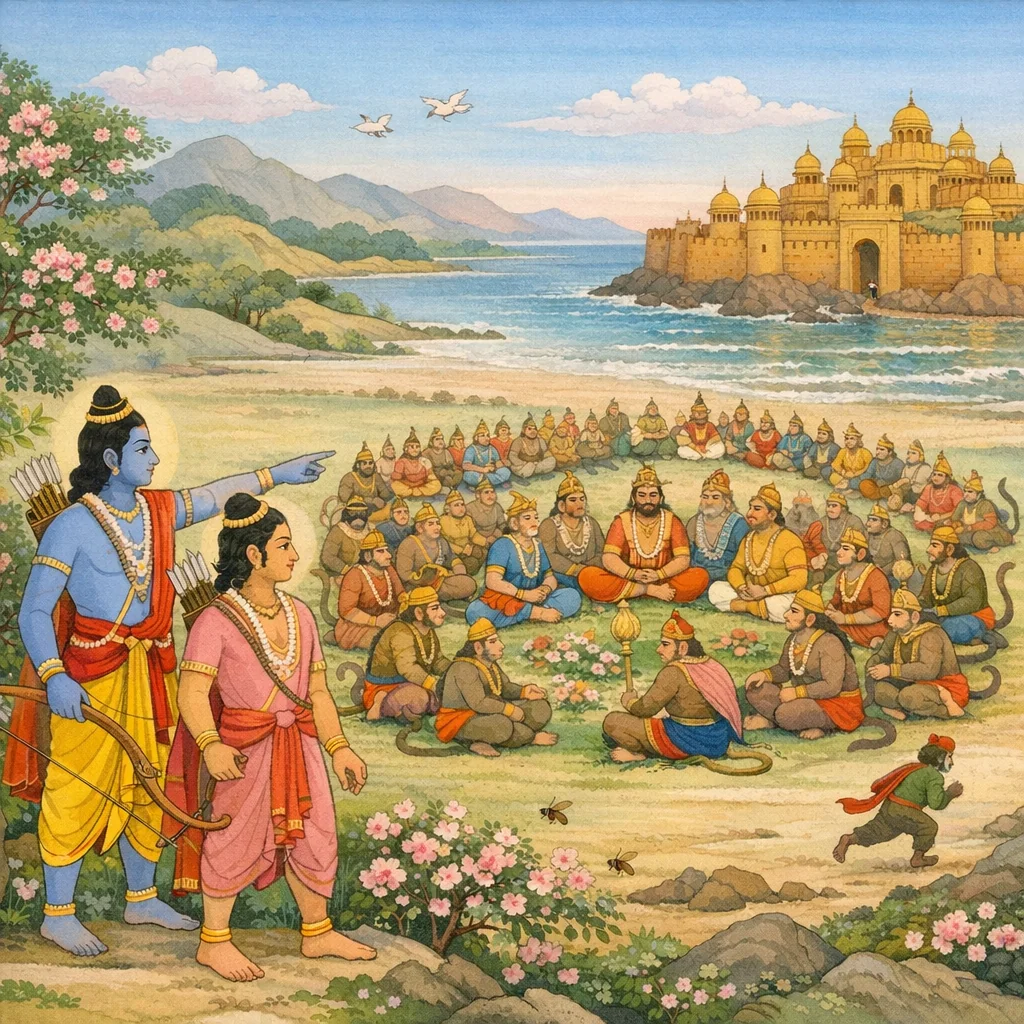
Sarga 24 stages the threshold moment before open battle. The Vanara host, settled by Rāma’s command, is likened to an autumnal full moon amid auspicious stars, then surges forward with oceanic force, shaking the earth. From Laṅkā come terrifying drum-resonances; the Vanaras answer with louder roars, matched by Rākṣasa alarm. Rāma, sorrowing for Sītā, points out Laṅkā’s elevated, sky-clasping architecture and its garden splendor—white-cloud-like vimānas, Chaitraratha-like groves, and trees alive with birds, cuckoos, and bees. He then directs a śāstra-aligned military division (vyūha): Angada with Nīla at the center, Ṛṣabha on the southern flank, Gandhamādana on the right flank, while Rāma and Lakṣmaṇa hold the head; Jāmbavān and Suṣeṇa with bear chiefs guard the ‘belly,’ and Sugrīva protects the rear. The organized army shines like cloud-masses in heaven, and Vanaras arm themselves with mountain-peaks and trees to pulverize Laṅkā. With the formation complete, the envoy Śuka is released and returns terrified to Rāvaṇa. Śuka reports the Vanaras’ fury, Rāma’s arrival after bridge-building, and urges immediate choice: return Sītā or prepare for war. Rāvaṇa responds with red-eyed wrath and boasts—refusing to yield Sītā even against gods, and proclaiming the irresistible ‘fire’ of his arrows—thereby sealing the inevitability of conflict.
Shlokas
Verse 1
सावीरसमितीराज्ञाविरराजव्यवस्थिता ।शशिनाशुभनक्षत्रापौर्णमासीवशारदी ।।।।
Thus arrayed and made to take position by the king, that assembly of heroes shone—like an autumn full-moon night bright with the moon and auspicious stars.
Verse 2
प्रचचालचवेगेनत्रस्ताचैववसुन्धरा ।पीड्यमानाबलौघेनतेनसागरवर्चसा ।।।।
Then the earth itself, as though alarmed, shook under the swift surge of that vast host whose might resembled the ocean.
Verse 3
ततश्शुश्रुवुराक्रुष्टंलङ्कायांकाननौकसः ।भेरीमृदङ्गसङ्घुष्टंतुमुलंरोमहर्षणम् ।।।।
Then the forest-dwelling hosts heard from within Laṅkā a fierce, tumultuous uproar—resounding with kettledrums and mṛdaṅgas—so dreadful that it made the hair stand on end.
Verse 4
बभूवुस्तेनघोषेणसंहृष्टाहरियूथपाः ।अमृष्यमाणास्तंघोषंविनेदुर्घोषवत्तरम् ।।।।
Roused by that clamour, the leaders of the vānaras were exhilarated; unable to bear that challenge, they roared back with an even greater roar.
Verse 5
राक्षसास्तुप्लवङ्गानांशुश्रुवुश्चाऽपिगर्जितम् ।नर्दतामिवदृप्तानांमेघानामम्बरेस्वनम् ।।।।
Even the Rākṣasas heard the Vanaras’ roar—like the thunderous sound of proud clouds bellowing across the sky.
Verse 6
दृष्टवादाशरथिर्लङ्कांचित्रध्वजपताकिनीम् ।जगाममनसासीतंदूयमानेनचेतसा ।।।।
Seeing Laṅkā adorned with varied banners and flags, Rāma (son of Daśaratha), his heart pained with sorrow, turned his mind again to Sītā.
Verse 7
अत्रसामृगशाबाक्षीरावणेनोपरुध्यते ।अभिभूताग्रहेणेवलोहिताङ्गेनरोहिणी ।।।।
Here, the doe-eyed Sītā is being held in restraint by Rāvaṇa—like Rohiṇī overwhelmed by a planet of red hue.
Verse 8
दीर्घमुष्णंचनिश्वस्यसमुद्वीक्ष्यचलक्ष्मणम् ।उवाचवचनंवीरस्तत्कालहितमात्मनः ।।।।
Drawing a long, heated breath and looking intently at Lakṣmaṇa, the heroic Rāma spoke words that were timely and beneficial for the moment.
Verse 9
आलिखन्तीमिवाकाशमुत्थितांपश्यलक्ष्मण ।मनसेवकृतांलङ्कांनगाग्रेविश्वकर्मणा ।।।।
“Look, Lakṣmaṇa—Laṅkā rises upon the mountain’s summit as though scratching the sky, as if Viśvakarman had fashioned it in the mind itself.”
Verse 10
विमानैर्बहुभिर्लङ्कासङ्कीर्णाभुविराजते ।विष्णोःपदमिवाकाशंछादितंपाण्डुभिर्घनैः ।।।।
Crowded with many aerial mansions, Laṅkā shines upon the earth—like the sky, the ‘path/step of Viṣṇu,’ covered with pale-white clouds.
Verse 11
पुष्पितैश्शोभितालङ्कावनैश्चत्ररथोपमैः ।नानापतगसङ्घुष्टै: फलपुष्पोपगैश्शुभैः ।।।।
Laṅkā is beautified by flowering groves, like the wondrous Citraratha garden; auspicious woods, rich with fruits and blossoms, resound with the calls of many kinds of birds.
Verse 12
पश्यमत्तविहाङ्गानिप्रलीनभ्रमराणिच ।कोकिलाकुलषण्डानिदोधवीतिशिवोऽनिलः ।।।।
See—there are proud birds and swarms of bees absorbed in the blossoms; clusters filled with cuckoos sway as a gentle, pleasant breeze shakes them.
Verse 13
इतिदाशरथीरामोलक्ष्मणंसमभाषत ।बलंचतद्वैविभजन् शास्त्रदृष्टेनकर्मणा ।।।।
Thus did Rāma, son of Daśaratha, speak to Lakṣmaṇa; and then, in accordance with the methods taught in the śāstras, he proceeded to apportion and organize that army for its tasks.
Verse 14
शशासकपिसेनायांबलमादायवीर्यवान् ।अङ्गदस्सहनीलेनतिष्ठेदुरसिदुर्जयः ।।।।
Let the valiant Angada—hard to overcome and a terror to foes—take charge of the Vanara host together with Nīla, and hold position at the army’s centre.
Verse 15
तिष्ठेद्वानरवाहिन्यावानरौघसमावृतः ।आश्रित्यदक्षिणंपार्श्वमृषभोवानरर्षभ:।। ।।
Let Ṛṣabha—foremost among the Vanaras—surrounded by his troop, take position on the army’s southern flank and hold it firm.
Verse 16
गन्धहस्तीवदुर्धर्षस्तरस्वीगन्धमादनः ।तिष्ठेद्वानरवाहिन्यास्सव्यंपार्श्वंसमाश्रित:।। ।।
Let the powerful Gandhamādana—unyielding like a proud elephant—take up the army’s left flank and stand fast there.
Verse 17
मूर्ध्निस्थास्याम्यहंयुक्तोलक्ष्मणेनसमन्वितः ।जाम्बवांश्चसुषेणश्चवेगदर्शीचवानरः ।।।।ऋक्षमुख्यामहात्मानःकुक्षिंरक्षन्तुतेत्रयः ।
I myself, fully prepared and together with Lakṣmaṇa, will stand at the head. Let Jāmbavān, Suṣeṇa, and Vegadarśin—the great bear-chiefs—guard the army’s middle section.
Verse 18
जघनंकपिसेनायाःकपिराजोऽभिरक्षतु ।पश्चार्धमिवलोकस्यप्रचेतास्तेजसावृतः ।।।।
Let the king of the Vanaras protect the rear of the Vanara army, as Pracetas—clad in splendour—guards the western quarter of the world.
Verse 19
सुविभक्तमहाव्यूहामहावानररक्षिता ।अनीकिनीसाविबभौयथाद्यौस्साभ्रसम्प्लवा ।।।।
Thus excellently arrayed in a great battle-formation and guarded by mighty Vanaras, that army shone like the sky filled with surging masses of clouds.
Verse 20
प्रगृह्यगिरिशृङ्गाणिमहातश्चमहीरुहन् ।लङ्कांविमर्दयिषवोरणे ।।।।
Seizing mountain-peaks and great trees, the Vanaras were intent on crushing Laṅkā in battle.
Verse 21
शिखरैर्विकिरामैनांलङ्कांमुष्टभिरेववा ।इतिस्मदधिरेसर्वेमनांसिहरिपुङ्गवाः ।।।।
All the foremost Vanara leaders fixed their minds on this: “We shall pulverize Laṅkā—either with mountain-peaks or even with our bare fists.”
Verse 22
ततोरामोमहातेजास्सुग्रीवमिदमब्रवीत् ।सुविभक्तानिसैन्यानिशुकएषविमुच्यताम् ।।।।
Then mighty Rāma said to Sugrīva: “The troops are now properly arrayed. Let this Śuka be released.”
Verse 23
रामस्यतुवचश्श्रुत्वावानरेन्द्रोमहाबलः ।मोचयामासतंदूतंशुकंरामस्यशासनात् ।।।।
Hearing Rama’s words, Sugrīva, the mighty lord of the Vanaras, released that envoy Śuka in obedience to Rama’s command.
Verse 24
मोचितोरामवाक्येनवानरैश्चनिपीडितः ।शुकःपरमसन्त्रस्तोरक्षोधिपमुपागमत् ।।।।
Freed by Rama’s word—yet tormented by the Vanaras—Śuka, deeply terrified, returned to the lord of the Rakshasas (Rāvaṇa).
Verse 25
रावणःप्रहसन्नेवशुकंवाक्यमुवाचह ।।।।किमिमौतेसितौपक्षौलूनपक्षश्चदृश्यसे ।कच्चिन्नानेकचित्तानांतेषांत्वंवशमागतः ।।।।
Laughing, Rāvaṇa addressed Śuka: “Why are your wings tied so? You even look as though your wings have been clipped. Surely you have not fallen into the power of those fickle-minded Vanaras?”
Verse 26
रावणःप्रहसन्नेवशुकंवाक्यमुवाचह ।।6.24.25।।किमिमौतेसितौपक्षौलूनपक्षश्चदृश्यसे ।कच्चिन्नानेकचित्तानांतेषांत्वंवशमागतः ।।6.24.26।।
Laughing, Rāvaṇa said to Śuka: “Why are your wings bound? You look as if your wings were clipped. Surely you have not come under the control of those fickle-minded Vanaras?”
Verse 27
ततस्सभयसंविग्नस्तदाराज्ञाभिचोदितः ।वचनंप्रत्युवाचेदंराक्षसाधिपमुत्तमम् ।।।।सागरस्योत्तरेतीरेऽब्रवंतेवचनंतथा ।यथासन्धेशमक्लिष्टंसान्त्वयन् श्लक्ष्णयागिरा ।।।।
Then Śuka, anxious with fear, prompted by the king, replied to the lord of the Rakshasas: “On the northern shore of the ocean, I delivered your message exactly as given—without strain—speaking gently, in a conciliatory tone.”
Verse 28
ततस्सभयसंविग्नस्तदाराज्ञाभिचोदितः ।वचनंप्रत्युवाचेदंराक्षसाधिपमुत्तमम् ।।6.24.27।।सागरस्योत्तरेतीरेऽब्रवंतेवचनंतथा ।यथासन्धेशमक्लिष्टंसान्त्वयन् श्लक्ष्णयागिरा ।।6.24.28।।
Then Śuka, fearful and shaken, urged by the king, answered the Rakshasa lord: “On the ocean’s northern shore I spoke your message as it was given, gently and in a soothing manner, without altering it.”
Verse 29
क्रुद्धैस्सैरहमुत्प्लुतदृष्टमात्रःप्लवङ्गमैः ।गृहीतोऽस्म्यपिचारब्दोहन्तुंलोप्तुंचमुष्टिभि ।।।।
The moment they saw me, those enraged Vanaras sprang up, seized me, and even began to strike me with their fists—seeking to kill or maim me.
Verse 30
नैवसम्भाषितुंशक्यास्सम्प्रश्नोऽत्रनलभ्यते ।प्रकृत्याकोपनास्तीक्ष्णानानराराक्षसाधिप ।।।।
“O lord of the Rakshasas, it was not possible to converse there; I could not even question them. By nature the Vanaras are quick to anger and fierce.”
Verse 31
सचहन्ताविराधस्यकबन्धस्यखरस्यच ।सुग्रीवसहितोरामस्सीताया: पदमागतः ।।।।
“That Rama—slayer of Virādha, Kabandha, and Khara—has come here with Sugrīva, setting foot (in this campaign) for Sītā’s sake.”
Verse 32
सकृत्वासागरेसेतुंतीर्त्वाचलवणोदधिम् ।एषरक्षांसिनिर्दूयधन्वीतिष्ठतिराघवः ।।।।
Having built a bridge across the ocean and crossed the salt sea, Rāghava now stands on the rākṣasa shore, bow in hand, driving the rākṣasas back.
Verse 33
ऋक्षवानरसङ्घानामनीकानिसहस्रशः ।गिरिमेघनिकाशानांछादयन्तिवसुन्धराम् ।।।।
The battle-formations of bears and vānaras, in their thousands—like mountains and clouds—cover the earth.
Verse 34
राक्षसानांबलौघस्यवानरेन्द्रबलस्यच ।नैतयोर्विद्यतेसन्धिर्देवदानवयोरिव ।।।।
Between the massed power of the rākṣasas and the force led by the lord of vānaras, no reconciliation is possible—just as between gods and demons.
Verse 35
पुराप्राकारमायान्तिक्षिप्रमेकतरंकुरु ।सीतांवास्मैप्रयच्छाशुसुयुद्धंवापिप्रदीयताम् ।।।।
Before they reach the city-wall, decide swiftly on one of two courses: either return Sītā to him at once, or else grant a proper battle.
Verse 36
शुकस्यवचनंश्रुत्वारावणोवाक्यमब्रवीत् ।रोषसंरक्तनयनोनिर्दहन्निनचक्षुषा ।।।।
Hearing Śuka’s words, Rāvaṇa replied—his eyes reddened with rage, as though he would burn with his very glance.
Verse 37
यदिमांप्रतियुध्येरन् देवगन्धर्वदानवाः ।नैवसीतांप्रदास्यामिसर्वलोकभयादपि ।।।।
Even if gods, gandharvas, and dānavas were to wage war against me—even out of fear of all the worlds—I will not give Sītā back.
Verse 38
कदासमभिधावन्तिराघवंमामकाश्शराः ।वसन्तेपुष्पितंमत्ताभ्रमराइवपादपम् ।।।।
When will my arrows rush upon Rāghava, like intoxicated bees swarming a tree in bloom in spring?
Verse 39
कदातूणीयशैर्दीप्तैर्गणश: कार्मुकच्युतैः ।शरैरादीपयाम्येनमुल्काभिरिवकुञ्जरम् ।।।।
When shall I set him ablaze with my arrows—glowing shafts released in volleys from my bow—like an elephant tormented by burning brands?
Verse 40
तच्चास्यबलमादास्येबलेनमहतावृतः ।ज्योतिषामिवसर्वेषांप्रभामुद्यन्दिवाकरः ।।।।
Surrounded by my vast host, I shall seize and eclipse his strength—just as the rising sun outshines the radiance of all the stars.
Verse 41
सागरस्येवमेवेगोमारुतस्येवमेगति: ।नहिदाशरथिर्वेदतेनमांयोद्धुमिच्छति ।।।।
“My force is like the ocean’s surge, and my swiftness like the Wind. Daśaratha’s son does not know this—therefore he wishes to fight me.”
Verse 42
नमेतूणीशयान्बाणान् सविषानिवपन्नगान् ।रामःपश्यतिसङ्ग्रामेतेनमांयोध्दुमिच्छति ।।।।
“Rāma has not seen, in battle, the arrows that lie in my quiver—like venomous serpents. Therefore he wishes to fight me.”
Verse 43
नजानातिपुरावीर्यममयुद्धेसराघवः ।ममचापमयींवीणांशरकोणैःप्रवादिताम् ।।।।ज्याशब्दतुमुलांघोरामार्तभीतमहास्वनाम् ।नाराचतलसन्नादांतांममाहितवाहिनीम् ।।।।अवगाह्यमहारङ्गंवादयिष्याम्यहंरणे ।
“That Rāghava has not earlier known my prowess in war. Entering the enemy host, I shall ‘play’ in battle my bow that is like a vīṇā—sounded by arrow-points—terrifying with the tumult of the bowstring’s roar, loud with the cries of the distressed and frightened, ringing like the clash of iron shafts.”
Verse 44
नजानातिपुरावीर्यममयुद्धेसराघवः ।ममचापमयींवीणांशरकोणैःप्रवादिताम् ।।6.24.43।।ज्याशब्दतुमुलांघोरामार्तभीतमहास्वनाम् ।नाराचतलसन्नादांतांममाहितवाहिनीम् ।।6.24.44।।अवगाह्यमहारङ्गंवादयिष्याम्यहंरणे ।
Drawing a long, heated breath and looking intently at Lakṣmaṇa, the heroic Rāma spoke words that were timely and beneficial for the moment.
Verse 45
नवासवेनापिसहस्रचक्षुषायथास्मिशक्योवरुणेनवास्वयम् ।यमेनवाधर्षयितुंशराग्निनामहाहवेवैश्रवणेनवापुन: ।। ।।
“In a great battle, it would not be possible to withstand the fire of my arrows—not even for Vāsava (Indra) of the thousand eyes, nor for Varuṇa himself, nor for Yama, nor again for Vaiśravaṇa (Kubera).”
Frequently Asked Questions
The key ethical action is the treatment of the enemy envoy: despite Śuka being seized and tormented by enraged Vanaras, Rāma orders his release once the army is properly deployed, modeling restraint and envoy-immunity within a dharma-governed conflict.
The chapter contrasts disciplined, śāstra-informed leadership with boastful self-deception: Rāma channels emotion (grief for Sītā) into ordered duty and protective formation, while Rāvaṇa’s rhetoric escalates into absolute refusal and pride, illustrating how adharma hardens into inevitability of ruin.
Laṅkā is mapped through elevated mountain-top fortification imagery, vimāna-filled skyline, and gardens compared to Kubera’s Chaitraratha; the northern shore of the ocean and the bridge (setu) are referenced as strategic approach points anchoring the campaign’s geography.