Sarga 19
विभीषणाभिषेकः — The Consecration of Vibhishana and Counsel on Crossing the Ocean
युद्धकाण्ड
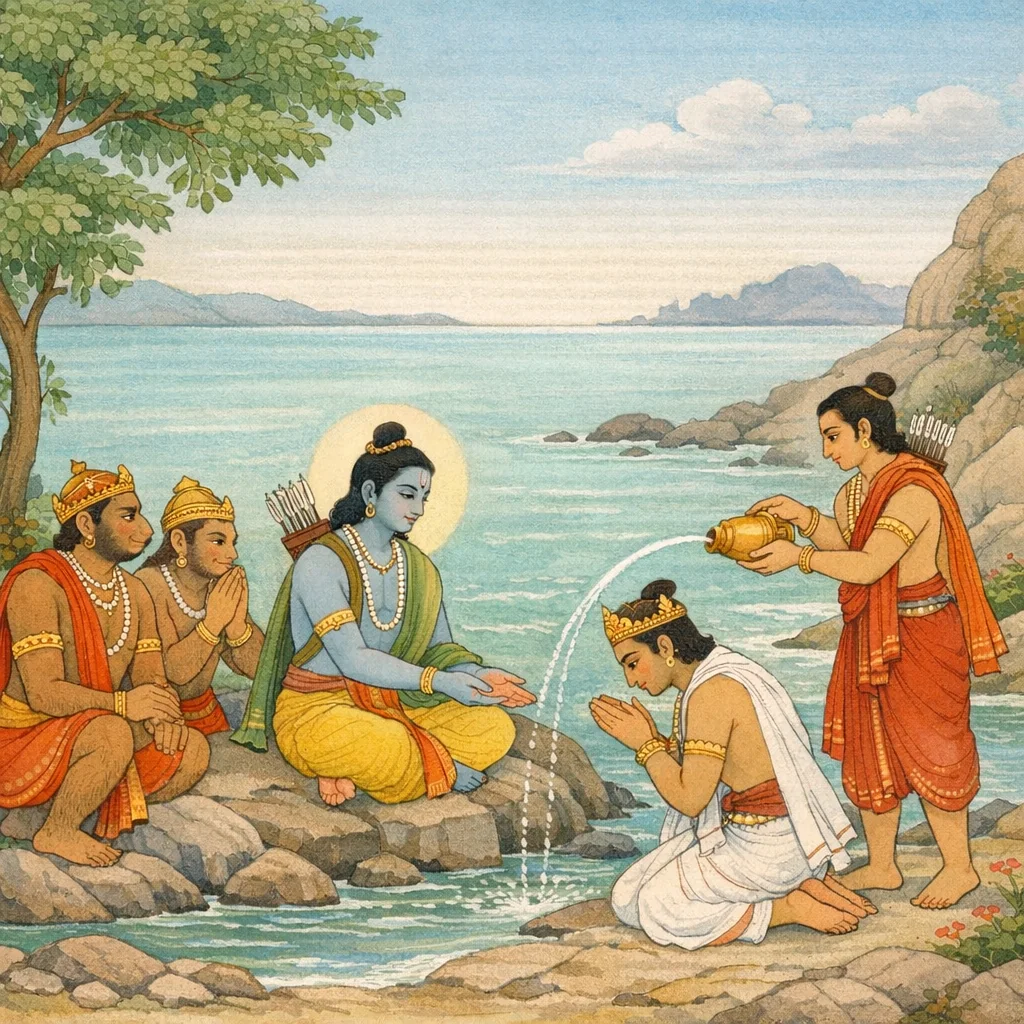
This sarga frames a key alliance event as a public, ritualized act of political legitimacy. After Rāma grants abhaya (assured protection), Vibhīṣaṇa descends, prostrates, and formally seeks refuge, surrendering his former ties to Laṅkā and placing life and sovereignty at Rāma’s disposal. Rāma responds with measured reassurance and requests an intelligence briefing on rākṣasa strengths and vulnerabilities. Vibhīṣaṇa enumerates principal threats—Rāvaṇa’s boon-based near-invulnerability, Kumbhakarṇa’s warlike power, Prahasta’s prior victory over Maṇibhadra, Indrajit’s invisibility through fire-rites, and other commanders—alongside the scale and ferocity of Laṅkā’s forces. Rāma then makes a binding political promise: upon Rāvaṇa’s defeat, Vibhīṣaṇa will be installed as king. The promise is immediately enacted through consecration: Lakṣmaṇa brings ocean-water and, amid the Vānara chiefs, anoints Vibhīṣaṇa as rākṣasa-rāja, prompting celebratory acclaim. The chapter closes with operational planning: Hanūmān and Sugrīva ask how to cross the imperturbable ocean; Vibhīṣaṇa advises seeking Sāgara’s refuge, citing dynastic ties to Sagara. Sugrīva relays this counsel; Rāma approves and sits on kuśa grass on the shore, poised for the next ritual-strategic step toward Laṅkā.
Shlokas
Verse 1
राघवेणाभयेदत्तेसन्नतोरावणानुजः ।विभीषणोमहाप्राज्ञोभूमिंसमवलोकयन् ।।6.19.1।।
When Rāghava had granted assurance of safety, wise Vibhīṣaṇa—Rāvaṇa’s younger brother—bowed and, looking upon the ground, prepared himself to come down (in submission).
Verse 2
खात्पपातावनींहृष्टोभक्तेरनुचरैस्सह ।सतरामस्यपरमात्मानिपपातविभीषणः ।।6.19.2।।
Joyful, Vibhīṣaṇa descended from the sky to the earth together with his devoted followers, and that noble-souled one fell down before Rāma in surrender.
Verse 3
पादयोश्शरणान्वेषीचतुर्भिस्सहराक्षसैः ।अब्रवीच्चतदावाक्यंरामंप्रतिविभीषणः ।।6.19.3।।धर्मयुक्तंचयुक्तंचसाम्प्रतंसम्प्रहर्षणम् ।
Seeking refuge at Rāma’s feet, Vibhīṣaṇa—together with four Rākṣasas—then spoke to Rāma words that were dharmic and fitting, conveying present confidence and great joy.
Verse 4
अनुजोरावणस्याहंतेनचाप्यवमानितः ।भवन्तंसर्वभूतानांशरण्यंशरणागतः ।।6.19.4।।
“I am Rāvaṇa’s younger brother; and by him I have been dishonored. I have come to you for refuge—you who are the refuge of all beings.”
Verse 5
परित्यक्तामयालङ्कमित्राणिचधनानिच ।भवद्गतंहिमेराज्यंजीवितंचसुखानिच ।।6.19.5।।
I have abandoned Laṅkā—friends and wealth as well; my kingdom, my life, and whatever happiness I have are now placed in your hands.
Verse 6
तथ्यतद्वचनंश्रुत्वारामोवचनमब्रवीत् ।।6.19.6।।वचसासान्त्वयित्वैनंलोचनाभ्यांपिबन्निव ।आख्याहिममतत्त्वेनराक्षसानांबलाबलम् ।।6.19.7।।
Hearing those truthful words, Rāma replied. Comforting him with gentle speech—gazing as though drinking him in with his eyes—he said: “Tell me truly the strengths and weaknesses of the Rākṣasas.”
Verse 7
तथ्यतद्वचनंश्रुत्वारामोवचनमब्रवीत् ।।6.19.6।।वचसासान्त्वयित्वैनंलोचनाभ्यांपिबन्निव ।आख्याहिममतत्त्वेनराक्षसानांबलाबलम् ।।6.19.7।।
Thus addressed by Rāma of untiring deeds, the rākṣasa (Vibhīṣaṇa) then began to describe in full Rāvaṇa’s power.
Verse 8
एवमुक्तंतदारक्षोरामेणाक्लिष्टकर्मणा ।रावणस्यबलंसर्वमाख्यातुमुपचक्रमे ।।6.19.8।।
Thus addressed by Rāma of untiring deeds, the rākṣasa (Vibhīṣaṇa) then began to describe in full Rāvaṇa’s power.
Verse 9
अवध्यस्सर्वभूतानांगन्धर्वोरगरक्षसाम् ।राजपुत्रदशग्रीवोवरदानात्स्वयंभुवः ।।6.19.9।।
O prince, by a boon granted by the Self-born (Brahmā), the ten-necked Rāvaṇa is not to be slain by gandharvas, serpents, or rākṣasas—or indeed by other beings.
Verse 10
रावणानन्तरोभ्राताममज्येष्ठश्चवीर्यवान् ।कुम्भकर्णोमहातेजाश्शक्रप्रतिबलोयुधि ।।6.19.10।।
“My elder brother—next in age to Rāvaṇa—is the mighty and radiant Kumbhakarṇa, Indra’s equal in strength upon the battlefield.”
Verse 11
रामसेनापतिस्तस्यप्रहास्तोयदिवाश्रुतः ।कैलासेयेनसङ्ग्रामेमणिभद्रःपराजितः ।।6.19.11।।
“Rāma, you may have heard of Prahasta, the commander of his (Rāvaṇa’s) army—he by whom Maṇibhadra was defeated in battle at Kailāsa.”
Verse 12
बद्धगोधाङ्गुळित्रश्चअवध्यकवचोयुधि ।धनुरादाययस्तिष्टन्नदृश्योभवतीन्द्रजित् ।।6.19.12।।
“And Indrajit—wearing bound iguana-hide finger-guards and armored with an impenetrable cuirass—stands in battle with bow in hand, becoming unseen.”
Verse 13
सङ्ग्रामसमयव्यूहेतर्पयित्वाहुताशनम् ।अन्तर्धानगतश्शत्रूनिन्द्रजिद् हन्तिराघव:।। 6.19.13।।
O Rāghava, after propitiating Agni (the Fire-god), Indrajit moves into invisibility and strikes down enemies amid the battle’s array.
Verse 14
महोदरमहापार्श्वौराक्षसश्चाप्यकम्पनः ।अनीकस्थास्तुतस्यैतेलोकपालसमायुधि ।।6.19.14।।
Mahodara, Mahāpārśva, and the rākṣasa Akampana—these are his commanders, formidable in war like the world-guardians themselves.
Verse 15
दशकोटिसहस्राणिरक्षसांकामरूपिणाम् ।मांसशोणितभक्ष्याणांलङ्कापुरनिवासिनाम् ।।6.19.15।।
In Laṅkā dwell countless thousands—tens of crores—of rākṣasas who change form at will and feed on flesh and blood.
Verse 16
सतैस्तुसहितोराजालोकपालानयोधयत् ।सहदेवैस्तुतेभग्नारावणेनमहात्मना ।।6.19.16।।
That king, supported by hundreds (of his kind), challenged even the world-guardians; and together with the gods themselves they were shattered by the great-souled Rāvaṇa.
Verse 17
विभीषणवच: श्रुत्वारामोदृढपराक्रमः ।अन्वीक्ष्यमनसासर्वमिदंवचनमब्रवीत् ।।6.19.17।।
Hearing Vibhīṣaṇa’s words, Rāma—firm in valor—reflected upon all of it in his mind and then spoke these words.
Verse 18
यानिकर्मापदानानिरावणस्यविभीषण: ।अख्यातानिचतत्त्वेनह्यवगच्छामितान्यहम् ।।6.19.18।।
O Vibhīṣaṇa, the deeds and exploits of Rāvaṇa that you have recounted—I understand them in their true import.
Verse 19
अहंहत्वादशग्रीवंसप्रहस्तंसबान्धवम् ।राजानंत्वांकरिष्यामिसत्यमेतद्ब्रवीमिते ।।6.19.19।।
After slaying Daśagrīva together with Prahasta and his kinsmen, I shall make you king—this I tell you in truth.
Verse 20
रसातलंवाप्रविशेत्पाताळंवापिरावणः ।पितामहासकाशंवानमेजीवन्विमोक्ष्यते ।।6.19.20।।
Even if Rāvaṇa were to enter Rasātala, or Pātāla, or even reach the abode of Brahmā—he will not escape me alive.
Verse 21
अहत्वारावणंसङ् ख्येसपुत्रजनबान्धवम् ।अयोध्यांनप्रवेक्ष्यामित्रिभिस्तैर्भ्रातृभिश्शपे ।।6.19.21।।
Unless I slay Rāvaṇa in battle, together with his sons, followers, and kinsmen, I shall not enter Ayodhyā—I swear it by my three brothers.
Verse 22
श्रुत्वातुवचनंतस्यरामस्याक्लिष्टकर्मणः ।शिरसावन्द्यधर्मात्मावक्तुमेवोपचक्रमे ।।6.19.22।।
Having heard the words of Rāma, tireless in action, the righteous Vibhīṣaṇa bowed his head in reverence and began to speak.
Verse 23
राक्षसानांवधेसाह्यंलङ्कायाश्चप्रधर्षणे ।करिष्यामियथाप्राणंप्रवेक्ष्यामिचवाहिनीम् ।।6.19.23।।
“I will give my full support for the slaying of the Rākṣasas and for the assault on Laṅkā; and I will help the army to enter with all the strength of my life.”
Verse 24
इतिब्रुवाणांरामस्तुपरिष्वज्यविभीषणम् ।अब्रवील्लक्ष्मणंप्रीतस्समुद्राज्जलमानय ।।6.19.24।।
When Vibhīṣaṇa had spoken thus, Rāma—pleased—embraced him and said to Lakṣmaṇa, “Bring water from the ocean.”
Verse 25
तेनचेमंमहाप्राज्ञमभिषिञ्चविभीषणम् ।राजानंरक्षसांक्षिप्रंप्रसन्नेमयिमानद ।।6.19.25।।
“With that water, consecrate this Vibhīṣaṇa—highly wise—as king of the Rākṣasas at once, for I am pleased with him, O worthy one.”
Verse 26
एवमुक्तस्तुसौमित्रिरभ्यषिञ्चद्विभीषणम् ।मध्येवानरमुख्यानांराजानंरामशासनात् ।।6.19.26।।
Thus addressed, Saumitrī (Lakṣmaṇa), by Rāma’s command, consecrated Vibhīṣaṇa as king in the midst of the foremost Vānara leaders.
Verse 27
तंप्रसादंतुरामस्यदृष्टवासद्यःप्लवङ्गमाः ।प्रचुक्रुशुर्महात्मानंसाधुसाध्वितिचाब्रुवन् ।।6.19.27।।
Seeing that gracious act of Rāma, the Vānaras at once leapt about in delight and acclaimed the great-souled one, crying, “Well done! Well done!”
Verse 28
अथाब्रवीद् हनूमांश्चसुग्रीवश्चविभीषणम् ।कथंसागरमक्षोभ्यंतरामवरुणालयम् ।।6.19.28।।सैन्यैःपरिवृतास्सर्वेवानराणांमहौजसाम् ।
Then Hanūmān and Sugrīva said to Vibhīṣaṇa, surrounded by the forces of the mighty Vānaras: “How are we to cross this imperturbable ocean, the abode of Varuṇa?”
Verse 29
उपायंनाधिगच्छामोयथानदनदीपतिम् ।तरामतरसासर्वेससैन्यावरुणालयम् ।।6.19.29।।
“We do not find a means by which all of us, together with the army, may swiftly cross this abode of Varuṇa—the lord of rivers and streams.”
Verse 30
एवमुक्तस्तुधर्मज्ञःप्रत्युवाचविभीषणः ।समुद्रंराघवोराजाशरणंगन्तुमर्हति ।।6.19.30।।
Thus addressed, Vibhīṣaṇa—knower of dharma—replied: “King Rāghava should go to the Ocean and seek refuge (appeal) there.”
Verse 31
खानितस्सगरेणायमप्रमेयोमहोदधिः ।कर्तुमर्हतिरामस्यज्ञाते: कार्यंमहामतिः ।।6.19.31।।
This immeasurable great ocean—once excavated by Sagara—ought, being great-minded, to accomplish Rāma’s purpose, for Rāma is of the same lineage.
Verse 32
एवंविभीषणेनोक्तोराक्षसेनविपश्चिता ।अजगामाथसुग्रीवोयत्ररामस्सलक्ष्मणः ।।6.19.32।।
Thus addressed by the wise rākṣasa Vibhīṣaṇa, Sugrīva then went to where Rāma stood with Lakṣmaṇa.
Verse 33
ततश्चाख्यातुमारेभेविभीषणवचश्शुभम् ।सुग्रीवोविपुलग्रीवोस्सागरस्योपवेशनम् ।।6.19.33।।
Then broad-necked Sugrīva began to report to Rāma Vibhīṣaṇa’s auspicious words—how the Ocean should be approached and addressed.
Verse 34
प्रकृत्याधर्मशीलस्यराघवस्याप्यरोचत ।।6.19.34।।सलक्ष्मणंमहातेजास्सुग्रीवंचहरीश्वरम् ।सत्क्रियार्थंक्रियादक्षंस्मितपूर्वमुवाचह ।।6.29.35।।
And this counsel was pleasing even to Rāghava, who by nature is steadfast in dharma.
Verse 35
प्रकृत्याधर्मशीलस्यराघवस्याप्यरोचत ।।6.19.34।।सलक्ष्मणंमहातेजास्सुग्रीवंचहरीश्वरम् ।सत्क्रियार्थंक्रियादक्षंस्मितपूर्वमुवाचह ।।6.29.35।।
Then the radiant Rāma, smiling first, spoke to Lakṣmaṇa and to Sugrīva, lord of the Vānara hosts—both skilled in action—about what should be rightly undertaken.
Verse 36
विभीषणस्यमन्त्रोऽयंममलक्ष्मण रोचते ।सुग्रीवःपण्डितोनित्यंभवान्मन्त्रविचक्षणः ।।6.19.36।।उभाभ्यांसम्प्रधार्यार्थंरोचतेयत्तदुच्यताम् ।
“Lakṣmaṇa, this counsel of Vibhīṣaṇa pleases me. Sugrīva is ever learned, and you are discerning in counsel. After you both consider what is truly useful, tell me what commends itself.”
Verse 37
एवमुक्तौततोवीरावुभौसुग्रीवलक्ष्मणौ ।समुदाचारसंयुक्तमिदंवचनमूचतुः ।।6.19.37।।
Thus addressed, the two heroes—Sugrīva and Lakṣmaṇa—replied with words marked by proper decorum and respectful custom.
Verse 38
किमर्थनौनरव्याघ्र: नरोचिष्यतिराघव: ।विभीषणेनयच्चोक्तमस्मिन् कालेसुखावहम् ।।6.19.38।।
“O Rāghava, tiger among men, why should we not approve what Vibhīṣaṇa has said—so beneficial and timely, bringing good in this moment?”
Verse 39
अबध्वासागरेसेतुंघोरेऽस्मिन्वरुणालये ।लङ्कानासादितुंशक्यासेन्द्रैरपिसुरासुरैः ।।6.19.39।।
“Without building a bridge across this dreadful ocean, Varuṇa’s abode, Laṅkā cannot be reached—even by the gods and asuras, Indra included.”
Verse 40
विभीषणस्यशूरस्ययथार्थंक्रियतांवचः ।।6.19.40।।अलंकालात्ययंकृत्वासागरोऽयंनियुज्यताम् ।यथासैन्येनगच्छामपुरींरावणपालिताम् ।।6.19.41।।
Vibhīṣaṇa’s counsel is truthful; let the words of that valiant one be carried out as they are.
Verse 41
विभीषणस्यशूरस्ययथार्थंक्रियतांवचः ।।6.19.40।।अलंकालात्ययंकृत्वासागरोऽयंनियुज्यताम् ।यथासैन्येनगच्छामपुरींरावणपालिताम् ।।6.19.41।।
Enough of letting time be wasted; let this Ocean be prevailed upon, so that we may proceed with the army to the city ruled by Rāvaṇa.
Verse 42
एवमुक्तःकुशास्तीर्नोतीरेनदनदीपतेः ।संविवेशतदारामोवेद्यामिवहुताशनः ।।6.19.42।।
Thus addressed, Rāma then seated himself on a spread of kuśa grass upon the shore of the lord of rivers, like sacred fire abiding on the altar.
Frequently Asked Questions
The pivotal action is śaraṇāgati: Vibhīṣaṇa, a rākṣasa and Rāvaṇa’s brother, seeks refuge. Rāma’s granting of abhaya formalizes protection beyond identity-based suspicion, converting a moral choice into a public alliance with political consequences.
Dharma is enacted through truthful commitment and right procedure: counsel is heard, intelligence is gathered, vows are made without ambiguity, and legitimacy is established through ritual (abhiṣeka) before escalation of violence.
The shoreline of the ocean (Varuṇālaya/Samudra) becomes a ritual-strategic stage: ocean-water is used for consecration, and Rāma sits on a kuśa mat like fire on an altar—linking battlefield planning with Vedic-cultural forms.