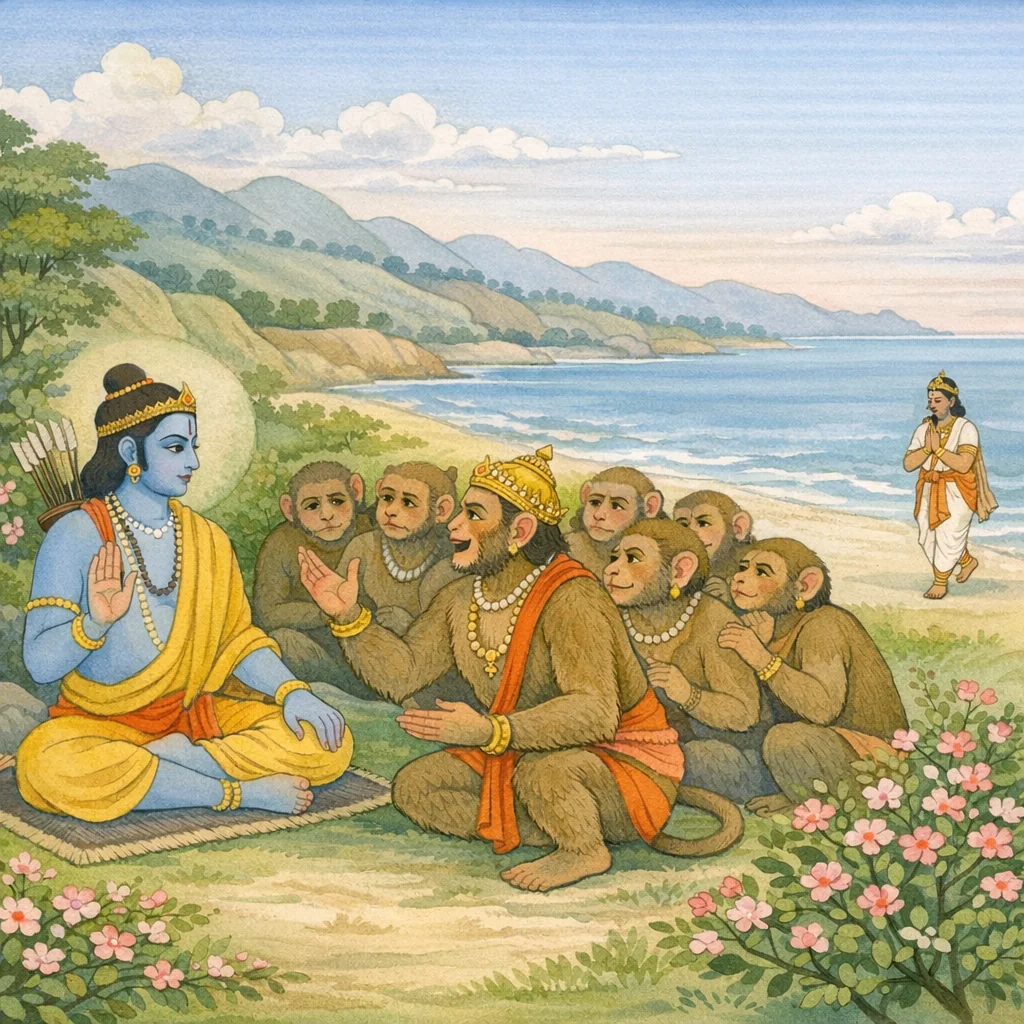
Sarga 18
शरणागति-धर्मनिर्णयः (Decision on Refuge and Dharma) / Rama’s Vow of Protection and the Acceptance of Vibhishana
युद्धकाण्ड
Sarga 18 is a policy-and-ethics colloquy situated at a decisive moment: Vibhīṣaṇa’s approach and the allied camp’s uncertainty. Rāma, pleased after hearing Hanumān, announces his intention to speak on Vibhīṣaṇa and invites his well-wishers to listen. Sugrīva responds with suspicion, interpreting Vibhīṣaṇa as a possible agent sent by Rāvaṇa and recommending restraint or capture. Rāma counters by asserting his invulnerability and then pivots to normative reasoning: he cites traditional exempla (the dove offering hospitality even to an enemy; remembered dharma-verses attributed to the sage Kandu) to establish that a suppliant with folded hands must not be harmed. The discourse crystallizes into a formal vow: whoever seeks refuge even once—whether Vibhīṣaṇa, Sugrīva, or even Rāvaṇa—will be granted fearlessness (abhaya) by Rāma. Sugrīva, moved by this dharmic articulation and his own inner assessment of Vibhīṣaṇa’s purity, endorses acceptance and urges immediate friendship. The chapter closes with Rāma proceeding to meet Vibhīṣaṇa, framing the episode as a doctrinal anchor for śaraṇāgati within royal conduct.
Shlokas
Verse 1
अथरामःप्रसन्नात्माशृत्वावायुसुतस्यह ।प्रत्यभाषतदुर्धषश्रुतवानात्मनिस्थितम् ।।।।
Then Rāma, pleased at heart, after hearing the words of Hanumān—the son of the Wind—replied; the formidable one spoke out what had settled in his own mind.
Verse 2
ममापितुविवक्षाऽस्तिकाचित्प्रतिविभीषणम् ।श्रोतुमिच्छामितत्सर्वंभवद्भिश्श्रेयसिस्थितैः ।।।।
I too wish to say a few words concerning Vibhīṣaṇa. I want all of you—who stand for my welfare—to listen fully to what I say.
Verse 3
मित्रभावेनसम्प्राप्तंनत्यजेयंकथञ्चन ।दोषोयद्यपितस्यस्यात्सतामेतदगर्हितम् ।।।।
Having come with a friendly intent, he must not be rejected in any way. Even if there are faults in him, this conduct is not blameworthy among the good.
Verse 4
सुग्रीस्त्वथतद्वाक्यमाभाष्यचविमृश्यच ।ततश्शुभतरंवाक्यमुवाचहरिपुङ्गवः ।।।।
Then Sugrīva, the foremost of the Vānara leaders, having responded to those words and reflected upon them, spoke a still more auspicious reply—one meant for Rāma’s good.
Verse 5
सुदुष्टोवाप्यदुष्टोवाकिमेषरजनीचरः ।ईदृशंव्यसनंप्राप्तंभ्रातरंयःपरित्यजेत् ।।।।कोनामसभवेत्तस्ययमेषनपरित्यजेत् ।
“Whether this night-roaming Rākṣasa is thoroughly wicked or not—what need we fear from him? He is one who has come to us after being forsaken by his own brother in such distress. Who, indeed, would not turn away a person like this—who would not reject him?”
Verse 6
वानराधिपतेर्वाक्यंश्रुत्वासर्वानुदीक्ष्यच ।।।।ईषदुत्स्मयमानस्तुलक्ष्मणंपुण्यलक्षणम् ।इतिहोवाचकाकुत्स्थोवाक्यंसत्यपराक्रमः ।।।।
Hearing the words of the Vānara king, Rāma of the Kakutstha line—whose valor is founded in truth—looked over everyone present, smiled faintly toward Lakṣmaṇa of auspicious marks, and then spoke.
Verse 7
वानराधिपतेर्वाक्यंश्रुत्वासर्वानुदीक्ष्यच ।।6.18.6।।ईषदुत्स्मयमानस्तुलक्ष्मणंपुण्यलक्षणम् ।इतिहोवाचकाकुत्स्थोवाक्यंसत्यपराक्रमः ।।6.18.7।।
Hearing the words of the Vānara king, Rāma of the Kakutstha line—whose valor is founded in truth—looked over everyone present, smiled faintly toward Lakṣmaṇa of auspicious marks, and then spoke.
Verse 8
अनधीत्यचशास्त्राणिवृद्धाननुपसेव्यच ।नशक्यमीदृशंवक्तुंयदुवाचहरीश्वरः ।।।।
“What the lord of the Vānaras has spoken in this manner cannot be spoken by one who has not studied the śāstras and has not served the elders.”
Verse 9
अस्तिसूक्ष्मतरंकिंचिद्यदत्रप्रतिभातिमे ।प्रत्यक्षंलौकिकंचापिविद्यतेसर्वराजसु ।।।।
“Yet, in this matter, something even subtler occurs to me—something that is plainly known in the worldly sphere, and is found among all kings.”
Verse 10
अमित्रास्तत्कुलीनाश्चप्रातिदेश्याश्चकीर्तिताः ।व्यसनेषुप्रहर्तारस्तस्मादयमिहागतः ।।।।
Even those of the same lineage, and the kings of neighboring regions, are spoken of as enemies—because in times of distress they strike. Therefore, for this reason, he has come here.
Verse 11
अपापास्तत्कुलीनाश्चमानयन्तिस्वकान्हितान् ।एषप्रायोनरेन्द्राणांशङ्कनीयस्तुशोभनः ।।।।
The blameless, and those of the same lineage, honor their own well-wishing allies. Yet, in the ways of kings, even a noble person often becomes one who is suspected.
Verse 12
यस्तुदोषस्त्वयाप्रोक्तोह्यादानेऽरिबलस्यच ।तत्रतेकीर्तयिष्यामियथाशास्त्रमिदंशृणु ।।।।
As for the fault you have mentioned regarding the acceptance of one who belongs to the enemy’s power, I will explain to you what the authoritative teaching says—listen to this.
Verse 13
नवयंतत्कुलीनाश्चराज्यकाङ् क्षीचराक्षसः ।पण्डिताहिभविष्यन्तितस्माद्ग्राह्योविभीषणः ।।।।
We are not of that clan, and a rākṣasa who longs for sovereignty is not the only possibility; there can indeed be discerning and learned persons among them. Therefore Vibhīṣaṇa should be accepted.
Verse 14
अव्यग्राश्चप्रहृष्टाश्चनभविष्यन्तिसङ्गता ।प्रणादश्चमहानेषततोऽस्यभयमागतम् ।।।।इतिभेदंगमिष्यन्तितस्माग्राह्योविभीषणः ।
They will not remain united—free of anxiety and content—together. This loud outcry shows that fear has come upon him; thus a breach has arisen among them. Therefore Vibhīṣaṇa is to be accepted.
Verse 15
नसर्वेभ्रातरस्तातभवन्तिभरतोपमाः ।मद्विथावापितुःपुत्रास्सुहृदोनाभवद्विथाः ।।।।
Dear one, not all brothers are like Bharata; not all sons are like me; and not all friends are like you.
Verse 16
एवमुक्तस्तुरामेणसुग्रीवस्सहलक्ष्मणः ।उत्थायेदंमहाप्राज्ञःप्रणतोवाक्यमब्रवीत् ।।।।
When Rāma had spoken thus, wise Sugrīva—along with Lakṣmaṇa—rose, bowed in respect, and spoke these words.
Verse 17
रावणेनप्रणिहितंतमवेहिविभीषणम् ।तस्याहंनिग्रहंमन्येक्षमंक्षमवतांवर ।।।।
Know that Vibhīṣaṇa has been sent by Rāvaṇa. I consider it proper that he be restrained—O best among the forbearing.
Verse 18
राक्षसोजिह्मयाबुध्यासन्दिष्टोऽयमिहागतः ।प्रहर्तुंत्वयिविश्वस्तेप्रच्छन्नोमयिवानघ ।।।।लक्ष्मणेवामहाबाहो सवध्यस्सचिवैस्सहा ।रावणस्यनृशंसस्यभ्राताह्येषविभीषणः ।।एवमुक्त्वारघुश्रेष्ठंसुग्रीवोवाहिनीपतिः ।वाक्यज्ञोवाक्यकुशलंततोमौनमुपागमत् ।।।।
This rākṣasa has come here, dispatched with crooked intent, to strike—once trust is gained—at you, or at me, or at mighty-armed Lakṣmaṇa, O blameless one. He should be put down along with his counsellors; for this is Vibhīṣaṇa, brother of the cruel Rāvaṇa. Having spoken thus to Rāma, best of the Raghus, Sugrīva—lord of the army, skilled in speech—then fell silent.
Verse 19
राक्षसोजिह्मयाबुध्यासन्दिष्टोऽयमिहागतः ।प्रहर्तुंत्वयिविश्वस्तेप्रच्छन्नोमयिवानघ ।।6.18.18।।लक्ष्मणेवामहाबाहो सवध्यस्सचिवैस्सहा ।रावणस्यनृशंसस्यभ्राताह्येषविभीषणः ।।एवमुक्त्वारघुश्रेष्ठंसुग्रीवोवाहिनीपतिः ।वाक्यज्ञोवाक्यकुशलंततोमौनमुपागमत् ।।6.18.19।।
This rākṣasa has come here, dispatched with crooked intent, to strike—once trust is gained—at you, or at me, or at mighty-armed Lakṣmaṇa, O blameless one. He should be put down along with his counsellors; for this is Vibhīṣaṇa, brother of the cruel Rāvaṇa. Having spoken thus to Rāma, best of the Raghus, Sugrīva—lord of the army, skilled in speech—then fell silent.
Verse 20
सुग्रीवस्यतुतद्वाक्यंरामश्रुत्वाविमृश्यच ।ततश्शुभतरंवाक्यमुवाचहरिपुङ्गवम् ।।।।
Hearing Sugrīva’s words and reflecting on them, Rāma then addressed the foremost of the Vānara leaders with words still more auspicious and fitting.
Verse 21
सुदुष्टोवाप्यदुष्टोवाकिमेषरजनीचरः ।सूक्ष्ममप्यहितंकर्तुंममाशक्तःकथञ्चन ।।।।
Wicked or not—what is this night-roamer to me? How could he ever be capable of doing even the slightest harm to me?
Verse 22
पिशाचानदानवान् यक्ष I नपृथिव्यांचैवराक्षसान् ।अङ्गुल्यग्रेणतान् हन्यामिच्छन् हरिगणेश्वर ।।।।
O lord of the Vānara hosts, if I so wished, I could destroy with the tip of a finger the piśācas, dānavas, yakṣas, and rākṣasas that roam this earth.
Verse 23
श्रूयतेहिकपोतेनशत्रुश्शरणमागतः ।अर्चितश्चयथान्यायंस्वैश्चमांसैर्निमन्त्रितः ।।।।
For it is heard that a dove, when an enemy came seeking refuge, honored him according to proper custom and even offered him its own flesh.
Verse 24
सहितंप्रतिजग्राहभार्याहर्तारमागतः ।कपोतोवानरश्रेष्ठ: किंपुनर्मद्विधोजनः ।।।।
O best of Vānaras, that dove received and sheltered even the one who had carried off its mate when he came near; how much more then should a man like me do so?
Verse 25
ऋषेःकण्वस्यपुत्रेणकण्डुनापरमर्षिणा ।शृणुगाथांपुरागीतांधर्मिष्ठासत्यवादिना ।।।।
Listen to a traditional verse once sung by the great sage Kaṇḍu, the son of Ṛṣi Kaṇva—most devoted to dharma and steadfast in truth.
Verse 26
बद्धाञ्जलिपुटंदीनंयाचन्तंशरणागतम् ।नहन्यदानृशंस्यार्थमपिशत्रुंपरन्तप ।।।।
O scorcher of foes, one should not kill—even an enemy—who comes seeking refuge, pitiably begging with hands folded, for the sake of non-cruelty.
Verse 27
आर्तोवायदिवादृप्तःपरेषांशरणांगतः ।अरिःप्राणान्परित्यज्यरक्षितव्यःकृतात्मना ।।।।
Even if he is distressed—or even arrogant—an enemy who has come seeking refuge (from others) must be protected by a self-controlled person, even at the cost of one’s own life.
Verse 28
सचेद्भयाद्वामोहाद्वाकामाद्वापिनरक्षति ।स्वयाशक्त्यायथासत्त्वंतत्पापंलोकगर्हितम् ।।।।
If, from fear or delusion—or even desire for gain—a person does not protect a refuge-seeker to the best of his ability, that sin becomes condemned by the world.
Verse 29
विनष्टःपश्यतस्तस्यारक्षिणश्शरणागतः ।आदायसुकृतंतस्यसर्वंगच्छेदरक्षित:।। ।।
If a refuge-seeker is left unprotected before his very eyes, the protector (who failed) is disgraced and ruined; and that unprotected one departs taking away all of his merit.
Verse 30
एवंदोषोमहानत्रप्रपन्नानामरक्षणे ।अस्वर्ग्यंचायशस्यंचबलवीर्यविनाशनम् ।।।।
Thus, in this matter, failing to protect those who have sought refuge is a grave fault: it bars one from heaven, brings infamy, and destroys strength and valor.
Verse 31
करिष्यामियथार्थंतुकण्डोर्वचनमुत्तमम् ।धर्मिष्ठंचयशस्यंचस्वर्ग्यंस्यात्तुफलोदये ।।।।
I will act in accordance with the excellent and truthful words of Kandu: such conduct is most righteous, brings fame, and yields heaven as its fruit in due time.
Verse 32
सकृदेवप्रपन्नायतवास्मीतिचयाचते ।अभयंसर्वभूतेभ्योददाम्येतद्व्रतंमम ।।।।
To one who seeks refuge even once and pleads, ‘I am yours,’ I grant fearlessness from all beings—this is my vow.
Verse 33
अनयैनंहरिश्रेष्ठ: दत्तमस्याभयंमया ।विभीषणोवासुग्रीव: यदिवारावणस्स्वयम् ।।।।
Bring him here, O best of vānaras; I have granted him safety. Whether it be Vibhīṣaṇa, O Sugrīva—or even Rāvaṇa himself.
Verse 34
रामस्यतुवच्शुत्वासुग्रीवःप्लवगेश्वरः ।प्रत्यभाषतकाकुत्स्थंसौहार्देनप्रचोदितः ।।।।
Hearing Rāma’s words, Sugrīva—the lord of the vānaras—replied to the Kakutstha prince, moved by affection.
Verse 35
किमत्रचित्रंधर्मज्ञ: लोकनाथ: सुखावहा: ।यत्त्वमार्यंप्रभाषेथास्सत्त्ववान् सत्पथेस्थितः ।।।।
What is surprising here, O knower of dharma, lord of the world, giver of welfare—when you, steadfast in the right path and rich in virtue, speak such noble words?
Verse 36
ममचाप्यन्तरात्मायंशुद्धंवेत्तिविभीषणम् ।अनुमानाच्चभावाच्चसर्वतस्सुपरीक्षितः ।।।।
My own inner conscience knows Vibhīṣaṇa to be pure; by inference and by his disposition, he has been well examined in every way.
Verse 37
तस्मात् क्षिप्रंसहास्माभिस्तुल्योभवतराघव: ।विभीषणोमहाप्राज्ञस्सखित्वंचाभ्युपैतुनः ।।।।
Therefore, O Rāghava, let the greatly wise Vibhīṣaṇa swiftly become our equal among us, and let him enter into friendship with us.
Verse 38
ततस्तुसुग्रीववचोनिशम्यतद्दरीश्वरेणाभिहितंनरेश्वरः ।विभीषणेनाशुजगामसङ्गमंपतत्त्रिराजेनयथापुरन्दरः ।।।।
Then the king of men, hearing Sugrīva’s fitting words, quickly went to meet Vibhīṣaṇa—like Purandara (Indra) going to meet the king of birds.
Frequently Asked Questions
The dilemma is whether Vibhīṣaṇa—Rāvaṇa’s brother—should be treated as a dangerous infiltrator (Sugrīva’s suspicion) or as a legitimate refugee deserving protection. The action resolved is Rāma’s decision to accept and protect the śaraṇāgata despite strategic risk.
The upadeśa is that śaraṇāgati creates a binding moral obligation: a suppliant who begs for refuge must not be harmed, and failure to protect is portrayed as a grave lapse with social and spiritual consequences. Rāma formalizes this as a personal vow to grant abhaya even to an enemy who seeks shelter.
Rather than naming a specific locale, the chapter highlights cultural-ethical institutions: the tradition of hospitality to a seeker of protection (illustrated by the dove exemplum) and the authority of śāstra/ṛṣi-teaching (Kandu and Kanva lineage) as normative landmarks guiding royal decision-making.