Sarga 128
अयोध्याप्रत्यागमन-सन्देशः (Hanuman Sent Ahead to Ayodhya)
युद्धकाण्ड
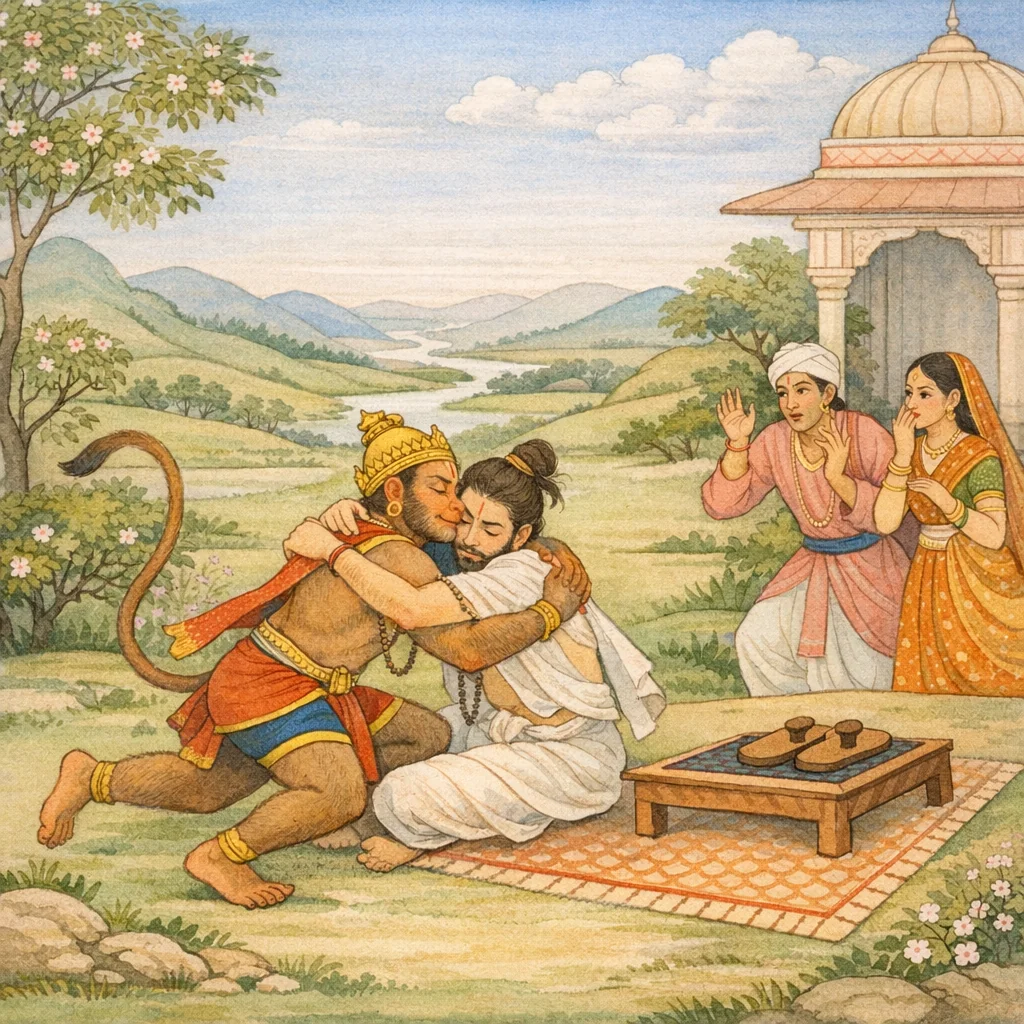
Observing Ayodhyā from the Puṣpaka, Rāma reflects on the return-journey’s milestones—approach to the ocean, the Ocean deity’s appearance, bridge-building, Rāvaṇa’s death, and divine boons—then commissions Hanumān as a rapid envoy. Hanumān is instructed to assess Bharata’s inner intention through external signs (facial color, gaze, speech), since the inherited kingdom’s abundance could tempt even the virtuous; this frames a technical protocol for political verification before a sensitive succession. Hanumān travels swiftly in human form, crosses the Gaṅgā–Yamunā confluence, reaches Śṛṅgaberapura, and greets Guha with Rāma’s welfare-message and itinerary. Proceeding toward Nandigrāma, he witnesses Bharata’s austere regency: emaciated, ascetic attire, ruling symbolically through Rāma’s pādukā while ministers, priests, and army chiefs stand by. Hanumān announces Rāma’s victory, Sītā’s recovery, and the imminent reunion; Bharata collapses in joy, embraces Hanumān, and offers lavish gifts for the auspicious news, reaffirming loyalty and dharmic governance during transition.
Shlokas
Verse 1
अयोध्यांतुसमालोक्यचिन्तयामासराघवः ।प्रियकामःप्रियंरामस्ततस्त्वरितविक्रमः ।।।।
Gazing upon Ayodhyā, Rāghava—Rāma, swift in decisive action and intent on what was dear—began to reflect (from the aerial car).
Verse 2
चिन्तयित्वाततोदृष्टिंवानरेषुन्यपातयत् ।उवाचधीमांस्तेजस्वीहनूमन्तंप्लवङ्गमम् ।।।।
Then Rāma—wise and radiant—reflected for a moment, cast his gaze upon the vānaras, and addressed Hanumān, the foremost among the monkeys.
Verse 3
अयोध्यांत्वरितोगत्वाशीघ्रंप्लवगसत्तम ।जानीहिकछचित्कुशलीजनोनृपतिमन्दिरे ।।।।
“Best of monkeys, go swiftly to Ayodhyā; quickly ascertain whether the people in the king’s palace are well.”
Verse 4
शृङ्गबेरिपुरंप्राप्यगुहंगहनगोचरम् ।निषादाधिपतिंब्रूहिकुशलंवचनान्मम ।।।।
Having reached Śṛṅgaveripura, find Guha—leader of the Niṣādas, who moves through the forest-depths—and convey to him my words of inquiry about his welfare.
Verse 5
श्रुत्वातुमांकुशलिनमरोगंविगतज्वरम् ।भविष्यतिगुहःप्रीतस्सममात्मसमस्सखा ।।।।
“On hearing that I am safe, healthy, and free from distress, Guha will be delighted—he who is my friend and as dear to me as my own self.”
Verse 6
अयोध्यायाश्चतेमार्गंप्रवृत्तिंभरतस्य च ।निवेदयिष्यतिप्रीतोनिषादाधिपतिर्गुहः ।।।।
“Delighted, Guha—the lord of the Niṣādas—will tell you the route to Ayodhyā, and also inform you about Bharata’s condition and conduct.”
Verse 7
भरतस्तुत्वयावाच्यःकुशलंवचनान्मम ।सिद्धार्थंशंसमांतस्मैसभार्यंसहलक्ष्मणम् ।।।।
“To Bharata you must convey my inquiry about his welfare; and tell him that I have accomplished my purpose and am returning—together with my wife and with Lakṣmaṇa.”
Verse 8
हरणंचापिवैदेह्यारावणेनबलीयसा ।सुग्रीवेण च सम्वादंवालिनश्चवधंरणे ।।।।
“You may also tell him of Vaidehī’s abduction by the mighty Rāvaṇa, of my alliance with Sugrīva, and of Vālin’s slaying in battle.”
Verse 9
मैथिल्यन्वेषणंचैवयथाचाधिगतात्वया ।लङ्घयित्वामहातोयमापगापतिमव्ययम् ।।।।
“Tell him too of the search for the Maithilī, and how you found her after leaping across the vast, unfailing ocean—the lord of waters.”
Verse 10
उपयानंसमुद्रस्यसागरस्य च दर्शनम् ।यथा च कारितस्सेतूरावणश्चयथाहतः ।।।।
“Tell him also of my approach to the Ocean and how the Ocean revealed himself; how the bridge was caused to be built; and how Rāvaṇa was slain.”
Verse 11
वरदानंमहेन्द्रेणब्रह्मणावरुणेन च ।महादेवप्रसादाच्छपित्राममसमागमम् ।।।।
“(Tell him) of the boon granted by Mahendra, by Brahmā, and by Varuṇa; and, by Mahādeva’s grace, of my meeting with my father.”
Verse 12
उपयातं च मांसौम्य भरतायनिवेदय ।सहराक्षसराजेनहरीणामीश्वरेण च ।।।।
“Gentle one, report to Bharata that I am arriving—together with the lord of the Vānara hosts and with the king of the Rākṣasas.”
Verse 13
जित्वाशत्रुगणान्रामःप्राप्यचानुत्तमंयशः ।उपायानंसमृद्धार्थस्सहमित्रैर्महाबलैः ।।।।
“Rāma—having conquered the hosts of foes and attained unsurpassed fame—has achieved his purpose and is returning, accompanied by mighty allies.”
Verse 14
एतच्छ्रुत्वायमाकारंभजतेभरतस्ततः ।स च तेवेदितव्यःस्यात्सर्वंयच्छापिमांप्रति ।।।।
“After hearing this, whatever demeanor Bharata assumes—toward me in particular—observe and understand it all; then report it back.”
Verse 15
ज्ञेयाःसर्वे च वृत्तान्ताःभरतस्येङ्गितानि च ।तत्त्वेनमुखवर्णेनदृष्ट्याव्याभाषितेन च ।।।।
“All the particulars—and Bharata’s true intentions—are to be discerned from his face’s color, his gaze, and the manner of his speech.”
Verse 16
सर्वकालसमृद्धंहिहस्त्यश्वरथसङ्कुलम् ।पितृपैतामहंराज्यंकस्यनावर्तयेन्मनः ।।।।
“For this ancestral kingdom—prosperous at all times and filled with elephants, horses, and chariots—whose mind would it not naturally draw?”
Verse 17
सङ्गत्याभरत्श्रीमान् राज्येनार्थीस्वयंभवेत् ।प्रशास्तुवसुधांसर्वामखिलांरघुनन्दनः ।।।।
“If, upon meeting, the illustrious Bharata should himself desire the kingdom, then let that delight of the Raghu line rule the entire earth.”
Verse 18
तस्यबुद्धिं च विज्ञायव्यवसायं च वानर ।यावन्नदूरंयाताःस्मक्षिप्रमागन्तुमर्हसि ।।।।
“O Vānara, having ascertained his mind and resolve, you must return quickly, before we have gone too far.”
Verse 19
इतिप्रतिसमादिष्टोहनूमान्मारुतात्मजः ।मानुषःधारयनृपमयोध्यांत्वरितोययौ ।।।।
Thus commanded, Hanumān—the son of Māruta—assumed a human form and swiftly set out for Ayodhyā.
Verse 20
अतोत्पपातवेगेनहनूमान्मारुतात्मजः ।गरुत्मानिववेगेनजिघृक्षन्पन्नगोत्तमम् ।।।।
Then Hanumān, son of Māruta, sprang up with great speed—like Garuḍa rushing to seize the chief of serpents.
Verse 21
लङ्घयित्वापितृपथंविहगेन्द्रालयंशुभम् ।गङ्गायमुनयोर्भीमंसमतीत्यसमागमम् ।।।।शृङ्गबेरपुरंप्राप्यगुहमासाद्यवीर्यवान् ।स वाचाशुभयाहृष्टोहनुमानिदमब्रवीत् ।।।।
Leaping along the ancestral path—auspicious, the region of the lord of birds—he crossed the formidable confluence of the Gaṅgā and Yamunā.
Verse 22
लङ्घयित्वापितृपथंविहगेन्द्रालयंशुभम् ।गङ्गायमुनयोर्भीमंसमतीत्यसमागमम् ।।6.128.21।।शृङ्गबेरपुरंप्राप्यगुहमासाद्यवीर्यवान् ।स वाचाशुभयाहृष्टोहनुमानिदमब्रवीत् ।।6.128.22।।
Reaching Śṛṅgaverapura, the mighty Hanumān met Guha; delighted, he spoke these auspicious words.
Verse 23
सखातुतवकाकुत्स्थोरामस्सत्यपराक्रमः ।ससीतस्सहसौमित्रिस्सत्वांकुशलमब्रवीत् ।।।।
“Your friend, Rāma of the Kakutstha line—whose valor is grounded in truth—together with Sītā and with Saumitri (Lakṣmaṇa), asks after your welfare.”
Verse 24
पञ्चमीमद्यरजनीमुषित्वावचनान्मुनेः ।भरद्वाजाभ्यनुज्ञातंद्रक्ष्यस्यद्यैवराघवम् ।।।।
“Today is the fifth night; after staying the night in accordance with the sage’s word, and with Bharadvāja’s permission, you will see Rāghava even today.”
Verse 25
एवमुक्त्वामहातेजास्सम्प्रहृष्टतनूरुहः ।उत्पपातमहावेगाद्वेगवान्विचारयन् ।।।।
Having spoken thus, the greatly radiant one—his hairs bristling with joy—leapt up again with tremendous speed, intent on his course.
Verse 26
सोऽपश्यद्रामतीर्थं च नदींवालुकिनींतथा ।वरूथींगोमतींचैवभीमंशालवनंतथा ।।।।प्रजाश्चबहुसाहस्रीःस्फीतान्जनपदानपि ।
On the way he beheld Rāma-tīrtha, and the river Vālukinī; likewise Varūthī and Gomati, and also the dread Śāla-forest—along with thriving realms and multitudes of people.
Verse 27
सःगत्वादूरमध्वानंत्वरितःकपिकुञ्जरः ।।।।आससादद्रुमान् फुल्लान्नन्दिग्रामसमीपगान् ।स्त्रीभिस्सपुत्रैर्वृद्धैश्चरममाणैःस्वलङ्कृतैः ।सुराधिपस्योपवनेयथाचैत्ररथेद्रुमान् ।।।।
Having sped a long distance on the road, Hanumān—the elephant among monkeys—reached blossom-laden trees near Nandigrāma, where well-adorned women, children, and elders were strolling and sporting, like trees in Indra’s garden and in Kubera’s Caitraratha grove.
Verse 28
सःगत्वादूरमध्वानंत्वरितःकपिकुञ्जरः ।।6.128.27।।आससादद्रुमान् फुल्लान्नन्दिग्रामसमीपगान् ।स्त्रीभिस्सपुत्रैर्वृद्धैश्चरममाणैःस्वलङ्कृतैः ।सुराधिपस्योपवनेयथाचैत्ररथेद्रुमान् ।।6.128.28।।
He reached the blossoming trees near Nandigrāma, where women with their children and elders—well-adorned and at ease—were sporting in gardens, as if in Indra’s own pleasure-grove, like the famed trees of Kubera’s Caitraratha.
Verse 29
क्रोशमात्रेत्वयोध्यायाचशीरकृष्णाजिनम्बरम् ।।।।ददर्शभरतंदीनंकृशमाश्रमवासिनम् ।जटिलंमलदिग्धाङ्गंभ्रातृव्यसनकर्शितम् ।। ।फलमूलाशिनंदान्तंतापसंधर्मचारिणम् ।समुन्नतजटाभारंवल्कलाजिनवाससम् ।।।।नियतंभावितात्मानंब्रह्मर्षिसमतेजसम् ।पादुकेतेपुरस्कृत्यप्रशासन्तंवसुन्धराम् ।। ।चातुर्वर्णस्यलोकस्यत्रातारंमहतोभयात् ।उपस्थितममात्यैश्चशुचिभिश्चपुरोहितैः ।।।।बलमुख्यैश्चयुक्तैश्चकाषायाम्बरदारिभिः ।
At about a krośa from Ayodhyā, he saw Bharata—clad in bark-garments and dark antelope-skin—piteous and emaciated, dwelling in a hermitage; with matted hair, his limbs smeared with grime, worn down by the sorrow of separation from his brother. He lived on fruits and roots, was self-restrained, an ascetic walking in dharma; his piled-up matted locks rose high, and he wore bark and skin. Disciplined, his inner self refined by contemplation, radiant like a brahmarṣi, he governed the earth by placing Rāma’s sandals before him. He stood as protector of the fourfold social order from great fear, attended by ministers and pure-minded priests, and by leading officers and companions wearing ochre robes.
Verse 30
क्रोशमात्रेत्वयोध्यायाचशीरकृष्णाजिनम्बरम् ।।6.128.29।।ददर्शभरतंदीनंकृशमाश्रमवासिनम् ।जटिलंमलदिग्धाङ्गंभ्रातृव्यसनकर्शितम् ।।6.128.30 ।फलमूलाशिनंदान्तंतापसंधर्मचारिणम् ।समुन्नतजटाभारंवल्कलाजिनवाससम् ।।6.128.31।।नियतंभावितात्मानंब्रह्मर्षिसमतेजसम् ।पादुकेतेपुरस्कृत्यप्रशासन्तंवसुन्धराम् ।।6.128.32 ।चातुर्वर्णस्यलोकस्यत्रातारंमहतोभयात् ।उपस्थितममात्यैश्चशुचिभिश्चपुरोहितैः ।।6.128.33।।बलमुख्यैश्चयुक्तैश्चकाषायाम्बरदारिभिः ।
To that Bharata—knower of dharma, appearing like dharma itself embodied—Hanumān, son of Māruta, spoke with folded hands.
Verse 31
क्रोशमात्रेत्वयोध्यायाचशीरकृष्णाजिनम्बरम् ।।6.128.29।।ददर्शभरतंदीनंकृशमाश्रमवासिनम् ।जटिलंमलदिग्धाङ्गंभ्रातृव्यसनकर्शितम् ।।6.128.30 ।फलमूलाशिनंदान्तंतापसंधर्मचारिणम् ।समुन्नतजटाभारंवल्कलाजिनवाससम् ।।6.128.31।।नियतंभावितात्मानंब्रह्मर्षिसमतेजसम् ।पादुकेतेपुरस्कृत्यप्रशासन्तंवसुन्धराम् ।।6.128.32 ।चातुर्वर्णस्यलोकस्यत्रातारंमहतोभयात् ।उपस्थितममात्यैश्चशुचिभिश्चपुरोहितैः ।।6.128.33।।बलमुख्यैश्चयुक्तैश्चकाषायाम्बरदारिभिः ।
That Kakutstha whom you grieve for—dwelling in Daṇḍakāraṇya, wearing bark-cloth and matted locks—has had me tell you of his welfare.
Verse 32
क्रोशमात्रेत्वयोध्यायाचशीरकृष्णाजिनम्बरम् ।।6.128.29।।ददर्शभरतंदीनंकृशमाश्रमवासिनम् ।जटिलंमलदिग्धाङ्गंभ्रातृव्यसनकर्शितम् ।।6.128.30 ।फलमूलाशिनंदान्तंतापसंधर्मचारिणम् ।समुन्नतजटाभारंवल्कलाजिनवाससम् ।।6.128.31।।नियतंभावितात्मानंब्रह्मर्षिसमतेजसम् ।पादुकेतेपुरस्कृत्यप्रशासन्तंवसुन्धराम् ।।6.128.32 ।चातुर्वर्णस्यलोकस्यत्रातारंमहतोभयात् ।उपस्थितममात्यैश्चशुचिभिश्चपुरोहितैः ।।6.128.33।।बलमुख्यैश्चयुक्तैश्चकाषायाम्बरदारिभिः ।
“Best of monkeys, go swiftly to Ayodhyā; quickly ascertain whether the people in the king’s palace are well.”
Verse 33
क्रोशमात्रेत्वयोध्यायाचशीरकृष्णाजिनम्बरम् ।।6.128.29।।ददर्शभरतंदीनंकृशमाश्रमवासिनम् ।जटिलंमलदिग्धाङ्गंभ्रातृव्यसनकर्शितम् ।।6.128.30 ।फलमूलाशिनंदान्तंतापसंधर्मचारिणम् ।समुन्नतजटाभारंवल्कलाजिनवाससम् ।।6.128.31।।नियतंभावितात्मानंब्रह्मर्षिसमतेजसम् ।पादुकेतेपुरस्कृत्यप्रशासन्तंवसुन्धराम् ।।6.128.32 ।चातुर्वर्णस्यलोकस्यत्रातारंमहतोभयात् ।उपस्थितममात्यैश्चशुचिभिश्चपुरोहितैः ।।6.128.33।।बलमुख्यैश्चयुक्तैश्चकाषायाम्बरदारिभिः ।
He saw Bharata—protector of the entire fourfold society from great fear—standing there, attended by pure-minded ministers and priests, and accompanied by leading commanders and disciplined men clad in ochre robes.
Verse 34
नहितेराजपुत्रंतंचीरकृष्णाजिनाम्बरम् ।।।।परिभोक्तुंव्यवस्यन्तिपौरावैधर्मवत्सलाः ।
For the citizens, devoted to dharma, did not resolve to indulge in enjoyments—when their prince himself wore bark-cloth and dark antelope-skin.
Verse 35
तम्धर्ममिवधर्मज्ञंदेहवन्तमिवापरम् ।।।।उवाचप्राञ्जलिर्वाक्यंहनूमान्मारुतात्मजः ।
To that Bharata—knower of dharma, appearing like dharma itself embodied—Hanumān, son of Māruta, spoke with folded hands.
Verse 36
वसन्तंदण्डकारण्येयंत्वंचीरजटाधरम् ।।।।अनुशोचसिकाकुत्स्थं स त्वांकौशलमब्रवीत् ।
That Kakutstha whom you grieve for—dwelling in Daṇḍakāraṇya, wearing bark-cloth and matted locks—has had me tell you of his welfare.
Verse 37
प्रियमाख्यामितेदेवशोकंत्यजसुदारुणम् ।।।।अस्मिन्मुहूर्तेभ्रात्रात्वंरामेणसहसङ्गतः ।
O noble one, I shall tell you joyful news. Abandon this most dreadful grief: at this very moment you will be reunited with your brother Rāma.
Verse 38
निहत्यरावणंरामःप्रतिलभ्य च मैथिलीम् ।।।।उपयातिसमृद्धार्थःसहमित्रैर्महाबलैः ।
Rāma has slain Rāvaṇa and regained Maithilī (Sītā). His purpose accomplished, he is now coming, accompanied by his mighty allies.
Verse 39
लक्ष्मणश्चमहातेजावैदेही च यशस्विनी ।।।।सीतासमग्रारामेणमहेन्द्रेणशचीयथा ।
And Lakṣmaṇa of great splendor, and the illustrious Vaidehī—Sītā, whole and unharmed—are with Rāma, as Śacī is with Mahendra (Indra).
Verse 40
एवमुक्तोहनुमताभरतःकैकयीसुतः ।।।।पपातसहसाहृष्टोहर्षान्मोहमुपागमत् ।
Thus addressed by Hanumān, Bharata—Kaikeyī’s son—rejoicing suddenly, fell down at once and was overcome by a swoon born of sheer delight.
Verse 41
ततोमुहूर्तादुत्थायप्रत्याश्वस्य च राघवः ।।।।हनूमन्तमुवाचेदंभरतःप्रियवादिनम् ।
Then, rising after a moment and regaining composure, Bharata—the Rāghava—spoke these words to Hanumān, the sweet-spoken.
Verse 42
अशोकजैःप्रीतिमयैःकपिमालिङ्ग्यसम्भ्रमात् ।।।।सिषेचभरतःश्रीमान्विपुलैरश्रुबिन्धुभिः ।
Glorious Bharata, overwhelmed with emotion, embraced the monkey (Hanumān) with joy-born affection and bathed him with copious tears.
Verse 43
देवोवामानुषोवात्वमनुक्रोशादिहागतः ।।।।प्रियाख्यानस्यतेसौम्यददामिब्रुवतःप्रियम् ।गवांशतसहस्रं च ग्रामाणां च शतंपरम् ।।।।सकुण्डलाश्शुभाचाराभार्याःकन्यास्तुषोडश ।हेमवर्णास्सुनासोरूश्शशिसौम्याननाःस्त्रियः ।।।।सर्वाभरणसम्पन्नास्सम्पन्नाःकुलजातिभिः ।
Are you a god or a man, come here out of compassion? O gentle one—because you have spoken such delightful tidings, I will reward you: a hundred thousand cows, a hundred excellent villages, and sixteen maidens of good conduct as wives, adorned with earrings—golden-complexioned, graceful in limb, moon-faced—richly furnished with every ornament and born of noble families.
Verse 44
देवोवामानुषोवात्वमनुक्रोशादिहागतः ।।6.128.43।।प्रियाख्यानस्यतेसौम्यददामिब्रुवतःप्रियम् ।गवांशतसहस्रं च ग्रामाणां च शतंपरम् ।।6.128.44।।सकुण्डलाश्शुभाचाराभार्याःकन्यास्तुषोडश ।हेमवर्णास्सुनासोरूश्शशिसौम्याननाःस्त्रियः ।।6.128.45।।सर्वाभरणसम्पन्नास्सम्पन्नाःकुलजातिभिः ।
O gentle one, for this dear and welcome message that you have spoken, I shall grant you a hundred thousand cows, and a hundred excellent villages as well.
Verse 45
देवोवामानुषोवात्वमनुक्रोशादिहागतः ।।6.128.43।।प्रियाख्यानस्यतेसौम्यददामिब्रुवतःप्रियम् ।गवांशतसहस्रं च ग्रामाणां च शतंपरम् ।।6.128.44।।सकुण्डलाश्शुभाचाराभार्याःकन्यास्तुषोडश ।हेमवर्णास्सुनासोरूश्शशिसौम्याननाःस्त्रियः ।।6.128.45।।सर्वाभरणसम्पन्नास्सम्पन्नाःकुलजातिभिः ।
“(I will give) sixteen maiden women as wives—wearing earrings, of good conduct, golden in complexion, with well-shaped noses and thighs, their faces gentle and moonlike—adorned with every ornament, and endowed with noble birth and prosperity.”
Verse 46
निशम्यरामागमनंनृपात्मजःकपिप्रवीरस्यतदाद्भुतोपमम् ।प्रहर्षितोरामदिदृक्ष्याऽभवत्पुनश्चहर्षादिदमब्रवीद्वचः ।।।।
Hearing from the foremost of monkeys the wondrous news of Rāma’s return, the prince’s son (Bharata) was filled with joy, eager to behold Rāma again; and, exulting, he spoke these words.
Frequently Asked Questions
Rāma instructs Hanumān to verify Bharata’s intent before the royal reunion, acknowledging that even a rightful heir may be tested by the kingdom’s prosperity; the envoy must read intention through observable conduct rather than assumption.
Legitimate rule is sustained by self-restraint and transparent intention: Bharata’s ascetic regency under the pādukā symbolizes governance as stewardship, while Rāma’s caution models responsible political discernment aligned with dharma.
Ayodhyā’s approach route is mapped through Śṛṅgaberapura (Guha’s domain), the Gaṅgā–Yamunā confluence, Nandigrāma (Bharata’s seat), and named rivers/forests (Gomatī, Vālukiṇī, Varūthinī, Śālavana), with the pādukā as the key cultural emblem of delegated sovereignty.