Sarga 123
इन्द्रवरदानम् / Indra Grants Boons: Restoration of the Vanara Host
युद्धकाण्ड
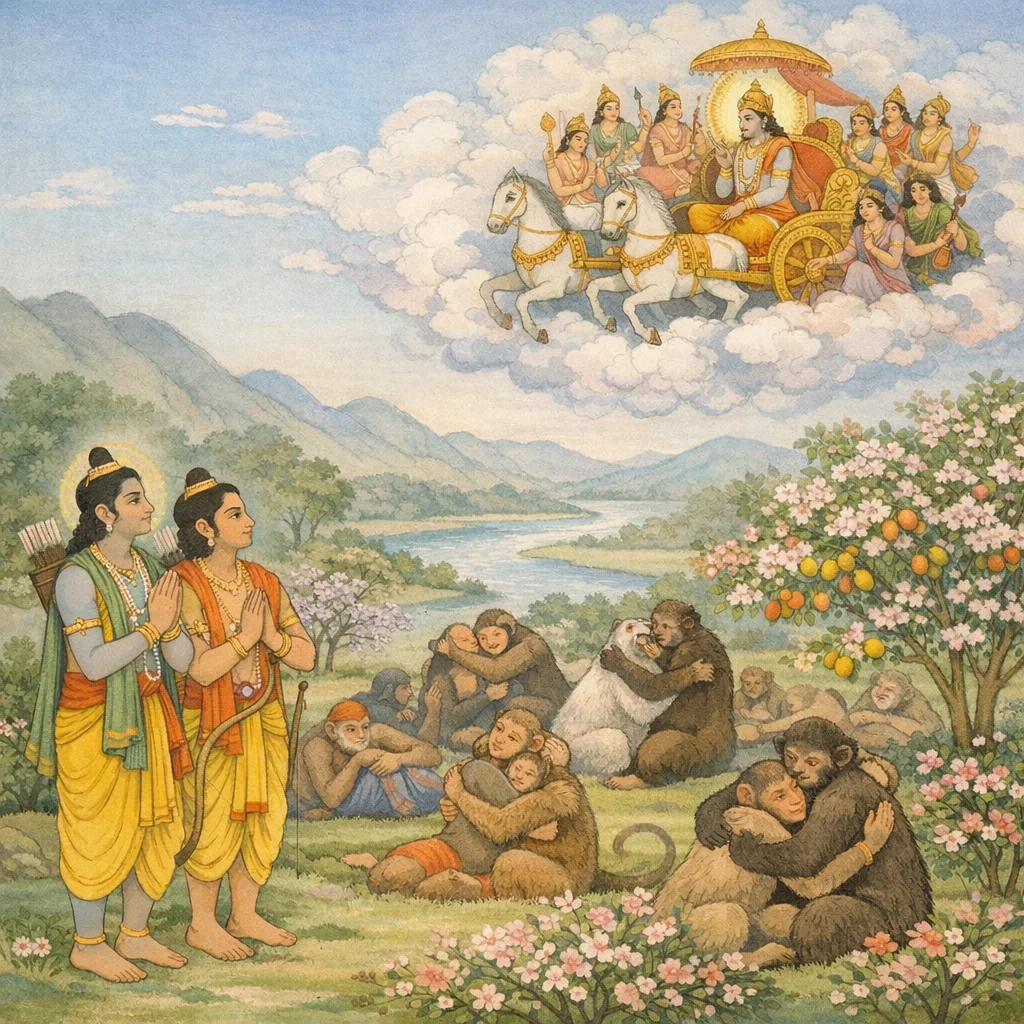
Sarga 123 presents a post-conflict consolidation scene framed as a divine dialogue. Indra (Mahendra/Pākaśāsana/Sahasrākṣa) addresses Rāma, who stands with joined palms, and invites him to state his wish. Rāma’s request is explicitly communal and restitutional: those vānaras and ṛkṣas who fought for his cause and reached Yama’s abode should regain life, become free of wounds, and be reunited with kin; additionally, the places where the vānaras live should flourish with unseasonal blossoms and fruits, and rivers should run pure and full. Indra assents, emphasizing the greatness of the boon and its certainty. The narrative then depicts the immediate effect: the fallen and wounded rise as if waking from sleep, restored in strength and astonished. The suras praise Rāma and Lakṣmaṇa and counsel the return to Ayodhyā—releasing the vānaras, consoling Maithilī, meeting Bharata and Śatrughna, seeing the mothers, and receiving consecration. Indra departs with the gods in sun-bright vimānas; Rāma formally dismisses the vānaras to rest, and the army is described as radiant in its renewed splendor.
Shlokas
Verse 1
प्रतिप्रयातेकाकुत्स्थेमहेन्द्रःपाकशासनः ।अब्रवीत्परमप्रीतोराघवंप्राञ्जलिंस्थितम् ।।।।
When Kākutstha had departed, Mahendra—the subduer of Pāka—spoke with great affection to Rāghava, who stood with palms joined in reverence.
Verse 2
अमोघंदर्शनंराम तवास्माकंनरर्षभ ।प्रीतियुक्ताःस्मतेनत्वंब्रूहियन्मनसेप्सितम् ।।।।
O Rāma, bull among men, your appearance before us is wondrous and auspicious. We are filled with joy; therefore, tell us what desire you hold in your heart.
Verse 3
एवमुक्तोमहेन्द्रेणप्रसन्नेनमहात्मना ।सुप्रसन्नमनाहृष्टोवचनंप्राहराघवः ।।।।
Thus addressed by Mahendra, the great-souled and gracious lord, Rāghava—his mind made serene and glad—spoke these words.
Verse 4
यदिप्रीतिस्समुत्पन्नामयितेविबुधेश्वर ।वक्ष्यामिकुरुमेसत्यंवचनंवदतांवर ।।।।
If goodwill has truly arisen in you toward me, O Lord of the gods—best among speakers—then I shall state my request; make my words come true.
Verse 5
ममहेतोःपराक्रान्तायेगतायमसादनम् ।तेसर्वेजीवितंप्राप्यसमुततिष्ठन्तुवानराः ।।।।
Those Vānaras who, for my sake, fought valiantly and have gone to Yama’s abode—may all of them regain life and rise again.
Verse 6
मत्कृतेविप्रयुक्तायेपुत्रैर्दारैश्चवानराः ।तान्प्रीतमनसःसर्वान्द्रष्टुमिच्छामिमानद ।।।।
O bestower of honor, I wish to see all those Vānaras—who, for my sake, have been separated from their sons and wives—now restored and joyful at heart.
Verse 7
विक्रान्ताश्चापिशूराश्च न मृत्युंगणयन्ति च ।कृतयत्नाविपन्नाश्चजीवयैनान् पुरन्दर ।।।।
They were bold and heroic, and they did not reckon with death. Having exerted themselves to the utmost, they fell in calamity—O Purandara, restore them to life.
Verse 8
मत्प्रियेष्वभिरक्ताश्च न मृत्युंगणयन्तिये ।त्वत्प्रसादात्समेयुस्तेवरमेतमहंवृणे ।।।।
Those who were devoted to what is dear to me and who did not reckon with death—by your grace may they return. This is the boon I choose.
Verse 9
नीरुजोनिर्व्रणांश्चैवसम्पन्नबलपौरुषान् ।गोलाङ्गूलांस्तथैवर्क्षांन्द्रष्टुमिच्छामिमानद ।।।।
O bestower of honor, I wish to see those long-tailed Vānaras and the bears free from illness and wounds, endowed again with strength and manly valor.
Verse 10
अकालेचापिपुष्पाणिमूलानि च फलानि च ।नद्यश्चविमलास्तत्रतिष्ठेयुर्यत्रवानराः ।।।।
Even out of season, let there be flowers, roots, and fruits; and let pure rivers flow in the places where the Vānaras dwell.
Verse 11
श्रुत्वातुवचनंतस्यराघवस्यमहात्मनः ।महेन्द्रःप्रत्युवाचेदंवचनंप्रीतिसंयुतम् ।।।।
Hearing the words of the great-souled Rāghava, Mahendra (Indra) replied in turn, with heartfelt delight.
Verse 12
महानयंवरस्तातयस्त्वयोक्तोरघूत्तम ।वदिर्मयानोक्तपूर्वं च तस्मादेतद्भविष्यति ।।।।
Dear one, O best of the Raghus—this boon you have asked is indeed great. Since it was not previously refused by me, therefore it shall come to pass.
Verse 13
समुत्तिष्ठन्तुतेसर्वेहतायेयुधिराक्षसैः ।ऋक्षाश्चसहगोपुच्छैर्निकृत्ताननबाहवः ।।।।
Let all those who were slain in battle by the Rākṣasas rise up again—both the long-tailed Vānaras and the bears—though their faces and arms had been cut down.
Verse 14
नीरुजोनिर्व्रणाश्चैवसम्पन्नबलपौरुषाः ।समुत्थास्यन्तिहरयस्सुप्तानिद्राक्ष्येयथा ।।।।
The monkeys shall rise—free from pain and wounds, endowed again with strength and manly vigor—just as sleepers rise when sleep has ended.
Verse 15
सुहृद्भिर्बान्धवैश्चैवज्ञातिभिःस्वजनेन च ।सर्वएवसमेष्यन्तिसम्युक्ताःपरयामुदा ।।।।
All shall come together again—reunited with friends, kinsmen, and their own people—filled with the highest joy.
Verse 16
अकालेपुष्पशबलाःफलवन्तश्चपादपाः ।भविष्यन्तिमहेष्वास नद्यश्चसलिलायुताः ।।।।
O great archer, trees shall bear blossoms and fruits even out of season, and rivers too shall be filled with water.
Verse 17
सव्रणैःप्रथमंगात्रैरिदानींनिर्व्रणैस्समैः ।ततस्समुत्थितास्सर्वेसुप्त्वेवहरियूथपाः ।।।।बभूवुर्वानरास्सर्वेकिंन्वेतदितिविस्मिताः ।
Those bodies that were earlier wounded now became whole and unwounded; then all the leaders of the Vānara troops rose up as if merely waking from sleep. All the Vānaras were astonished, saying, “What is this?”
Verse 18
काकुत्स्थंपरिपूर्णार्थंदृष्टवासर्वेसुरोत्तमाः ।।।।अब्रुवन्परमप्रीतास्स्तुत्वारामंसलक्ष्मणम् ।
Seeing Kakutstha’s purpose fully accomplished, all the foremost gods—delighted—praised Rāma together with Lakṣmaṇa and then spoke.
Verse 19
गच्छायोध्यामितोराजन्विसर्जय च वानरान् ।।।।मैथिलींसान्त्वयस्वैनामनुरक्तांयशस्विनीम् ।
O King, go from here to Ayodhyā; dismiss the Vānaras. And comfort Maithilī—devoted to you and illustrious—reassuring her heart.
Verse 20
भ्रारातरंभरतंपश्यत्वच्छोकाद्व्रतचारिणम् ।।।।शत्रुघ्नं च महात्मानंमात्रूःसर्वाःपरन्तप ।अभिषेचयचात्मानंपौरान्गत्वाप्रहर्षय ।।।।
O subduer of foes, behold your brother Bharata—steadfast in his vow, wasting in grief for you; behold also the great-souled Śatrughna and all your mothers. Accept consecration as king, and on reaching the citizens, gladden them.
Verse 21
भ्रारातरंभरतंपश्यत्वच्छोकाद्व्रतचारिणम् ।।6.123.20।।शत्रुघ्नं च महात्मानंमात्रूःसर्वाःपरन्तप ।अभिषेचयचात्मानंपौरान्गत्वाप्रहर्षय ।।6.123.21।।
O subduer of foes, behold your brother Bharata—steadfast in his vow, wasting in grief for you; behold also the great-souled Śatrughna and all your mothers. Accept consecration as king, and on reaching the citizens, gladden them.
Verse 22
एवमुक्त्वासहस्राक्षोरामंसौमित्रिणासह ।विमानैःसूर्यसङ्काशैर्ययौहृष्टःसुरैःसह ।।।।
Having spoken thus to Rāma together with Saumitrī (Lakṣmaṇa), the thousand-eyed Indra—delighted—departed with the gods in sun-bright aerial cars.
Verse 23
अभिवाद्य च काकुत्स्थ: सर्वांस्तांस्त्रिदशोत्तमान् ।लक्ष्मणेनसहभ्रात्रावासमाज्ञापयत्तदा ।।।।
Then Kakutstha (Rāma), having saluted all those foremost among the gods, ordered the troops to return to their quarters, accompanied by his brother Lakṣmaṇa.
Verse 24
ततस्तुसालक्ष्मणरामपालितामहाचमूर्हृष्टजनायशस्विनी ।श्रियाज्वलन्तीविरराजसर्वतोनिशाप्रणीतेवहिशीतरश्मिना ।।।।
Thereafter that vast host—guarded by Rāma and Lakṣmaṇa, filled with rejoicing people and made illustrious—shone with splendor on every side, like the night made radiant by the cool-rayed moon.
Frequently Asked Questions
The pivotal action is Rāma’s choice of boon: rather than personal reward, he seeks restitution for allies—revival of the fallen vānaras/ṛkṣas, healing of wounds, and reunion with families—framing victory as an obligation to repair loss.
The dialogue teaches that legitimate leadership is measured by gratitude and care for dependents; divine power is invoked not for domination but for restoration—life, health, community reunification, and ecological well-being as signs of dharmic completion.
Ayodhyā is foregrounded as the destination of civic restoration (reunion with Bharata, Śatrughna, and the mothers; consecration), while the vānaras’ habitation is culturally marked by prosperity motifs—unseasonal blossoms/fruits and pure, full rivers—signifying renewed order.