Sarga 121
अग्निपरीक्षासाक्ष्यं (Agni’s Testimony and Sītā’s Revalidation)
युद्धकाण्ड
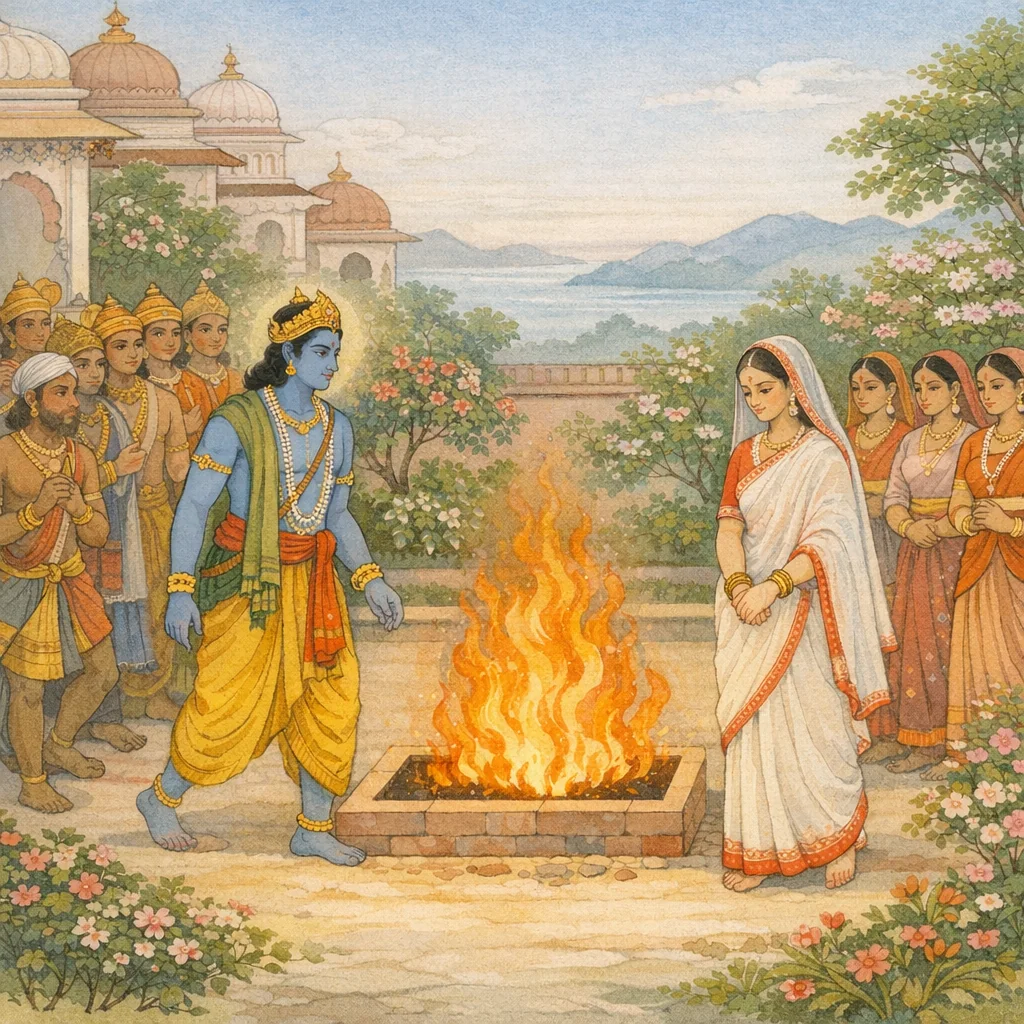
This sarga presents a juridical-theological closure to the war narrative through witnessed testimony. After Brahmā’s address, Agni (Vibhāvasu/Havyavāhana/Pāvaka), as “loka-sākṣī” (world-witness), rises from the fire bearing Vaidehī and returns her to Rāma in radiant, unaltered form. Agni formally declares her sinlessness and fidelity in speech, mind, intellect, and even glance, describing her captivity under rākṣasī surveillance, temptations, and threats without deviation from devotion to Rāma. Rāma then articulates the ethical logic of public credibility: though Sītā is known to be pure across the three worlds, her long residence in Rāvaṇa’s inner apartments could trigger social suspicion; therefore, for the conviction of the three worlds (loka-pratyaya) he allowed the fire-entry, not from personal doubt. He affirms Sītā’s inviolability—likened to a flame inaccessible even in thought to the wicked—and asserts he cannot renounce her any more than one can abandon one’s own fame or self. The chapter closes with Rāma accepting counsel, being praised, and enjoying rightful happiness reunited with his wife.
Shlokas
Verse 1
एतच्छ्रुत्वाशुभंवाक्यंपितामहसमीरितम् ।अङ्केनादायवैदेहिमुत्पपातविभावसुः ।।।।
Hearing those auspicious words spoken by the Grand-sire (Brahmā), Vibhāvasu (Agni) sprang forth, lifting Vaidehī in his arms.
Verse 2
नविधूयाथचितांतांतुवैदेहींहव्यवाहनः ।उत्तस्थौमूर्तिमानाशुगृहीत्वाजनकात्मजाम् ।।।।
Then the Fire-god, without scattering that funeral-pyre, quickly rose up in embodied form, taking Vaidehī—Janaka’s daughter—in his hands.
Verse 3
तरुणादित्यसङ्काशंतप्तकाञ्चनभूषणाम् ।रक्ताम्बरधरांबालांसीलकुञ्चितमूर्थजाम् ।।।।अक्लिष्टमाल्याभरणांतथारूपामनिन्दिताम् ।ददौरामायवैदेहीमङ्केकृत्वाविभावसुः ।।।।
Blazing like the young rising sun, adorned with refined gold ornaments, clad in red garments, youthful, and with dark curling hair—wearing unsoiled garlands and ornaments, and appearing just as before, the blameless Vaidehī was taken into Agni’s arms and then given back to Rāma.
Verse 4
तरुणादित्यसङ्काशंतप्तकाञ्चनभूषणाम् ।रक्ताम्बरधरांबालांसीलकुञ्चितमूर्थजाम् ।।6.121.3।।अक्लिष्टमाल्याभरणांतथारूपामनिन्दिताम् ।ददौरामायवैदेहीमङ्केकृत्वाविभावसुः ।।6.121.4।।
“Confined and hidden within the inner apartments, her mind fixed on you and devoted to you alone, she was kept under guard by rākṣasī women—terrible, with terrible intentions.”
Verse 5
अब्रवीत्तुतदारामंसाक्षीलोकस्यपावकः ।एषातेराम वैदेहीपापमस्यां न विद्यते ।।।।
Then Pāvaka, the Fire-god—witness for the world—spoke to Rāma: “Here is your Vaidehī, O Rāma; in her there is no sin.”
Verse 6
नैववाचा न मनसानैवबुद्ध्या न चक्षुषा ।सुवृत्तावृत्तशौण्डीरन त्वामत्यचरच्छुभा ।।।।
“Neither by speech, nor by mind, nor by understanding, nor even by her gaze did the auspicious and well-conducted Sītā transgress against you, O hero steadfast in righteous conduct.”
Verse 7
रावणेनापनीतैषावीर्योसतिक्तेनरक्षसा ।त्वयाविरहितादीनाविवशानिर्जनाद्वनात् ।।।।
“This woman was carried off by Rāvaṇa, the rākṣasa intoxicated with his own might, when she was separated from you—helpless, distressed—taken from the lonely forest.”
Verse 8
रुद्धाचान्तःपुरेगुप्तात्वच्छित्तात्वत्परायणा ।रक्षिताराक्षसीभिश्चघोराभिर्घोरबुद्धिभिः ।।।।
“Confined and hidden within the inner apartments, her mind fixed on you and devoted to you alone, she was kept under guard by rākṣasī women—terrible, with terrible intentions.”
Verse 9
प्रलोभ्यमानाविविधंभर्त्स्यमाना च मैथिली ।नाचिन्तयततद्रक्षस्त्वद्गतेनान्तरात्मना ।।।।
“Though tempted in many ways and threatened as well, Maithilī—her inner self fixed upon you—did not give her mind to that rākṣasa at all.”
Verse 10
विशुद्धभावांनिष्पापांप्रतिगृह्णीष्वमैथिलीम् ।न किञ्चिरभिधातव्याअहमाज्ञापयामिते ।।।।
Accept Maithilī back: her inner being is pure and she is without sin. You are not to say anything in reply—I command you.
Verse 11
ततःप्रीतिमानारामःश्रुत्यैवंवदतांवरः ।दध्यौमुहूर्तंधर्मात्माबाष्पव्याकुललोचनः ।।।।
Then righteous Rāma—best among speakers—hearing those words, rejoiced within; yet with tear-troubled eyes he reflected for a moment.
Verse 12
एवमुक्तोमहातेजाधृतिमान्दृढविक्रमः ।उवाचत्रिदशश्रेष्ठंरामोधर्मभृतांवरः ।।।।
Thus addressed, Rāma—radiant, steadfast, and firm in valor—supreme among upholders of dharma, spoke to the foremost of the gods.
Verse 13
अवश्यंत्रिषुलोकेषु न सीतापापमर्हति ।दीर्घकालोषिताहीयंरावणान्तःपुरेशुभा ।।।।
Surely, in the three worlds it is known that auspicious Sītā is not guilty of sin; yet she did dwell for a long time within Rāvaṇa’s inner chambers.
Verse 14
बालिशोखलुकामात्मारामोदशरथात्मजः ।इतिवक्ष्यन्तिमांसन्तोजानकीमविशोध्यहि ।।।।
‘Rāma, Daśaratha’s son, is surely foolish—ruled by desire’: thus, people would speak of me, if I were to accept Jānakī without testing her purity.
Verse 15
अनन्यहृदयांभक्तांमच्चित्तपरिवर्तिनीम् ।अहमप्यवगच्छामिमैथिलींजनकात्मजाम् ।।।।
I too know Maithilī, Janaka’s daughter—devoted, with an undivided heart, ever turning her mind toward me alone.
Verse 16
इमामपिविशालाक्षींरक्षितांस्वेनतेजसा ।रावणोनातिवर्तेतवेलामिवमहोदधिः ।।।।
Even this wide-eyed lady, protected by her own radiance—Rāvaṇa could not overstep her, just as the great ocean cannot cross its shore-boundary.
Verse 17
प्रत्ययार्थंतुलोकानांत्रयाणांसत्यसंश्रयः ।उपेक्षेचापिवैदेहींप्रविशन्तींहुताशनम् ।।।।
But for the sake of convincing the three worlds—since I rest upon truth—I even stood by as Vaidehī entered the fire.
Verse 18
न हिशक्तःसुदुष्टात्मामनसापिहिमैथिलीम् ।प्रधर्षयितुमप्राप्यांदीप्तामग्निशिखामिव ।।।।
That utterly wicked one was not capable—even in thought—of violating Maithilī, who was unapproachable, blazing like a tongue of fire.
Verse 19
नेयमर्हतिचैश्वर्यंरावणान्तःपुरेशुभा ।अनन्याहिमयासीताभास्करेणप्रभायथा ।।।।
Auspicious Sītā would not care for any splendor in Rāvaṇa’s inner palace; she is inseparable from me, as radiance is from the sun.
Verse 20
विशुद्धात्रिषुलोकेषुमैथिलीजनकात्मजा ।न विहातुंमयाशक्याकीर्तिरात्ववतायथा ।।।।
“Maithilī, Janaka’s daughter, is pure in all the three worlds. I cannot abandon her—just as a self-possessed man cannot abandon his own fame.”
Verse 21
अवश्यं च मयाकार्यंसर्वेषांवोवचोहितम् ।स्निग्धानांलोकनाधानामेवं च वदतांहितम् ।।।।
“And I must indeed act upon your beneficial words—words spoken for good—by you affectionate ones, leaders worthy of the world’s respect.”
Verse 22
इत्येवम्विजयीमहाबलःप्रशस्यमानःस्वकृतेनकर्मणा ।समेत्यरामःप्रिययामहायशाःसुखंसुखार्होऽनुबभूवराघवः ।।।।
Thus, victorious and mighty, Rāma—illustrious and praised for his own deeds—reunited with his beloved and, as one worthy of happiness, experienced happiness.
Frequently Asked Questions
The dilemma is legitimacy versus private knowledge: Rāma acknowledges Sītā’s purity yet permits the fire-entry so that the wider world cannot accuse him of accepting her without verification, preserving royal and social trust.
Dharma in leadership includes accountability to collective perception when it safeguards social order; truth is upheld not only internally but also through credible witness and transparent validation.
The key cultural-ritual landmark is the sacrally charged fire/pure-fire setting (agni, citā) functioning as a public witness; the narrative references Rāvaṇa’s antaḥpura (inner quarters) as the contested space of captivity and suspicion.