Sarga 119
सीताया अग्निप्रवेशः (Sita’s Ordeal by Fire / Agni-Pariksha)
युद्धकाण्ड
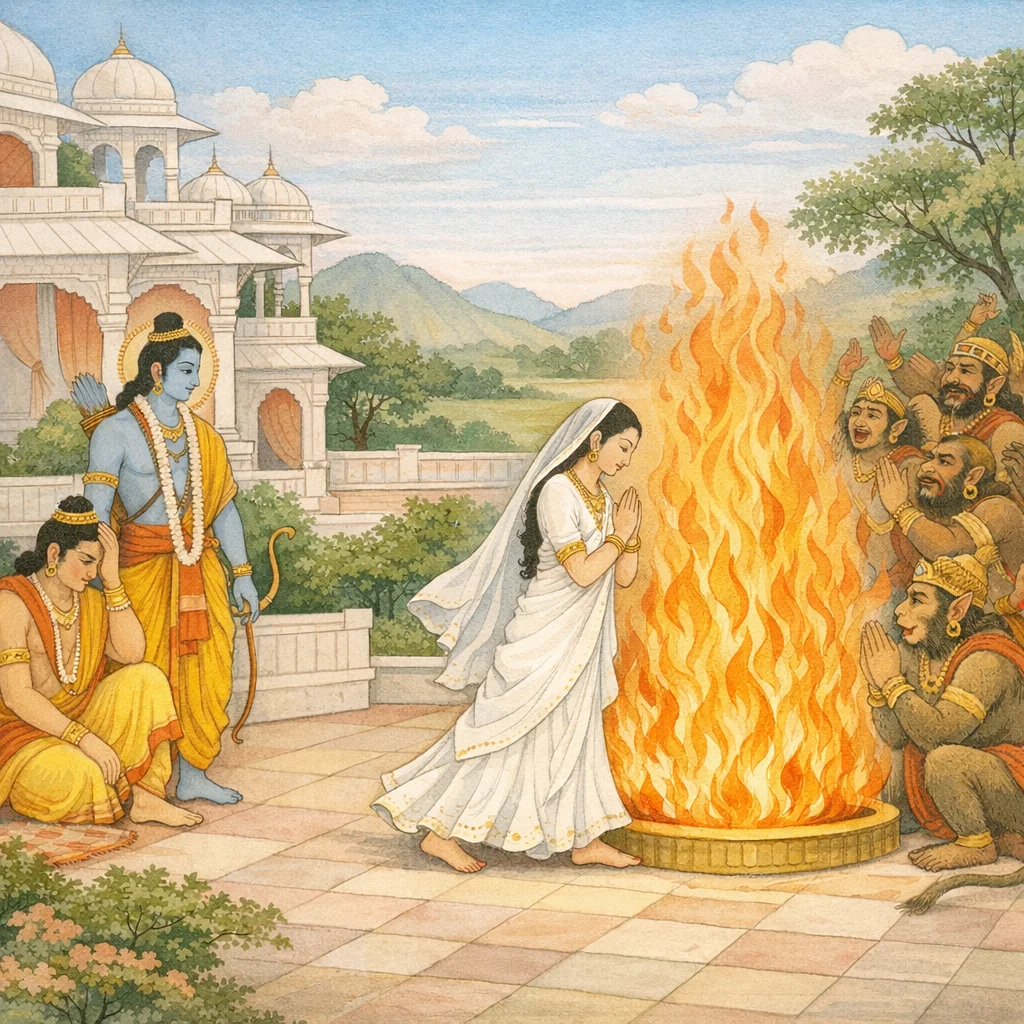
This sarga presents a tightly structured public-ethical crisis following Rama’s harsh, socially inflected speech that wounds Vaidehi (Sita) before an assembled audience. Sita replies in a reasoned, self-justifying sequence: she rejects being judged by the conduct of “vulgar women,” distinguishes inner intention (mind/heart) from bodily coercion under captivity, and appeals to the long intimacy and trust of marriage. She argues that if suspicion were decisive, the rescue itself and the exertions of allies would become purposeless. Turning from discourse to ritual proof, she requests Lakshmana to prepare a pyre, framing self-immolation as the only remaining dignified path when repudiated in public assembly. Lakshmana, indignant yet obedient to Rama’s nonverbal indication, prepares the fire; no one can remonstrate with Rama, described as death-like in resolve. Sita performs pradakṣiṇa, salutes gods and brahmanas, and pronounces invocations calling cosmic deities and Agni as witnesses to her unwavering fidelity in action, speech, and thought. She then enters the blazing fire fearlessly; the gathered beings—humans, Vanaras, Rakshasas, and celestial orders—react with astonishment, lamentation, and acclamation, emphasizing communal witnessing as the chapter’s adjudicative mechanism.
Shlokas
Verse 1
एवमुक्तातुवैदेहिपरुषंरोमहर्षणम् ।राघवेणसरोषेणश्रुत्वाप्रव्यथिताऽभवत् ।।।।
Thus addressed, Vaidehī, hearing Rāghava’s harsh words—words that raised the hair in horror—became deeply shaken, for he spoke in anger.
Verse 2
सातदश्रुतपूर्वंहिजनेमहतिमैथिली ।श्रुत्वाभर्तृर्वचोरूक्षंलज्जयावनताभवत् ।।।।
Then Maithilī, having heard her husband’s harsh words before the great assembly of people, bowed down in shame and stood with her face lowered.
Verse 3
प्रविशन्तीवगात्राणिस्वानिसाजनकात्मजा ।वाक्षरैस्स्सैःसशल्येवभृशमाश्रूण्यवर्तयत् ।।।।
As though wounded by those arrow-like words, Janaka’s daughter seemed to shrink into her own limbs and shed tears in great excess.
Verse 4
ततोबाष्पपरिक्लिन्नंप्रमार्जन्तीस्वमाननम् ।शनैर्गद्गदयावाचाभर्तारमिदमब्रवीत् ।।।।
Then, wiping her own face wet with tears, she spoke to her husband—slowly, in a voice broken with sobs—these words.
Verse 5
किंमामसदृशंवाक्यमीदृशंश्रोत्रदारुणम् ।रूक्षंश्रावयसेवीर प्राकृतःप्राकृतमिव ।।।।
Hero, why do you speak to me with words so unlike you—so harsh to the ear and so rough—as though an ordinary man were addressing an ordinary woman?
Verse 6
न तथास्मिमहाबाहो यथामामवगच्छसि ।प्रत्ययंगच्छमेस्वेनचारित्रेणैवतेशपे ।।।।
O mighty-armed one, I am not as you imagine me to be; be assured of me through my own conduct—I swear it to you by my character.
Verse 7
पृथकस्त्रीणांप्रचारेणजातिंत्वंपरिशङ्कसे ।परित्यजैनांशङ्कांतुयदितेऽहंपरीक्षिता ।।।।
By the conduct of certain women you suspect the whole of womankind; abandon this doubt—if indeed you have examined me.
Verse 8
यदहंगात्रसम्पर्शंगतास्मिविशवाप्रभो ।कामकारो न मेतत्रदैवंतत्रापराध्यति ।।।।
Lord, if I suffered the touch of another’s limbs, I was helpless; there I had no freedom of choice—fate and force are to be blamed there, not I.
Verse 9
मदधीनंतुयत्तन्मेहृदयंत्वयिवर्तते ।पराधीनेषुगात्रेषुकिंकरिष्याम्यनीश्वरी ।।।।
But what is under my control—my heart—remains in you; when my limbs are under another’s power, what could I do, being without freedom?
Verse 10
सहसम्वृद्धभावेनसंसर्गेण च मानद ।यदितेऽहं न विज्ञाताहतातेनास्मिशाश्वतम् ।।।।
O honourable Rāma! If, despite our being brought up together in affection and despite our close bond, you still do not truly know me, then I am ruined forever.
Verse 11
प्रेषितस्तेमहावीरोहनुमानवलोककः ।लङ्कास्थाहंत्वयाराजन्किंतदा न विसर्जिता ।।।।
O King! When the great hero Hanūmān was sent by you as a scout to find me, while I was in Laṅkā—why did you not renounce me then, if doubt was truly your stance?
Verse 12
प्रत्यक्षंवानरस्यास्यतद्वाक्यसमनन्तरम् ।त्वयासन्त्यक्तयावीरत्यक्तंस्याजजीवितंमया ।।।।
O hero! If you had rejected me immediately after hearing that message—in the very presence of that Vānara—I would have relinquished my life then and there.
Verse 13
न वृथातेश्रमोऽयंस्यात्संशयेन्यस्यजीवितम् ।सुहृज्जनपरिक्लेशो न चायंविपुलस्तव ।।।।
If you truly harboured doubt, then this toil of yours was in vain—along with the lives risked by others; and this great suffering of your friends would not have been warranted.
Verse 14
त्वयातुनृपशार्दूलदोषमेवानुवर्तता ।लघुनेवमनुष्येणस्त्रीत्वमेवपुरस्कृतम् ।।।।
But you, O tiger among kings, followed only a fault—yielding to it; like a petty man you gave precedence to a weakness, treating me as though ‘womanhood’ itself were the grounds for suspicion.
Verse 15
अपदेशेनजनकादुत्पततिर्वसुथातलात् ।ममवृत्तं च वृत्तज्ञबहुते न पुरस्कृतम् ।।6.119.15।।
My origin—spoken of as arising from the earth and being connected with Janaka—and my conduct, O knower of right conduct: you have not given due weight to these, though they are many and well-known.
Verse 16
न प्रमाणीकृतंपाणिर्भाल्येममनिपीडितः ।ममभक्तिश्चशीलं च सर्वंतेपृष्ठतःकृतम् ।।।।
Was the clasping of my hand in youth—not taken by you as a binding sign? Have my devotion, my character, and all that I have lived by been set aside behind your back?
Verse 17
इतिब्रुवन्तीरुदतीबाष्पगद्गगभाषिणी ।उवाचलक्ष्मणंसीतादीनंध्यानपरायणम् ।।।।
Speaking thus, weeping, her voice choked with tears, Sītā addressed Lakṣmaṇa—who stood pained and absorbed in thought.
Verse 18
चितांमेकुरुसौमित्रेव्यवनस्यास्यभेषजम् ।मिध्यापवादोपहतानाहंजीवितुमुत्सहे ।।।।
O Saumitri, prepare a funeral pyre for me—the only remedy for this calamity. Struck by false accusations, I do not wish to go on living.
Verse 19
अप्रीतेनगुणैर्भर्त्रात्यक्तायाजनसंसदि ।याक्षमामेगतिर्गन्तुंप्रवेक्ष्येहव्यवाहनम् ।।।।
When my husband, not satisfied even with my virtues, casts me off in an assembly of people, there is only one course left for me to take: here and now I shall enter the fire, the carrier of oblations.
Verse 20
एवमुक्तस्तुवैदेह्यालक्ष्मणःपरवीरहा ।अमर्षवशमापन्नोराघवंसमुदैक्षत ।।।।
Thus addressed by Vaidehī, Lakṣmaṇa—slayer of hostile heroes—overcome with indignation, looked up at Rāghava.
Verse 21
स विज्ञायततश्छन्दंरामस्याकारसूचितम् ।चितांचकारसौमित्रिर्मतेरामस्यवीर्यवान् ।।।।
Understanding Rāma’s intention as conveyed by his expression, the valiant Saumitrī (Lakṣmaṇa) prepared a funeral-pyre on the ground, acting in accordance with Rāma’s decision.
Verse 22
नहिरामंतदाकश्चित्कालान्तकयमोपमम् ।अनुनेतुमथोवक्तुंद्रष्टुंवाप्यशकत्सुहृत् ।।।।
For at that time no friend could approach Rāma—who seemed like Yama, the ender at the close of time—neither to entreat him, nor to speak, nor even to look upon him.
Verse 23
अधोमुखंस्थितंरामंततःकृत्वाप्रदक्षिणम् ।उपावर्ततवैदेहीदीप्यमानंहुताशनम् ।।।।
Then Vaidehī, having circumambulated Rāma—standing with face lowered—turned toward the blazing fire.
Verse 24
प्रणम्यदैवतेभ्यश्चब्राह्मणेभ्यश्चमैथिली ।बद्धाञ्जलिपुटाचेदमुवाचानगिसमीपतः ।।।।
Having bowed to the gods and to the brāhmaṇas, Maithilī, with hands joined in reverence, spoke these words from near the fire.
Verse 25
यथामेहृदयंनित्यंनापसर्पतिराघवात् ।तथालोकस्यसाक्षीमांसर्वतःपातुपावकः ।।।।
If truly my heart has never turned away from Rāghava, then may Pāvaka—witness of the world—protect me on every side.
Verse 26
यथामांशुद्धचरितांदुष्टांजानातिराघवः ।तथालोकस्यसाक्षीमांसर्वतःपातुपावकः ।।।।
If Rāghava knows me to be of pure conduct and not corrupted, then may Pāvaka—witness of the world—protect me everywhere.
Verse 27
कर्मणामनसावाचायथानातिचराम्यहम् ।राघवंसर्वधर्मज्ञंतथामांपातुपावकः ।।।।
If by deed, by mind, or by speech I have never transgressed against Rāghava—knower of all dharma—then may Pāvaka protect me.
Verse 28
आदित्योभगवान्वायुर्धिशश्चन्द्रस्तथैव च ।अहश्चापितथासन्ध्येरात्रिश्चपृथिवीतथआ ।।।।यथान्येऽपिविजानन्तितथाचारित्रसंयुताम् ।
May the blessed Āditya, Vāyu, the Directions, and the Moon—as also Day, Twilight, Night, and Earth, and all the other (deities) who know—recognize me as endowed with good conduct.
Verse 29
एवमुक्त्वातुवैदेहीपरिक्रम्यहुताशनम् ।विवेशज्वलनंदीप्तंनिःशङ्केनान्तरात्मना ।।।।
Having spoken thus, Vaidehī circumambulated the fire and, fearless and inwardly composed, entered the blazing flames.
Verse 30
नश्चसुमहांस्तत्रबालवृद्धसमाकुलः ।।।।ददर्शमैथिलींदीप्तांप्रविशन्तींहुताशनम् ।
There, a vast crowd—thronged with both the young and the old—looked on and saw Maithilī entering the blazing fire.
Verse 31
सातप्तनवहेमाभातप्तकाञ्चनभूषणा ।।।।पपातज्वलनंदीप्तंसर्वलोकस्यसन्निधौ ।
She—shining like newly refined gold, adorned with glowing golden ornaments—fell into the blazing fire in the presence of all the people.
Verse 32
ददृशुस्तांविशालाक्षींपतन्तींहव्यवाहनम् ।।।।सीतांसर्वाणिरूपाणिरुक्मवेदिनिभांतदा ।
Then all beings beheld wide-eyed Sītā as she descended into the bearer of oblations (the fire), luminous like a golden altar.
Verse 33
ददृशुस्तांमहाभागांप्रविशन्तींहुताशनम् ।।।।सीतांकृत्स्नास्त्रयोलोकाःपुण्यामाज्याहुतीमिव ।
The entire three worlds beheld the greatly fortunate Sītā entering the fire, like a sacred offering of ghee poured into the flames.
Verse 34
प्रचुक्रुशुःस्त्रियःसर्वास्तांदृष्टवाहव्यवाहवे ।।।।पतन्तींसंस्कृतांमन्रन्स्सैर्वसोर्दारामिवाध्वरे ।
All the women cried out on seeing her fall into the oblation-bearing fire, as though she were a steady stream of ghee in a sacrifice, sanctified by mantras.
Verse 35
ददृशुस्तांत्रयोलोकादेवगन्धर्वदानवाः ।।।।शस्तांपतन्तींनिरयेत्रिविवाद्धेवतामिव ।
The gods, Gandharvas, and Dānavas across the three worlds beheld her as she fell, praising her—like a goddess seeming to plunge from heaven into hell.
Verse 36
तस्यामग्निंविशन्त्यांतुहाहेतिविपुलःस्वनः ।।।।रक्षसांवानराणां च सम्बभूवाद्भुतोपमः ।
As she entered the fire, a great roar arose among the Rākṣasas and the Vānaras—cries of “hā hā,” astonishment-filled and wondrous.
Frequently Asked Questions
The sarga centers on a public dharma-conflict: Rama’s concern for royal reputation and communal judgment versus Sita’s claim to unimpeachable fidelity under coercive captivity. The decisive action is Sita’s choice of ritual ordeal—entering fire—to establish truth through cosmic and communal witnessing.
It distinguishes moral culpability by intention and agency (mind/word/deed) rather than mere physical contact under compulsion, while also showing how public office can demand proofs framed for society. The text thereby stages a tension between inner virtue and external validation mechanisms.
Key landmarks include Lanka as the site of captivity recalled in argument, and the public assembly setting where reputation is negotiated. Culturally, the chapter highlights pradakṣiṇa, salutations to gods and brahmanas, and the fire-ordeal (Agni as witness) as a ritual-legal idiom of verification.