Sarga 113
रावणवधदर्शनम् — Lament of the Rākṣasa Women upon Seeing Rāvaṇa Slain
युद्धकाण्ड
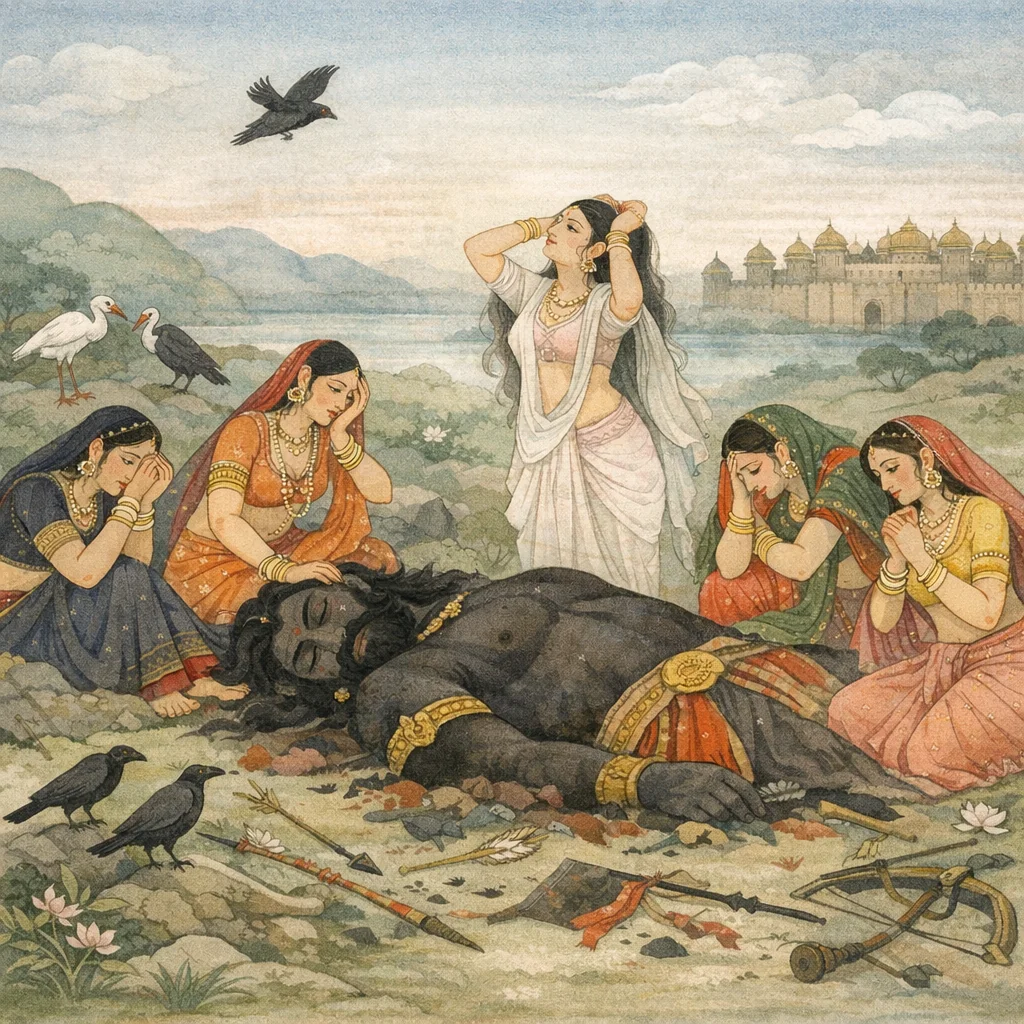
This sarga stages the immediate civic and domestic aftermath of Rāvaṇa’s death. Grief-stricken rākṣasī women rush from the inner apartments (antaḥpura) and enter the blood-mired battlefield, searching for husbands and kin amid severed trunks and fallen bodies. They behold Rāvaṇa’s immense corpse, likened to a dark mountain-heap, and collapse upon his limbs; individual gestures of mourning are cataloged—embracing, clinging to feet and neck, rolling on the ground, fainting, and bathing his face with tears in a lotus-and-dew simile. Their lamentation turns reflective and didactic: they contrast Rāvaṇa’s former terror over Indra, Yama, Gandharvas, Ṛṣis, and Suras with his present helplessness, slain by a mortal warrior. The women explicitly diagnose causality—failure to heed well-wishing counsel (especially Vibhīṣaṇa’s), the abduction and detention of Sītā, and the resulting ‘root-destruction’ (mūlahara) of their community—while also articulating a theology of fate (daiva) as an unstoppable course that no wealth, will, prowess, or royal command can reverse. The chapter concludes with their bird-like wailing (krauncha/kurarī imagery), preserving a formal elegiac cadence within the war-book’s martial frame.
Shlokas
Verse 1
रावणंनिहतंदृष्टवाराघवेणमहात्मना ।अन्तःपुराद्विनिष्पेतूराक्षस्यश्शोककर्शिताः ।।।।
Seeing Rāvaṇa slain by the great-souled Rāghava, the rākṣasī women—worn down by grief—rushed out from the inner chambers.
Verse 2
वार्यमाणास्सुबहुशोवेष्टन्त्यःक्षितिपांसुषु ।विमुक्तकेश्यश्शोकार्तागावोवत्सहतायथा ।।।।
Though restrained again and again, many women rolled in the dust of the earth, their hair dishevelled, crying in grief like cows whose calves have been killed.
Verse 3
उत्तरेणविनिष्क्रम्यद्वारेणसहराक्षसैः ।प्रविश्यायोधनंघोरंविचिन्वन्त्वोहतंपतिम् ।।।।आर्यपुत्रेतिवादिन्योहानाथेति च सर्वशः ।परिपेतुःकबन्धाङ्कांमहींशोणितकर्दमाम् ।।।।
Coming out by the northern gate together with the rākṣasas, the women entered the dreadful battlefield, searching for their slain husbands. Crying out everywhere, “O noble son!” and “O my lord, I am without protector!”, they wandered over the ground strewn with trunks, smeared with blood and mire.
Verse 4
उत्तरेणविनिष्क्रम्यद्वारेणसहराक्षसैः ।प्रविश्यायोधनंघोरंविचिन्वन्त्वोहतंपतिम् ।।6.113.3।।आर्यपुत्रेतिवादिन्योहानाथेति च सर्वशः ।परिपेतुःकबन्धाङ्कांमहींशोणितकर्दमाम् ।।6.113.4।।
Coming out through the northern gate with the rākṣasas, they entered the dreadful battlefield, seeking their slain husbands; crying “O noble son!” and “Alas, my lord!”, they roamed everywhere over the earth littered with headless trunks and thick with blood and mud.
Verse 5
ताबाष्पपरिपूर्णाक्ष्योभर्तृशोकपराजिताः ।करेण्वइवनर्द्नत्योविनेदुर्हतयूथपाः ।।।।
Their eyes brimming with tears and overcome by grief for their husbands, they cried out—like she-elephants whose leader has been slain—raising a terrible roar.
Verse 6
ददृशुस्तामहाकायंमहावीर्यंमहाद्युतिम् ।रावणंनिहतम्भूमौनीलाञ्जनचयोपमम् ।।।।
They saw Rāvaṇa—of gigantic form, immense power, and great radiance—slain upon the ground, like a heap of dark collyrium-stone (a black mountain-mass).
Verse 7
ताःपतिंसहसादृष्टवाशयानंरणपांसुषु ।निपेतुस्तस्यगात्रेषुछिन्नावनलताइव ।।।।
Seeing their husband lying amid the dust of battle, they suddenly fell upon his limbs—like garden-creepers cut down and collapsing.
Verse 8
बहुमानात्परिष्वज्यकाचिदेवंरुरोद ह ।चरणौकाचिदालम्ब्यकाचित्कण्ठेऽवलम्ब्य च ।।।।
Out of deep reverence, some embraced him and cried out aloud; some clung to his feet and wept, and others hung upon his neck, weeping.
Verse 9
उत्क्षिप्य च भुजौकाचिद्भूमौसुपरिवर्तते ।हतस्यवदनंदृष्टवाकाचिन्मोहमुपागमत् ।।।।
Some, flinging up their arms, fell to the ground and rolled about; some, on seeing the face of the slain, were overcome by shock and faintness.
Verse 10
काचिदङ्केशिरःकृत्वारुरोदमुखमीक्षती ।स्नापयन्तीमुखंबाष्पैस्तुषारैरिवपङ्कजम् ।।।।
One woman set his head upon her lap and wept as she gazed at his face, bathing it with tears like dew upon a lotus.
Verse 11
एवमार्ताःपतिंदृष्टवारावणंनिहतंभुवि ।चुक्रुशुर्भहुधाशोकाद्भूयस्ताःपर्यदेवयन् ।।।।
Thus afflicted, seeing their husband Rāvaṇa slain upon the ground, they cried out in many ways, lamenting again and again in overwhelming sorrow.
Verse 12
येनमित्रासितःशक्रोयेनवित्रासितोयमः ।येनवैश्रवणोराजापुष्पकेणवियोजितः ।।।।गन्धर्वाणामृषीणां च सुराणां च महात्मनाम् ।भयंयेनरणेदत्तंसोऽयंशेतेरणेहतः ।।।।
He before whom even Śakra and Yama trembled; he who deprived King Vaiśravaṇa of the Puṣpaka; he who struck fear in battle into Gandharvas, Ṛṣis, and the great-souled gods—he now lies slain upon the battlefield.
Verse 13
येनमित्रासितःशक्रोयेनवित्रासितोयमः ।येनवैश्रवणोराजापुष्पकेणवियोजितः ।।6.113.12।।गन्धर्वाणामृषीणां च सुराणां च महात्मनाम् ।भयंयेनरणेदत्तंसोऽयंशेतेरणेहतः ।।6.113.13।।
He who once spread fear in battle among the Gandharvas, the seers, and the high-souled gods—now lies here on the battlefield, slain.
Verse 14
असुरेभ्यःसुरेभ्योवापन्नगेभ्योऽपिवातथा ।भयंयो न विजानातितस्येदंमानुषाद् भयम् ।।।।
He who never knew fear—whether from Asuras, from the gods, or even from the serpent-races—has now met fear from a mere human.
Verse 15
अवध्योदेवतानांयस्तथादानवराक्षसाम् ।हतःसोऽयंरणेशेतेमानुषेणपदातिना ।।।।
He whom neither the gods nor the Dānavas and Rākṣasas could slay—he now lies on the battlefield, killed by a human warrior on foot.
Verse 16
यो न शक्यस्सुरैर्हन्तुं न यक्षैर्नासुरैस्तथा ।सोऽयंकश्चिदिवासत्त्वोमृत्युंमर्त्येनलम्भितः ।।।।
He whom neither gods, nor Yakṣas, nor Asuras could kill—he has now met death at the hands of a mortal, lying as though bereft of all power.
Verse 17
एवंवदन्त्योरुरुदुस्तस्यतादुःखिताःस्त्रियः ।भूयएव च दुःखार्ताविलेपुश्चपुनःपुनः ।।।।
Speaking thus, those grief-stricken women wept loudly for him; tormented by sorrow, they wailed again and again.
Verse 18
अशृण्वतातुसुहृदांसततंहितवादिनाम् ।मरणायहृतासीताराक्षसाश्चनिपातिताः ।।।।एतास्सममिदानींतेवयमात्मा च पातितः ।
Because you did not listen to your well-wishers who spoke what was beneficial, you abducted Sītā only to meet death; and the Rākṣasas too have been struck down. Now, together, you—along with us all, and even your very self—have fallen into ruin.
Verse 19
ब्रुवाणोऽपिहितंवाक्यमिष्टोभ्राताविभीषणः ।।।।धृष्टंपरुषितोमोहत्त्वयात्मवथकाङ्क्षिणा ।
Even when your beloved brother Vibhīṣaṇa spoke words for your good, you—blinded by delusion and bent on your own destruction—answered him with harshness and contempt.
Verse 20
दिनिर्यातितातेस्वासतीतारामायमैथिली ।।।।ननस्स्याद्व्यसनंघोरमिदंमूलहरंमहत् ।
Had you sent back Sītā of Mithilā—Rāma’s own wife—to Rāma, this terrible calamity that has uprooted us would not have come upon us.
Verse 21
वृत्तकामोभवेद्भ्रातारामोमित्रकुलंभवेत् ।।।।वयंचाध्विवाःसर्वाःसकमा न च शत्रवः ।
Your brother’s purpose would have been fulfilled; Rāma would have become an ally to our line. We would not all have become widows—and the enemies would not have had their wish fulfilled.
Verse 22
त्वयापुनर्नृशंशंसेनसीतांसंरुन्धताबलात् ।।।।राक्षसावयमात्मा च त्रयंतुल्यंनिपातितम् ।
Because you, in cruelty, kept Sītā confined by force, the rākṣasas, we ourselves, and you too—these three—have all been brought down together in ruin.
Verse 23
न कामकारःकामंवातवराक्षसपुङ्गव ।दैवंचेष्टयतेसर्वंहतंदैवेनहन्यते ।।।।
O foremost of rākṣasas, neither one’s self-will nor one’s desire alone prevails; destiny impels all. Whom fate has struck down—by fate he is slain.
Verse 24
वानराणांविनाशोऽयंराक्षसानां च तेरणे ।तवचैवमहाबाहो दैवयोगादुपागतः ।।।।
O mighty-armed one, in this war this destruction has come upon the vānaras, upon the rākṣasas, and upon you as well—through the convergence of destiny.
Verse 25
नैवार्थेन न कामेनविक्रमेण न चाज्ञया ।शक्यादैवगतिर्लोकेनिवर्तयितुमुद्यता ।।।।
In this world, the course of destiny, once set in motion, cannot be turned back—neither by wealth, nor by desire, nor by prowess, nor even by royal command.
Verse 26
विलेपुरेवंदीनास्ताराक्षसाधिपयोषितः ।कुरर्यइवदुःखार्ताबाष्पपर्याकुलेक्षणाः ।।।।
Thus the wives of the lord of rākṣasas wailed in misery—tormented by grief, their eyes clouded and shaken with tears—crying like kurarī birds.
Frequently Asked Questions
The sarga foregrounds the ethical breach of forcibly detaining Sītā and rejecting well-intentioned counsel; the women interpret these actions as the decisive pivot that brings collective ruin, framing personal desire (kāma) against governance ethics and restraint.
Power is impermanent and morally accountable: one who inspired fear in gods can still fall when adharma matures into consequence; additionally, daiva-gati is portrayed as a course that cannot be halted by wealth, will, prowess, or command, urging humility and heedfulness to good counsel.
The antaḥpura (inner apartments) and the uttara-dvāra (northern gate) anchor the movement from palace to battlefield, while the raṇa/āyodhana landscape—blood and mud, severed bodies—functions as a cultural tableau of wartime lamentation; Puṣpaka vimāna is cited as a significant royal object tied to Rāvaṇa’s prior dominance.