Sarga 112
रावणवधोत्तरं विभीषणशोकः—क्षत्रधर्मोपदेशः (Vibhishana’s Lament after Ravana’s Fall; Instruction on Kshatriya-Dharma)
युद्धकाण्ड
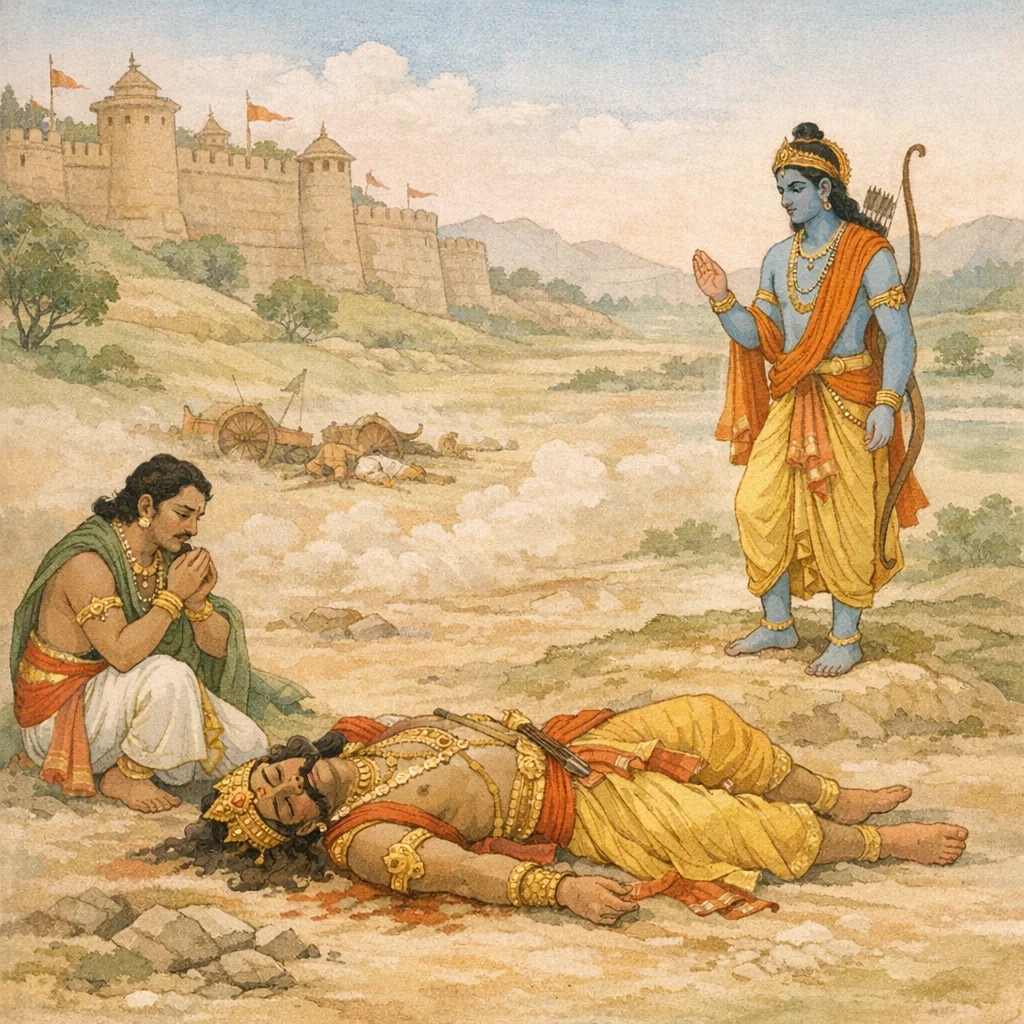
Sarga 112 stages the immediate aftermath of Rāvaṇa’s death. Vibhīṣaṇa, seeing his brother slain and lying on the battlefield, breaks into lamentation, describing the fallen king through a sequence of high metaphors: a great “rākṣasa-king tree” crushed by the “tempest of Rāghava,” an elephant in rut overthrown by the Ikṣvāku-lion, and a rākṣasa-fire extinguished by the rain-cloud of Rāma. He also mourns the collapse of order and vitality that Rāvaṇa represented for his people, portraying cosmic inversion (sun fallen, moon darkened, fire quenched). Rāma responds with a sober ethical discourse: a warrior who falls in battle according to kṣatriya duty is not to be mourned; victory is never absolute in war; even those feared by the three worlds must submit to time. Having received this framing, Vibhīṣaṇa requests permission to perform funerary rites, emphasizing Rāvaṇa’s ritual credentials and asserting that enmity ends with death. Rāma assents, directing the transition from combat to saṃskāra (last rites) and political-ritual stabilization.
Shlokas
Verse 1
भ्रातरंनिहतंदृष्टवाशयानंनिर्जितंरणे ।शोकवेगपरीतात्माविललापविभीषणः ।।।।
Seeing his brother slain and lying lifeless on the battlefield, Vibhīṣaṇa—overwhelmed by a surge of grief—lamented aloud.
Verse 2
वीर विक्रान्त विख्यात प्रवीण नयकोविद ।महार्हाशयनोपेतकिंशेषेनिहतोभुवि ।।।।
O valiant one—mighty, renowned, skilled, and wise in statecraft—accustomed to a splendid couch: why do you now lie slain upon the earth?
Verse 3
विक्षिप्यदीर्घौनिश्चेष्टौभुजावङ्गभूषितौ ।मुकुटेनापवृत्तेनभास्कराकारवर्चसा ।।।।
Your long arms, adorned with armlets, lie flung aside and motionless; and your crown has fallen away, radiant with a splendor like the sun.
Verse 4
दंवीरसम्प्राप्तंयन्मयापूर्वमीरितम् ।काममोहपरीतस्ययत्तन्नरुचितंतव ।।।।
O hero, what I foretold earlier has now come to pass—though, when you were overcome by desire and delusion, it did not please you to hear it.
Verse 5
यन्नदर्पात्प्रहस्तोवानेन्द्रजिन्नापरेजनाः ।न कुम्बकर्णोऽतिरथोनातिकायोनरान्तकः ।।।।न स्वयंत्वममन्येथास्तस्योदर्कोऽयमागतः ।
Out of pride, neither Prahasta nor Indrajit, nor the other warriors—neither Kumbhakarṇa the great chariot-fighter, nor Atikāya, nor Narāntaka—nor you yourself gave heed. This is the consequence of that.
Verse 6
गतस्सेतुस्सुनीतीनांगतोधर्मस्यविग्रहः ।।।।गतस्सत्त्वस्यसङ्क्षेपःप्रस्तावानांगतिर्गता ।आदित्यःपतितोभूमौमग्नस्तमसिचन्द्रमाः ।।।।चित्रभानुःप्रशान्तार्चिर्व्यवसायोनिरुद्यमः ।अस्मिन्निपतितेवीरे भूमौशस्त्रभृतांवरे ।।।।
With this foremost of weapon-bearers fallen to the ground, it is as though the boundary of prudent conduct has vanished, the very embodiment of dharma has departed, the treasury of strength has been cast down, and what was worthy and fitting has lost its course. It is as if the sun has fallen to earth, the moon has sunk into darkness, fire has gone out, and human resolve has become inert.
Verse 7
गतस्सेतुस्सुनीतीनांगतोधर्मस्यविग्रहः ।।6.112.6।।गतस्सत्त्वस्यसङ्क्षेपःप्रस्तावानांगतिर्गता ।आदित्यःपतितोभूमौमग्नस्तमसिचन्द्रमाः ।।6.112.7।।चित्रभानुःप्रशान्तार्चिर्व्यवसायोनिरुद्यमः ।अस्मिन्निपतितेवीरे भूमौशस्त्रभृतांवरे ।।6.112.8।।
With him fallen, it is as though the boundary of prudent conduct has disappeared, the embodiment of dharma has departed, strength has been cast down, and what is fitting has lost its direction; it is as if the sun has fallen to earth and the moon has sunk into darkness.
Verse 8
गतस्सेतुस्सुनीतीनांगतोधर्मस्यविग्रहः ।।6.112.6।।गतस्सत्त्वस्यसङ्क्षेपःप्रस्तावानांगतिर्गता ।आदित्यःपतितोभूमौमग्नस्तमसिचन्द्रमाः ।।6.112.7।।चित्रभानुःप्रशान्तार्चिर्व्यवसायोनिरुद्यमः ।अस्मिन्निपतितेवीरे भूमौशस्त्रभृतांवरे ।।6.112.8।।
Fire seems to have lost its flame, and resolve seems to have become motionless—now that this foremost of weapon-bearers has fallen upon the earth.
Verse 9
किंशेषमिहलोकस्यगतसत्त्वस्यसम्प्रति ।रणेराक्षसशार्दूलेप्रसुप्तइवपांसुषु ।।।।
Now, when the tiger among the Rākṣasas lies in the battlefield dust as if asleep, and the world’s strength has ebbed away—what remains here at all?
Verse 10
धृतिप्रवालःप्रसह्याग्य्रपुष्पस्तपोबलश्शौर्यनिबद्धमूलः ।रणेमहान्राक्षसराजवृक्षःसम्मर्दितोराघवमारुतेन ।।।।
In battle, the great ‘tree’ that was the rākṣasa-king—its shoots being steadfastness, its foremost blossoms being stubborn force, its strength born of austerity, and its roots bound fast by valor—was crushed by the gale that was Rāghava.
Verse 11
तेजोविषाणःकुलवंशवंशःकोपप्रसादापरगात्रहस्तः ।इक्ष्वाकुसिंहावगृहीतदेहःसुप्तःक्षितौरावणगन्धहस्ती ।।।।
That rut-maddened elephant—Rāvaṇa—whose tusks were prowess, whose massive frame was lineage upon lineage, whose limbs were wrath and favor, has been seized by the Ikṣvāku-lion and now lies ‘asleep’ upon the earth.
Verse 12
पराक्रमोत्साहविजृम्भितार्चिर्निःश्वासधूमस्स्वबलप्रतापः ।प्रतापवान्सम्यतिराक्षसाग्निर्विर्वापितोरामपयोधरेण ।।।।
The rākṣasa-fire, blazing with prowess and surging energy as its flames, with sighs as its smoke and its own strength as its scorching heat—though mighty—was quenched in battle by the rain-cloud that was Rāma.
Verse 13
सिंहरक्षलाङ्गूलककुद्विषाणःपराभिजिद्गन्धनगन्धहस्ती ।रक्षोवृषश्चापलकर्णचक्षुःक्षितीश्वरव्याघ्रहतोऽवसन्नः ।।।।
The rākṣasa-bull—victorious over foes, rut-proud like an elephant, with lion-like rākṣasas as its trailing tail, hump, and horns, and with beastly ears and eyes—was struck down and brought low by the tiger that was the lord of the earth.
Verse 14
वदन्तंहेतुमद्वाक्यंपरिदृष्टार्थनिश्चयम् ।रामःशोकसमाविष्टमित्युवाचविभीषणम् ।।।।
To Vibhīṣaṇa—overcome with grief, yet speaking reasoned words with a settled understanding—Rāma spoke as follows.
Verse 15
नायंविनष्टोनिश्चेष्टस्समरेचण्डविक्रमः ।अत्युन्नतमहोत्साहःपतितोऽयमशङ्कितः ।।।।
He has not fallen as one ruined and powerless; in war he was of fierce valor—of towering ardor—and he fell without fear.
Verse 16
नैवंविनष्टाःशोच्यन्तेक्षत्रधर्मव्यवस्थिताः ।वृधदिमाशंसमानायेनिपतन्तिरणाजिरे ।।।।
Those who are steadfast in kṣatriya duty and fall on the field of battle—seeking honorable advancement—are not to be mourned as ‘lost’ in that manner.
Verse 17
येनसेन्द्रास्त्रयोलोकास्त्रासितायुधिधीमता ।तस्मिन्कालसमायुक्ते न कालःपरिशोचितुम् ।।।।
He whom the three worlds—Indra included—once feared in war: when he has met his appointed Time, this is no time for excessive grieving.
Verse 18
नैकान्तविजयोयुद्धेभूतपूर्वःकदाचन ।परैराहन्यतेवीरःपरान्वाहन्तिसंयुगे ।।।।
In war, there has never been—at any time—an assured, one-sided victory. In battle a hero may strike down the foe, or he may himself be struck down by the foe.
Verse 19
इयंहिपूर्वैस्सन्दिष्टागतिःक्षत्रियसम्मता ।क्षत्रियोनिहतंसङ्ख्ये न शोच्यइतिनिश्चयः ।।।।
This is the course laid down by the ancients and approved for kṣatriyas: a kṣatriya slain in battle is not to be mourned—such is the settled rule.
Verse 20
तदेवंनिश्चयंदृष्टवातत्त्वमास्थायविज्वरः ।यदिहानन्तरंकार्यंकल्प्यंतदनुचिन्तय ।।।।
Therefore, having seen this settled truth and standing by principle, be free from fevered grief; reflect now on what must be done next, and arrange what is proper hereafter.
Verse 21
मुक्तवाक्यंविक्रान्तंराजपुत्रंविभीषणः ।उवाचशोकसन्तप्तोभ्रातुर्हितमनन्तरम् ।।।।
After the valiant prince had spoken, Vibhīṣaṇa—burning with grief—then spoke in turn, seeking what would be for his brother’s good.
Verse 22
योऽयंविमर्देष्वविभग्नपूर्वःसुरैस्समस्थेरपिवासवेन ।भवन्तमासाद्यरणेविभग्नोवेलामिवासाद्ययथासमुद्रः ।।।।
This one, who had never before been broken in combat—even by all the gods together with Indra—has been shattered in battle upon meeting you, like the ocean’s surge that breaks upon reaching the shore.
Verse 23
अनेनदत्तानिवनीपकेषुभुक्ताश्चभोगानिभृताश्चभृत्याः ।धनानिमित्रेषुसमर्पितानिवैराण्यमित्रेषुनिपातितानि ।।।।
By him gifts were bestowed upon mendicants; enjoyments were experienced; dependents were supported; wealth was entrusted to friends; and hostilities were directed against enemies and brought to their fall.
Verse 24
एषोहिताग्निश्च:महातपाश्चवेदान्तगःकर्मसुचाग्य्रशूरः ।एतस्ययत्प्रेतगतस्यकृत्यंतत्कर्तुमिच्छामितवप्रसादात् ।।।।
He maintained the sacred fires, practised great austerities, was grounded in Vedic knowledge, and stood foremost in ritual duties. With your gracious consent, I wish to perform what is to be done for him now that he has departed.
Verse 25
मरणान्तानिवैराणिनिर्वृत्तंवःप्रयोजनम् ।क्रियतामस्यसंस्कारोममाप्येषयथातव ।।।।
Enmities end with death; your purpose has been fulfilled. Let his funerary rites be performed—this is as much my concern as it is yours.
Frequently Asked Questions
The dilemma is whether a slain enemy-king—also Vibhīṣaṇa’s brother—should be mourned and how to act immediately after victory; the action resolved is the authorization and performance of proper funerary rites (saṃskāra) despite prior enmity.
Rāma’s upadeśa frames battlefield death as an accepted kṣatriya end, rejects the notion of permanent victory, and places even world-feared rulers under Kāla (time/death), thereby converting grief into duty-bound, stabilizing action.
The primary setting is the battlefield at Laṅkā (implied by the war context); culturally, the chapter highlights Vedic-royal ritual practice—maintenance of sacred fire (hitāgni) and the necessity of prētakṛtya/saṃskāra (last rites) as a post-war norm.