Sarga 109
राघव-रावणयोः घोर-द्वैरथ-युद्धम् (The Fierce Chariot-Duel of Rama and Ravana)
युद्धकाण्ड
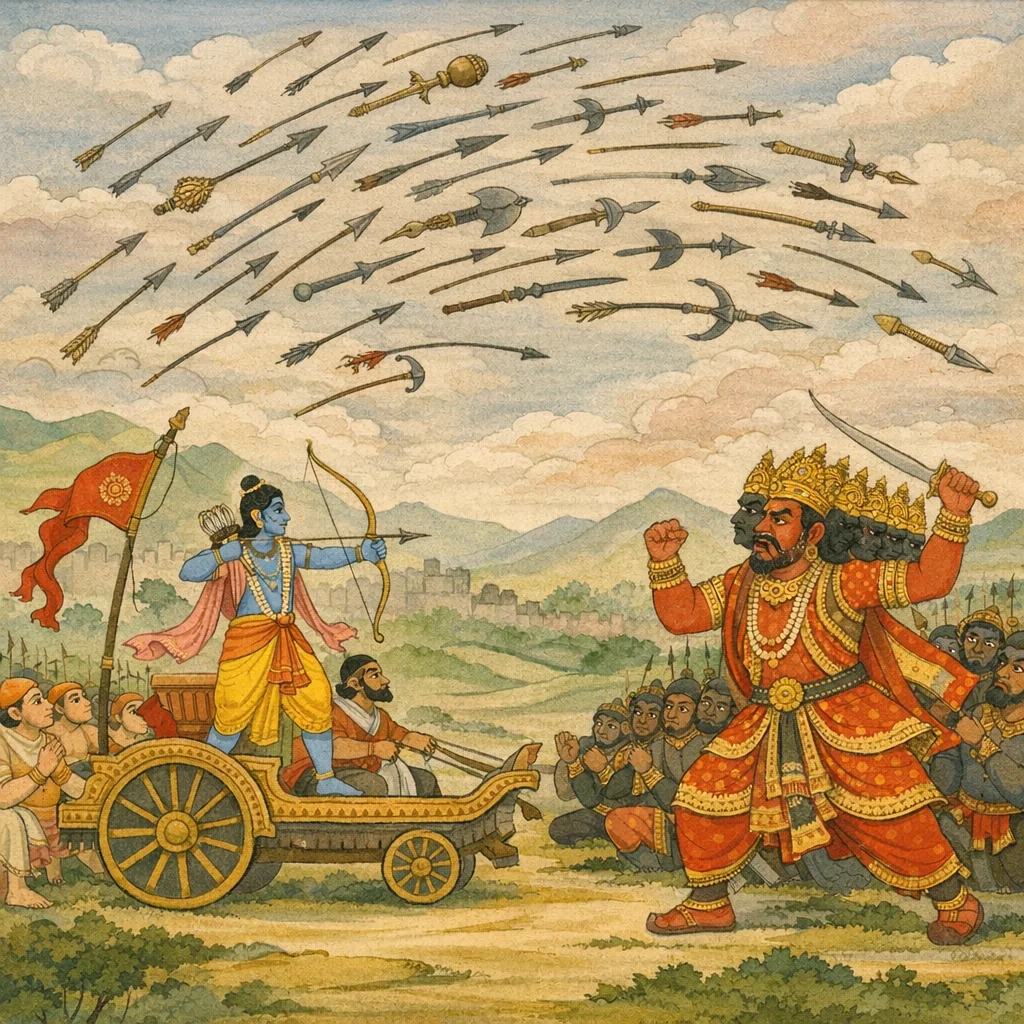
Sarga 109 concentrates on the escalation of the direct duel (dvairatha-yuddha) between Rama and Ravana, presented as a conflict whose intensity is described as fearsome to the world. Both armies temporarily suspend their own engagements, standing motionless with weapons raised, absorbed in astonished spectatorship—an epic device that isolates the duel as the decisive ethical and narrative axis. Ravana, enraged, targets Rama’s chariot-flag; his arrows fail to sever the emblem, grazing the chariot and falling. Rama, responding with controlled fury, aims at Ravana’s flagpost (dhvaja/ketu) and cuts it down; the post falls to the ground, provoking Ravana’s burning indignation. Ravana retaliates by raining volleys of arrows and conjuring a vast ‘weapon-rain’ (śastra-varṣa) through māyā, deploying an arsenal that includes maces, iron bars, discs, clubs, mountain-peaks, trees, tridents, and axes. The sky becomes densely netted with arrows from both sides, appearing like a second firmament; none of the missiles are wasted, as they meet targets or collide midair and fall. The exchange proceeds blow-for-blow, including strikes upon each other’s horses, culminating in a brief but hair-raising, tumultuous phase of the duel and Ravana’s heightened anger over the loss of his standard.
Shlokas
Verse 1
ततःप्रवृत्तंसुक्रूरंरामरावणयोस्तदा ।सुमहदद्वैरथंयुद्धंसर्वलोकभयावहम् ।।6.109.1।।
Thereupon began the exceedingly cruel, vast chariot-duel between Rāma and Rāvaṇa—an encounter that brought dread to all the worlds.
Verse 2
ततोराक्षससैन्यं च हरीणां च महद्बलम् ।प्रगृहीतप्रहरणंनिश्चेष्टंसमवर्तत ।।6.109.2।।
Then both hosts—the rākṣasas and the mighty army of the Vānara-s—stood still, weapons already in hand, as the battle poised on the edge of a decisive exchange.
Verse 3
सम्प्रयुद्धेतुतौदृष्टवाबलवन्नरराक्षसौ ।व्याक्षिप्तहदृयास्सर्वेपरंविस्मयमागताः ।।6.109.3।।
Seeing the mighty man and the rākṣasa locked in close combat, all onlookers—hearts seized and unsettled—fell into the utmost astonishment.
Verse 4
नाप्रहरणैर्व्यग्रैर्भुजैर्विस्मितबुद्धयः ।तस्थुःप्रेक्षय च सर्वेतेनाभिजग्मुःपरस्परम् ।।6.109.4।।
All stood still, weapons raised in their eager arms, minds astonished as they watched; they did not rush upon one another.
Verse 5
रक्षसांरावणंचापिवानराणां च राघवम् ।पश्यतांविस्मिताक्षाणांसैन्यंचित्रमिवाबभौ ।।6.109.5।।
As the rākṣasas stared at Rāvaṇa and the vānaras at Rāghava with astonished eyes, the whole host appeared like a wondrous painted scene.
Verse 6
तौतुतत्रनिमित्तानिदृष्टवाराघवरावणौ ।कृतबुद्धीस्थिरामर्षौयुयुधातेह्यभीतवत् ।।6.109.6।।
But Rāghava and Rāvaṇa, seeing the portents there, firm in resolve and steady in wrath, fought on fearlessly.
Verse 7
जेतव्यमितिकाकुत्स्थोमर्तव्यमितिरावणः ।धृतौस्ववीर्यसर्वस्वंयुद्धेऽदर्शयतांतदा ।।6.109.7।।
Then the steadfast Kākutstha, resolved, “I must win,” and Rāvaṇa, resolved, “I must die,” displayed in battle the full measure of their valor.
Verse 8
ततःक्रोधाद्धशग्रीवश्शरान्सन्धायवीर्यवान् ।मुमोचध्वजमुद्धिस्यराघवस्यरथेस्थितम् ।।6.109.8।।
Thereupon, the valiant Daśagrīva, enraged, set his arrows and released them, aiming at the banner fixed upon Rāghava’s chariot.
Verse 9
तेशरास्तमनासाद्यपुरन्दररथध्वजम् ।रथशक्तिंपरामृश्यनिपेतुर्धरणीतले ।।6.109.9।।
Those arrows, failing to reach that standard likened to Indra’s chariot-banner, merely grazed the chariot’s frame and fell upon the ground.
Verse 10
ततोरामोऽपिसङ्क्रुद्धश्चपमाकृष्यवीर्यवान् ।कृतप्रतिकृतंकर्तुंमनसस्सम्प्रचक्रमे ।।6.109.10।।
Then valiant Rāma too, angered, drew his bow and resolved in his mind to repay what had been done—to answer Rāvaṇa’s attack with a fitting counterstroke.
Verse 11
रावणध्वजमुद्दिस्यमुमोचनिशितंशरम् ।महासर्पमिवासह्यंज्वलन्तंस्वेनतेजसा ।।6.109.11।।
Aiming at Rāvaṇa’s banner, Rāma released a keen arrow—intolerable like a great serpent—blazing with its own radiance.
Verse 12
रामश्चिक्षेपतेजस्वीकेतुमुद्धिश्यसायकम् ।जगाम स महींछित्त्वादशग्रीवध्वजंशरः ।।6.109.12।।
Glorious Rāma loosed an arrow at the banner-staff; that shaft, tearing through Daśagrīva’s standard, plunged into the earth.
Verse 13
स निकृत्तोऽपतद्भूमौरावणस्यन्दनध्वजः ।ध्वजस्योन्मथनंदृष्टवारावणस्समहाबलः ।।6.109.13।।सम्प्रदीप्तोऽभवत्क्रोधादमर्षात्प्रहसन्निव ।स रोषवशमापन्नश्शरवर्षंववर्ष ह ।।6.109.14।।
Thus cut down, the standard upon Rāvaṇa’s chariot fell to the ground. Seeing his banner struck and ruined, that mighty Rāvaṇa took the affront to heart.
Verse 14
स निकृत्तोऽपतद्भूमौरावणस्यन्दनध्वजः ।ध्वजस्योन्मथनंदृष्टवारावणस्समहाबलः ।।6.109.13।।सम्प्रदीप्तोऽभवत्क्रोधादमर्षात्प्रहसन्निव ।स रोषवशमापन्नश्शरवर्षंववर्ष ह ।।6.109.14।।
He blazed with wrath and wounded pride, as though laughing in scorn; overcome by fury, he rained down a storm of arrows.
Verse 15
रामस्यतुरगान्दीप्तै: शरैर्विव्याथरावणः ।तेदिव्याहरयस्तत्रनास्खलन्नापिबभ्रमुः ।।6.109.15।।बभूवुःस्वस्थहृदयाःपद्मनालैरिवाहताः ।
Rāvaṇa pierced Rāma’s horses with blazing arrows; yet those splendid steeds neither stumbled nor reeled there—remaining calm at heart, as though struck only by lotus-stalks.
Verse 16
तेषामसम्भ्रमंदृष्टवावाजिनांरावणस्तदा ।।6.109.16।।भूयएवसुसङ्क्रुद्धश्शरवर्षंमुमोच ह ।
Then, seeing the horses remain unshaken, Rāvaṇa grew even more enraged and again unleashed a heavy shower of arrows.
Verse 17
गदाश्चपरिघांश्चैवचक्राणिमुसलानि च ।।6.109.17।।गिरिशृङ्गाणिवृक्षांश्चतथाशूलपरश्वधान् ।
There were maces and iron bars, discs and clubs—mountain-peaks and uprooted trees as well, along with tridents and axes.
Verse 18
मायाविहितमेतत्तुशस्त्रवर्षमपातयत् ।।6.109.18।।सहस्रशस्तदाबाणानश्रान्तहृदयोद्यमः ।
Then, unwearied in will and effort, he brought down a weapon-storm wrought by magic—casting arrows by the thousand.
Verse 19
तुमुलंत्रासजननंभीमंभीमप्रतिस्वनम् ।।6.109.19।।तद्वर्षमभवद्युद्धेनैकशस्त्रमयंमहत् ।
In the midst of war there arose a vast downpour of many kinds of weapons—uproarious, fear-producing, dreadful, and echoing with terrifying sound.
Verse 20
राघवरथंसमन्ताद्वानरेबले ।।6.109.20।।सायकैरन्तरिक्षं च चकारसुनिरन्तरम् ।
With Rāghava’s chariot hemming them in on every side, the Vanara host was blanketed by arrows—so densely that even the sky seemed filled without a gap.
Verse 21
मुमोच ह दशग्रीवोनिःसङ्गेनान्तरात्मना ।।6.109.21।।व्यायच्छमानंतंदृष्टवासत्वरमरावणंरणे ।प्रहसन्निवकाकुत्स्थसन्दधेनिशितान्शरान् ।।6.109.22।।स मुमो च ततोबाणान्शतशोऽथसहस्रशः ।
Then Daśagrīva loosed his shafts freely, his inner mind unrestrained—driving the combat onward with unchecked force.
Verse 22
मुमोच ह दशग्रीवोनिःसङ्गेनान्तरात्मना ।।6.109.21।।व्यायच्छमानंतंदृष्टवासत्वरमरावणंरणे ।प्रहसन्निवकाकुत्स्थसन्दधेनिशितान्शरान् ।।6.109.22।।स मुमो च ततोबाणान्शतशोऽथसहस्रशः ।
Seeing Rāvaṇa pressing forward swiftly in the fight, Kākutstha, as though smiling in calm confidence, set sharp arrows to his bow and then released them—by hundreds and by thousands.
Verse 23
तान् दृष्टवारावणश्चक्रेस्वशरैःखंनिरन्तरम् ।।6.109.23।।ततस्थाभ्यांप्रमुक्तेनशरवर्षेणभास्वता ।शरबद्धमिवाभातिद्वितीयंभास्वदम्भरम् ।।6.109.24।।
Seeing those arrows, Rāvaṇa in turn filled the sky continuously with his own shafts.
Verse 24
तान् दृष्टवारावणश्चक्रेस्वशरैःखंनिरन्तरम् ।।6.109.23।।ततस्थाभ्यांप्रमुक्तेनशरवर्षेणभास्वता ।शरबद्धमिवाभातिद्वितीयंभास्वदम्भरम् ।।6.109.24।।
From those two, a radiant rain of arrows poured forth; the shining expanse of the sky appeared as though woven into a net of shafts—like a second, luminous firmament.
Verse 25
नानिमित्तोऽभवद्भाणोनानिर्भेत्ता न निष्फलः ।अन्योन्यमभिसम्हत्यनिपेतुर्धरणीतले ।।6.109.25।।तथाविसृजतोर्भाणान् रामरावणयोर्मृथे ।
No arrow went astray; none lacked piercing force; none was futile. Striking against one another, they fell upon the earth—such was the exchange of missiles between Rāma and Rāvaṇa in that battle.
Verse 26
प्रायुध्येतामविच्छिन्नमस्यन्तौसव्यदक्षिणम् ।।6.109.26।।चक्रतुश्चशरैर्घोरैर्निरुच्छवासमिवाम्बरम् ।
They fought on without pause, shooting from left and right; with dreadful arrows they made the sky seem breathless, leaving no open space between the flights.
Verse 27
रावणस्यहयान्रामोहयान्रामस्यरावणः ।।6.109.27।।जघ्नतुस्तौतदान्योन्यंकृतानुकृतकारिणौ ।
Rāma struck down Rāvaṇa’s horses, and Rāvaṇa struck down Rāma’s horses—each answering the other blow for blow.
Verse 28
एवंतुतौसुसङ्क्रुद्धौचक्रतुर्युद्धमुत्तमम् ।।6.109.28।।मुहूर्तमभवद्युद्धंतुमुलंरोमहर्षणम् ।
Thus, the two, greatly enraged, waged a superb duel; for a time the battle raged, tumultuous and hair-raising.
Verse 29
As the mighty Rāvaṇa and the elder brother of Lakṣmaṇa fought in battle with sharp arrows, the lord of the Rākṣasas—when his banner-staff fell—grew fiercely enraged at Rāma, the foremost of the Raghu line.
Frequently Asked Questions
The pivotal action is symbolic and strategic: Rama targets and severs Ravana’s dhvaja/ketu (battle standard). This is not mere spectacle; it functions as a controlled, morale-breaking strike that provokes Ravana’s rage while marking a visible turning of prestige within the dharmic framework of decisive combat.
The chapter teaches that righteous resolve must govern wrath: Rama’s anger is depicted as disciplined and purposive (aimed action), whereas Ravana’s response expands into excessive, māyā-driven saturation violence. The contrast frames victory as the product of steadied mind and proportionate force rather than uncontrolled fury.
No new geographic landmark is foregrounded; the ‘landmark’ is martial-cultural: chariot warfare (dvairatha-yuddha), the battlefield standard (dhvaja/ketu) as a sign of sovereignty, and the epic convention of armies pausing to witness a decisive duel.