Sarga 108
रावणरथवैभव–निमित्तदर्शन–राममातलिसंवादः (Ravana’s Chariot, Portents, and Rama–Matali Instructions)
युद्धकाण्ड
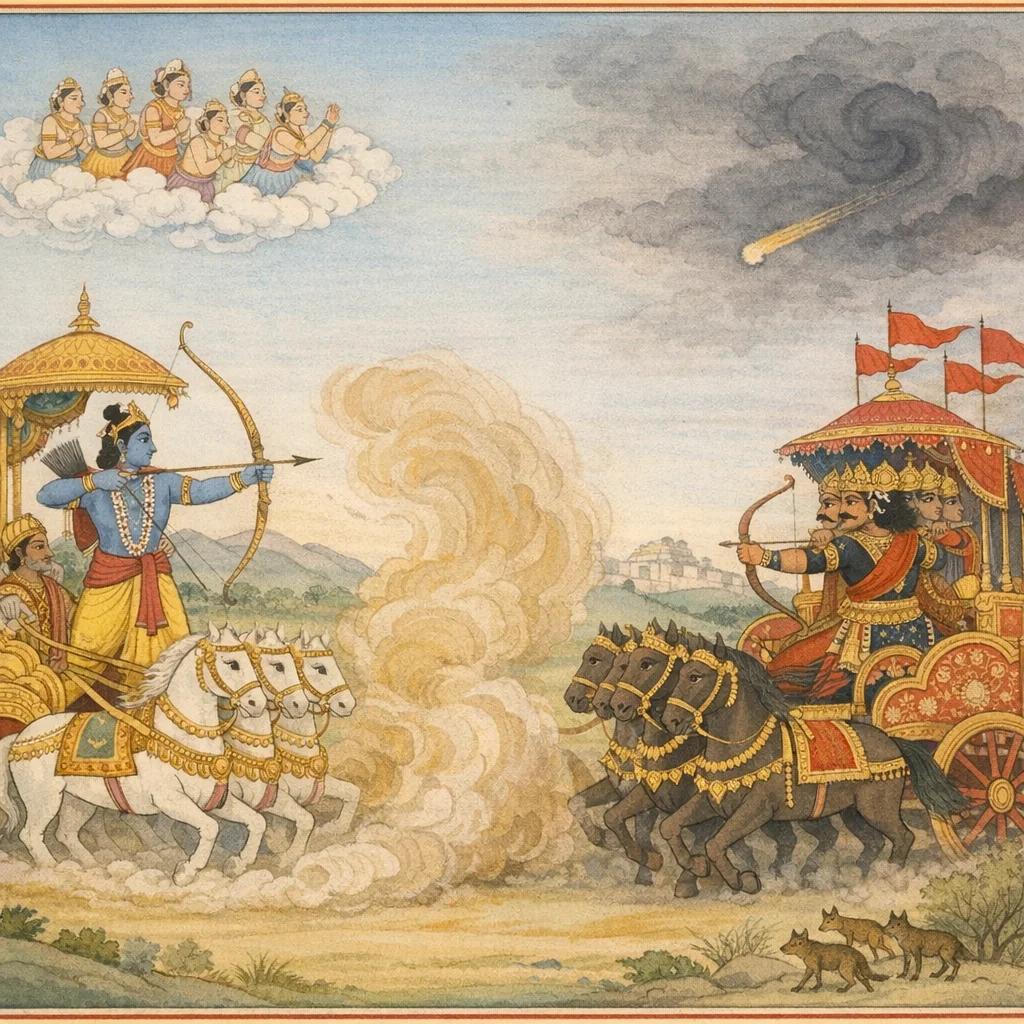
This sarga opens with an ornate, kinetic description of Rāvaṇa’s chariot—Gandharva-city-like in form, heavy with flags and standards, yoked to horses adorned with gold chains, and engineered for maximum battlefield intimidation. As the duel intensifies, Rāma observes the enemy chariot’s aggressive approach and warns Mātali (Indra’s charioteer) that Rāvaṇa’s reversed, reckless movement signals self-destruction. Rāma issues precise operational instructions: remain alert, drive straight toward the enemy, keep the mind unconfused, and control the reins with steady vision—an applied ethics of disciplined action in combat. Mātali, pleased, maneuvers expertly, turning to unsettle Rāvaṇa with wheel-raised dust. Rāvaṇa strikes Rāma with arrows; Rāma responds by taking up the powerful Indra-like bow, and the two face each other like lions, each intent on the other’s death. Celestial beings gather to witness the duel. A sequence of ominous portents concentrates around Rāvaṇa—blood-rain, circling winds, vultures and jackals, dust-darkened directions, meteors, thunderbolts without clouds—while auspicious victory-signs arise for Rāma. Reading these nimittas, Rāma becomes confident of victory and advances with heightened prowess to conclude the enemy’s end.
Shlokas
Verse 1
स रथंसारथिःहृष्टंपरसैन्यप्रधर्षणम् ।गन्धर्वनगराकारंसमुच्छ्रितपाताकिनम् ।।।।युक्तंपरमसम्पन्नैर्वजिभिर्हेममालिभिः ।युद्धोपकरणैःपूर्णंपताकाध्वजमालिनीम् ।।।।ग्रसन्तमिवचाकाशंनादयन्तंवसुन्धराम् ।प्रणाशंपरनैन्यानांस्वनैन्यस्यप्रहर्षणम् ।।।।रावणस्यरथंक्षिप्रंचोदयामाससारथिः ।
His delighted charioteer urged on Rāvaṇa’s chariot swiftly—terrible to the enemy host, shaped like a Gandharva-city, and bristling with lofty banners. It was yoked to superb horses adorned with golden garlands and fully fitted with implements of war; with its flags and standards it seemed to swallow the sky and make the earth resound—bringing ruin to the opposing ranks and exhilaration to its own.
Verse 2
स रथंसारथिःहृष्टंपरसैन्यप्रधर्षणम् ।गन्धर्वनगराकारंसमुच्छ्रितपाताकिनम् ।।6.108.1।।युक्तंपरमसम्पन्नैर्वजिभिर्हेममालिभिः ।युद्धोपकरणैःपूर्णंपताकाध्वजमालिनीम् ।।6.108.2।।ग्रसन्तमिवचाकाशंनादयन्तंवसुन्धराम् ।प्रणाशंपरनैन्यानांस्वनैन्यस्यप्रहर्षणम् ।।6.108.3।।रावणस्यरथंक्षिप्रंचोदयामाससारथिः ।
It was yoked to superb horses adorned with golden garlands, fully furnished with implements of war, and festooned with flags and standards.
Verse 3
स रथंसारथिःहृष्टंपरसैन्यप्रधर्षणम् ।गन्धर्वनगराकारंसमुच्छ्रितपाताकिनम् ।।6.108.1।।युक्तंपरमसम्पन्नैर्वजिभिर्हेममालिभिः ।युद्धोपकरणैःपूर्णंपताकाध्वजमालिनीम् ।।6.108.2।।ग्रसन्तमिवचाकाशंनादयन्तंवसुन्धराम् ।प्रणाशंपरनैन्यानांस्वनैन्यस्यप्रहर्षणम् ।।6.108.3।।रावणस्यरथंक्षिप्रंचोदयामाससारथिः ।
Seeming to swallow the sky and making the earth resound—ruinous to the opposing host and heartening to its own—Rāvaṇa’s charioteer swiftly drove that chariot onward.
Verse 4
समापतन्तंसहसास्वनवन्तंमहाध्वजम् ।।।।रथंराक्षसराजस्यनरराजोददर्श ह ।कृष्णवाजिसमायुक्तंयुक्तंरौद्रेणवर्चसा ।।।।दीप्यमानमिवाकाशेविमानंसूर्यवर्चसं ।तडित्पताकागहनंदर्शितेन्द्रायुधप्रभम् ।।।।
Then the king among men beheld the rākṣasa-king’s chariot rushing in violently—resounding with its bells and crowned with a great standard.
Verse 5
समापतन्तंसहसास्वनवन्तंमहाध्वजम् ।।6.108.4।।रथंराक्षसराजस्यनरराजोददर्श ह ।कृष्णवाजिसमायुक्तंयुक्तंरौद्रेणवर्चसा ।।6.108.5।।दीप्यमानमिवाकाशेविमानंसूर्यवर्चसं ।तडित्पताकागहनंदर्शितेन्द्रायुधप्रभम् ।।6.108.6।।
It was yoked to dark horses and was harnessed with a fierce, wrathful radiance.
Verse 6
समापतन्तंसहसास्वनवन्तंमहाध्वजम् ।।6.108.4।।रथंराक्षसराजस्यनरराजोददर्श ह ।कृष्णवाजिसमायुक्तंयुक्तंरौद्रेणवर्चसा ।।6.108.5।।दीप्यमानमिवाकाशेविमानंसूर्यवर्चसं ।तडित्पताकागहनंदर्शितेन्द्रायुधप्रभम् ।।6.108.6।।
Blazing in the sky like a celestial car, it shone with the brilliance of the sun—dense with lightning-like pennants, displaying a radiance like Indra’s bow.
Verse 7
शराधाराविमुञ्चन्तंधारासारमिवाम्बुदम् ।तंदृष्टवामेघसङ्काशमापतन्तंरथंरिपोः ।।।।गिरेर्वज्राभिमृष्टस्यदीर्यतस्सदृशस्वनम् ।विस्पारयन्वैवेगेनबालचन्द्रानतंधनुः ।।।।उवाचसारथिंरामंसहस्राक्षस्यमातलिम् ।
Rāma saw the enemy’s chariot rushing in, releasing streams of arrows like a rain-cloud pouring down sheets of water—cloudlike in its mass and onrush.
Verse 8
शराधाराविमुञ्चन्तंधारासारमिवाम्बुदम् ।तंदृष्टवामेघसङ्काशमापतन्तंरथंरिपोः ।।6.108.7।।गिरेर्वज्राभिमृष्टस्यदीर्यतस्सदृशस्वनम् ।विस्पारयन्वैवेगेनबालचन्द्रानतंधनुः ।।6.108.8।।उवाचसारथिंरामंसहस्राक्षस्यमातलिम् ।
Drawing his bow swiftly into a crescent like the young moon, Rāma made a sound like a mountain splitting when struck by a thunderbolt; then he spoke to Mātali, the charioteer of the thousand-eyed Indra.
Verse 9
मातलेपश्यसम्रद्धमापतन्तंरथंरिपोः ।।।।यथापसव्यंपततावेगेनमहतापुनः ।समरेहन्तुमात्मानंतथानेनकृतामतिः ।।।।
“Mātali, look—how the enemy’s chariot rushes forward in reckless haste, turning back again in a contrary course with great speed. It seems to me his resolve is set on destroying himself in this battle.”
Verse 10
मातलेपश्यसम्रद्धमापतन्तंरथंरिपोः ।।6.108.9।।यथापसव्यंपततावेगेनमहतापुनः ।समरेहन्तुमात्मानंतथानेनकृतामतिः ।।6.108.10।।
Mātali, look at the enemy’s splendid chariot rushing in—how, turning back in the wrong direction, he charges again with tremendous speed. It seems to me his resolve is such that, in battle, he is bent on his own destruction.
Verse 11
तदप्रमादमातिष्ठन्प्रत्युद्गच्छरथंरिपोः ।विध्वंसयितुमिच्छामिवायुर्मेघमिवोत्थितम् ।।।।
So, standing firm in alertness, drive the chariot straight toward the enemy. I wish to destroy him—like the wind that rises and scatters a cloud.
Verse 12
अविक्लबमसम्भ्रान्तमव्यग्रहृदयेक्षणम् ।रमशिसञ्चारनियंप्रचोदयरथंद्रुतम् ।।।।
Drive the chariot swiftly—without faltering, without confusion—steady in heart and in sight, keeping firm control over the course of the reins.
Verse 13
कामं न त्वंसमाधेयःपुरन्दररथोचितः ।युयुत्सुरहमेकाग्रःस्मारयेत्वां न शिक्ष्ये ।।।।
Indeed, you need no instruction—you are worthy of driving Purandara’s (Indra’s) chariot. I, intent on battle with single-pointed focus, only remind you from time to time; I do not presume to teach you.
Verse 14
परितुष्टः स रामस्यतेनवाक्येनमातलिः ।प्रचोदयामासरथंसुरसारथिरुत्तमः ।।।।
Pleased by Rāma’s words, Mātali—the finest charioteer of the gods—urged the chariot onward.
Verse 15
अपसव्यंततःकुर्वन् रावणस्यमहारथम् ।चक्रसम्भूतरसारावणंव्यवदूनयन् ।।।।
Then, making Rāvaṇa’s great chariot veer in a reverse course, Mātali shook Rāvaṇa by the dust raised from the rolling wheels.
Verse 16
ततःक्रुद्धोदशग्रीवस्ताम्रविस्फारितेक्षणः ।रथप्रतिमुखंरामंसायकैरवधूनयत् ।।।।
Then Daśagrīva, enraged, his coppery eyes flaring wide, struck at Rāma—who faced him from the chariot-front—shaking him with a volley of arrows.
Verse 17
धर्षणामर्षितोरामोधैर्यंरोषेणलम्भयन् ।जग्राहसुमहावेगमैन्द्रंयुधिशरासनम् ।।।।
Rāma, stung by the assault and letting righteous anger sharpen his steadfastness, took up in battle Indra’s bow, endowed with tremendous speed and force.
Verse 18
शरांश्चसुमहावेगान्सूर्यरश्मिसमप्रभान् ।तदुपोढुंमहद्युद्धमन्योन्यवधकाङ्क्षिणोः ।।।।परस्पराभिमुखयोर्दृप्तयोरिवसिंहयोः ।
And arrows of immense speed, radiant like the sun’s rays, were readied as that great battle drew near—two opponents facing one another, each intent on the other’s death, like proud lions confronting lion.
Verse 19
ततोदेवास्सगन्धर्वास्सिद्धाश्चपरमर्षयः ।।।।समीयुर्द्वैरथंद्रष्टुंरावणक्षयकाङ्क्षिणः ।
Then the Devas, Gandharvas, Siddhas, and great seers assembled to witness the chariot-duel, longing for Rāvaṇa’s destruction.
Verse 20
वर्षरुधिरंदेवोरावणस्यरधोपरि ।।।।वातामण्डलिनस्त्रीव्राह्यपसव्यंप्रचक्रमुः ।
Blood rained down from the heavens upon Rāvaṇa’s chariot, and fierce winds whirled in circles, blowing inauspiciously from left to right.
Verse 21
महत् गृध्रकुलंचास्यभ्रममाणंनभस्तले ।।।।येनयेनरथोयातितेनतेनप्रधावति
A vast flock of vultures wheeled in the sky above him; wherever his chariot went, there they hurried after it.
Verse 22
सन्ध्ययाचावृतालङ्काजपापुष्पनिकाशया ।।।।दृश्यतेसम्प्रदीप्तेवदिवसेऽपिवसुन्धरा ।
Laṅkā appeared veiled as though by dusk, with a redness like hibiscus blossoms; even in daylight the earth looked as if it were aflame.
Verse 23
सनिर्घातामहोल्काश्चसम्प्रपेतुर्महास्वनाः ।।।।विषादयंस्तेरक्षांसिरावणस्यतदाहिताः ।
Meteors with thunderous crashes and great roaring sounds fell, and the Rākṣasas grew despondent, taking them as signs of Rāvaṇa’s impending ruin.
Verse 24
सनिर्घातामहोल्काश्चसम्प्रपेतुर्महास्वनाः ।।6.108.23।।विषादयंस्तेरक्षांसिरावणस्यतदाहिताः ।
Laṅkā appeared veiled as though by dusk, with a redness like hibiscus blossoms; even in daylight the earth looked as if it were aflame.
Verse 25
रावणश्चयतस्तत्रप्रचचालवसुन्धरा ।।।।रक्षसां च प्रहरतांगृहीताइवबाहवः ।
Meteors with thunderous crashes and great roaring sounds fell, and the Rākṣasas grew despondent, taking them as signs of Rāvaṇa’s impending ruin.
Verse 26
ताम्राःपीतास्सिताश्वेताःपतितास्सूर्यरश्मयः ।।।।दृश्यन्तेरावणस्याग्रेपर्वतस्येवधातवः ।
Before Rāvaṇa, the sun’s rays fell in hues of red, yellow, pale, and white—appearing like mineral-veins upon a mountain.
Verse 27
गृध्रैरनुगताश्चास्यवमन्त्योज्वलनंमुखैः ।।।।प्रणेदुर्मुखमीक्षन्त्यःसम्रद्धमशिवंशिवाः ।
Followed by vultures, the she-jackals, facing him, spewed blazing fire from their mouths; staring on, they cried out—an omen thick with inauspiciousness.
Verse 28
प्रतिकूलंववेवायूरणेपांसून् समुकतिरन् ।।।।तस्यराक्षसराजस्यकुर्वन्दृष्टिविलोपनम् ।
An adverse wind blew across the battle, flinging up dust and obscuring the sight of that king of Rākṣasas.
Verse 29
निपेतुरिन्द्राशनयस्सैन्येचाप्यसमन्ततः ।।।।दुर्विषह्यस्वनाघोरंविनाजलधरोदयम् ।
Indra’s thunderbolts fell upon the army on every side—terrifying and deafening—though no clouds had risen.
Verse 30
दिशश्चप्रदिशस्सर्वाबभूवुस्तिमिरावृताः ।।।।पांसुवर्षेणमहतादुर्दर्शं च नभोऽभवत् ।
All directions and intermediate quarters became shrouded in darkness; by a great rain of dust, the sky itself turned hard to see.
Verse 31
कुर्वन्त: कलहंघोरंशारिकास्तद्रथंप्रति ।।।।निपेतुश्शतशस्तत्रदारुणादारुणारुताः ।
Uttering dreadful cries and making a fierce clamor, minas (śārikā-birds) fell there upon that chariot in their hundreds—frightful in their harsh calls.
Verse 32
जघनेभ्यःस्फुलिङ्गांश्चनेत्रेभ्योऽश्रूणिसन्ततम् ।।।।मुमुचुस्तस्यतुरगास्तुल्यमग्नि च वारि च ।
His horses continually let fall sparks from their hindquarters, and from their eyes unceasing tears—releasing, as it were, fire and water together in equal measure.
Verse 33
एवंप्रकाराबहवस्समुत्पाताभयापहाः ।।।।रावणस्यविनाशायदारुणाःसम्प्रजज्ञिरे ।
Thus, many dreadful and fearsome portents arose—terrible in form—proclaiming the destruction of Rāvaṇa.
Verse 34
रामस्यापिनिमित्तानिसौम्यानि च शिवानि च ।।।।बभूवुर्जयशंसीनिप्रादुर्भूतानिसर्वशः ।
For Rāma as well, auspicious and gentle signs appeared on every side—portents that proclaimed victory.
Verse 35
निमित्तानि च सौम्यानिराघवःस्वजयायवै ।।।।दृष्टवापरमसम्हृष्टोहतंमेने च रावणम् ।
Seeing auspicious omens that signaled his own victory, Rāghava became exceedingly glad and deemed Rāvaṇa as already slain (by his hand).
Verse 36
ततोनिरीक्ष्यात्मगतानिराघवोरणेनिमित्तानिनिमित्तकोविदः ।जगामहर्षं च परां च निर्वृतिंचकारयुद्धेह्यधिक च विक्रमम् ।।।।
Then Rāghava—skilled in reading the signs of battle—observed the portents arising within himself, attained joy and deep assurance, and in the fight displayed still greater valor to bring the foe to an end.
Frequently Asked Questions
The pivotal action is Rāma’s insistence on apramāda (alertness) and controlled execution while engaging a lethal opponent: he frames chariot-driving not as impulsive aggression but as disciplined, rule-governed conduct necessary to end adharma with minimal error.
The upadeśa is that clarity of mind and mastery of instruments (reins, chariot, weapons) are extensions of inner steadiness; victory is portrayed as emerging from composure, correct judgment, and alignment with auspicious moral order rather than mere force.
Laṅkā is highlighted through an atmospheric transformation—daylight appearing dusk-red like japa flowers—functioning as a cultural-literary marker of liminality, where the city’s fate is read through omens and the war’s cosmic spectatorship.