Sarga 106
रावण-सारथि-संवादः (Ravana and the Charioteer: Counsel, Omens, and Battlefield Conduct)
युद्धकाण्ड
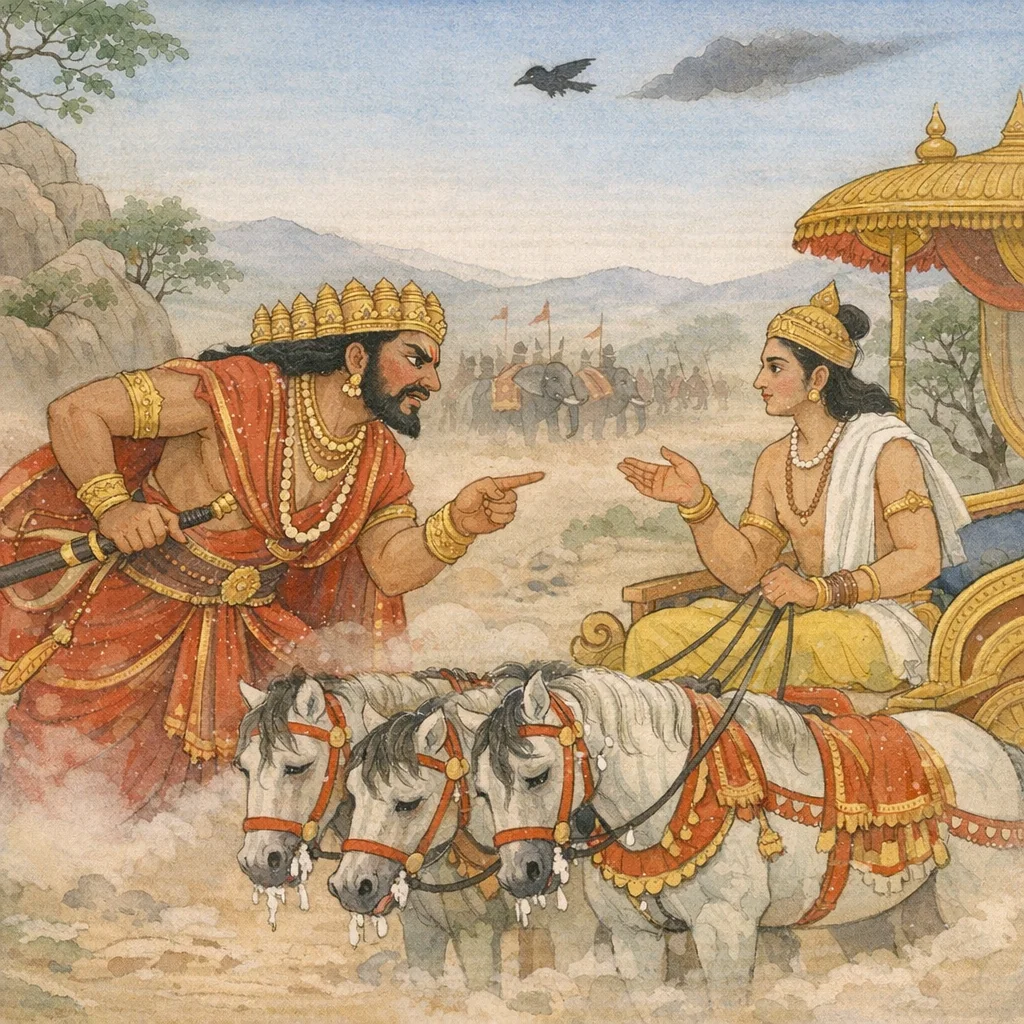
Sarga 106 stages a high-stakes dialogue between Rāvaṇa and his sārathi (charioteer) at a moment of tactical withdrawal. Rāvaṇa, described as deluded and destiny-driven, with anger-reddened eyes, rebukes the charioteer for turning the chariot back before the enemy, accusing him of cowardice, incompetence, and even collusion with opponents. The charioteer responds with measured, conciliatory speech grounded in nīti: he denies fear or betrayal, frames his action as welfare-oriented service, and argues that a charioteer must assess time, terrain, signs, omens, the warrior’s condition, and the strength/weakness of forces. He cites exhausted horses and inauspicious portents as practical reasons for retreat, emphasizing that tactical repositioning can be dharmically and strategically appropriate. Rāvaṇa is persuaded, praises the charioteer, gifts him an auspicious hand-ornament, and orders an immediate advance toward Rāghava (Rāma). The sarga closes with the chariot swiftly arriving before Rāma’s chariot, re-establishing direct confrontation and underscoring the tension between wrath-driven command and prudent counsel.
Shlokas
Verse 1
सतुमोहात्सुसङ्क्रुद्धःकृतान्तबलचोदितः ।क्रोधसंरक्तनयनोरावणंसूतमब्रवीत् ।।।।
But Rāvaṇa—deluded and fiercely enraged, driven onward by the force of fate—his eyes reddened with wrath, spoke to his charioteer.
Verse 2
हीनवीर्यमिवाशक्तंपौरुषेणविवर्जितम् ।भीरुंलघुमिवासत्त्वंविहीनमिवतेजसा ।।।।विमुक्तमिवमायाभिरस्त्रैरिवबहिष्कृतम् ।मामवज्ञायदुर्बुद्धेस्वयाबुद्ध्याविचेष्टसे ।।।।
Taking me for one bereft of valor and incapable, devoid of manliness—timid, petty, lacking in spirit and splendor—as though abandoned by stratagems and cast out by weapons, you, foolish man, disregard me and act on your own misguided judgment.
Verse 3
हीनवीर्यमिवाशक्तंपौरुषेणविवर्जितम् ।भीरुंलघुमिवासत्त्वंविहीनमिवतेजसा ।।6.106.2।।विमुक्तमिवमायाभिरस्त्रैरिवबहिष्कृतम् ।मामवज्ञायदुर्बुद्धेस्वयाबुद्ध्याविचेष्टसे ।।6.106.3।।
As though bereft of stratagems, as though cast off from weapons, you act—O misguided one—disregarding me and following only your own perverse judgement.
Verse 4
किमर्थंमामवज्ञायमच्छन्दमनवेक्ष्य च ।त्वयाशत्रुसमक्षंमेरथोऽयमपवाहितः ।।।।
For what reason, disregarding me and ignoring my wish, have you driven my chariot away—right in the presence of the enemy?
Verse 5
त्वयाद्यहिममानार्य चिरकालसमार्जितम् ।यशोवीर्यं च तेजश्चप्रत्ययश्चविनाशितः ।।।।
By you today—O ignoble one—my fame, my valor, my splendor, and the confidence placed in me, all earned over a long time, have been ruined.
Verse 6
प्रख्यातवीर्यस्यरञ्जनीयस्यविक्रमैः ।पश्यतोयुद्धलुब्धोऽहंकृतंकापुरुषस्त्वया ।।।।
Before an adversary famed for valor and admirable for his prowess, you have made me—though I am war-loving—appear like a coward, even as I looked on.
Verse 7
यस्त्वंरथमिदंमोहान्नचेद्वहसिदुर्मते ।सत्योऽप्रतितर्कोमेपरेणत्वमुपस्कृतः ।।।।
If, deluded, you will not drive this chariot, O ill-minded one, then it is truly beyond doubt to me that you have been won over by the enemy.
Verse 8
न हितद्विद्यतेकर्मसुहृदोहितकाङ्क्षिणः ।रिपूणांसदृशंत्वेतद्यतत्त्वयैतदनुष्ठितम् ।।।।
This deed is not the act of a well-wisher who seeks another’s good; rather, what you have done is fitting for enemies.
Verse 9
निवर्तयरथंशीघ्रंयावन्नापैतिमेरिपुः ।यदिवाध्युषितोऽसित्वंस्मर्यतेयदिमेगुणः ।।।।
Turn the chariot back quickly, before my enemy withdraws—if indeed you have long dwelt with me and if you still remember my merits.
Verse 10
एवंपुरुषमुक्तस्तुहितबुद्धिबुद्धिना ।अब्रवीद्रावणंसूतोहितंसानुनयंवचः ।।।।
Thus spoken to harshly by Rāvaṇa—though he was one of sound, beneficial judgment—the charioteer replied with words that were wholesome and conciliatory.
Verse 11
न भीतोऽस्मि न मूढोऽस्मिनोपजप्तोऽस्मिशत्रुभिः ।न प्रमत्तो न निःस्नेहोविस्मृता न च सत्क्रिया ।।।।
“I am not afraid; I am not foolish; I have not been won over by enemies. I am not negligent, nor devoid of loyalty; nor have I forgotten the good services (done to me).”
Verse 12
मयातुहितकामेवयशश्चपरिरक्षता ।स्नेहप्रसन्नमनसाहितमित्यप्रियंकृतम् ।।।।
“But I—wishing your welfare, and indeed guarding your fame—acting with a mind softened by affection and goodwill, did what I deemed beneficial, though it seemed displeasing (to you).”
Verse 13
नास्मिन्नर्थेमहाराज त्वंमांप्रियहितेरतम् ।कश्चिल्लघुरिवानार्योदोषतोगन्तुमर्हसि ।।।।
“In this matter, O great king, you should not judge me—devoted to what is pleasing yet beneficial—as though I were some petty, unworthy man, faulting me in error.”
Verse 14
श्रूयतांप्रतिदास्यामियन्निमित्तंमयारथः ।नदीवेगइवामंभोभिेसंयुगेविनिवर्तितः ।।।।
“Listen—I will answer why I turned the chariot back from the fight, as one diverts a rushing river’s force toward the sea.”
Verse 15
श्रमंतवावगच्छामिमहतारणकर्मणा ।न हितेवीर्यसौमुख्यंप्रकर्षंवोपधारये ।।।।
“I recognize your exhaustion from the great labor of battle; and in this situation I do not see that your valor is showing its former advantage or superiority.”
Verse 16
रथोद्वहनखिन्नाश्चभग्नामेरथवाजिनः ।दीनाघर्मपरिश्रान्तागावोवर्षहताइव ।।।।
“My chariot-horses are exhausted from hauling the chariot; they are broken down—wretched and worn out by heat—like cattle battered by rain.”
Verse 17
निमित्तानि च भूयिष्ठंयानिप्रादुर्भवन्तिनः ।तेषुतेष्वभिपन्नेषुलक्ष्याम्यप्रदक्षिणम् ।।।।
The many portents that keep appearing to us again and again—all of them, as I observe, are turning out adverse (moving in the inauspicious direction).
Verse 18
देशकालौ च विज्ञेयौलक्षणानीङ्गितानि च ।दैन्यंहर्षश्चखेदश्चरथिनश्चबलाबलम् ।।।।
One must assess the place and time, the signs and omens, the warrior’s dejection, exhilaration, and fatigue—and also the strength and weakness of the one mounted in the chariot.
Verse 19
स्थलनिम्नानिभूमेश्चसमानिविषमाणि च ।युद्धकालश्चविज्ञेयःपरस्यान्तरदर्शनम् ।।।।
One should know the terrain’s rises and depressions—its level and uneven tracts—the proper timing for combat, and also discern the enemy’s inner vulnerability.
Verse 20
उपयानापयाने च स्थानंप्रत्यपसर्पणम् ।सर्वमेतद्रथस्थेनज्ञेयंरथकुटुम्भिना ।।।।
Approaching and withdrawing, holding position and falling back—every such maneuver must be understood by the one stationed on the chariot, the charioteer entrusted with the chariot’s charge.
Verse 21
तवविश्रामहेतोस्तुतथैषांरथवाजिनाम् ।रौद्रंवर्जयताखेदंक्षमंकृतमिदंमया ।।।।
This was done by me to give you rest, and likewise to spare these chariot-horses from fierce strain and exhaustion; for this act, I ask to be forgiven.
Verse 22
स्वेच्छयान मयावीररथोऽयमपवाहितः ।भर्तृस्नेहपरीतेनमयेदंयत्कृतंप्रभो ।।।।
O hero, my lord—this chariot was not drawn back by me on mere whim; what I did was done out of devotion and affection for my master.
Verse 23
आज्ञापययथातत्त्वंवक्ष्यस्यरिनिषूदन ।तत्करिष्याम्यहंवीरगतानृण्येनचेतसा ।।।।
Command me as you truly decide, O slayer of foes; that I shall carry out, O hero, with a mind free of reservation and wholly committed.
Verse 24
सन्तुष्टस्तेनवाक्येनरावणस्तस्यसारथेः ।प्रशस्यैनंबहुविधंयुद्धलुब्धोऽब्रवीदिदम् ।।।।
Pleased by the charioteer’s words, Rāvaṇa praised him in many ways; eager for battle, he then spoke as follows.
Verse 25
रथंशीघ्रमिदंसूतराघवाभिमुखंनय ।नाहत्वासमरेशत्रून्निवर्तिष्यतिरावणः ।।।।
Drive this chariot swiftly, charioteer, straight toward Rāghava. Rāvaṇa will not turn back from battle without striking down the foes.
Verse 26
एवमुक्त्वाततस्तुष्टोरावणोराक्षसेश्वरः ।ददौतस्यशुभंह्येकंहस्ताभरणमुत्तमम् ।।।।श्रुत्वारावणवाक्यानिसारथिस्सन्यवर्तत ।
Having spoken thus, Rāvaṇa—the lord of the Rākṣasas—became satisfied, and he bestowed upon that charioteer a single excellent and auspicious hand-ornament. Hearing Rāvaṇa’s words, the charioteer turned the chariot back (as commanded).
Verse 27
ततोद्रुतंरावणवाक्यचोदितःप्रचोदयामासहयान्ससारथिः ।स राक्षसेन्द्रस्य ततो महारथःक्षणेनरामस्यरथाग्रतोऽभवत् ।।।।
Then, urged on by Rāvaṇa’s words, the charioteer swiftly drove the horses. In a mere moment, the great chariot of the lord of the Rākṣasas came to stand before Rāma’s chariot.
Frequently Asked Questions
The dilemma is whether withdrawing a chariot from active combat constitutes dishonor or prudent duty. Ravana treats retreat as humiliation and suspected betrayal, while the charioteer frames it as responsible action to preserve the king and resources (horses), guided by assessment of omens, terrain, and readiness.
The sarga teaches that effective leadership requires listening to welfare-oriented counsel, and that strategy must integrate observable conditions (fatigue, logistics) and interpretive signs (nimitta/omen). It contrasts anger-driven perception with reasoned nīti, showing how disciplined advice can redirect volatile authority.
Rather than naming a specific city-sector, the chapter highlights operational ‘landmarks’ of warfare: assessment of deśa-kāla (place-time), bhūmi’s terrain features (ups/downs, evenness/ruggedness), and the battlefield space between Ravana’s and Rama’s chariots as the immediate locus of confrontation.