Sarga 103
ऐन्द्ररथप्रदानम् — Indra’s Chariot Offered to Rāma; The Duel Intensifies
युद्धकाण्ड
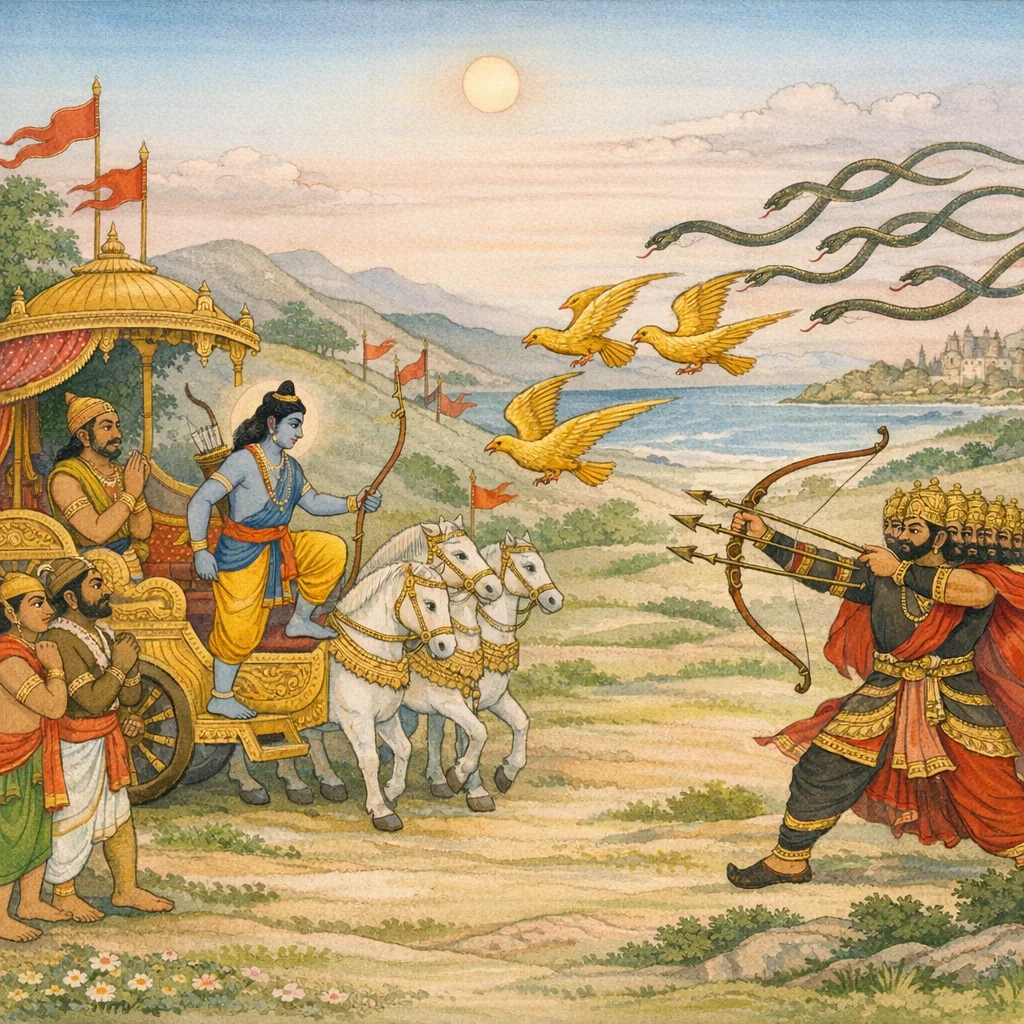
Sarga 103 frames a fairness-critique of the duel—Rāma stands on earth while Rāvaṇa fights from a chariot—prompting Devas and celestial beings to voice that the contest is not equal. Indra, hearing these ‘nectar-like’ words, orders his charioteer Mātali to take the divine chariot to the battlefield and invite Rāma to mount it. Mātali arrives with a richly described, gold-adorned chariot drawn by green horses, bearing Indra’s martial equipment: a mighty bow, fire-bright armor, sun-like arrows, and an auspicious stainless śakti. He formally salutes Rāma, announces Indra’s gift for victory, and offers himself as sārathi. Rāma performs respectful circumambulation and ascends, radiating splendor. The battle then escalates: Rāvaṇa launches terrifying Rakṣasa missiles whose arrows become venomous serpents filling the quarters; Rāma counters with the Garuḍa-weapon, transforming the serpent-arrows into golden suparṇa forms that destroy the threat. Rāvaṇa retaliates with dense arrow-showers, strikes Mātali, cuts the chariot’s banner, and wounds Indra’s horses, causing anxiety among gods, sages, and Vānara leaders. The sarga closes with omen-poetics—planetary conjunctions, a dimmed sun, and turbulent ocean imagery—mirroring the cosmic stakes of the Rāma–Rāvaṇa confrontation.
Shlokas
Verse 1
लक्ष्मणेनतुतद्वाक्यमुक्तंश्रुत्वा स राघवः ।सन्दधेपरवीरघ्नोधनुरादायवीर्यवान् ।।।।
Hearing the words spoken by Lakṣmaṇa, Rāghava—valiant and a slayer of hostile champions—took up his bow and set it in readiness.
Verse 2
रावणायशरानघोरान्विससर्जचमूमुखे ।अधान्यंरथमास्थायरावणोराक्षसाधिपः ।।।।अभ्यधावतकाकुत्स्थंस्वर्भानुरिवभास्करम् ।
Rama hurled dreadful arrows at Ravana’s forces at the front. Then Ravana, lord of the Rakshasas, mounting another chariot, rushed toward Kakutstha (Rama) like Svarbhānu (Rāhu) advancing upon the Sun.
Verse 3
दशग्रीवोरधस्थस्तुरामंवज्रोपमैश्शरैः ।।।।आजघानमहाशैलंधाराभिरिवतोयदः ।
Then Daśagrīva, standing in his chariot, struck at Rāma with thunderbolt-like arrows—like a rain-cloud pelting a great mountain with torrents.
Verse 4
दीप्तपावकसङ्काशैःशरैःकाञ्चनभूषणैः ।।।।अभ्यवर्षद्रणरामोदशग्रीवंसमाहितः ।
Steady in purpose, Rāma showered Daśagrīva in the thick of battle with arrows that gleamed like blazing fire and were adorned with gold.
Verse 5
भूमौस्थितस्यरामस्यरथस्थस्य च रक्षसः ।।।।न समंयुद्धमित्याहुर्देवगन्धर्वकिन्नराः ।
The Devas, Gandharvas, and Kinnaras declared: “This fight is not equal—Rāma stands on the ground while the Rākṣasa fights from a chariot.”
Verse 6
ततोदेववरर्श्रीमान् श्रुत्वातेषांवचोऽमृतम् ।।।।आहूयमातलिंशक्रोवचनंचेदमब्रवीत् ।
Then Śakra (Indra), the splendid foremost among the gods, hearing their nectar-like words, summoned Mātali and spoke these instructions.
Verse 7
रथेनममभूमिष्ठंशीघ्रंयाहिरघूत्तमम् ।।।।आहूयभूतलंयातःकुरुदेवहितंमहत् ।
“Go quickly in my chariot to the foremost of the Raghus who stands upon the earth; summon him and, having come down to the battlefield, accomplish this great good desired by the gods.”
Verse 8
इत्युक्तोदेवराजेनमातलिर्देवसारथिः ।।।।प्रणम्यशिरसादेवंततोवचनमब्रवीत् ।
Thus addressed by the king of the gods, Mātali—the divine charioteer—bowed his head in reverence and then replied.
Verse 9
शीघ्रंयास्यामिदेवेन्द्रसारथ्यं च करोम्यहम् ।।।।ततोहयैश्चसम्योज्यहरितैःस्यन्दनोत्तमम् ।
“I shall go at once, O lord of the gods, and I will serve as charioteer; then, yoking the finest chariot with the green horses…”
Verse 10
ततःकाञ्चनचित्राङ्गःकिङ्किणीशतभूषितः ।।।।तरुणादित्यसङ्काशोवैदूर्यमयकूबरः ।सदश्वैःकाञ्चनापीडैर्युक्तश्श्वेतप्रकीर्णकैः ।।।।हरिभिःसूर्यसङ्काशैर्हेमजालविभूषितैः ।रुक्मवेणुध्वज्श्रीमन्देवराजरथोवरः ।।।।देवराजेनन्दिष्टोरथमारुह्यमातलिः ।अभ्यवर्ततकाकुत्स्थमवतीर्यत्रिवष्टपात् ।।।।
Thereupon appeared the excellent chariot of the Lord of the Devas—glorious, with golden ornamentation and hundreds of tinkling bells; radiant like the young sun, with a yoke fashioned of vaidūrya-gem; yoked to fine horses adorned with golden crests and white trappings—green-hued steeds shining like the sun and netted with gold. Assigned by the King of the Devas, Mātali mounted that chariot and, descending as though from Svarga, advanced toward Kakutstha (Rāma).
Verse 11
ततःकाञ्चनचित्राङ्गःकिङ्किणीशतभूषितः ।।6.103.10।।तरुणादित्यसङ्काशोवैदूर्यमयकूबरः ।सदश्वैःकाञ्चनापीडैर्युक्तश्श्वेतप्रकीर्णकैः ।।6.103.11।।हरिभिःसूर्यसङ्काशैर्हेमजालविभूषितैः ।रुक्मवेणुध्वज्श्रीमन्देवराजरथोवरः ।।6.103.12।।देवराजेनन्दिष्टोरथमारुह्यमातलिः ।अभ्यवर्ततकाकुत्स्थमवतीर्यत्रिवष्टपात् ।।6.103.13।।
It was yoked to excellent horses adorned with golden crests and white trappings—green-hued steeds radiant like the sun, embellished with a net-work of gold.
Verse 12
ततःकाञ्चनचित्राङ्गःकिङ्किणीशतभूषितः ।।6.103.10।।तरुणादित्यसङ्काशोवैदूर्यमयकूबरः ।सदश्वैःकाञ्चनापीडैर्युक्तश्श्वेतप्रकीर्णकैः ।।6.103.11।।हरिभिःसूर्यसङ्काशैर्हेमजालविभूषितैः ।रुक्मवेणुध्वज्श्रीमन्देवराजरथोवरः ।।6.103.12।।देवराजेनन्दिष्टोरथमारुह्यमातलिः ।अभ्यवर्ततकाकुत्स्थमवतीर्यत्रिवष्टपात् ।।6.103.13।।
That foremost chariot of the King of the Devas was splendid, bearing a banner-staff fashioned from golden bamboo.
Verse 13
ततःकाञ्चनचित्राङ्गःकिङ्किणीशतभूषितः ।।6.103.10।।तरुणादित्यसङ्काशोवैदूर्यमयकूबरः ।सदश्वैःकाञ्चनापीडैर्युक्तश्श्वेतप्रकीर्णकैः ।।6.103.11।।हरिभिःसूर्यसङ्काशैर्हेमजालविभूषितैः ।रुक्मवेणुध्वज्श्रीमन्देवराजरथोवरः ।।6.103.12।।देवराजेनन्दिष्टोरथमारुह्यमातलिः ।अभ्यवर्ततकाकुत्स्थमवतीर्यत्रिवष्टपात् ।।6.103.13।।
Commissioned by the Lord of the Devas, Mātali mounted the chariot and, descending from Trivaṣṭapa (Svarga), came forward toward Kakutstha (Rāma).
Verse 14
अब्रवीच्चतदारामंसप्रतोदोरथेस्थितः ।प्राञ्जलिर्मातलिर्वाक्यंसहस्राक्षस्यसारथिः ।।।।
Then Mātali, the charioteer of the thousand-eyed (Indra), standing upon the chariot with whip in hand, addressed Rāma with palms joined in reverence.
Verse 15
सहस्राक्षेणकाकुत्थ्सरथोऽयंविजयायते ।दत्तस्तवमहासत्त्वश्रीमन् शत्रुनिबर्हण ।।।।
“O Kakutstha—mighty-souled, glorious, and crusher of foes—this chariot has been bestowed upon you by the thousand-eyed (Indra) for your victory.”
Verse 16
इदमैन्द्रंमहच्चापंकवचंचानगिसन्निभम् ।शराश्चादित्यसङ्काशाःशक्तिश्चविमलाशिवा ।।।।
“Here are Indra’s mighty bow, and an armour gleaming like fire; arrows brilliant as the sun; and a stainless, auspicious javelin as well.”
Verse 17
आरुह्येमंरथंवीरराक्षसंजहिरावणम् ।मयासारथिनाराजन् महेन्द्रइवदानवान् ।।।।
“O heroic king, mount this chariot—with me as your charioteer—and strike down the rākṣasa Rāvaṇa, as Mahendra once slew the Dānavas.”
Verse 18
इत्युक्तःसम्परिक्रम्यरथंतमभिवाद्य च ।आरुरोहतदारामोलोकान् लक्ष्मविराजयन् ।।।।
Thus addressed, Rāma circumambulated the chariot and paid it reverence; then he ascended it, causing the worlds to shine with his auspicious splendour.
Verse 19
तद्भभूवाद्भुतंयुद्धंतुमुलंरोमहर्षणम् ।रामस्य च महाबाहोरावणस्य च रक्षसः ।।।।
Then there arose a wondrous battle—fierce and hair-raising—between Rama, the mighty-armed, and Ravana the Rakshasa.
Verse 20
स गान्धर्वेणगान्धर्वंदैवंदैवेनराघवः ।अस्त्रंराक्षसराजस्यजघानपरमास्त्रवित् ।।।।
Raghava, master of the highest weapons, shattered the Rakshasa-king’s missile—countering the Gandharva-weapon with the Gandharva, and the divine with the divine.
Verse 21
अस्त्रंतुपरमंघोरंराक्षसंराक्षसाधिपः ।ससर्जपरमक्रुद्धःपुनरेवनिशाचरः ।।।।
But the lord of the Rakshasas—the night-roamer—furious to the extreme, once again hurled a most dreadful Rakshasa missile.
Verse 22
तेरावणधनुर्मुक्ताःशराःकाञ्चनभूषणाः ।अभ्यवर्तन्तकाकुत्स्थंसर्पाभूत्वामहाविषाः ।।।।
Those arrows, released from Ravana’s bow and adorned with gold, rushed toward Kakutstha—becoming great venomous serpents.
Verse 23
तेदीप्तवदनादीप्तंसमन्तोज्वलनंमुखैः ।राममेवाभ्यवर्तन्तव्यादितास्याभयानकाः ।।।।
Those terrifying ones, with flaming mouths agape, blazing on every side and spewing fire from their faces, surged straight toward Rama.
Verse 24
तैर्वासुकिसमस्पर्शैर्दीप्तभोगैर्महाविषैः ।दिशश्चसन्ततास्सर्वाप्रदिशश्चसमावृताः ।।।।
By those—like Vāsuki in touch, with blazing coils and deadly venom—all directions and intermediate quarters were spread over and enveloped.
Verse 25
तान् दृष्टवापन्नगान् रामःसमापततआहवे ।अस्त्रंगारुत्मतंघोरंप्रादुश्चक्रेभयावहम् ।।।।
Seeing those serpents rushing in battle, Rama brought forth the dreadful, fearsome missile of Garuḍa.
Verse 26
तेराघवधनुर्मुक्तारुक्मपुङ्खाःशिखिप्रभाः ।सुपर्णाःकाञ्चनाभूत्वाविचेरुःसर्पशत्रवः ।।।।
Those shafts released from Raghava’s bow—gold-feathered and radiant—became golden Suparṇas (Garuḍa-birds) and ranged about as enemies of serpents.
Verse 27
तेतान्सर्वान् जघ्नुस्सर्परूपान्महाजवान् ।सुपर्णरूपारामस्यविशिखाःकामरूपिणः ।।।।
Rama’s swift shafts—taking the form of Suparṇas and changing shape at will—struck down all those serpent-forms.
Verse 28
अस्त्रेप्रतिहतेक्रुद्धोरावणोराक्षसाधिपः ।अभ्यवर्षत्तदारामंघोराभिःशरवृष्टिभिः ।।।।
When his missiles were repelled, Rāvaṇa, lord of the Rākṣasas, flared up in anger and then drenched Rāma with a terrifying rain of arrows.
Verse 29
ततश्शरसहस्रेणराममक्लिष्टकारिणम् ।अर्दयित्वाशरौघेणमातलिम्प्रत्यविध्यत ।।।।
Thereafter, having battered Rāma—ever tireless in action—with a thousand arrows, he then struck Mātali with a dense volley of shafts.
Verse 30
चिच्छेदकेतुमुद्धिश्यशरेणैकेनरावणः ।पातयित्वारथोपस्थेरथात्केतुं च काञ्चनम् ।।।।ऐन्द्रानपिजघानाश्वान्शरजालेनरावणः ।
Aiming at the chariot’s banner, Rāvaṇa severed it with a single arrow, bringing down the golden standard from the chariot-platform; then, with a net-like barrage of arrows, he struck even Indra’s horses.
Verse 31
तदृष्ट्वासुमहातत्कर्मरावणस्यदुरात्मना: ।विषेदुर्देवगन्धर्वाचारणादानवैस्सह ।।।।राममार्तंतदादृष्टवासिद्धाश्चपरमर्षयः ।व्यथितावानरेन्द्राश्चबभूवुस्सविभीषणाः ।।।।रामचन्द्रमसंदृष्टवाग्रस्तंरावणराहुणा ।
Seeing that immense deed of the evil-minded Rāvaṇa, the Devas, Gandharvas, and Cāraṇas—together with the Dānavas—fell into despair. Seeing Rāma afflicted, the Siddhas and highest seers too were shaken; and the leaders of the Vānaras, along with Vibhīṣaṇa, grew anxious—beholding the moon-like Rāma as though eclipsed by a Rāhu in the form of Rāvaṇa.
Verse 32
तदृष्ट्वासुमहातत्कर्मरावणस्यदुरात्मना: ।विषेदुर्देवगन्धर्वाचारणादानवैस्सह ।।6.103.31।।राममार्तंतदादृष्टवासिद्धाश्चपरमर्षयः ।व्यथितावानरेन्द्राश्चबभूवुस्सविभीषणाः ।।6.103.32।।रामचन्द्रमसंदृष्टवाग्रस्तंरावणराहुणा ।
This Southern Recension presentation repeats/combines the same statement: all celestial orders and the Vānara chiefs with Vibhīṣaṇa became despondent on seeing Rāma afflicted, as though the moon-like Rāma were eclipsed by Rāvaṇa in the manner of Rāhu.
Verse 33
प्राजात्यं च नक्षत्रंरोहिणींकशशिनःप्रियाम् ।।।।समाक्रम्यबुधस्तस्थौप्रजानामशुभावहः ।
Budha (Mercury), having overrun Rohiṇī—the lunar mansion dear to the Moon and sacred to Prajāpati—stood there, an omen believed to bring misfortune upon the people.
Verse 34
सधूमपरिवृत्तोर्मिःप्रज्वलन्निवसागरः ।।।।उत्पपाततदाक्रुद्धस्स्पृशन्निवदिवाकरम् ।
Then the ocean, its waves swirling amid smoky haze, seemed to blaze in wrath; it heaved upward as though trying to touch the Sun himself.
Verse 35
शस्त्रवर्णस्सुपरुषोमन्दरश्मिद्दिवाकरः ।।।।अदृश्यतकबन्धाङ्कःसंसक्तोधूमकेतुना ।
The Sun appeared weapon-grey, harsh and dim-rayed—marked as if by a headless trunk (kabandha)—as though entangled with Dhūmaketu, a fearful portent.
Verse 36
कोसलानां च नक्षत्रंव्यक्तमिन्द्राग्निदैवतम् ।।।।आक्रम्याङ्गारकस्तस्थौविशाखामपिचाम्बरे ।
In the sky, Aṅgāraka (Mars) occupied Viśākhā as well—the asterism clearly presided over by Indra and Agni, associated with the fortunes of the kings of Kosala—signaling troubling conditions.
Verse 37
दशास्योविंशतिभुजःप्रगृहीतशरासनः ।।।।अदृशास्यःदशग्रीवःमैनाकःपर्वतःइव
Ten-faced and twenty-armed, gripping his bow, Daśagrīva came into view—like the great mountain Maināka.
Verse 38
निरस्यमानोरामस्तुदशग्रीवेणरक्षसा ।।।।नाशक्नोदभिसन्धातुंसायकान्रणमूर्धनि ।
Pressed hard by the Rākṣasa Daśagrīva at the very forefront of the fight, Rāma could not even properly set his arrows to aim.
Verse 39
सःकृत्वाभ्रुकुटिंक्रुद्धःकिञ्चित्सम्रक्तलोचनः ।।।।जगामसुमहाक्रोधंनिर्दहन्निवचक्षुषा ।
He, enraged, knit his brows; his eyes grew bloodshot, and he fell into a terrible fury—as though he would burn with his gaze.
Frequently Asked Questions
The ethical issue is combat parity: celestial observers judge it unfair that Rāma fights on foot while Rāvaṇa fights from a chariot, prompting Indra to restore balance by gifting a divine chariot and equipment.
Power must be exercised within a moral frame: even in total war, legitimacy is strengthened by fairness, disciplined restraint, and correct use of knowledge (astra-counterastra), rather than by advantage alone.
Rather than named terrestrial sites, the sarga foregrounds a cultural-cosmic landscape: Indra’s heavenly chariot descending to the battlefield and omen-signs (nakṣatras, planets, eclipsing imagery, ocean turbulence) that situate the duel within a universe-wide moral drama.