Sarga 102
लक्ष्मण-प्राणरक्षा: (Lakshmana’s Revival by the Herb-Mountain)
युद्धकाण्ड
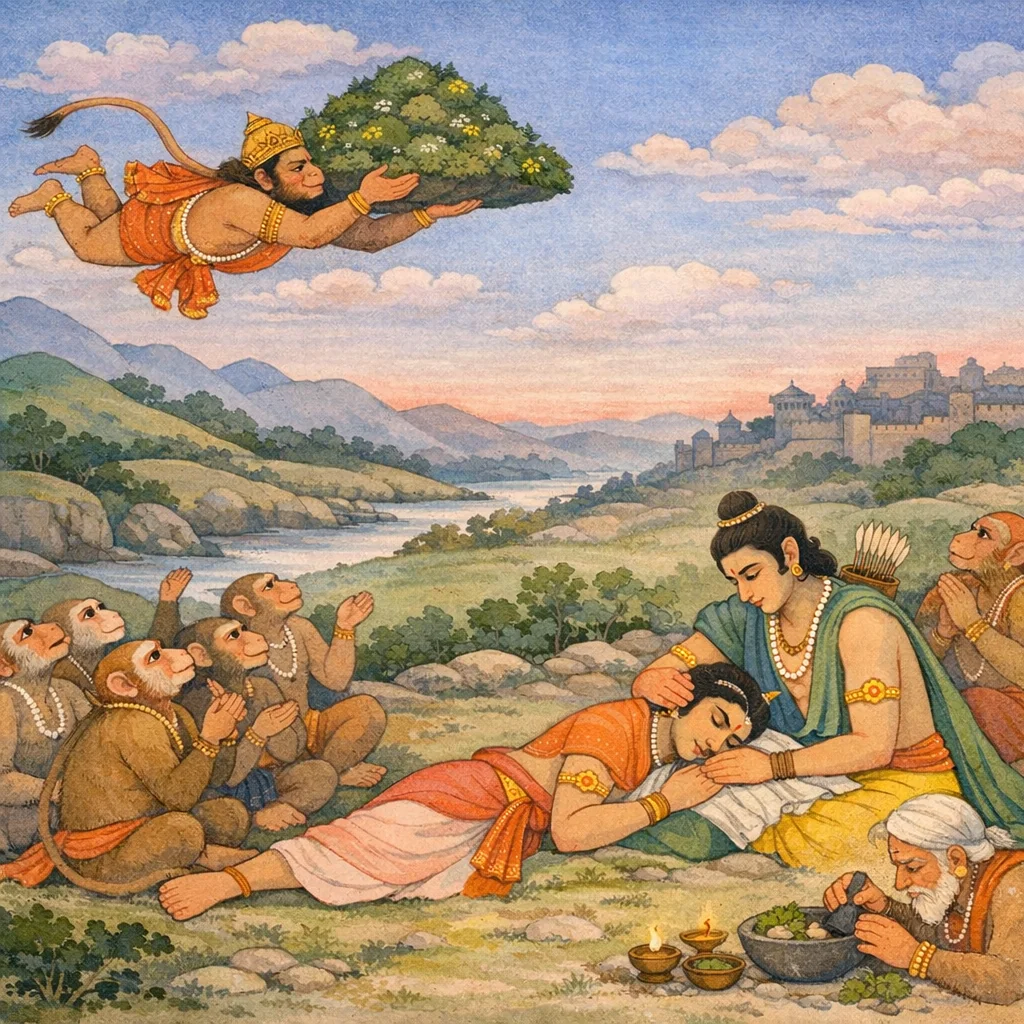
This sarga centers on a battlefield medical crisis and its ethical reverberations. Rāma sees Lakṣmaṇa struck by Rāvaṇa’s śakti (javelin) and drenched in blood, and his composure collapses into grief: he questions the value of victory, life, and even the war’s purpose without his brother. Suṣeṇa consoles Rāma with diagnostic reasoning—Lakṣmaṇa’s face retains radiance and his heart and limbs show signs of life—urging Rāma to abandon despair. Suṣeṇa then directs Hanumān to the Auṣadhi-parvata (herb mountain) to fetch four named mahauṣadhis (Savarṇakaraṇī, Sāvarṇyakaraṇī, Sañjīvakaraṇī, Sandhānī). Unable to identify them, Hanumān resolves to carry the entire southern peak, uproots and transports it at speed, and delivers it to the battlefield. Suṣeṇa extracts and crushes the herbs and administers them nasally to Lakṣmaṇa, who rises freed from the embedded weapon and pain. The Vānara leaders rejoice; Rāma embraces Lakṣmaṇa with tears. Lakṣmaṇa, however, admonishes Rāma to uphold his vow and complete Rāvaṇa’s destruction, reframing personal grief within the epic’s dharma of promise-keeping and public justice.
Shlokas
Verse 1
शक्त्याविनिहतंदृष्टवारावणेनबलीयसा ।लक्ष्मणंसमरेशूरंरूधिरौघपरिप्लुतम् ।।।।स दत्त्वातुमुलंयुद्धंरावणस्यदुरात्मनः ।विसृजन्नेवबाणौघान् सुषेणमिदमब्रवीत् ।।।।
Seeing heroic Lakṣmaṇa struck down in battle by the javelin of the exceedingly powerful Rāvaṇa, and drenched in streams of blood, Rāma nonetheless pressed the fierce combat against that evil-minded Rāvaṇa—still releasing volleys of arrows—and then spoke these words to Suṣeṇa.
Verse 2
शक्त्याविनिहतंदृष्टवारावणेनबलीयसा ।लक्ष्मणंसमरेशूरंरूधिरौघपरिप्लुतम् ।।6.102.1।।स दत्त्वातुमुलंयुद्धंरावणस्यदुरात्मनः ।विसृजन्नेवबाणौघान् सुषेणमिदमब्रवीत् ।।6.102.2।।
Seeing heroic Lakṣmaṇa struck down in battle by the mighty Rāvaṇa’s spear and drenched in torrents of blood, Rāma—while waging a fierce fight against that wicked one and still releasing volleys of arrows—spoke these words to Suṣeṇa.
Verse 3
एषरावणवीर्येणलक्ष्मणःपतितोभुविः ।सर्पवच्चेष्टतेवीरोभूमौशोकमुदिरीयन् ।।।।
Struck down by Ravana’s might, Lakshmana has fallen upon the earth; that heroic one writhes on the ground like a serpent, stirring up grief.
Verse 4
शोणितार्द्रमिमंवीरंप्राणैःप्रियतरंमम ।पश्यतोममकाशक्तिर्योद्धुंपर्याकुलात्मनः ।।।।
“As I watch this hero—dearer to me than life itself—soaked in blood, my very mind is thrown into turmoil. How can I have the strength to fight?”
Verse 5
अ यं स समरश्लाघीभ्रातामेशुभलक्षणः ।यदिपञ्चत्वमापन्नःप्राणैर्मेकिंसुखेनवा ।।।।
This brother of mine—renowned in battle and marked with auspicious signs—if he has met with death, what use to me are life or happiness?
Verse 6
लज्जतीवहिवीर्यंभ्रश्यतीवकराद्धनुः ।सायकाव्यवसीदन्तिदृष्टिर्भाष्पवशंगता ।।।।
My valor seems to shrink in shame; the bow seems to slip from my hand; my arrows fall away, and my sight has gone under the power of tears.
Verse 7
अवसीदन्तिगात्राणिस्वप्नयानेनृणामिव ।चिन्तामेवर्ततेतीव्रामुमूर्षापि च जायते ।।।।
My limbs give way, as though I were moving in a dream; fierce anxiety alone surges within me, and even the wish to die arises.
Verse 8
भ्रातरंनिहतंदृष्टवारावणेनदुरात्मना ।विष्टनन्तंतुदुःखार्तंमर्मण्यभिहतंभृशम् ।।।।
Seeing his brother struck down by the evil-minded Rāvaṇa—wounded grievously in vital parts and writhing in pain—(Rāma was overwhelmed).
Verse 9
राघवोभ्रातरंदृष्टवाप्रियंप्राणंबहिश्चरम् ।दुःखेनमहताविष्टोध्यानशोकपरायणः ।।।।
Rāghava, seeing his brother—dearer than life itself, as though his very life moved outside him—was engulfed by immense grief, given over wholly to sorrowful brooding.
Verse 10
परंविषादमापन्नोविललापाकुलेन्द्रियः ।भ्रातरंनिहतंदृष्टवालक्ष्मणंरणपांसुषु ।।।।
When he saw his brother Lakṣmaṇa struck down amid the dust of the battlefield, Rāma was overcome with profound despair; his senses shaken, he lamented aloud.
Verse 11
विजयोऽपिहिमेशूर न प्रियायोपकल्पते ।अचक्षुर्विषयश्चन्द्रःकांप्रीतिंजनयिष्यति ।।।।
“O hero, even victory brings me no joy. What delight can the moon give to one for whom it is no longer within the reach of sight?”
Verse 12
किंमेयुद्धेनकिंप्राणैर्युद्धकार्यं न विद्यते ।यत्रायंनिहतश्शेतेरणमूर्धनिलक्ष्मणः ।।।।
“What use to me is this battle, what use is life itself? There is no purpose in fighting when Lakṣmaṇa lies struck down at the very front of the fray.”
Verse 13
यथैवमांवनंयान्तमनुयातिमहाद्युतिः ।अहमप्युपयास्यामितथैवैनंयमक्षयम् ।।।।
“Just as the radiant Lakṣmaṇa followed me when I went to the forest, so too will I follow him now—to the abode of Yama, the Lord of Death.”
Verse 14
इष्टबन्धुजनोनित्यंमां स नित्यमनुव्रतः ।इमामवस्थांगमितोराक्षसैःकूटयोधिभिः ।।।।
“He who always cherished his loved ones and ever followed faithfully after me—he has been brought to this dreadful condition by the Rākṣasas who fight by deceit.”
Verse 15
देशेदेशेकलत्राणिदेशेदेशे च बान्दवाः ।तंतुदेशं न पश्यामियत्रभ्रातासहोदरः ।।।।
“Wives may be found in many places, and relatives too in many places; but I see no land where one can find again a true brother born of the same mother.”
Verse 16
इत्येवंविलपन्तंतंशोकविह्वलितेद्रनियम् ।विवेष्टमानंकरुणमच्छवसन्तंपुनःपुनः ।।।।राममाश्वासयनवीरसुषेनोवाक्यमब्रवीत
As Rāma lamented thus—his senses overwhelmed by grief, writhing in anguish and repeatedly heaving deep sighs—Suṣeṇa, the valiant one, consoled him and spoke.
Verse 17
किनुराज्येनदुर्धर्षलक्ष्मणेनविनामम ।कथंवक्ष्याम्यहंत्वम्बांसुमित्रांपुत्रवत्सलाम् ।।।।
“Without Lakṣmaṇa—so hard to overcome—what is a kingdom to me? And how could I ever speak to mother Sumitrā, who is so tender toward her son?”
Verse 18
न मृथोयंमहाबाहो लक्ष्मणोलक्षमिवर्धन: ।न चास्यविक्रतंवक्त्रानापिशस्वासं न निष्प्रभं ।।।।
O mighty-armed Rama, enhancer of fortune—Lakṣmaṇa is not dead. His face is not distorted; his breath has not ceased; and his radiance has not faded.
Verse 19
सुप्रभंसुप्रसन्नं च मुखमस्यनिरीक्ष्यताम् ।।।।पद्मपत्रतलौहस्तौसुप्रसन्ने च लोचने ।
Look—his face is radiant and serene; his palms are like the surface of lotus-leaves, and his eyes too are calm and clear.
Verse 20
ऐ वं न विद्यतेरूपंगतासूनांविशम्पते ।।।।माविषादंमृकृथावीरसप्राणोऽयमरिन्दम ।
O lord among men, such an appearance is not found in those whose life has departed. Do not give way to despair, O hero—this tamer of foes is still alive.
Verse 21
आ ख्यासतितुप्रसुप्तस्यस्रस्तगात्रस्यभूतले ।।।।सोच्छवासंहृदयंवीरकम्पमानंमुहुर्मुहुः ।
Though he lies as if asleep on the ground, with limbs slack, his breathing and the hero’s heart—throbbing again and again—make it known that life persists.
Verse 22
एवमुक्त्वामहाप्राज्ञःसुषेणोराघवंवचः ।।।।समीपस्थमुवाचेदंहनूमन्तंमहाकपिम् ।
Having spoken these words to Rāghava, the very wise Suṣeṇa then addressed Hanumān, the great monkey, who stood nearby.
Verse 23
सौम्य शीघ्रमितोगत्वाशैलमौषधिपर्वतम् ।।।।पूर्वंतुकथितोयोऽसौवीर जाम्बवताशुभ: ।दक्षिणेशिखरेजातामोषधिमानय ।।।।सवर्णकरणींनाम्नासावर्ण्यकरणींतथा ।सञ्जीवकरणींवीरसन्धानीं च महौषधीम् ।।।।सञ्जीवनार्धंवीरस्यलक्ष्मणस्यमहात्मनः ।
O gentle one, go quickly from here to the mountain of herbs—the auspicious one that Jāmbavān earlier told you about. Bring the herbs that grow on its southern peak: Savarṇakaraṇī, Sāvarṇyakaraṇī, Sañjīvakaraṇī, and the great herb Sandhāni—so that the heroic, great-souled Lakṣmaṇa may be restored to life.
Verse 24
सौम्य शीघ्रमितोगत्वाशैलमौषधिपर्वतम् ।।6.102.23।।पूर्वंतुकथितोयोऽसौवीर जाम्बवताशुभ: ।दक्षिणेशिखरेजातामोषधिमानय ।।6.102.24।।सवर्णकरणींनाम्नासावर्ण्यकरणींतथा ।सञ्जीवकरणींवीरसन्धानीं च महौषधीम् ।।6.102.25।।सञ्जीवनार्धंवीरस्यलक्ष्मणस्यमहात्मनः ।
Thus instructed, the illustrious Hanumān went to the mountain of herbs; but, unable to recognize those great healing plants, he fell into anxious reflection.
Verse 25
सौम्य शीघ्रमितोगत्वाशैलमौषधिपर्वतम् ।।6.102.23।।पूर्वंतुकथितोयोऽसौवीर जाम्बवताशुभ: ।दक्षिणेशिखरेजातामोषधिमानय ।।6.102.24।।सवर्णकरणींनाम्नासावर्ण्यकरणींतथा ।सञ्जीवकरणींवीरसन्धानीं च महौषधीम् ।।6.102.25।।सञ्जीवनार्धंवीरस्यलक्ष्मणस्यमहात्मनः ।
Bring, O hero, the great herbs named Savarṇakaraṇī, Sāvarṇyakaraṇī, and also Sañjīvakaraṇī and Sandhānī—so that the heroic Lakṣmaṇa, that great-souled one, may be restored to life.
Verse 26
इत्येवमुक्तोहनुमान्गत्वाचौषथिपर्वतम् ।।।।चिन्तामभ्यगमछ्रचीमानजानं स्ता महौषधीः ।
Thus instructed, the illustrious Hanumān went to the mountain of herbs; but, unable to recognize those great healing plants, he fell into anxious reflection.
Verse 27
तस्यबुद्धि: समुत्पन्नामारुतेरमितौजसः ।।।।इदमेवगमिष्यामिगृहीत्वाशिखरंगिरेः ।
Then the keen resolve arose in Hanuman, the son of the Wind, of boundless energy: “I will go at once—taking the mountain’s peak itself.”
Verse 28
अस्मिंस्तुशिखरेजातामोषधिंतांसुखावहाम् ।।।।प्रतर्केणावगच्छामिसुषेणोह्यवमब्रवीत् ।
By reasoning I conclude that the healing herb—the one that brings relief—grows on this very peak, for Sushena said so.
Verse 29
अगृह्ययदिगच्छामिविशल्यकरणीमहम् ।।।।कालात्ययेनदोषःस्याद्वैक्लब्यं च महद्भवेत् ।
“If I were to go without taking Viśalyakaraṇī, delay would bring fault—and great confusion would arise.”
Verse 30
इतिसञ्चिन्त्यहनूमान्गत्वाक्षिप्रंमहाबलः ।।।।आसाद्यपर्वतश्रेष्ठंप्रक्रम्यगिरेश्शिरः ।फुल्लनानातरुगणंसमुत्पाट्यमहाबलः ।।।।गृहीत्वाहरिशार्दूलोहस्ताभ्यांसमतोलयत् ।
Thinking thus, mighty Hanuman swiftly reached the best of mountains; approaching its summit, he uprooted the peak with its many trees in bloom, and—tiger among the vanaras—lifted and steadied it with both hands.
Verse 31
इतिसञ्चिन्त्यहनूमान्गत्वाक्षिप्रंमहाबलः ।।6.102.30।।आसाद्यपर्वतश्रेष्ठंप्रक्रम्यगिरेश्शिरः ।फुल्लनानातरुगणंसमुत्पाट्यमहाबलः ।।6.102.31।।गृहीत्वाहरिशार्दूलोहस्ताभ्यांसमतोलयत् ।
Holding the mountain’s peak, Hanuman sprang up into the sky—like a dark rain-cloud, heavy with water, rising aloft.
Verse 32
सनीलमिवजीमूतंतोयपूर्णंनभस्तलात् ।।।।उत्पपातगृहीत्वातुहनूमान् शिखरंगिरेः ।
Holding the mountain’s peak, Hanuman sprang up into the sky—like a dark rain-cloud, heavy with water, rising aloft.
Verse 33
समागम्यमहावेगःसंन्यस्यशिखरंगिरेः ।।।।विश्रम्यकिञ्चिद्धनुमान्सुषेणमिदमब्रवीत् ।
Arriving at great speed, Hanuman set down the mountain peak; after resting a moment, he spoke these words to Sushena.
Verse 34
ओषधीर्नावगच्छामिताअहंहरिपुङ्गव ।।।।तदिदंशिखरंकृत्स्नंगिरेस्तस्याहृतंमया ।
“O foremost of the vanaras, I could not recognize those herbs; therefore I have brought here the entire peak of that mountain.”
Verse 35
एवंकथयमानंतुप्रशस्यपवनात्मजम् ।।।।सुषेणोवानरश्रेष्ठोजग्राहोत्पाट्यचौषधीः ।
As the son of the Wind spoke thus, Sushena—foremost among the vanaras—praised him, uprooted the required herbs, and took them up.
Verse 36
विस्मितास्तुबभूवुस्तेसर्वेवानरपुङ्गवाः ।।।।दृष्टवाहनूमतःकर्मसुरैरपिसुदुष्करम् ।
All the foremost leaders among the Vānaras were astonished on witnessing Hanumān’s deed—an undertaking that is exceedingly difficult even for the gods.
Verse 37
ततःसङ्क्षोदयित्वातामोषधिंवानरोत्तमः ।।।।लक्ष्मणस्यददौनस्तस्सुषेणस्सुमहाद्युतिः ।
Then Suṣeṇa—the brilliant foremost among the Vānaras—crushed that herb and administered it into Lakṣmaṇa’s nostrils.
Verse 38
विशल्यस्ससमाघ्रायलक्ष्मणःपरवीरहा ।।।।विशल्योविरुजश्शीघ्रमुदतिष्ठन्महीतलात् ।
Lakṣmaṇa, the slayer of enemy champions, inhaled it; freed from the embedded weapon and released from pain, he quickly rose up from the earth.
Verse 39
तमुत्थितंतुहरयोभूतलात्प्रेक्ष्यलक्ष्मणम् ।।।।साधुसावधितिसुप्रीतालक्ष्मणंप्रत्यपूजयन् ।
Seeing Lakṣmaṇa rise from the ground, the Vānaras—overjoyed—cried “Well done! Well done!” and offered him reverent honors in return.
Verse 40
एह्येहीत्यब्रवीद्रामोलक्ष्मणंपरवीरहा ।।।।सस्वजेस्नेहगाढं च बाष्पपर्याकुलेक्षणः ।
Rāma, the destroyer of enemy heroes, called out to Lakṣmaṇa, “Come, come!” and with eyes clouded by tears, embraced him tightly in deep affection.
Verse 41
ब्रवीच्छपरिष्वज्यसौमित्रिंराघवस्तदा ।।।।दिष्ट्यात्वांवीरपश्यामिमरणात्पुनरागतम् ।
Then Rāghava, embracing Saumitri, said: “By good fortune, hero, I see you returned once more from death.”
Verse 42
न हिमेजीवितेनार्थस्सीतयाविजयनेवा ।।।।कोहिमेवदतेनार्धस्त्वयिपञ्चत्वमागते ।
“For me, life itself would have no purpose—nor even Sītā, nor victory—if you had fallen into death; what value would any speech of mine have then?”
Verse 43
इत्येवंवदतस्तस्यराघवस्यमहात्मनः ।।।।भिन्नश्शिथिलयावाचालक्ष्मणोवाक्यमब्रवीत् ।
As the great-souled Rāghava spoke in this manner, Lakṣmaṇa—troubled by those weakening words—responded with a reply.
Verse 44
तांप्रतिज्ञांप्रतिज्ञायपुरासत्यपराक्रम ।।।।लघुःकश्चिदिवासत्त्वोनैवंवक्तुमिहार्हसि ।
“O you of truth-founded valor—having earlier taken that vow—you should not speak like this now, as though you were some petty, spiritless man.”
Verse 45
न हिप्रतिज्ञांकुर्वन्तिवितथांसत्यवादिनः ।।।।लक्षणंहिमहत्त्वस्यप्रतिज्ञापरिपालनम् ।
For truth-speakers do not make their vows in vain; keeping one’s pledge is indeed the mark of greatness.
Verse 46
नैराश्यमुपगन्तुं च नालंतेमत्कृतेऽनघ ।।।।वधेनरावणस्याद्यप्रतिज्ञामनुपालय ।
O sinless one, it is not right for you to fall into despair on my account. Today, by slaying Rāvaṇa, uphold your vow.
Verse 47
नजीवन्यास्यतेशत्रुस्तवबाणपथंगतः ।।।।नर्दतस्तीक्षणदंष्ट्रस्यसिंहस्येवमहागजः ।
No enemy who has entered the path of your arrows will escape alive—just as a great elephant cannot live when caught by a roaring lion with sharp fangs.
Verse 48
अहंतुवधमिच्छामिशीघ्रमस्यदुरात्मनः ।।।।यावदस्तं न यात्येषकृतकर्मादिवाकरः ।
I wish to see the death of this evil-minded one swiftly—before the sun, having completed his course, sets.
Verse 49
यदिवधमिच्छसिरावणस्यसङ्ख्येयदि च कृतांहितवेच्छसिप्रतिज्ञाम् ।यदितवराजसुताभिलाषआर्यकुरु च वचोममशीघ्रमद्यवीर ।।।।
O hero, noble one—if you wish for Rāvaṇa’s death in battle, if you would see your beneficent vow fulfilled, and if you long for the king’s daughter—then do what I say, quickly, today.
Frequently Asked Questions
Rāma’s grief creates a dharma-crisis: whether personal despair can override a public vow and wartime duty. The sarga resolves it by restoring Lakṣmaṇa and reaffirming that righteous action requires steadiness and commitment to vowed justice.
The chapter teaches that promise-keeping (pratijñā-paripālana) is a defining mark of greatness, and that sorrow—however human—must be integrated into disciplined action guided by reason, counsel, and service.
The Auṣadhi-parvata (mountain of medicinal herbs) and its southern peak are foregrounded as a curative landmark, reflecting epic-era cultural memory of healing knowledge integrated into battlefield narratives.