Sarga 100
रावण–रामयुद्धप्रारम्भः (The Intensification of the Rama–Ravana Duel)
युद्धकाण्ड
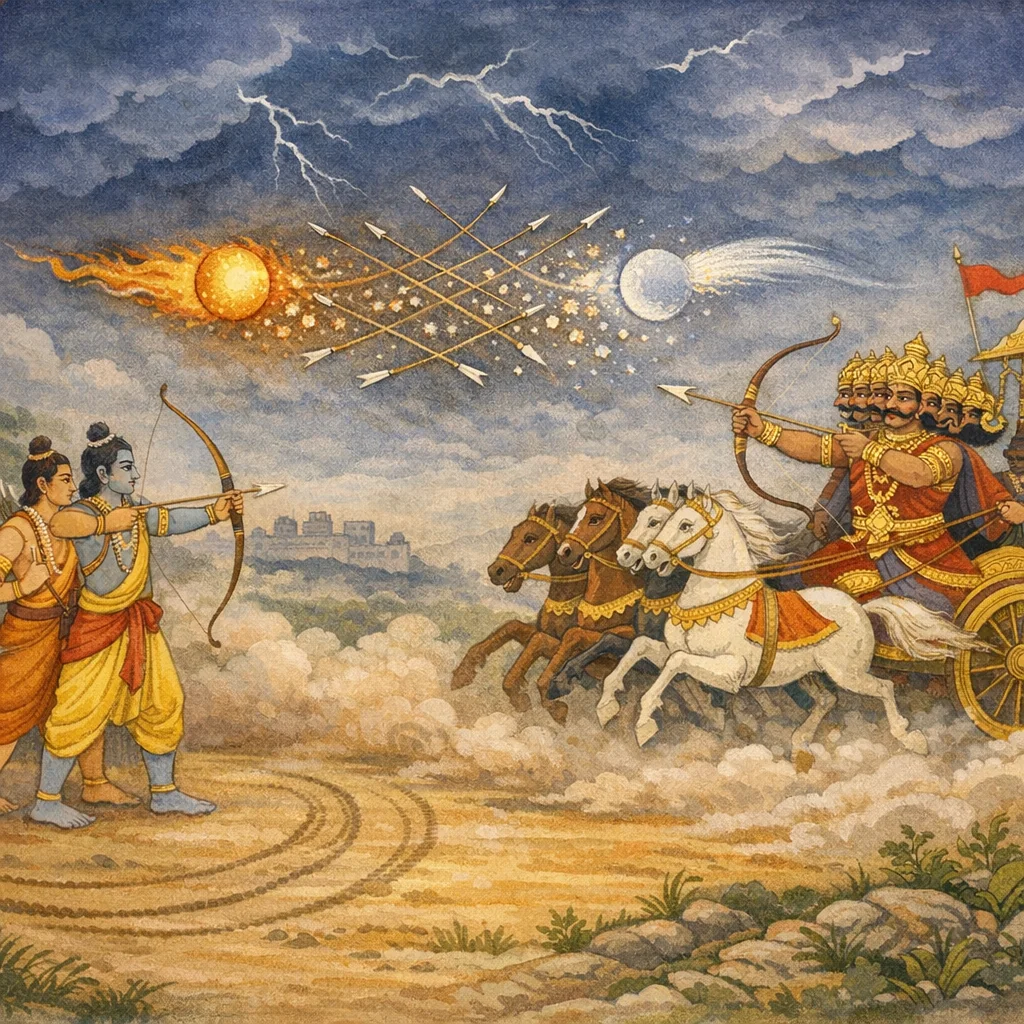
Sarga 100 escalates the central duel by linking battlefield losses to leadership psychology and weapon-ritual. After the deaths of Mahodara, Mahāpārśva, and the mighty Virūpākṣa, Rāvaṇa is depicted as entering a state of heightened wrath and urges his charioteer forward. His advance shakes the environment, and he deploys the Tāmasa weapon—darkness-associated, Brahmā-bestowed—burning and routing the Vānara forces and raising dust across the ground. Rāma, seeing the routed Vānaras and Rāvaṇa’s approach, takes a firm stance with Lakṣmaṇa, described through high epic similes (Vishnu–Indra; bow “scraping” the sky). A sustained exchange of arrow-showers follows: interception in midair, displays of manual dexterity, circular maneuvering, and imagery of cosmic dissolution (Rāhu near sun and moon; sky clouded like lightning-streaked storm). Rāvaṇa targets Rāma’s forehead with nārāca volleys; Rāma bears them without distress and counters by invoking the Raudra astra, yet Rāvaṇa’s armor absorbs the impact. Rāvaṇa then releases a demon-presided illusory arsenal of animal-faced and five-headed serpent-like arrows; Rāma responds with Agni-presided missiles of solar, lunar, cometary, planetary, and lightning-like forms, dissolving Rāvaṇa’s projectiles into thousands of fragments. The Vānara leaders rejoice at the neutralization of the hostile astras, and the sarga closes with Sugrīva’s exultant acclaim of Daśarathi’s unwearied combat efficacy.
Shlokas
Verse 1
महोदरमहापार्श्वौहतौदृष्टवातुराक्ष ।तस्मिंश्चनिहतेवीरेविरूपाक्षेमहाबले ।।6.100.1।।आविवेशमहान् क्रोधोरावणंतुमहामृधे ।सूतं सञ्चोदयामास वाक्यं चेदमुवाच ह ।।6.100.2।।
Seeing the Rākṣasas Mahodara and Mahāpārśva slain, and that mighty hero Virūpākṣa fallen as well, a great rage entered Rāvaṇa in the midst of that fierce battle; he spurred on his charioteer and spoke these words.
Verse 2
महोदरमहापार्श्वौहतौदृष्टवातुराक्ष ।तस्मिंश्चनिहतेवीरेविरूपाक्षेमहाबले ।।6.100.1।।आविवेशमहान् क्रोधोरावणंतुमहामृधे ।सूतं सञ्चोदयामास वाक्यं चेदमुवाच ह ।।6.100.2।।
Seeing the Rākṣasas Mahodara and Mahāpārśva slain, and that mighty hero Virūpākṣa fallen as well, a great rage entered Rāvaṇa in the midst of that fierce battle; he spurred on his charioteer and spoke these words.
Verse 3
निहतानाममात्यानांरुद्धस्यनगरस्य च ।दुःखमेवापनेष्यामि हत्या तौ रामलक्ष्मणौ ।।6.100.3।।
“By killing Rama and Lakshmana, I shall remove the grief of my fallen ministers and the suffering of my besieged city (Lanka).”
Verse 4
रामवृक्षंरणेहमनिसीतापुष्पफलप्रदम् ।प्रशाखायस्यसुग्रीवोजाम्बवान्कुमुदोनलः ।।6.100.4।।दिविदश्चैवमैन्दश्चअङ्गदोगन्दमादनः ।हनुमांश्चसुषेणव्चसर्वे च हरियूथपाः ।।6.100.5।।
In battle, that “Rāma-tree” will be felled—one that is destined to bear Sītā as its flower and fruit. Its great branches are Sugrīva, Jāmbavān, Kumuda, Nala, and also Dvivida, Mainda, Aṅgada, Gandhamādana, Hanumān, Suṣeṇa, and all the leaders of the monkey-host.
Verse 5
रामवृक्षंरणेहमनिसीतापुष्पफलप्रदम् ।प्रशाखायस्यसुग्रीवोजाम्बवान्कुमुदोनलः ।।6.100.4।।दिविदश्चैवमैन्दश्चअङ्गदोगन्दमादनः ।हनुमांश्चसुषेणव्चसर्वे च हरियूथपाः ।।6.100.5।।
In battle, that “Rāma-tree” will be felled—one that is destined to bear Sītā as its flower and fruit. Its great branches are Sugrīva, Jāmbavān, Kumuda, Nala, and also Dvivida, Mainda, Aṅgada, Gandhamādana, Hanumān, Suṣeṇa, and all the leaders of the monkey-host.
Verse 6
स दिशोदशघोषेणरथस्यातिरथोमहान् ।नादयन् प्रययौतूर्णंराघवंचाभ्यधावत ।।6.100.6।।
That great master-charioteer, making his chariot roar so that the ten directions resounded, sped swiftly and charged straight at Rāghava (Rāma).
Verse 7
पूरितातेनशब्देनसनदीगिरिकानना ।सञ्चचाल मही सर्वा त्रस्तसिंहमृगद्विजा ।।6.100.7।।
Filled by that sound, the land—with its rivers, mountains, and forests—shook, and its lions, beasts, and birds were thrown into terror.
Verse 8
तामसंसुमहाघोरंचकारास्त्रंसुदारुणम् ।निर्ददाहकपीन् सर्वांस्तेप्रपेतुःसमन्ततः ।।6.100.8।।
He unleashed the Tāmasa weapon—exceedingly terrible and dread—burning all the monkeys, who fell down on every side.
Verse 9
उत्पपातरजोभूमौतैर्भग्नैःसम्प्रधावितैः ।न हितत्सहितुंशेकुर्भ्रह्मणानिर्मितंस्वयम् ।।6.100.9।।
Dust rose from the ground as the broken troops ran in all directions; for they were not able to withstand that weapon, fashioned by Brahmā himself.
Verse 10
तान्यनीकान्यनेकानि रावणस्य शरोत्तमैः ।दृष्टवाभग्नानि शतशो राघवः पर्यवस्थितः ।।6.100.10।।
Seeing many formations shattered in hundreds by Rāvaṇa’s finest arrows, Rāghava stood his ground, firm and unshaken.
Verse 11
ततोराक्षसशार्दूलोविद्राव्यहरिवाहिनीम् ।स ददर्शततोरामंतिष्ठन्तमपराजितम् ।।6.100.11।।लक्ष्मणेनसहभ्रात्राविष्णुनावासवंयथा ।अलिखन्तमिवाकाशमवष्टभ्यमहद्धनुः ।।6.100.12।।पद्मपत्रविशालाक्षंदीर्घबाहुमरिन्दमम् ।
Then that tiger among the Rākṣasas, having driven back the Vānara host, beheld Rāma standing unconquered—together with his brother Lakṣmaṇa, like Viṣṇu with Vāsava—bracing a mighty bow that seemed to scrape the very sky: lotus-petaled, wide-eyed, long-armed, a subduer of foes.
Verse 12
ततोराक्षसशार्दूलोविद्राव्यहरिवाहिनीम् ।स ददर्शततोरामंतिष्ठन्तमपराजितम् ।।6.100.11।।लक्ष्मणेनसहभ्रात्राविष्णुनावासवंयथा ।अलिखन्तमिवाकाशमवष्टभ्यमहद्धनुः ।।6.100.12।।पद्मपत्रविशालाक्षंदीर्घबाहुमरिन्दमम् ।
Then that tiger among the Rākṣasas, having driven back the Vānara host, beheld Rāma standing unconquered—together with his brother Lakṣmaṇa, like Viṣṇu with Vāsava—bracing a mighty bow that seemed to scrape the very sky: lotus-petaled, wide-eyed, long-armed, a subduer of foes.
Verse 13
ततोरामोमहातेजाःसौमित्रिसहितोबली ।।6.100.13।।वानरांश्चरणेभग्नानापतन्तं च रावणम् ।समीक्ष्यराघवोहृष्टोमध्येजग्राहकार्मुकम् ।।6.100.14।।
Then mighty Rāma, radiant with great splendor and accompanied by Saumitri (Lakṣmaṇa), seeing the vānara warriors broken in battle and Rāvaṇa charging in, felt a fierce gladness of resolve and, there in the midst, grasped his bow.
Verse 14
ततोरामोमहातेजाःसौमित्रिसहितोबली ।।6.100.13।।वानरांश्चरणेभग्नानापतन्तं च रावणम् ।समीक्ष्यराघवोहृष्टोमध्येजग्राहकार्मुकम् ।।6.100.14।।
Then mighty Rāma, radiant with great splendor and accompanied by Saumitri (Lakṣmaṇa), seeing the vānara warriors broken in battle and Rāvaṇa charging in, felt a fierce gladness of resolve and, there in the midst, grasped his bow.
Verse 15
विस्फारयितुमारेभेततः स धनुरुत्तमम् ।महावेगंमहानादंनिर्भन्दन्निवमेदिनीम् ।।6.100.15।।
Then he began to string and draw his excellent bow—mighty in impetus and thunderous in sound—like one rending the very earth.
Verse 16
रावणस्य च बाणौघैरामविस्फारितेन च ।शब्देनराक्षसास्तेन पेतुश्च शतशस्तदा ।।6.100.16।।
Then, amid Rāvaṇa’s torrents of arrows and the resounding twang of Rāma’s drawn bow, rākṣasas fell by the hundreds.
Verse 17
तयोःशरपथंप्राप्यरावणोराजपुत्रयोः ।स बभौ च यथाराहुःसमीपशशिसूर्ययोः ।।6.100.17।।
When Rāvaṇa came within the arrow-path of the two royal princes, he appeared like Rāhu drawing near the moon and the sun.
Verse 18
तमिच्छन् प्रधमम् योद्धुंलक्ष्मणोनिशितैःशरैः ।मुमोचधनुरायम्यशरानग्निशिखोपमान् ।।6.100.18।।
Wishing to engage him first, Lakṣmaṇa drew his bow and released sharp arrows—like tongues of fire—toward him.
Verse 19
तान्मुक्तमात्रानाकाशे लक्ष्मणेन धनुष्मता ।बाणान् बाणैर्महातेजा रावणः प्रत्यवारयत् ।।6.100.19।।
The moment those arrows were released into the sky by bow-bearing Lakṣmaṇa, the greatly radiant Rāvaṇa checked them there with his own arrows.
Verse 20
एकमेकेनबाणेनत्रिभिस्त्रीन् दशभिर्दश ।लक्ष्मणस्य प्रचिच्छेद दर्शयन् पाणिलाघवम् ।।6.100.20।।
Displaying the swiftness of his hand, he cut down Lakṣmaṇa’s arrows—one with one, three with three, and ten with ten.
Verse 21
अभ्यतिक्रम्यसौमित्रिंरावणःसमितिञ्जयः ।आससादरणेरामंस्थितंशैलमिवापरम् ।।6.100.21।।
Rāvaṇa, famed as a conqueror in battle, bypassed Saumitrī (Lakshmana) and advanced toward Rama, who stood firm in the fight like another mountain.
Verse 22
स राघवंसमासाद्यक्रोधसंरक्तलोचनः ।व्यसृजच्छरवर्षाणिरावणो राक्षसेश्वरः ।।6.100.22।।
Coming up to Rāghava, Rāvaṇa—the lord of the rākṣasas—his eyes reddened with anger, unleashed a rain of arrows.
Verse 23
शराधारास्ततोरामोरावणस्यधनुश्च्युताः ।दृष्टवैवापतिताःशीघ्रंभल्लान् जग्राहसत्वरम् ।।6.100.23।।
Then Rama, seeing the torrents of arrows released from Rāvaṇa’s bow falling upon him, swiftly took up bhalla-arrows at once.
Verse 24
तान् शरौघांस्ततोभल्लैस्तीक्ष्णैश्चिच्छेदराघवः ।दीप्यमानान् महाघोरान्क्रुद्धानाशीविषानिव ।।6.100.24।।
Thereupon Rāghava cut down those surging streams of arrows with sharp bhallas—arrows blazing and dreadful, like enraged venomous serpents.
Verse 25
राघवोरावणंतूर्णंरावणोराघवंतथा ।अन्योन्यंविविधैस्तीक्ष्णैःशरवर्षैर्ववर्षतुः ।।6.100.25।।
Rāghava swiftly rained sharp volleys upon Rāvaṇa, and Rāvaṇa likewise upon Rāghava—each showering the other with diverse, piercing arrow-storms.
Verse 26
चेरतुश्चचिरंचित्रंमण्डलंसव्यदक्षिणम् ।बाणवेगात्समुत्क्षिप्तावन्योन्यमपराजितौ ।।6.100.26।।
For a long while the two undefeated warriors moved in wondrous circles, wheeling left and right, each driving and repelling the other by the force and speed of their arrows.
Verse 27
तयोर्भूतानिवित्रेसुर्युगपत्सम्प्रयुध्यतोः ।रौद्रयोःसायकमुचोर्यमान्तकनिकाशयोः ।।6.100.27।।
As those two fierce bowmen fought at once, hurling arrows upon each other like Yama and Antaka, all beings were struck with terror—as though at the world’s final crisis.
Verse 28
सततंविविधैर्बाणैर्बभूवगगनंतदा ।घनैरिवातपापायेविद्युन्मालाससमाकुलैः ।।6.100.28।।
Then the sky was continually filled with arrows of many kinds, resembling a mass of clouds in the waning of sunlight, thick with garlands of lightning.
Verse 29
गवाक्षितमिवाकाशंबभूवशरवृष्टिभिः ।महावेगैस्सुतीक्ष्णैग्रैर्गृध्रपत्रैःसुवाजितैः ।।6.100.29।।
With showers of arrows—swift as the wind, razor-pointed, and feathered with vulture plumes—the sky appeared as though latticed with windows.
Verse 30
शरान्धकारमाकाशंचक्रतुःप्रथमंतदा ।गतेऽस्तं तपने चापि महामेघाविवोथतितौ ।।6.100.30।।
Then, at the very outset, they turned the sky into darkness with their arrows; even though the sun had set, it looked as if two vast storm-clouds had risen.
Verse 31
तयोरभून्महद्युद्धमन्योन्यवथकाङ्क्षिणोः ।अनासाद्यमच्नित्यं च वृत्रवासवयोरिव ।।6.100.31।।
Between the two—each intent on the other’s destruction—there arose a mighty battle, unapproachable and unimaginable, like that of Vṛtra and Vāsava (Indra).
Verse 32
उभौहिपरमेष्वासावुभौयुद्धविशारदौ ।उभावस्त्रविदां मुख्यावुभौ युद्धेविचेरतुः ।।6.100.32।।
For both were supreme bowmen; both were expert in warfare; both were foremost among those who know missiles—and in battle they moved without faltering.
Verse 33
उभौहियेनव्रजतस्तेनतेनशरोर्मयः ।ऊर्मयोवायुनाविद्धा जग्मुः सागरयोरिव ।।6.100.33।।
Whichever way the two advanced, in that very direction the surging streams of arrows swept forth—like waves in two oceans driven by the wind.
Verse 34
ततःसंसक्तहस्तस्तुरावणोलोकरावणः ।नराचमालांरामस्यललाटेप्रत्यमुञ्चत ।।6.100.34।।
Then Rāvaṇa—whose hands were fully engaged in combat, the ‘crier of the worlds’—hurled a garland of iron shafts onto Rāma’s forehead.
Verse 35
रौद्रचापप्रयुक्तांतांनीलोत्पलदलप्रभाम् ।शिरसाधारयद्रामो न व्यथमभ्यपद्यत ।।6.100.35।।
Rāma bore those arrows, shot from the dreadful bow, as though they were blue-lotus petals in their sheen; he did not give way to pain.
Verse 36
अथमन्त्रानभिजपन्रौद्रमस्तमुदीरयन् ।शरान् भूयःसमादाय रामः क्रोधसमन्वितः ।।6.100.36।।मुमोच च महातेजाश्चापमायम्यवीर्यवान् ।
Then mighty, radiant Rāma—angered—murmured the mantras and invoked the Rudra-empowered missile; taking up many more arrows, the valiant one drew his bow and released them.
Verse 37
तेमहामेघसङ्काशेकवचेपतिताःशराः ।।6.100.37।।अवध्येराक्षसेन्द्रस्य न व्यथांजनयंस्तदा ।
But those arrows, falling upon the cloud-like armor of the rākṣasa-king—impenetrable—failed then to produce any pain.
Verse 38
पुनरेवाधतंरामोरथस्थंराक्षसाधिपम् ।।6.100.38।।ललाटेपरमास्त्रणसर्वास्त्रकुशलोऽभिनत् ।
Once again Rāma—skilled in every weapon—struck and pierced the rākṣasa-lord seated in his chariot, hitting him on the forehead with an excellent missile.
Verse 39
तेभित्त्वाबाणरूपाणिपञ्चशीर्षाइवोरगाः ।।6.100.39।।श्वसन्तोविविशुर्भूमिंरावणप्रतिकूलिताः ।
Those shafts—like five-headed serpents—after piercing, were turned back by Rāvaṇa; hissing, they plunged into the earth.
Verse 40
निहत्यराघवस्यास्त्रंरावणःक्रोधमूर्छितः ।।6.100.40।।असुरंसुमहाघोरमन्यदस्त्रं चकारसः ।
Having nullified Rāghava’s missile, Rāvaṇa—overwhelmed by anger—fashioned and released another weapon, exceedingly dreadful, empowered by demonic force.
Verse 41
सिंहव्याघ्रमुखांश्चापिकङ्ककाकमुखानपि ।।6.100.41।।गृध्रश्येनमुखांश्चापिशृगाववदनांस्तथा ।ईहामृगमुखांश्चापिव्यादितास्यान् भयावहान् ।।6.100.42।।पञ्चास्यान् लेलिहानांश्चससर्जनिशितान् शरान् ।
He loosed sharp arrows whose heads seemed like lions and tigers, like kites and crows, like vultures and hawks, and likewise like jackals—terrifying, mouths gaping wide. He also discharged five-mouthed, tongue-flickering, serpent-like shafts, fearsome to behold.
Verse 42
सिंहव्याघ्रमुखांश्चापिकङ्ककाकमुखानपि ।।6.100.41।।गृध्रश्येनमुखांश्चापिशृगाववदनांस्तथा ।ईहामृगमुखांश्चापिव्यादितास्यान् भयावहान् ।।6.100.42।।पञ्चास्यान् लेलिहानांश्चससर्जनिशितान् शरान् ।
He loosed sharp arrows whose heads seemed like lions and tigers, like kites and crows, like vultures and hawks, and likewise like jackals—terrifying, mouths gaping wide. He also discharged five-mouthed, tongue-flickering, serpent-like shafts, fearsome to behold.
Verse 43
शरान् खरमुखांश्चान्यान्वराहमुखसंश्रितान् ।।6.100.43।।श्वानकुक्कुटवक्त्रांश्चमकराशीविषाननान् ।एतांश्चान्यांश्चमायावीससर्जनिशितान् शरान् ।।6.100.44।।रामंप्रतिमहातेजाःक्रुद्धस्सर्पइवश्वसन् ।
That mighty, deceitful one, enraged and hissing like a serpent, hurled at Rāma more sharp arrows—some donkey-faced, some boar-faced, some with the faces of dogs and cocks, and others like makaras and venomous serpents—along with many more besides.
Verse 44
शरान् खरमुखांश्चान्यान्वराहमुखसंश्रितान् ।।6.100.43।।श्वानकुक्कुटवक्त्रांश्चमकराशीविषाननान् ।एतांश्चान्यांश्चमायावीससर्जनिशितान् शरान् ।।6.100.44।।रामंप्रतिमहातेजाःक्रुद्धस्सर्पइवश्वसन् ।
That mighty, deceitful one, enraged and hissing like a serpent, hurled at Rāma more sharp arrows—some donkey-faced, some boar-faced, some with the faces of dogs and cocks, and others like makaras and venomous serpents—along with many more besides.
Verse 45
असुरेणसमाविष्टंसोऽस्त्रणरघुपुङ्गवः ।।6.100.45।।ससर्जास्त्रं महोत्साहः पावकः पावकोपमः ।
When that weapon, infused with demonic power, bore down upon him, the foremost of the Raghus—great in resolve and blazing like fire—released the Fire-astra in response.
Verse 46
अग्निदीप्तमुखान्बाणांस्तत्रसूर्यमुखानपि ।।6.100.46।।चन्द्रार्धचन्द्रवक्रांश्चधूमकेतुमुखानपि ।ग्रहनक्षत्रवर्णांश्चमहोल्कामुखसंस्थितान् ।।6.100.47।।विद्युजजिह्वोपमांश्चापिससर्ज विविधान् शरान् ।
Thereupon, he discharged many kinds of arrows—some with heads blazing like fire, some like the sun; some shaped like the full moon and the crescent; some like a comet; some bearing the hues of planets and stars; some set with great meteoric brilliance; and some like tongues of lightning.
Verse 47
अग्निदीप्तमुखान्बाणांस्तत्रसूर्यमुखानपि ।।6.100.46।।चन्द्रार्धचन्द्रवक्रांश्चधूमकेतुमुखानपि ।ग्रहनक्षत्रवर्णांश्चमहोल्कामुखसंस्थितान् ।।6.100.47।।विद्युजजिह्वोपमांश्चापिससर्ज विविधान् शरान् ।
Thereupon, he discharged many kinds of arrows—some with heads blazing like fire, some like the sun; some shaped like the full moon and the crescent; some like a comet; some bearing the hues of planets and stars; some set with great meteoric brilliance; and some like tongues of lightning.
Verse 48
तेरावणशराघोराराघवास्त्रसमाहताः ।।6.100.48।।विलयं जग्मुराकाशे जग्मुश्चैव सहस्रशः ।
Struck by Rāghava’s missiles, those dreadful shafts of Rāvaṇa dissolved in the sky and shattered into thousands of fragments.
Verse 49
तदस्त्रंनिहतंदृष्टवारामेणाक्लिष्टकर्मणा ।।6.100.49।।हृष्टानेदुस्ततःसर्वेकपयःकामरूपिणः ।सुग्रीवप्रमुखावीराःसम्परिक्षिप्यराघवम् ।।6.100.50।।
Seeing that weapon neutralized by Rāma of tireless deeds, all the shape-changing monkeys cried out in joy; the heroes led by Sugrīva gathered around Rāghava.
Verse 50
तदस्त्रंनिहतंदृष्टवारामेणाक्लिष्टकर्मणा ।।6.100.49।।हृष्टानेदुस्ततःसर्वेकपयःकामरूपिणः ।सुग्रीवप्रमुखावीराःसम्परिक्षिप्यराघवम् ।।6.100.50।।
That great master-charioteer, making his chariot roar so that the ten directions resounded, sped swiftly and charged straight at Rāghava (Rāma).
Verse 51
Then Rāghava, having countered the missiles released from Rāvaṇa’s arms, the great-souled Dāśarathi—filled with joy—(stood victorious); and the delighted lords of the monkeys cried aloud.
Frequently Asked Questions
The pivotal action is leadership under catastrophic loss: Rāvaṇa responds to the deaths of his champions by escalating force through Brahmā-bestowed and demon-presided astras, while Rāma answers with controlled, technically sanctioned counter-weapons—framing victory as disciplined dharma rather than mere rage.
The sarga presents a contrast between anger-driven escalation and steady mastery: true martial authority is shown as composure, trained intelligence (astra-vidyā with mantra), and resilience—Rāma’s unshaken bearing becomes an ethical model for action under pressure.
The battlefield before Laṅkā is implied through references to the besieged city’s suffering and the routed Vānara host; culturally, the chapter foregrounds epic ‘astra culture’—named divine weapons (Tāmasa, Raudra, Agni), armor (kavaca), and chariot warfare conventions.