Sarga 10
विभीषणोपदेशः — Vibhishana’s Counsel to Ravana and the Catalogue of Omens
युद्धकाण्ड
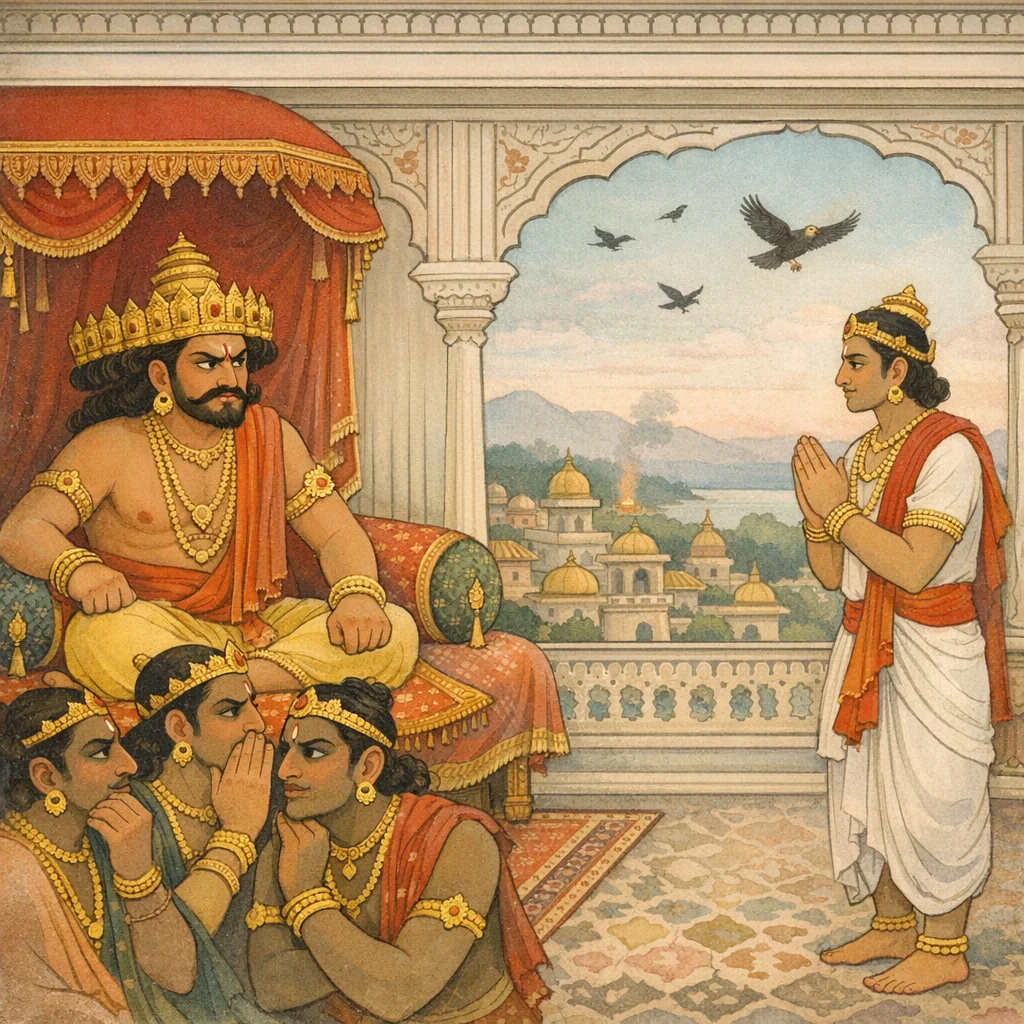
At dawn, Vibhīṣaṇa proceeds to Rāvaṇa’s fortified residence, described in elevated architectural and courtly detail (gold-adorned seats, Vedic recitations, and ritual preparations). Entering with proper decorum, he greets Rāvaṇa seated in royal splendor and addresses him privately in the presence of ministers. Vibhīṣaṇa frames his speech as हित (welfare-oriented counsel), grounded in timing, place, and pragmatic statecraft. He reports a sequence of अशुभ-निमित्त (inauspicious omens) observed since Vaidehī’s arrival in Laṅkā: sacrificial fires burning poorly with smoke and sparks; serpents and ants appearing in ritual spaces and offerings; livestock and war-animals showing distress and abnormality; harsh cries of crows, gatherings of eagles over the city, and thunder-like sounds of carnivorous animals at the gates. From this omenology he derives a political-ethical remedy: the appropriate “atonement” is to return Vaidehī to Rāghava. He also clarifies his motive as neither delusion nor greed, noting that ministers have remained silent out of fear. Rāvaṇa, seized by anger, rejects the counsel with boasts of invulnerability and dismisses Vibhīṣaṇa, marking a critical narrative hinge where reasoned advice is refused and war becomes inevitable.
Shlokas
Verse 1
ततःप्रत्युषसिप्राप्तेप्राप्तधर्मार्थनिश्चयः ।राक्षसाधिपतेर्वेश्मभीमकर्माविभीषणः ।।।।
Then, at dawn, Vibhīṣaṇa—resolute about dharma and prudent policy—set out for the residence of the lord of the rākṣasas (Rāvaṇa), a man of formidable deeds.
Verse 2
शैलाग्रचयसङ्काशंशैलशृङ्गमिवोन्नतम् ।सुविभक्तमहाकक्षंमहाजनपरिग्रहम् ।।।।
Rāvaṇa’s palace rose lofty like a mountain summit crowded with peaks—towering like a mountain crest—its great halls well arranged into spacious divisions and thronged with multitudes.
Verse 3
मतिमद्भिर्महामात्रैरनुरक्तैरधिष्ठितम् ।राक्षसैराप्तपर्याप्तैस्सर्वतःपरिरक्षितम् ।।।।
It was administered by wise and loyal great ministers, and on every side it was securely guarded by capable and trustworthy rākṣasas.
Verse 4
मत्तमातङ्गनिश्श्वासैर्व्याकुलीकृतमारुतम् ।शङ्खघोषमहाघोषंतूर्यनादानुनादितम् ।।।।
The place was churned by gusts as if from the hot breaths of rutting elephants; it resounded with the great blare of conches and reverberated with the sounding of festive instruments.
Verse 5
प्रमदाजनसम्बाधंप्रजल्पितमहापथम् ।तप्तकाञ्चननिर्यूहंभूषणोत्तमभूषितम् ।।।।
The great thoroughfare was crowded with women and alive with lively chatter; its passages gleamed like heated gold, and it was adorned with the finest ornaments.
Verse 6
गन्धर्वाणामिवाऽवासमालयंमरुतामिव ।रत्नसञ्चयसम्बाधंभवनंभोगिनामिव ।।।।
It seemed like the dwelling of the Gandharvas, like an abode of the Maruts; packed with heaps of jewels, it was like the mansion of the pleasure-loving Nāgas.
Verse 7
तंमहाभ्रमिवाऽदित्यस्तेजोविस्तृतरश्मिमान् ।अग्रजस्यालयंवीरःप्रविवेशमहाद्युतिः ।।।।
Then the heroic Vibhīṣaṇa—radiant like the sun whose beams spread wide—entered that dwelling of his elder brother.
Verse 8
पुण्यान्पुण्याहघोषांश्चवेदविद्भिरुदाहृतान् ।शुश्रावसुमहातेजाभ्रातुर्विजयसंश्रितान् ।।।।
The highly resplendent one heard sacred ‘puṇyāha’ proclamations—uttered by Veda-knowers—invoked for his brother’s victory.
Verse 9
पूजितान् दधिपात्रैश्चसर्पिर्भिस्सुमनोक्षतैः ।मन्त्रवेदविदोविप्रान्ददर्शसमहाबलः ।।।।
That mighty one saw Brahmins—learned in mantras and the Veda—being honored with bowls of curd, with ghee, flowers, and grains.
Verse 10
सपूज्यमानोरक्षोभिद्दीप्यमानस्स्वतेजसा ।आसनस्थंमहाबाहुर्ववन्देधनदानुजम् ।।।।
Honored by the rākṣasas and radiant with his own splendor, the broad-shouldered one (Vibhīṣaṇa) bowed to the younger brother of Dhanada (Kubera)—Rāvaṇa—who was seated on his throne.
Verse 11
सराजदृष्टिसम्पन्नमासनंहेमभूषितम् ।जगामसमुदाचारंप्रयुज्याचारकोविदः ।।।।
Skilled in proper conduct, Vibhīṣaṇa approached the gold-adorned seat favored by the king’s glance, observing the full decorum of the court.
Verse 12
सरावणंमहात्मानंविजनेमन्त्रिसन्निधौ ।उवाचहितमत्यर्थंवचनंहेतुनिश्चितम् ।।।।
When only the ministers were present and others had withdrawn, Vibhīṣaṇa addressed the eminent Rāvaṇa with words that were deeply beneficial, grounded in sound reasoning, and aimed decisively at his welfare.
Verse 13
प्रसाद्यभ्रातरंजेष्ठंसान्त्वेनोपस्थितक्रमः ।देशकालार्थसंवादिदृष्टलोकपरावरः ।।।।
Having first placated his elder brother with gentle words, observing proper courtly decorum, Vibhīṣaṇa—one who understood the world’s good and ill and knew counsel suited to place, time, and purpose—began to advise him.
Verse 14
यदाप्रभृतिवैदेहीसम्प्रास्तेमांपुरींतव ।तदाप्रभृतिदृश्यन्तेनिमित्तान्यशुभानिनः ।।।।
Ever since Vaidehī came to this city of yours, from that very time onward we have been witnessing inauspicious portents.
Verse 15
सस्फुलिङ्गस्सधूमार्चिस्सधूमकलुषोदयः ।मन्त्रसङ्घहुतोऽप्यग्निर्नसम्यगभिवर्थते ।।।।
Even the sacrificial fire—though offered into with full rites and mantras—throws up sparks and smoke, rises in a murky, smoke-stained flare, and does not blaze forth properly.
Verse 16
अग्निष्ठेष्वग्निशलासुतथाब्रह्मस्थालीषुच ।सरीसृपाणिदृश्यन्तेहन्येषुचपिपीलिकाः ।।।।
In the household hearths, in the fire-halls of sacrifice, and even at the sacred offering-places, serpents are seen; and ants are found crawling in the oblations.
Verse 17
गवांसयांसिस्कन्नानिविमदावीरकुञ्जराः ।दीनमश्वाःप्रहेषन्तेनचग्रासाभिनन्दिनः ।।।।
The cows’ milk has dried up; the proud war-elephants have lost their musth; the horses neigh pitifully and no longer take delight even in their fodder.
Verse 18
खरोष्ट्राश्वतराराजभनभिन्नरोमास्स्रवन्तिच ।नस्वभावेऽवतिष्ठन्तिविधानैरपिचिन्तिताः ।।।।
O King, donkeys, camels, and mules are shedding their hair and oozing and wailing; even when treated with various remedies, they do not return to their normal condition.
Verse 19
वायसाःसङ्घशःक्रूराव्याहरन्तिसमन्ततः ।समवेताश्चदृश्यन्तेविमानाग्रेषुसङ्घशः ।।।।
Cruel crows, flocking together, cry harshly on every side; gathered in groups, they are seen in flocks perched upon the tops of the aerial palaces.
Verse 20
गृध्राश्चपरिलीयन्तेपुरीमुपरिपिण्डिताः ।उपपन्नाश्चस्नध्येद्वेव्याहऱ्नत्यशिवंशिवाः ।।।।
Vultures too gather in clusters and repeatedly settle above the city; and jackals, assembling at both twilights, utter inauspicious cries.
Verse 21
क्रव्यादानांमृगाणांचपुरीद्वारेषुसङ्घशः ।श्रूयन्तेविपुलाघोषास्सविस्फूर्जितनिस्स्वनाः ।।।।
At the city-gates, in gathered groups, the loud cries of carnivorous beasts were heard—rumbling and cracking like thunder.
Verse 22
तदेवंप्रस्तुतेकार्येप्रायश्चित्तमिदंक्षमम् ।रोचतेयदिवैदेहीराघवायप्रदीयताम् ।।।।
Now that matters have come to this point, this atonement seems fitting: let Vaidehī be restored to Rāghava.
Verse 23
इदंचयदिवामोहाल्लोभाद्वाव्याहृतंमया ।तत्रापिचमहाराज नदोषंकर्तुमर्हसि ।।।।
And if these words of mine have been spoken from delusion or from greed, even then, O great king, you should not impute fault to me.
Verse 24
अयंहिदोषस्सर्वस्यजनस्यास्योपलक्ष्यते ।रक्षसांराक्षसीनांचपुरस्यान्तःपुरस्यच ।।।।
For this offense is known to everyone here—to the rākṣasas and rākṣasī women, to the whole city, and even to those within the inner apartments.
Verse 25
श्रावणेचास्यमन्त्रस्यनिवृत्तास्सर्वमन्त्रिणः ।अवश्यंचमयावाच्यंयद्दृष्टमपिवाश्रुतम् ।।।।सम्विधाययथान्यायंतद्भवान् कर्तुमर्हति ।
All the ministers have held back from reporting this counsel to you. But I must speak what has been seen or heard. Having considered what is just, you should act accordingly.
Verse 26
इतिस्ममन्त्रिणांमध्येभ्राताभ्रातरमूचिवान् ।रावणंराक्षसांश्रेष्ठंपथ्यमेतद्विभीषणः ।।।।
Thus, in the midst of the ministers, Vibhīṣaṇa spoke this wholesome counsel to his brother Rāvaṇa, foremost among the rākṣasas.
Verse 26
इतिस्ममन्त्रिणांमध्येभ्राताभ्रातरमूचिवान् ।रावणंराक्षसांश्रेष्ठंपथ्यमेतद्विभीषणः ।।।।
Thus, in the midst of the ministers, Vibhīṣaṇa spoke this wholesome counsel to his brother Rāvaṇa, foremost among the rākṣasas.
Verse 27
हितंमहार्थंमृदुहेतुसंहितंव्यतीतकालायतिसम्प्रतिक्षमम् ।निशम्यतद्वाक्यमुपस्थितज्वरःप्रसङ्गवानुत्तरमेतदब्रवीत् ।।।।
Having heard those gentle words—beneficial, weighty, and grounded in reason, fit for past, present, and future—Rāvaṇa, seized by the fever of anger, replied with a hostile retort.
Verse 28
भयंनपश्यामिकुतश्चिदप्यहंनराघवःप्राप्स्यतिजातुमैथिलीम् ।सुरैस्सहेन्द्रैरपिसङ्गरेकथंममाग्रतस्स्थास्यतिलक्ष्मणाग्रजः ।।।।
“I see no fear from anyone at all. Rāghava will never obtain Maithilī. And how could Lakṣmaṇa’s elder brother stand before me in battle—even if the gods came with Indra?”
Verse 29
इत्येवमुक्त्वासुरसैन्यनाशनोमहाबलस्संयतिचण्डविक्रमः ।दशाननोभ्रातरमाप्तवादिनंविसर्जयामासतदाविभीषणम् ।।।।
Having spoken thus, the ten-headed Rāvaṇa—mighty, fierce in battle, famed as a destroyer of the gods’ armies—then dismissed Vibhīṣaṇa, his brother who had spoken trustworthy counsel.
Frequently Asked Questions
The pivotal action is Vibhishana’s recommendation that Ravana restore Vaidehi (Sita) to Rama as the appropriate corrective measure (prāyaścitta), directly challenging Ravana’s decision to retain her despite mounting civic and ritual disorder.
The chapter teaches that welfare-oriented truth (hita) must be spoken even under intimidation, and that kingship fails when pride rejects reasoned counsel; the refusal to correct adharma intensifies collective suffering and hastens downfall.
The narrative foregrounds Ravana’s palace and Lanka’s civic-ritual landscape—fire-sacrifice halls (agnishālā), offering spaces (brahmasthalī), city gates, and royal seats—using these as cultural markers where omens register the state’s moral imbalance.