Sarga 9
पुष्पकविमानवर्णनम् — Description of the Pushpaka Vimana and Ravana’s Inner Palace
सुन्दरकाण्ड
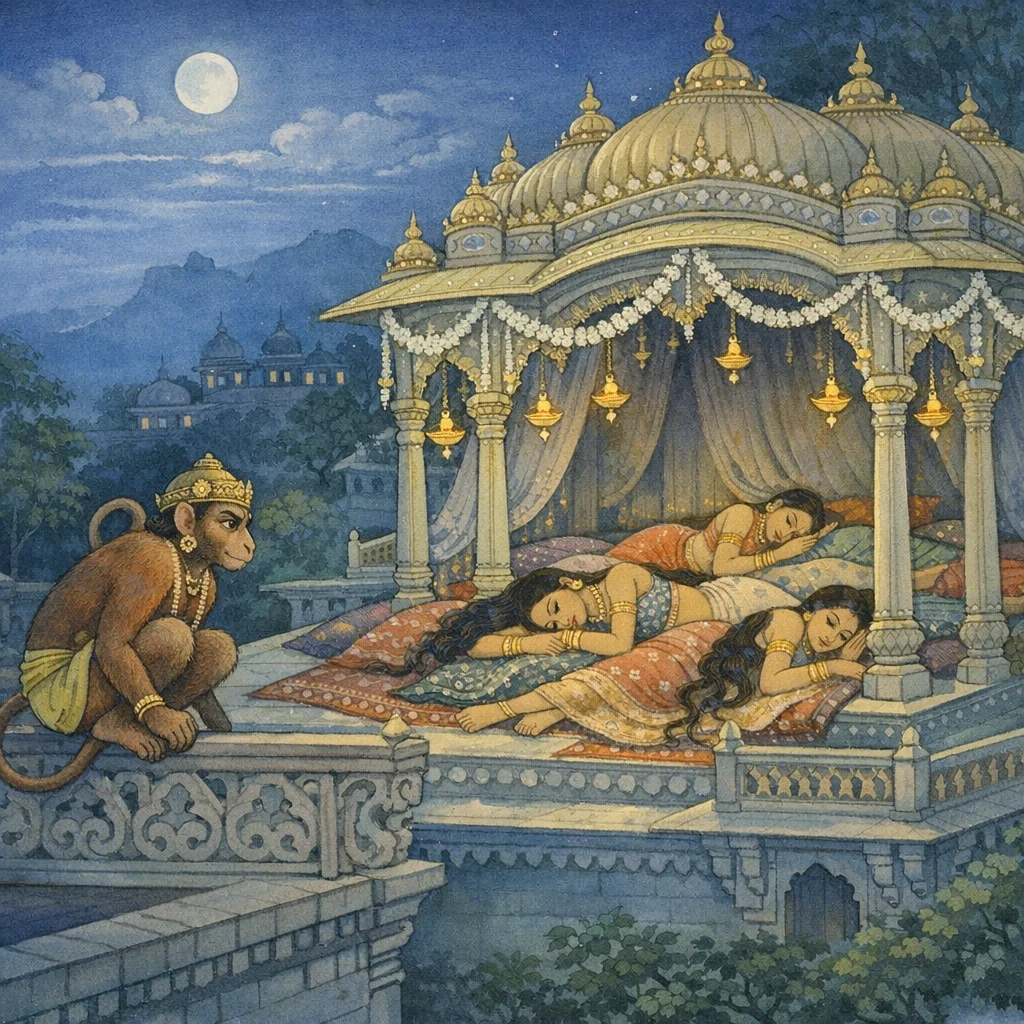
In this sarga, Hanumān continues his methodical search for Vaidehī by surveying the demon-king’s principal residence. The narration shifts into technical architectural and aesthetic description: a vast central mansion complex, then the gem-embellished Puṣpaka-vimāna—crafted by Viśvakarmā for Brahmā, later obtained by Kubera through tapas, and seized by Rāvaṇa by force—serving as a moral genealogy of objects (legitimate acquisition versus violent appropriation). The text catalogs materials (multiple gold types, crystal, sapphire, coral, pearls), structural elements (pillars, latticed windows, stairways, platforms), and sensory atmosphere (incense, flowers, food-and-wine fragrance), using kāvya imagery to render Laṅkā’s opulence as both alluring and ethically dissonant. Hanumān is guided by fragrance toward Rāvaṇa’s favored hall, where innumerable women sleep after revelry; their ornamentation and postures are compared to lotuses, stars, rivers, and creepers. Hanumān’s internal reasoning culminates in a dharmic inference: among these women, only Sītā is described as not willingly associated with Rāvaṇa, sharpening the condemnation of the abduction as an anārya act.
Shlokas
Verse 1
तस्यालयवरिष्ठस्य मध्ये विपुलमायतं।ददर्श भवनश्रेष्ठं हनुमान्मारुतात्मजः।।5.9.1।।
In the heart of that foremost palace, Hanumān—the son of the Wind—saw a mansion preeminent among mansions, vast and lofty in extent.
Verse 2
अर्धयोजनविस्तीर्णमायतं योजनं हि तत्।भवनं राक्षसेन्द्रस्य बहुप्रासादसङ्कुलम्।।5.9.2।।
The lord of the rākṣasas’ residence was a vast complex crowded with many palaces—extending a yojana in length and half a yojana in breadth.
Verse 3
मार्गमाणस्तु वैदेहीं सीतामायतलोचनाम्।सर्वतः परिचक्राम हनूमानरिसूदनः।।5.9.3।।
Hanumān, the subduer of foes, searched everywhere, moving about on all sides in quest of Sītā of Videha, the wide-eyed one.
Verse 4
उत्तमं राक्षसावासं हनुमानवलोकयन्।आससादाथ लक्ष्मीवान् राक्षसेन्द्रनिवेशनम्।।5.9.4।।चतुर्विषाणैर्द्विरदैस्त्रिविषाणैस्तथैव च।परिक्षिप्तमसम्बाधं रक्ष्यमाणमुदायुधैः।।5.9.5।।
Surveying the finest mansions of the rākṣasas, the radiant Hanumān at last reached the dwelling of the lord of the rākṣasas. It was spacious and unobstructed, encircled by elephants with two, three, and even four tusks, and guarded by weapon-bearing sentries.
Verse 5
उत्तमं राक्षसावासं हनुमानवलोकयन्।आससादाथ लक्ष्मीवान् राक्षसेन्द्रनिवेशनम्।।5.9.4।।चतुर्विषाणैर्द्विरदैस्त्रिविषाणैस्तथैव च।परिक्षिप्तमसम्बाधं रक्ष्यमाणमुदायुधैः।।5.9.5।।
It was ringed about by elephants—some with four tusks and some with three—as well as by others, and it was spacious, yet guarded by armed sentries.
Verse 6
राक्षसीभिश्च पत्नीभी रावणस्य निवेशनम्।आहृताभिश्च विक्रम्य राजकन्याभिरावृतम्।।5.9.6।।तन्नक्रमकराकीर्णं तिमिङ्गिलझषाकुलम्।वायुवेगसमाधूतं पन्नगैरिव सागरम्।।5.9.7।।
Hanumān entered Rāvaṇa’s palace, thronged with rākṣasī wives and with princesses carried off after being conquered in war. To his eyes it resembled an ocean—crowded with crocodiles, sharks, great sea-creatures and fish, and heaving as though driven by the wind, with serpents like waves upon it.
Verse 7
राक्षसीभिश्च पत्नीभी रावणस्य निवेशनम्।आहृताभिश्च विक्रम्य राजकन्याभिरावृतम्।।5.9.6।।तन्नक्रमकराकीर्णं तिमिङ्गिलझषाकुलम्।वायुवेगसमाधूतं पन्नगैरिव सागरम्।।5.9.7।।
Hanumān entered Rāvaṇa’s palace, thronged with rākṣasī wives and with princesses carried off after being conquered in war. To his eyes it resembled an ocean—crowded with crocodiles, sharks, great sea-creatures and fish, and heaving as though driven by the wind, with serpents like waves upon it.
Verse 8
या हि वैश्रवणे लक्ष्मीर्या चेन्द्रे हरिवाहने।सा रावणगृहे सर्वा नित्यमेवानपायिनी।।5.9.8।।
Whatever wealth belonged to Vaiśravaṇa (Kubera), and whatever belonged to Indra who rides Hari (his mount), all of it seemed ever-present and unfailing in Rāvaṇa’s house.
Verse 9
या च राज्ञः कुबेरस्य यमस्य वरुणस्य च।तादृशी तद्विशिष्टा वा ऋद्धी रक्षोगृहेष्विह।।5.9.9।।
The riches here in the houses of the rākṣasas were like those of King Kubera, of Yama, and of Varuṇa—or even more excellent than theirs.
Verse 10
तस्य हर्म्यस्य मध्यस्थं वेश्म चान्यत्सुनिर्मितं।बहुनिर्यूहसङ्कीर्णं ददर्श पवनात्मजः।।5.9.10।।
Within the centre of that palace, the son of the Wind saw yet another well-built residence—an extensive complex interwoven with many inner chambers and structures.
Verse 11
ब्रह्मणोऽर्थे कृतं दिव्यं दिवि यद्विश्वकर्मणा।विमानं पुष्पकं नाम सर्वरत्नविभूषितम्।।5.9.11।।परेण तपसा लेभे यत्कुबेरः पितामहात्।कुबेरमोजसा जित्वा लेभे तद्राक्षसेश्वरः।।5.9.12।।
There stood the wondrous aerial chariot named Puṣpaka, adorned with every kind of jewel—crafted in heaven by Viśvakarman for Brahmā. That very chariot Kubera had obtained from his grandsire (Brahmā) through supreme austerity; but the lord of the rākṣasas gained it by defeating Kubera with force.
Verse 12
ब्रह्मणोऽर्थे कृतं दिव्यं दिवि यद्विश्वकर्मणा।विमानं पुष्पकं नाम सर्वरत्नविभूषितम्।।5.9.11।।परेण तपसा लेभे यत्कुबेरः पितामहात्।कुबेरमोजसा जित्वा लेभे तद्राक्षसेश्वरः।।5.9.12।।
There stood the wondrous aerial chariot named Puṣpaka, adorned with every kind of jewel—crafted in heaven by Viśvakarman for Brahmā. That very chariot Kubera had obtained from his grandsire (Brahmā) through supreme austerity; but the lord of the rākṣasas gained it by defeating Kubera with force.
Verse 13
ईहामृगसमायुक्त्तै: कार्तस्वरहिरमण्मयैः।सुकृतैराचितं स्तम्भैः प्रदीप्तमिव च श्रिया।।5.9.13।।मेरुमन्दरसङ्काशैरुल्लिखद्भिरिवाम्बरं।कूटागारैश्शुभाकारैस्सर्वतस्समलङ्कृतम्।।5.9.14।।
It was upheld by finely wrought pillars of kārtasvara and hiraṇmaya gold, set with īhāmṛga figures, and it seemed to blaze with splendour. With lofty pavilions of auspicious form—like Meru and Mandara themselves—it appeared as though it were scraping the sky, adorned on every side.
Verse 14
ईहामृगसमायुक्त्तै: कार्तस्वरहिरमण्मयैः।सुकृतैराचितं स्तम्भैः प्रदीप्तमिव च श्रिया।।5.9.13।।मेरुमन्दरसङ्काशैरुल्लिखद्भिरिवाम्बरं।कूटागारैश्शुभाकारैस्सर्वतस्समलङ्कृतम्।।5.9.14।।
It was upheld by finely wrought pillars of kārtasvara and hiraṇmaya gold, set with īhāmṛga figures, and it seemed to blaze with splendour. With lofty pavilions of auspicious form—like Meru and Mandara themselves—it appeared as though it were scraping the sky, adorned on every side.
Verse 15
ज्वलनार्कप्रतीकाशं सुकृतं विश्वकर्मणा।हेमसोपानसंयुक्तं चारुप्रवरवेदिकम्।।5.9.15।।
Fashioned with superb skill by Viśvakarman, it shone like fire and the sun, fitted with golden stairways and distinguished by beautiful raised platforms.
Verse 16
जालवातायनैर्युक्तं काञ्चनैः स्स्फाटिकैरपि।इन्द्रनीलमहानीलमणिप्रवरवेदिकम्।।5.9.16।।
It was fitted with latticed windows of gold, inlaid also with crystal, and its excellent platforms were set with sapphire gems—Indranīla and Mahānīla.
Verse 17
विद्रुमेण विचित्रेण मणिभिश्च महाघनैः।निस्तुलाभिश्च मुक्ताभिस्तलेनाभिविराजितम्।।5.9.17।।
Its surface shone brilliantly, adorned with variegated coral, exceedingly precious gems, and peerless pearls.
Verse 18
चन्दनेन च रक्तेन तपनीयनिभेन च।सुपुण्यगन्धिना युक्तमादित्यतरुणोपमम्।।5.9.18।।
It was anointed with red sandalwood, gleaming like refined gold, richly fragrant, and radiant like the young rising sun.
Verse 19
कूटागारैर्वराकारैर्विविधैस्समलङ्कृतम्।विमानं पुष्पकं दिव्यमारुरोह महाकपिः।।5.9.19।।
Adorned with many splendid and varied kūṭāgāras, the great monkey (Hanumān) climbed up into the wondrous aerial car, Puṣpaka.
Verse 20
तत्रस्थस्स तदा गन्धं पानभक्ष्यान्नसम्भवम्।दिव्यं सम्मूर्छितं जिघ्रद्रूपवन्तमिवानिलम्।।5.9.20।।
Standing there, he then inhaled a heavenly, intoxicating fragrance arising from drinks, delicacies, and foods—like wind made tangible in form.
Verse 21
स गन्धस्तं महासत्त्वं बन्धुर्बन्धुमिवोत्तमम्। इत एहीत्युवाचेन तत्र यत्र स रावणः।।5.9.21।।
That fragrance, as though a dear kinsman to an excellent kinsman, seemed to call the mighty hero—“Come this way”—and to lead him to where Rāvaṇa was.
Verse 22
ततस्तां प्रस्थितश्शालां ददर्श महतीं शुभाम्।रावणस्य मनः कान्तां कान्तामिव वरस्त्रियम्।।5.9.22।।
Then, proceeding onward, he saw a vast and splendid hall—beloved to Rāvaṇa’s heart, like a cherished chief queen.
Verse 23
मणिसोपानविकृतां हेमजालविभूषिताम्।स्फाटिकैरावृततलां दन्तान्तरितरूपिकाम्।।5.9.23।।
He saw that mansion’s stairways fashioned with gem-inlay, its openings adorned with golden lattice-work, its floors overlaid with crystal, and its decorative figures set in silver within ivory frames.
Verse 24
मुक्ताभिश्च प्रवालैश्च रूप्यचामीकरैरपि।विभूषितां मणिस्तम्भैस्सुबहुस्तम्भभूषिताम्।।5.9.24।।
It was ornamented with pearls and corals, with silver and gold, and richly arrayed with many pillars—pillars themselves set with gems.
Verse 25
नम्रैरृजुभिरत्युच्चैस्समन्तात्सुविभूषितैः।स्तम्भै: पक्षैरिवात्युच्चैर्दिवं संप्रस्थितामिव।।5.9.25।।
With lofty, exquisitely adorned columns all around—some gently curved, others straight—the mansion appeared, with those towering pillars like wings, as though it were setting out to rise toward heaven.
Verse 26
महत्या कुथयास्तीर्णां पृथिवीलक्षणाङ्कया।पृथिवीमिव विस्तीर्णां सराष्ट्रगृहमालिनीम्।।5.9.26।।
It was spread with a vast carpet marked with ‘earthly’ designs—like an expanse of the world itself—bearing, as it were, garland-like rows of kingdoms, towns, and houses.
Verse 27
नादितां मत्तविहगैर्दिव्यगन्धाधिवासिताम्।परार्ध्यास्तरणोपेतां रक्षोधिपनिषेविताम्।।5.9.27।।
It resounded with the calls of excited birds, was pervaded by divine fragrance, furnished with priceless coverings, and was frequented—indeed inhabited—by the lord of the rākṣasas.
Verse 28
धूम्रामगरुधूपेन विमलां हंसपाण्डुराम्।चित्रां पुष्पोपहारेण कल्माषीमिव सुप्रभाम्।।5.9.28।।
Smoky with the incense of agaru, yet spotless and swan-white; made variegated by offerings of flowers, it shone radiantly—like Kalmāṣī, the famed wish-giving cow.
Verse 29
मनस्संह्लादजननीं वर्णस्यापि प्रसादिनीम्।तां शोकनाशिनीं दिव्यां श्रियः सञ्जननीमिव।।5.9.29।।
It delighted the mind and even brightened one’s complexion; it seemed divine—like a source of prosperity—and as though it could banish sorrow itself.
Verse 30
इन्द्रियाणीन्द्रियार्थैस्तु पञ्च पञ्चभिरुत्तमैः।तर्पयामास मातेव तदा रावणपालिता।।5.9.30।।
Then that chamber maintained by Rāvaṇa, like a mother, seemed to satisfy the five senses with their five excellent objects of enjoyment.
Verse 31
स्वर्गोऽयं देवलोकोऽयमिन्द्रस्येयं पुरी भवेत्।सिद्धिर्वेयं परा हि स्यादित्यमन्यत मारुतिः।।5.9.31।।
Māruti reflected: “This seems like heaven—like the world of the gods. This could be Indra’s city itself; or else it must be some supreme achievement of creation.”
Verse 32
प्रध्यायत इवापश्यत्प्रदीपांस्तत्र काञ्चनान्।धूर्तानिव महाधूतैर्देवनेन पराजितान्।।5.9.32।।
There he saw golden lamps burning steadily; to him they looked like gamblers sunk in thought, defeated at dice by master gamblers.
Verse 33
दीपानां च प्रकाशेन तेजसा रावणस्य च।अर्चिर्भिर्भूषणानां च प्रदीप्तेत्यभ्यमन्यत।।5.9.33।।
By the lamps’ radiance, by Rāvaṇa’s own brilliance, and by the gleam of ornaments, Hanumān imagined the place as though it were aflame with light.
Verse 34
ततोऽपश्यत्कुथाऽऽसीनं नानावरायम्बरस्रजम्।सहस्रं वरनारीणां नानावेषविभूषितम्।।5.9.34।।
Then he saw a thousand beautiful women seated on carpets, adorned in many costumes, wearing garments and garlands of various colors.
Verse 35
परिवृत्तेऽर्धरात्रे तु पाननिद्रावशं गतम्।क्रीडित्वोपरतं रात्रौ सुष्वाप बलवत्तदा।।5.9.35।।
When midnight had passed, exhausted after revelry, overcome by drink and sleep, they then lay in heavy slumber.
Verse 36
तत्प्रसुप्तं विरुरुचे निश्शब्दान्तरभूषणम्।निःशब्दहंसभ्रमरं यथा पद्मवनं महत्।।5.9.36।।
As they slept, with the inner jingling of ornaments fallen silent, they appeared beautiful—like a vast lotus-grove where swans and bees are quiet.
Verse 37
तासां संवृतदन्तानि मीलिताक्षीणि मारुतिः।अपश्यत्पद्मगन्धीनि वदनानि सुयोषिताम्।।5.9.37।।
Māruti saw the faces of those well-born women—teeth hidden, eyes closed—fragrant like lotuses.
Verse 38
प्रबुद्धानीव पद्मानि तासां भूत्वा क्षपाक्षये।पुनस्संवृतपत्राणि रात्राविव बभुस्तदा।।5.9.38।।
Their faces seemed like lotuses that had opened at dawn, yet now, as in night again, appeared with petals closed.
Verse 39
इमानि मुखपद्मानि नियतं मत्तषट्पदाः।अम्बुजानीव फुल्लानि प्रार्थयन्ति पुनः पुनः।।5.9.39।।
Surely, like intoxicated bees returning again and again to blooming lotuses, such bees would repeatedly long for these lotus-like faces.
Verse 40
इति चामन्यत श्रीमानुपपत्त्या महाकपिः।मेने हि गुणतस्तानि समानि सलिलोद्भवैः।।5.9.40।।
Thus the illustrious great monkey reasoned it out, concluding that in their qualities those faces were truly comparable to water-born lotuses.
Verse 41
सा तस्य शुशुभे शाला ताभिस्त्रीभिर्विराजिता।शारदीव प्रसन्ना द्यौस्ताराभिरभिशोभिता।।5.9.41।।
Adorned by those women, his mansion shone—like the clear autumn sky, made all the more lovely by its stars.
Verse 42
स च ताभिः परिवृतश्शुशुभे राक्षसाधिपः।यथा ह्युडुपतिश्शीमांस्ताराभिरभिसंवृतः।।5.9.42।।
And the lord of the rākṣasas, surrounded by them, shone—like the splendid moon encircled by stars.
Verse 43
याश्च्यवन्तेऽम्बरात्ताराः पुण्यशेषसमावृताः।इमास्तास्सङ्गताः कृत्स्ना इति मेने हरिस्तदा।।5.9.43।।
Then Hanumān thought: “These women, gathered here in a heap, are like stars that have fallen from the sky when their store of merit is spent.”
Verse 44
ताराणामिव सुव्यक्तं महतीनां शुभार्चिषाम्।प्रभावर्णप्रसादाश्च विरेजुस्तत्र योषिताम्।।5.9.44।।
There, the women’s radiance, color, and graceful charm were clearly evident—like those of great stars that shine with auspicious light.
Verse 45
व्यावृत्तगुरुपीनस्रक्प्रकीर्णवरभूषणाः।पानव्यायामकालेषु निद्रापहृतचेतसः।।5.9.45।।
Their heavy, full garlands were displaced and their fine ornaments lay scattered; after drinking and exertion in pleasure, their minds were overcome by sleep.
Verse 46
व्यावृत्ततिलकाः काश्चित्काश्चिदुद्भ्रन्तनूपुराः।पार्श्वे गलितहाराश्च काश्चित्परमयोषितः।।5.9.46।।
Some had their forehead-marks smudged; some had their anklets loosened; and some noble women had their necklaces slipped to one side.
Verse 47
मुक्ताहाराऽवृताश्चान्याः काश्चिद्विस्रस्तवाससः।व्याविद्धरशनादामाः किशोर्य इव वाहिताः।।5.9.47।।
Others were covered with broken strings of pearls; some had their garments slipped; some had their waist-belts snapped—lying at rest like young mares after being driven hard.
Verse 48
सुकुण्डलधराश्चान्या विच्छिन्नमृदितस्रजः।गजेन्द्रमृदिताः फुल्ला लता इव महावने।।5.9.48।।
Others, still wearing fine earrings yet with their garlands torn and crushed, looked like blooming creepers in a great forest trampled by lordly elephants.
Verse 49
चन्द्रांशुकिरणाभाश्च हाराः कासांचिदुत्कटाः।हंसा इव बभुस्सुप्ताः स्तनमध्येषु योषिताम्।।5.9.49।।
The large pearl-necklaces of some women, gleaming like moonbeams, lay asleep between their breasts—like swans at rest.
Verse 50
अपरासां च वैडूर्याः कादम्बा इव पक्षिणः।हेमसूत्राणि चान्यासां चक्रवाका इवाभवन्।।5.9.50।।
On some women, the vaidūrya gems seemed like kadamba-birds; on others, the golden chains appeared like ruddy geese (cakravākas).
Verse 51
हंसकारण्डवाकीर्णाश्चक्रवाकोपशोभिताः।आपगा इव ता रेजुर्जघनैः पुलिनैरिव।।5.9.51।।
Adorned with swans and kāraṇḍava-birds, and bright with cakravākas, those women shone like rivers—while their hips resembled the riverbanks (sandbars).
Verse 52
किङ्किणीजालसङ्कोशास्ता हैमविपुलाम्बुजाः।भावग्राहा यशस्तीराः सुप्ता नद्य इवाऽऽबभुः।।5.9.52।।
With their nets of tiny bells appearing like buds, with broad golden ornaments like lotuses, with love-gestures like crocodiles, and with fame-like shining banks—sleeping, they appeared like rivers at rest.
Verse 53
मृदुष्वङ्गेषु कासाञ्चित्कुचाग्रेषु च संस्थिताः।बभुर्वर्भूषणानीव शुभा भूषणराजयः।।5.9.53।।
On the tender limbs of some women—and even upon the tips of their breasts—there lay fair lines of ornaments, which appeared like ornaments upon ornaments.
Verse 54
अंशुकान्ताश्च कासाञ्चिन्मुखमारुतकम्पिताः।उपर्युपरि वक्त्राणां व्याधूयन्ते पुनः पुनः।।5.9.54।।
For some women, the garment-fringes, stirred by the breeze of their own breath, repeatedly fluttered up and down over their faces.
Verse 55
ताः पताका इवोद्धूताः पत्नीनां रुचिरप्रभाः।नानावर्णसुवर्णानां वक्त्रमूलेषु रेजिरे।।5.9.55।।
Those radiant fringes, lifted like little banners, shone near the faces of the wives—women of varied hues and golden splendor.
Verse 56
ववल्गुश्चात्र कासांचित्कुण्डलानि शुभार्चिषाम्।मुखमारुतसंसर्गान्मन्दं मन्दं सुयोषिताम्।।5.9.56।।
Here, the earrings of some fair women—glowing with auspicious radiance—gently, gently quivered from contact with the breeze of their breath.
Verse 57
शर्कराऽसवगन्धैश्च प्रकृत्या सुरभिः सुखः।तासां वदननिश्वासस्सिषेवे रावणं तदा।।5.9.57।।
Then the breath from their mouths—naturally fragrant and scented with sugar-wine—was pleasing, as though it were attending upon Rāvaṇa.
Verse 58
रावणाननशङ्काश्च काश्चिद्रावणयोषितः।मुखानि स्म सपत्नीनामुपाजिघ्रन्पुनः पुनः।।5.9.58।।
Some of Rāvaṇa’s women, imagining it to be Rāvaṇa’s face, repeatedly smelled the faces of their co-wives.
Verse 59
अत्यर्थं सक्तमनसो रावणे ता वरस्त्रियः।अस्वतन्त्राः सपत्नीनां प्रियमेवाऽचरंस्तदा।।5.9.59।।
Those noble women, their minds excessively attached to Rāvaṇa, and lacking freedom, then behaved only in ways pleasing to their co-wives.
Verse 60
बाहूनुपनिधायान्याः पारिहार्यविभूषितान्।अंशुकानि च रम्याणि प्रमदास्तत्र शिश्यिरे।।5.9.60।।
There, some women slept with their arms placed as pillows, setting aside their adornments; others slept resting upon beautiful garments laid beneath their heads.
Verse 61
अन्या वक्षसि चान्यस्यास्तस्याः काचित्पुनर्भुजम्।अपरा त्वङ्कमन्यस्यास्तस्याश्चाप्यपरा भुजौ।।5.9.61।।
One lay upon another’s breast; again, another rested upon her arm. Yet another slept upon a different woman’s lap, while another used her arms as a support.
Verse 62
ऊरुपार्श्वकटीपृष्ठमन्योन्यस्य समाश्रिताः।परस्परनिविष्टाङ्ग्यो मदस्नेहवशानुगाः।।5.9.62।।
Swayed by intoxication and passion, they slept leaning upon one another’s thighs, sides, hips, and backs, their limbs intertwined with one another.
Verse 63
अन्योन्यभुजसूत्रेण स्त्रीमाला ग्रथिता हि सा।मालेव ग्रथिता सूत्रे शुशुभे मत्तषट्पदा।।5.9.63।।
Linked by one another’s arms as though by a thread, that garland of women shone—like a flower-garland strung together, with intoxicated bees clinging to it.
Verse 64
लतानां माधवे मासि फुल्लानां वायुसेवनात्।अन्योन्य मालाग्रथितं संसक्तकुसुमोच्चयम्।।5.9.64।।व्यतिवेष्टितसुस्कन्धमन्योन्यभ्रमराकुलम्।आसीद्वनमिवोद्धूतं स्त्रीवनं रावणस्य तत्।।5.9.65।।
Rāvaṇa’s ‘grove of women’ appeared like a wood of creepers in the spring month of Mādhava: blossoming under the breeze’s caress, interwoven like garlands, their flower-clusters touching and clinging. With strong joints entwined and bees swarming from one to another, it seemed like a thicket shaken by the wind.
Verse 65
लतानां माधवे मासि फुल्लानां वायुसेवनात्।अन्योन्य मालाग्रथितं संसक्तकुसुमोच्चयम्।।5.9.64।।व्यतिवेष्टितसुस्कन्धमन्योन्यभ्रमराकुलम्।आसीद्वनमिवोद्धूतं स्त्रीवनं रावणस्य तत्।।5.9.65।।
Rāvaṇa’s ‘grove of women’ appeared like a wood of creepers in the spring month of Mādhava: blossoming under the breeze’s caress, interwoven like garlands, their flower-clusters touching and clinging. With strong joints entwined and bees swarming from one to another, it seemed like a thicket shaken by the wind.
Verse 66
उचितेष्वपि सुव्यक्तं न तासां योषितां तदा।विवेकः शक्य आधातुं भूषणाङ्गाम्बरस्रजाम्।।5.9.66।।
Then, among those women, it was not possible to clearly distinguish what belonged where—ornaments from limbs, garments from garlands—though each had been worn in its proper place.
Verse 67
रावणे सुखसंविष्टे तास्त्रियो विविधप्रभाः।ज्वलन्तः काञ्चना दीपाः प्रैक्षन्तानिमिषा इव।।5.9.67।।
While Rāvaṇa lay comfortably asleep, those women—radiant in varied splendor—seemed as though the blazing golden lamps were staring at them without blinking.
Verse 68
राजर्षिपितृदैत्यानां गन्धर्वाणां च योषितः।राक्षसानां च याः कन्यास्तस्य कामवशं गताः।।5.9.68।।
Women from the lines of royal sages, Pitṛs, Daityas, and Gandharvas—and maidens of the rākṣasas as well—had come under the sway of his desire.
Verse 69
युद्धकामेन ताः सर्वा रावणेन हृताः स्त्रियः।समदा मदनेनैव मोहिताः काश्चिदागताः।।5.9.69।।
All those women had been carried off by Rāvaṇa out of his passion for war; and a few, intoxicated and deluded by desire, had come there of their own accord.
Verse 70
न तत्र काचित्प्रमदा प्रसह्य वीर्योपपन्नेन गुणेन लब्धा।न चान्यकामापि न चान्यपूर्वा विना वरार्हां जनकात्मजां ताम्।।5.9.70।।
There, no woman had been obtained by sheer force; they were gained through valor and qualities. None was attached to another, and none had belonged to another before—except that revered daughter of Janaka, Sītā.
Verse 71
न चाकुलीना न च हीनरूपा नादक्षिणा नानुपचारयुक्ता।भार्याभवत्तस्य न हीनसत्त्वा न चापि कान्तस्य न कामनीया।।5.9.71।।
None who became his wife was low-born; none lacked beauty; none was unkind or discourteous. None was weak in spirit; and none was, for that beloved, unworthy of desire.
Verse 72
बभूव बुद्धिस्तु हरीश्वरस्य यदीदृशी राघवधर्मपत्नी।इमा यथा राक्षसराजभार्याः सुजातमस्येति हि साधुबुद्धेः।।5.9.72।।
Then this thought arose in the wise lord of monkeys: “If Rāma’s lawful wife were of such a kind—like these wives of the rākṣasa king—then indeed it would mean good birth and fortune for him.”
Verse 73
पुनश्च सोऽचिन्तयादात्तरूपो ध्रुवं विशिष्टा गुणतो हि सीता।अथायमस्यां कृतवान्महात्मा लङ्केश्वरः कष्टमनार्यकर्म।।5.9.73।।
Then again, resuming his true form, he reflected: “Surely Sītā is distinguished by virtue above them all. Alas—this lord of Laṅkā has committed, against her, a grievous act unworthy of the noble.”
Frequently Asked Questions
Hanuman must observe Ravana’s private quarters—filled with luxury and sleeping women—without losing mission-focus or violating ethical restraint; the sarga frames his action as disciplined reconnaissance rather than indulgent looking.
Splendor is not proof of righteousness: the Puṣpaka’s provenance (earned by tapas, then seized by force) and Sita’s exception among Ravana’s consorts reinforce that dharma depends on rightful conduct, not on aesthetic or political power.
The narrative highlights the inner palace of Laṅkā and the Puṣpaka-vimāna; culturally, it references divine regalia and cosmological markers (Meru, Mandara; Kubera/Indra/Yama/Varuna) to calibrate Ravana’s wealth against pan-Indic royal and divine standards.