Sarga 8
पुष्पकविमानदर्शनम् (Vision of the Pushpaka Aerial Chariot)
सुन्दरकाण्ड
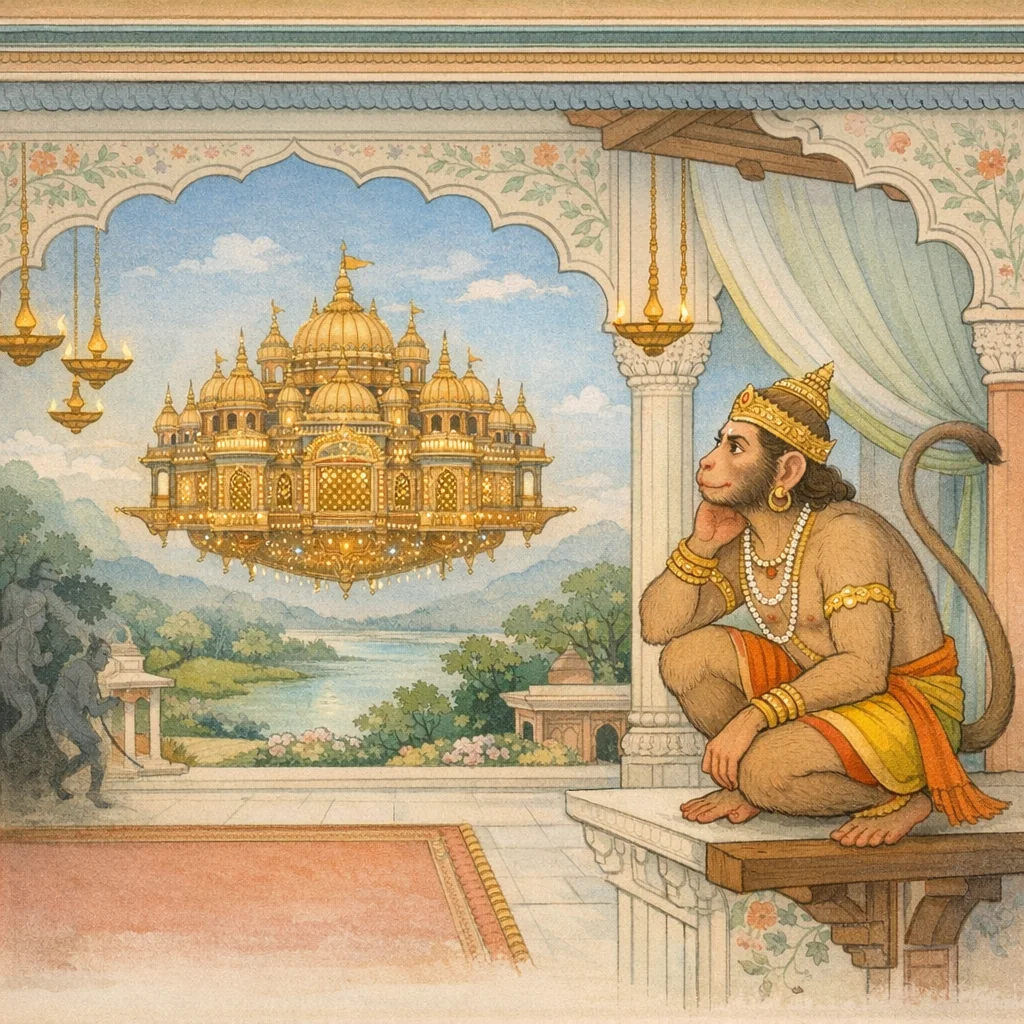
In this sarga, Hanumān—moving through the inner spaces of Laṅkā’s palatial architecture—observes the Pushpaka vimāna positioned within the mansion’s center. The chapter is primarily descriptive (vastu-varṇana): the aerial chariot is portrayed as gem-inlaid, diamond-adorned, and fitted with latticed windows of burnished gold. Its craftsmanship is attributed to Viśvakarman and framed as beyond ordinary measure, shining like a beacon in the solar path. The narration emphasizes that nothing in it is uncrafted or non-precious; its uniqueness surpasses even divine standards, suggesting royal sovereignty and superhuman resources. The vimāna is further characterized as responsive to the master’s intention—able to reach desired places by thought—furnished with multiple special resting areas, and shaped like a mountain peak with many wondrous towers. Finally, its conveyance by thousands of swift, fearsome bhūta-groups (night-ranging beings) is noted, culminating in Hanumān’s appraisal of its beauty as exceeding even springtime’s charm. Thematically, the sarga juxtaposes Laṅkā’s opulence with the ethical mission of restraint and observation.
Shlokas
Verse 1
स तस्य मध्ये भवनस्य संस्थितंमहद्विमानं मणिवज्रचित्रितम्।प्रतप्तजाम्बूनदजालकृत्रिमंददर्श वीरः पवनात्मजः कपिः।।।।
In the middle of that mansion, the heroic monkey—Hanumān, son of the Wind—saw a great aerial chariot, adorned with gem and diamond work, and fitted with lattice-like windows fashioned from burnished gold.
Verse 2
तदप्रमेयाप्रतिकारकृत्रिमंकृतं स्वयं साध्विति विश्वकर्मणा।दिवं गतं वायुपथप्रतिष्ठितंव्यराजतादित्यपथस्य लक्ष्मवत्।।।।
That vimāna—fashioned by Viśvakarman himself as a perfect achievement, with incomparable and inimitable workmanship—seemed to have ascended into the sky and taken its place upon the aerial path, shining like a radiant marker in the Sun’s course.
Verse 3
न तत्र किञ्चिन्न कृतं प्रयत्नतोन तत्र किञ्चिन्न महार्हरत्नवत्।न ते विशेषा नियताः सुरेष्वपिन तत्र किञ्चिन्न महाविशेषवत्।।।।
In that Puṣpaka there was nothing left uncrafted with painstaking care, nothing that was not set with precious gems. Such exceptional splendours are not found even among the gods; indeed, there was nothing there that was not supremely distinctive.
Verse 4
तपः समाधानपराक्रमार्जितंमनः समाधानविचारचारिणम्।अनेकसंस्थानविशेषनिर्मितंततस्ततस्तुल्यविशेषदर्शनम्।।।।
It was obtained through austerity, mastery, and heroic power; and it moved according to the composed intention and thought of its lord. Fashioned with many distinctive arrangements, it appeared everywhere with an equal and consistent excellence.
Verse 5
विशेषमालम्ब्य विशेषसंस्थितंविचित्रकूटं बहुकूटमण्डितम्।मनोऽभिरामं शरदिन्दुनिर्मलंविचित्रकूटं शिखरं गिरेर्यथा।।।।
Resting on a special design and arranged in a distinctive way, it rose with wondrous peaks and was adorned with many pinnacles. Delightful to the mind and pure as the autumn moon, it looked like a mountain summit crowned with marvellous ridges.
Verse 6
वहन्ति यं कुण्डलशोभिताननाःमहाशना व्योमचरा निशाचराः।विवृत्तविध्वस्तविशाललोचनाःमहाजवा भूतगणाः सहस्रशः।।।।
Thousands of bhūta-hosts bore it—night-roaming beings that moved through the sky, their faces bright with earrings, gluttonous by nature, swift in motion, and terrible with wide, rolling eyes.
Verse 7
वसन्तपुष्पोत्करचारुदर्शनंवसन्तमासादपि कान्तदर्शनम्।स पुष्पकं तत्र विमानमुत्तमंददर्श तद्वानरवीरसत्तमः।।।।
There the foremost hero among the vānaras beheld the excellent aerial chariot Puṣpaka—beautiful like a heap of spring blossoms, and more enchanting even than the spring season itself.
Frequently Asked Questions
The pivotal action is Hanumān’s restraint-based reconnaissance: he observes extraordinary wealth and power (the Pushpaka) without distraction, maintaining mission focus and non-appropriation while operating in hostile territory.
The sarga teaches that aishvarya (splendor and capability) is ethically neutral until aligned with dharma; the observer’s mind must remain steady, using perception for right purpose rather than temptation or fear.
The landmark is the Pushpaka vimāna situated within a central palace space in Laṅkā, described through cultural markers of royal craft—gold lattices, jewel inlay, and the artisan ideal represented by Viśvakarman.